Thursday, October 13, 1994

In Search Of the Perfect Sermon


The Jewish Week, October 13, 1994

I bumped into Jonah the other day. Jonah and I are old friends, especially when I'm preparing my sermons for the High Holidays. You don't have to be a rabbi to relate to Jonah. Everyone who contemplates a flight from responsibility meets Jonah somewhere along the way.

As I approached the Days of Awe, I was afflicted once again with what some rabbis call "Elulitis," but which for me is an annual, if not daily, re-enactment of Jonah's basic choice -- the path of anonymous, burdensome responsibility or a speedy descent into the abyss.

In 1978, fresh out of college, I chose to become a rabbi. My route was rather elliptical; it was almost a process of elimination that brought me to the seminary. There was no calling, no summons from On High; I was opting into a profession, one like all others, or so I thought.

Yet here I was, on the eve of a new year, about to utter the words that, if done properly, could change hundreds of lives and have a profound effect on my community. Here I was, once again, being drained of every ounce of energy, pouring out my soul in order to save theirs.

As my story unfolds in this column, doubtless there will be ample opportunity to share my more embarrassing moments and mundane frustrations. But for the most part I hope to share the sublime with you, to cut through the trivialities that prevail all too much in relationships and have also come to cheapen my noble profession.

A rabbi can either be irrelevant or of ultimate relevance to people. I choose the latter, even if the burden is so much greater. That means the sermons must stretch toward perfection.

I'm not talking about perfect length. If a sermon is perfect, neither speaker nor listener can recall what day it is, much less the length. The perfect sermon transcends time and it transports the listener far from any place a watch can dare wander (but try to be reasonable and keep this bliss to around a half-hour on the holidays).

When the high priest emerged from the Holy of Holies, I wonder how many Levites looked up at him saying, "Too long, let's cut down on the blood sprinkling next year." We've lost the Temple, but why must we also lose the grandeur of the moment?

I'm not speaking about pace, the placement of jokes, all the techniques we learn and hone. None of this matters if the message isn't there, and the passion behind it. And there has to be a real, honest-to-goodness person, not a mask, behind the passion. I receive tons of sermonic material from worthy organizations prior to the holidays. Most of it goes straight into the trash. If it doesn't come straight from my heart, it will never reach theirs.

The perfect sermon has to leave both sides in a state of exhilarated exhaustion. It's possible for the listener to feel like a participant even as she or he sits in supposed passivity. There is a place for today's trend toward Donahue-style dialogues, but on the Days of Awe nothing can duplicate an old-fashioned sermon if it is done properly.

Finally, to deliver a perfect sermon the rabbi has to love people. There's where I've had my greatest problem in the past.

These are the people, after all, who wake my wife on Sunday mornings with silly phone calls, who spread unfair rumors about me snubbing the "old-timers" or avoiding Uncle Joe at the hospital, or who rag at me for daring to take a position on controversial issues. These are the ones who ensnare me in an ever-tightening net of obligation as they draw ever closer and demand more flesh.

I look out at them some years and understand why Jonah didn't want to save Nineveh. They drain me of all my strength. They can be shallow. They can be callous. They can be cruel.

This year I looked into the mirror and said, "Who am I?" which allowed me then to look out at them and say, "They are human." Then, it was as if we looked at each other and said, "You know, we're not so bad. Let's work on this thing together."

This year, I got it right, and I've done enough clinkers in the past to know the difference. All the sleepless nights (sort of an Elul ritual for me) added up to four nearly timeless and virtually sleepless half hours for the majority of those assembled.

But I wanted more.

Athletes call it the Zone, that place where we all want to be, where every jumper swishes and every fastball looks like a watermelon. For a rabbi, the Zone is entered when you can sense exactly how the congregation will respond to every comment and you then respond instinctively to them. It is a feeling of utter control combined with the funny sensation that you are not really the one doing the speaking, that the words are coming from somewhere deep within you, not from the printed text. Just as a good actor becomes the part, a good rabbi becomes the sermon and a good sermon transcends the rabbi. Somewhere between the first taste of apple in honey and the final Neilah blast, I came as close as I've ever been to becoming the message.

The holy and human intersect when we, like Jonah, come to accept our burdensome destiny. This year, for whatever reason, I not only accepted my magnificent affliction, but I embraced it. And as I enfolded it in the spoken word, I was able to inscribe, in indelible ink, the name of one congregation into the Book of Life.

Friday, September 2, 1994

Setting Our Clocks To Jewish Time (Jewish Week - first article)


The Jewish Week, September 8, 1994

How often have we been hearing that familiar refrain lately: "My, the holidays are early this year." Ever since Passover snuck in like a lamb last March, the crescendo has been building. With Rosh HaShanah linked to Labor Day and Chanukah set to begin on Thanksgiving weekend, the cry is sure to continue for another few months, until, mercifully, the month of Adar replicates itself next winter and we get back to normal. Except then, everything will be deemed "late."

With our brains and bodies stuck on the monotonous, relentless tick of secular time, it's natural to wonder if the Jewish holidays ever fall on schedule. But when life sways to the rhythms of the Jewish calendar, the question never arises. For most, the idea of Jewish time has more to do with tardy board meetings than an intricate system of ritual, emotion and instruction affixed to the cycles of nature. The hour has come for Jews to begin living on Jewish time. That venerated goal of Jewish continuity can hardly be served when our peak religious experiences are always being measured in secular seconds. Until we begin thinking of Rosh HaShanah as neither early or late, but right on target -- two months after Tisha b'Av and half a year from Passover -- we're grafting Judaism artificially into a corner of our beings. For Judaism to breathe, it must be lived on its own terms, on its own schedule.

That said, so nu, why is the holiday so early this year?

Since you asked, yes, it's true, Rosh HaShanah hasn't fallen this early on the secular calendar in quite some time; 19 years to be exact. It was 1975 when it last began on Sept. 5, and here's why. The rabbis calculated the lunar month to be 29 days, 12 hours, 44 minutes and 3.33 seconds (and they were less than a half a second off).

The year consists of 12 of those months, or approximately 354 days. With the secular, solar calendar lasting 365 days, the lunar calendar falls 11 days behind the solar -- one each year. The rabbis figured that an additional month should be added seven times in each 19-year cycle in order to keep agricultural festivals in their seasons. Passover must come in the spring and Sukkot in the fall (unless you live in the Southern Hemisphere, but let's not complicate things). The sages actually were a little off in these calculations, or Passover would be celebrated in June. Fortunately, that's one of those problems we can afford to leave to subsequent generations, like the national debt and the identity of Deep Throat.

The extra month is added during the winter of the third, sixth, eighth, 11th, 14th, 17th and 19th years of the cycle. Notice that leap years are usually three years apart, but occasionally two. Since we're now entering the 17th year of the cycle, we've gone nine years since the last two-year interval (years 6 and 8). That means we've had fewer leap years recently, therefore we've been losing more days to the secular calendar. The 17th year always has the earliest Rosh HaShanah, and the ninth year (because it's preceded by the greatest frequency of leap years) the latest. Get it? Sorry you asked?

Now isn't it so much easier just to live on Jewish time rather than trying to understand it? How often do we ask ourselves about the logic of the secular calendar, which has a new year that occurs when nothing at all is changing and new days begin at an arbitrary hour when few are awake to appreciate it? Give me a calendar that asks us to turn inward just as the weather outside is nudging us precisely in that direction, one that expels us from winter's hibernation to the pulsating poetry of "Song of Songs" and the drama of national release, and one that always promises the moon's return to ripeness, no matter how dark things seem.

To those living within the Jewish time frame, this summer's bombardment of Jupiter wasn't just a cosmic peep show; it was serious theological stuff. Why, after all, did it commence on the eve of Tisha b'Av, a day of great reckoning for the world? Next year, when the fast day coincides with the 50th anniversary of Hiroshima, the same questions will be asked again. What does it all mean?

For inhabitants of secular time, the only dilemmas occur when July 4 doesn't create a three-day weekend or Christmas falls on a Sunday. When do they collect garbage? When can they play football? When can we shop?

Speaking of football, the only thing that compares to the rhythm of the Jewish year, with all its rituals and pageantry, is the American sports calendar. As a young boy growing up in the Boston area, fall meant three things: playing football, stuffing those delicious marble cake slices from the synagogue sukkah into my jacket pocket and watching someone other than the Red Sox win the World Series. Spring meant sneaking out of school to attend opening day at Fenway, usually with a matzah sandwich crumbling in my book bag.

But this year, the sports world has upset the rhythm. With baseball on strike, one of the great rituals of autumn might be fortified, one that has always been there. Seasonal rituals don't normally die easily -- they still have May Day parades in Moscow -- because we need them as a constant by which to measure our years. We need the seder table as a gauge of how the family has evolved, to see who is sitting where this year. Our lives spin around these sacred moments. We need the World Series for precisely the same reason. Baseball -- the myth, not the business -- has never changed. The Series has always been there. The Red Sox have always lost. We need that certainty, and now we may not have it.

But not to fear. If we can trade in our bats and balls for lulavs and etrogs, the rhythm of fall can be salvaged, maybe even enhanced. In Judaism, we are all both owners and players. There are no strikes. Our festivals will always be there for us when they are expected, at least for a few thousand years. Betrayed by the gods of baseball, Jews have a chance to return to a different kind of pageantry this year, one with all the sweet smells and cool breezes of an autumn afternoon at the ballpark, complete with a ceremonial circling of the bases -- seven of them on Simchat Torah. And since Sukkot isn't controlled by the TV networks, the festivities don't always drone on past midnight, that random divider of days. They are tied not to the ratings clock but to the miraculous dance of the sun and moon. Sukkot is also cheaper than baseball. A decent lulav set costs $35, much less than a World Series ticket.

It's really not so difficult to convert over to Jewish time. It's not like Celsius or kilometers or changing dollars to shekels. There's a very easy way to integrate the Jewish calendar into the rhythm of your life: Go out and buy one.

When you do, and live by it, something remarkable will begin to happen. Your moods will shift and undulate, responding to events that occurred centuries ago. Holidays will arrive neither early nor late, and each week will flow into Shabbat none too soon.

And what is Jewish continuity but the transmission of the cadences of Jewish life from one generation to the next? I am often asked, will the American Jewish community be around in the next century? To which I respond: Who can predict? The next century is still 46 years away. There is only one thing that is certain. As long as there are any Jews left on this planet, meetings will still begin 15 minutes late.

Wednesday, June 1, 1994

From the Archives: TBE's Bulletin, 30 Years Ago

At the conclusion of each programming year, I used to lay out my "State of the Synagogue" with a focus on religion and education, youth and social (the president would give the financial report).  Here is one from exactly 30 years ago.  You can see some of the dreams we had then and assess how those dreams have withstood the test of time.  To see a clearer pdf of these pages, click here
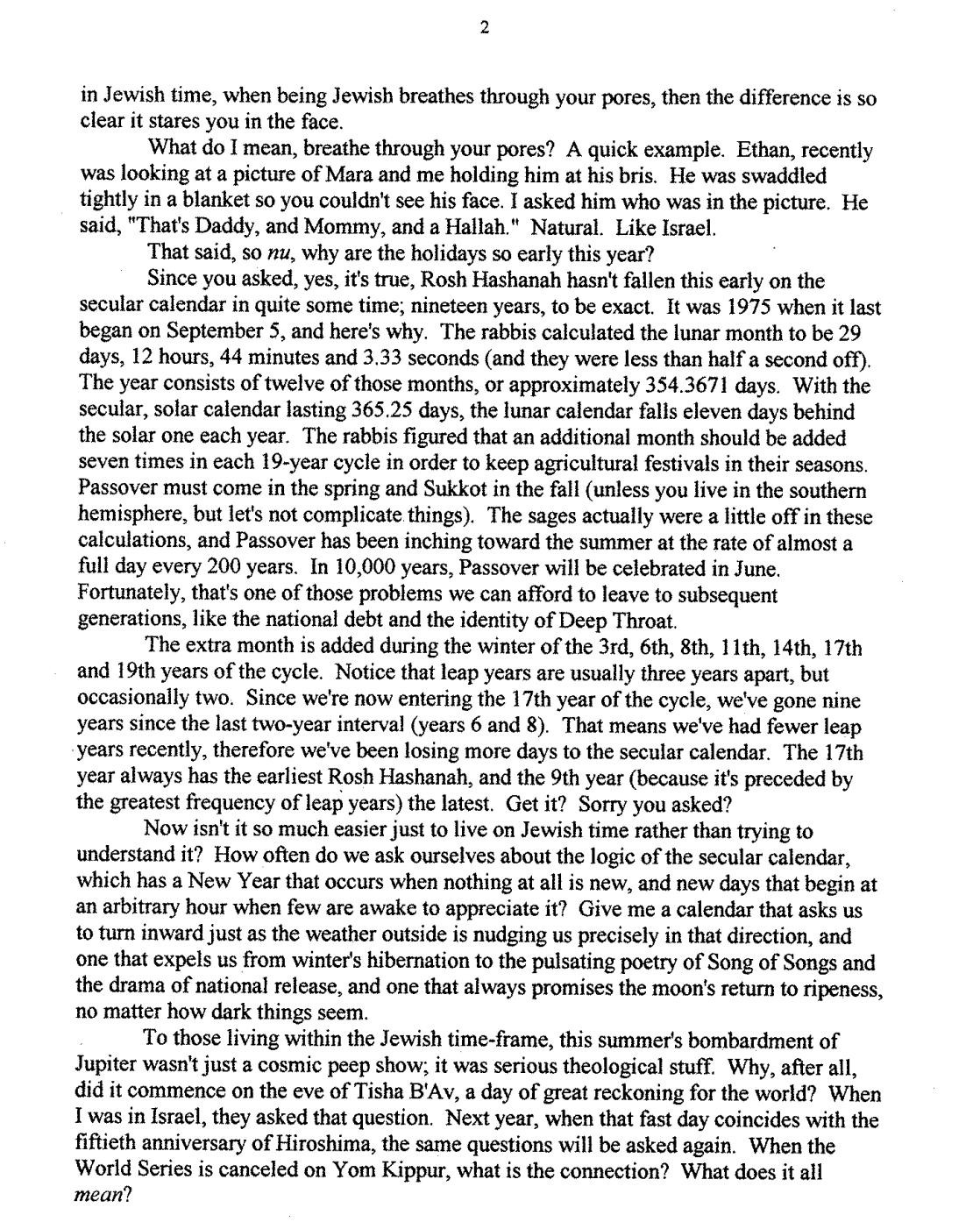
And as a bonus, click here for another bulletin from earlier that same year.  And check out a few pages from that one on the bottom of this page, including a very timely article by a certain 12th grader who is set to become TBE's next president. 


Sunday, March 13, 1994

Birth Rite (New York Times Magazine)

The New York Times Magazine, March 13 1994


PDF of original article

As one of their duties, rabbis guide nervous parents through the ritual wounding their son’s genitalia on the eighth day following birth. I know, because as a Conservative rabbi for the past 10 years, I have done exactly that.

I’ve led hundreds of mothers and fathers through their baby boys’ circumcisions, reciting my routine explanations in favor of the ritual. But it was not until last year, after the birth of my son Daniel, that I came to appreciate the deeper meaning behind circumcision. True, I had witnessed hundreds of cuttings, but until that day I had never myself performed one.

As a rabbi and as a parent, I had figured that my second son’s circumcision would be like that of the first. I assumed I would chant a blessing or two, then daub his mouth with wine-soaked gauze. But the mohel (circumciser), with whom I had worked countless times suddenly handed me the knife. He pointed to my squirming Son, whose hands and legs were tied to the board. The foreskin had been pulled up over the glans of the penis and was now protruding through a narrow slit of the small, stainless steel clamp.
"It's all set up," the mohel said. "No way you can go wrong."

"It's the greatest honor a father can have," he added.

He had taken that line right out of my script. But there was one difference: I remind parents that they have the option of delegating to the mohel the performance of that radical affirmation of the covenant between the Jewish people and God.

"All you have to do is cut," he said.

Daniel, who had been crying incessantly throughout, suddenly stopped. Like Isaac centuries before, Daniel waited in silence for his father's knife to drop.

Daniel had spent most of his first week of life blissfully attached to one of the other of my wife Mara's breasts while I played computer games with our 2-year old Ethan. I also attended to the medical insurance, informed relatives of Daniel’s birth, got his Social Security number and shopped for food. In short, I had become Master of the Mundane – until I was handed the knife.

Since the day Abraham circumcised Isaac, the knife has transformed father into sculptor, asserting his responsibility to mold and perfect nature. The knife also turns father into mentor, one willing to inflict pain for the sake of proper moral development.

But most of all, the knife turns father into potential murderer. It is no coincidence that only one biblical chapter after Abraham circumcises Isaac, he nearly slaughters him, perhaps with the same knife. One does not have to be a Freudian to know that the birth of a son brings about more than unalloyed joy to the father. There is no greater primal anger than that caused by seeing another male in carnal contact with your wife, in this case the physical intimacy of mother and son. And there is no greater primal envy than that caused by looking down at the person who was brought into the world specifically to be your survivor. In traditional Jewish society a male child was called a "kaddish," the one who would say the memorial prayers when the parent dies. With the birth of a "kaddish," the father hears a whisper that it is now all right to die.

In the face of this anger and jealousy, give the father a knife and ask him to do that? There? And besides, I’m squeamish. The last time I gave blood, I passed out. I shave only with an electric razor. I'm a vegetarian. And finally…well, let’s just say that I am no surgeon. Mara and I ruminate for hours before cutting our baby's fingernails. But with our friends and relatives waiting impatiently, what was I to do when the mohel gave me the knife? I took it in my right hand, forgetting that I bat, throw, eat and probably cut foreskins best lefty, and swallowed hard.

My hand trembled as I began to push the blade across the edge of the clamp through which an inch of my infant's foreskin protruded. But the blade wasn't cutting easily. The seconds felt like hours as my hand swayed back and forth.

The situation called for a hard, sturdy chop. It called for a butcher. In fact, in the Middle Ages the community’s mohel was often the one who slaughtered animals for kosher meat. Looking at my son, I realized success required tunnel vision, to regard the skin as lifeless, distinct from the person attached to it. But I wasn't used to cutting meat, raw or cooked. Was this what it was all about? Unprovoked aggression? Dehumanization of one's own flesh and blood? It was becoming clear that in order to finish the job I would have to rely on a carnivorous side that I didn't think existed, that I feared greatly.

Then Daniel began to cry again.

I suppose that had Abraham fumbled things this badly, even stoic Isaac might have cried. But Daniel let loose a wail that normally was reserved for four in the morning and was always assuaged by a speedy rendezvous with his mother. This time, though, there were just the two of us. I was holding the knife, and he appeared to sense its power.

Then I noticed for the first time his blue eyes looking straight into mine, and it was a look not of fear but of utter dependence and trust. It was the kind of look we Masters of the Mundane aren't used to getting from infants.

I finally understood that the knife transforms the father not to sculptor, mentor, or butcher, but, paradoxically, into a shield. The breast provides, but the knife protects. It channels a father's natural anger and jealousy into one controlled cut. He takes off one small part in order to preserve – and love – the whole.

A rush of guilt and fear went through me. I just wanted to hold Daniel and tell him that never again would he suffer the agony of rampant parental rage. With one burst of empathy and a series of short jagged flicks, the foreskin was gone. The mohel cleaned things up and it was over.

No parent should be denied this experience, even vicariously, of inflicting upon his child a ritualized blow so intense as to make him both shake and recoil, yet so controlled that no damage is really done, to signify that this will be the worst the child will ever know from his parent's hand. For it is from the father's hand that Abraham's knife dangles, every moment of every day.