Showing posts with label gratitide. Show all posts

Friday, November 16, 2018

Shabbat-O-Gram for November 16-23

Shabbat-O-Gram


This week's Shabbat-o-Gram is sponsored by Caryl Ferber Poser and Peter Poser in honor of the wedding of their daughter, Ariel Ferber Poser to Stephen  Benjamin Bedik, son of Robin and Scot Bedik.  

Shabbat Shalom!

Young families having fun at TBE Family Fun Day at last week.
  

Shabbat Shalom, as we dig out from the season's first winter storm and Israel heads for early elections.


An Attitude of Gratitude

TBE Congregant Ben Evans, who helped us to commemorate the 80th Anniversary of Kristallnacht last  Friday night by sharing his own recollections of that fateful night, as a ten year old living in Germany. We were honored by the presence of his family, including a number of grandchildren who had never heard this story told in such detail before. 

We are hopeful for the case of the custodian at our sister synagogue in Mount Kisco whose recent deportation is being challenged in the courts.  An additional local angle - he is being represented by the son in law of TBE's Steve and Susan Leiterstein.  Read the latest here 

We are thankful to all who will bringing spirited rock music to our social hall on Friday night for Rock Shabbat, and to those who will be bringing multi-faith spirituality to our sanctuary on Sunday at 5 PM for our annual "Shabbat School," at our service we'll be discussing the meaning of gratitude - 

In the wake of the Tree of Life attack in Pittsburgh, among the unresolved issues is one that may not seem very significant when compared to the stinging loss of eleven innocent lives, but is vexing nonetheless:

Should Jews turn the other cheek?

A few days after the attack, the Rev. Eric S.C. Manning, leader of the Emanuel African Methodist Episcopal Church in Charleston, S.C., where nine parishioners were murdered in 2015, paid a shiva call to Pittsburgh, where he embraced Rabbi Jeffrey Myers of the Tree of Life congregation. Their shared grief moved us all, but at the same time it brought attention to one aspect of the two cases that wasn't shared.

Following the Charleston attack, the victims' families famously forgave the murderer as he stood before them in court. By contrast, as the New York Times reported, the Jews of Pittsburgh had no intentions of being so forgiving.   The Times article states that Jews interviewed said they had been too busy burying the dead and trekking from shiva to shiva to devote much thought to the killer. It then adds, "But Jewish theologians also explained that their tradition, rooted more in the retributive justice of the Old Testament than the turn-the-cheek ethos of the New Testament, takes a different approach to forgiveness."

Yes, it's true, Judaism does take a different approach. The article goes on to explain, correctly, that the Jewish concept of teshuvah calls on the perpetrator to seek forgiveness from the victim before having any hope of absolution. Then it adds that Pittsburgh mourners "felt little instinct to forgive the person responsible for such horror."

Clearly, there is a difference in how the victims of Pittsburgh and Charleston approached similar calamities. But whenever someone traces things back to the "retributive justice of the Old Testament God," an enormous red flag is raised. There are many images of God depicted in the Hebrew Bible, some more vengeful and others more loving. The thunderous God of the Exodus Sinai narrative is later encountered by Elijah, in the very same place, as a "still, small voice." And that kind n' gentle New Testament God seemed to conveniently forget to turn-the-cheek during the Crusades and Inquisition.

The notion of a perpetually vengeful Old Testament God has inspired stereotypic images of hard-hearted Jews, even though the Torah explicitly prohibits taking revenge and holding grudges.
Why does Judaism not encourage the unconditional embrace of your enemy? When you turn your cheek, you are no longer looking at your offender in the eye, face to face. True reconciliation can only occur when two human beings can truly see what is human in the other, and how each of us is created in the divine image. But there are times when such authentic encounters simply can't happen. The Pittsburgh perpetrator showed no signs of remorse during his appearance in court, and it is doubtful that he will when he stands trial. 
It would be a grave injustice to blindly forgive him.

After the Charleston massacre, I attended a local prayer vigil, at which I heard a presentation by Inni Kaur, a representative of the local Sikh community, reflecting on her own faith group's experiences.

It should be noted that the Sikh community suffered a similar massacre, at a temple in Oak Creek, Wisconsin in 2012. Unfortunately, no religious group is immune to such attacks. The image of people at prayer or study seeing their sanctuary violated, having the pastoral serenity and love of neighbor rendered instantaneously into a garish nightmare, is one that cuts across cultures.

My Sikh colleague recalled Oak Creek, and how the community rallied together and preached love over hate, and, like Charleston, even forgave the perpetrator of the violence. She said, "These communities' have shown us that faith helps endure any hardship, even the most unspeakable suffering. Faith does not mean we forget pain or grief. Faith means that we live free of hate. These monumental acts of forgiveness compel each and every one of us to work towards ending the racial terror that exists in our country today; to find ways to look beyond the boundaries of race, color, ethnicity and see the Oneness in all."

So "forgiving" enemies is not about letting them off the hook - it's about telling them, loud and clear, that they have not succeeded in driving a wedge between groups. It's about achieving a greater societal goal by suppressing base urges. In Charleston, Oak Creek, Orlando, and now Pittsburgh, the ideology of hate was drowned in a sea of love.

In Charleston, the victims' supreme gesture of love yielded tangible results - the removal of the Confederate flag from the state capitol. One hate-driven young man accomplished in one evening what Martin Luther King could not accomplish in a lifetime, at least with regard to the shunning of this symbol of hate.

One might say that for the bereaved of Charleston, forgiveness was the best revenge of all.
For the Jews of Pittsburgh, the best revenge against the particular hatred espoused by White Nationalists has not been to turn the other cheek, but to build stronger bridges to other targeted communities, like African Americans and Muslims, who have shown such love in the wake of the attack.

And that love was reflected at the ballot box, where polls suggest that late deciders in the recent midterm elections swung away from the harsh nativism espoused by Republicans following the pipe bomb attacks on Democrats and the Pittsburgh Pogrom. (Yes, these days pogroms no longer require angry mobs with pitchforks; now all it takes is a single crazy hater with an AR-15).

As voters decided "enough is enough," our newest Jewish martyrs changed America, while the bereaved turned not the other cheek, but perhaps the tide of history.

(this article to appear also on (The Jewish Week website)

Rabbi Joshua Hammerman

Friday, November 18, 2016

Shabbat-O-Gram for November 18


TBE's Discussion Group, a monthly learning and social havurah, went to the Tenement Museum on the Lower East Side last Sunday.  See our entire fall photo album

Shabbat Shalom

There will be no O-Gram next week, but keep us in mind as you go over the river and through the woods.  Services will happen, naturally, through the holiday weekend, with morning minyan at the special holiday time of 9 AM on Thursday and Friday.  Mazal tov to Jason Yudell and family on his becoming Bar Mitzvah on Shabbat morning.  And welcome back to our community to old friend Ilana DeLaney, who will be featured at the UJF’s annual learning extravaganza “Tapestry,” on Saturday night.  Tomorrow will also be our first Shabbat School day for the year, where Hebrew School gets shifted from Sunday to Shabbat - and this week’s will include Torah Cupcake Wars.

The Interfaith Council of Southwestern Connecticut and the Mayor's Multicultural Council will hold an Interfaith Prayer Service on Tuesday, November 22, at 6:00 PM in the Stamford Government Center (888 Washington Boulevard). I will be attending. We stand together as citizens from a variety of religious backgrounds and non-religious backgrounds to support all those who, based on the rhetoric of the recent campaign, feel threatened, need support, or are unsure of what the future holds.  Meanwhile, as we continue to sort through the events of the past ten days, it is helpful to read the balanced perspective of AJC CEO David Harris as well as the just-released recommendations of the ADL task force to stem the hate that has been surging on social media.  The report (pdf here) was discussed at length at an ADL conference in New York this week.

This week the Boston Jewish community released results of a comprehensive new study (download it here), which, when compared to a decade ago, suggests that dramatic changes are occurring in how Jews connect to Judaism, Israel, and traditional institutions-synagogues, denominations, organizations and schools.  No two communities are exactly alike, but there is much that those of us living in other Jewish communities can learn from this.

For instance, the percentage of Boston Jews who identify as Reform or Conservative has significantly declined in ten years, from nearly three-quarters (74%) in 2005 to less than half (44%) today. The Orthodox population in Boston is steady at just 4%. By contrast, the number of Jews who do not identify with any denomination-those who are secular, culturally Jewish, or “just Jewish”-has increased dramatically, from 17% in 2005 to 45% of the population in 2015.

From the survey: “Corresponding to the decrease in denominational affiliation, synagogue membership is also in the midst of change. Overall, 37% of households reported belonging to a Jewish congregation or synagogue, as compared with 42% in the 2005 study. As in the 2005 study, these are “point in time” numbers and mask the affiliation rate over time.  In 2015, 70% of in-married Jewish households with children ages 9-13 were affiliated with a congregation showing the continued central role that congregations play in the life of our community. At the same time, this represents a drop from over 83% affiliation among similar households in 2005. In contrast to the drop among in-married households, when we look at the membership rates for interfaith families raising Jewish children, we see higher rates of membership as compared to 2005. We also know from observation that there is growth and strength in some synagogues, where membership is expanding and programming is engaging families and individuals of all ages and lifecycle stages, while other congregations are in decline.”

As I said, there is much to learn. 

Growing Large By Thinking Small

Without much fanfare, TBE has developed a number of thriving “havurot” (affinity groups), to add to the ones we have established over the years.  We’ve got a Young Couples Group, that meets often and is now discussing ways to increase their impact on the community, and Empty Nester’s Group that’s been meeting regularly, a vibrant Grandparents’ Group, (those with grandchildren who in dual-faith families) which began meeting this month as part of our Keruv program, and the spectacular start to our Sha-ba-bim-bam Families, families with kids of preschool age and younger - whose number keeps on growing (and they’ll get together again this Shabbat morning at 11!).  Add to that our longest running havurah, the Discussion Group, which meets monthly to learn and schmooze together.  They went to the Lower East Side last Sunday.  

Our Sisterhood and Men’s Club are social groupings as well, of course (along with sub-groups like our monthly Rosh Hodesh Group), as is our Adult Choir, Beth El Cares, Morning Minyan and Shabbat “regulars,” our B’nai Mitzvah Club, and now an adult education cohort that has expanded dramatically with the start of our JTS Ethics Class.  Then there’s Reyut, our helpful healers and friendly visitors and our C.S.A.,which has wrapped up another successful season.  Aside from promoting local farmers, sustainable agriculture and healthy eating, we donated over 400 lbs of food to the Food bank of Lower Fairfield County.  We should be very proud. The C.S.A is not a social group per se, but I can say that my family (two and four legged) have had some great opportunities to chat with folks each week as people have picked up their veggies at the shed. 

All of these groups, along with our board, and our hard working committees planning upcoming events like Temple Rock and the Women’s Seder.  Plus our weekly anchor, our Friday Night Kabbalat Shabbat attendees - and attendance has been significantly higher this fall.  My apologies for any group left out.  We are growing large by thinking small.  I hope everyone can find their niche in our expanding community of sub-communities.  Wherever you are on your life’s journey, there is a place for you at TBE.
Have Some Hungary with your Turkey

If you feel that sense of community here, help us take that spirit on the road next summer on our Jewish Heritage Tour of Central Europe.  Please discuss this with family and friends at your Thanksgiving tables.  At a time when the Holocaust has become even more central to our self awareness as Jews and how we confront the dangers of our world, we need to reaffirm our role as witnesses.  Please RSVP to me at rabbi@tbe.org if you can come to our informational and organizational meeting on Wed. Nov. 30 at the home of Sari and Alan Jaffe.  


Our Better Angels


We can now add to that list of thriving groups our Eighth Grade Youth Group, led by Lisa Gittelman Udi and Mara Hammerman. I am really grateful to both of them, as well as to the parents and kids, who have expressed a real desire to carry their very positive Hebrew School experience to the next level.  Last Sunday, I got to “come with” as the group collected food outside Stop and Shop for the JFS’s Thanksgiving Food Drive.  The kids handed out flyers asking shoppers to buy specific kosher-marked products, which were then used to prepare full meals for a significant number of families.  What moved me tremendously was the generous response they received from so many shoppers, and the way that in turn moved the teens.  Most of the shoppers weren’t Jewish, yet they went out of their way to look for kosher markings - some asked us what they mean.  

So all in one fell swoop, our TBE teens were able to 1) do a great mitzvah 2) teach strangers about Jewish values like tzedakkah and kashrut 3) be great ambassadors of the Jewish community to many who are not Jewish 4) come to appreciate the charitable nature of total strangers (many who were clearly coming from church) and, oh yes, have a great time, topped off by froyo at Sixteen Handles.

How to Survive Your Thanksgiving Dinner

Given all the pressures of the past few months, it is not unlikely that some of the stress will spill on over to your Thanksgiving dinner.  So here are my Ten Suggestions as to how to avoid Armageddon breaking out at your table.

1)     Stay away from all controversial subjects. These days that includes even the weather, which has become a hot topic, both figuratively and literally.  So if you avoid controversial topics like politics, religion, family, the weather and Aunt Sadie’s dry-as-the-Sahara sponge cake, that pretty much leaves us with meditating, chewing, whistling and various barnyard noises. 
2)     Stay away from any toxic words - in other words, anything that has been said on cable news over the past 24 months.  Abraham Joshua Heschel wrote, “One of the results of the rapid depersonalization of our age is a crisis of speech, profanation of language.... Language has been reduced to labels, talk has become double-talk. We are in the process of losing faith in the reality of words.”  
3)     Actually, silence is a good thing.  A few moments of silence couldn’t hurt.  Abraham Joshua Heschel again: “Just to be is a blessing. Just to live is holy.”   So for a few moments, contemplate what it means to be a blessing.  Don’t say anyth8ing, and ponder what it means to just be.
4)     While you are contemplating, now is the time to cultivate mindfulness.  Use this guide to bring a greater sense of mindfulness to all your Thanksgiving related activities.  When you are food shopping, allow the food to call out to you.  Turn off the radio while driving and be aware of your posture and your breathing.  Notice the foliage and the changes in landscape, how as you climb in elevation, fall slowly slips into winter.  Wherever you are, whatever you are doing, take deep breaths!
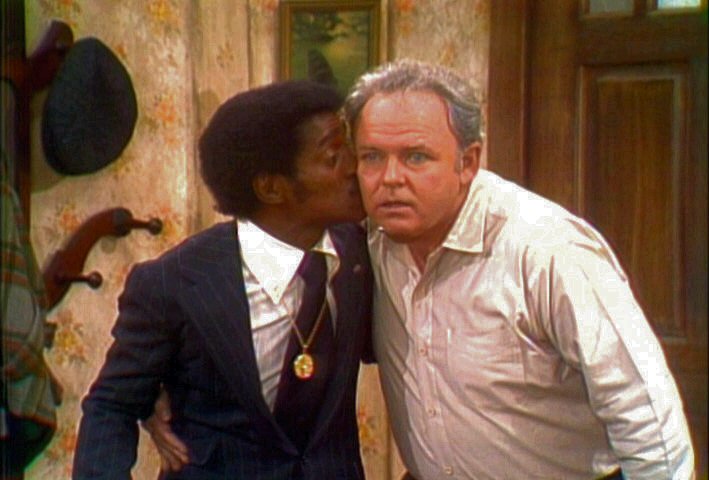
5)     Cast away labels.  Uncle Joe shouldn’t be pegged as “Socialist Uncle Joe who voted for Jill Stein, or “Uncle Archie, the lovable bigot.” Joe is just Joe and Archie is just Archie.
6)     Think of what everyone around the table has in common, not how they differ.  Somewhere in between the soup and the salad, slip into the conversation that you’ve recently had your DNA examined and it turns out the family is .1 percent Native American.  That should get you clear through to the pumpkin pie.  Remember to record for posterity the reaction of your Uncle Archie.
  
7)     When you do speak, speak from your heart.  The Hebrew word for family, Mishpacha, comes from the word “to pour.”  Originally the reference was to blood, and family blood runs deep, but this is a time not to shed blood, heaven forbid, but to strategically spill your guts. Try to aim for a deeper conversation than last year’s discussion on all things Kardashian.  Remember that everyone is fearful these days - for all kinds of reasons.  We are all looking for support and genuine caring.
8)     Focus on the food (except for Aunt Sadie’s sponge cake).  Noshing is sacred.  There are some nice stories about food, like this Kabbalistic tale about the twelve hallot, one of my personal favorites. Download Hazon’s “Food for Thought” supplement and use some its excellent material at your table.  You will thank me. 
9)     Have the new Hamilton Mixtape handy, or just pass around the lyrics.  If you are looking for a Jewish slant, play this mash up of the Schuyler sisters as Tevya’s daughters. If things start to get tense at the table, just increase the volume.  Much better than escaping to the Lions v. Vikings in the other room.
10) And of course, count your blessings by actually reciting blessings, including the Motzi to start the meal and Birkat Hamazon to end it.  Here’s a short form, and here’s the whole thing.  Read about the 100 blessings Jews traditionally recite each day or look at 100 new blessings composed by the TBE Confirmation Class back in 1993.  Or, best of all, just look around the table at all the people who, despite themselves sometimes, have loved you through the course of your life.  Before the Alzheimer’s kicked in, or the Jewish Guilt, or adolescence, or that one horrible, un-take-back-able thing that was said.  Look around and realize how lucky you are to be alive right now.  These are interesting times that have chosen us. Love ‘em or hate ‘em, we are here.  To echo Eliza, “The fact that we’re alive is a miracle - just stay alive, that would be enough.” Abraham Joshua Heschel begs to differ, opening a dialogue that we should pursue: He wrote the following in "No Religion is an Island," (to complete the quote I excerpted in #3):
Just to be is a blessing. Just to live is holy. And yet being alive is no answer to the problems of living. To be or not to be is not the question. The vital question is: how to be and how not to be? The tendency to forget this vital question is the tragic disease of contemporary man, a disease that may prove fatal, that may end in disaster. To pray is to recollect passionately the perpetual urgency of this vital question.
Yes, with apologies to Eliza, to stay alive would not be enough. it’s not just about survival alone.  It’s about living an exalted life, a holy life, a moral life, a good life. Now more than ever, we are thankful for the ability that each of us possesses to nudge the world ever so slightly in that direction.  And we are thankful for the people who will join us on that quest. 
And I am thankful for all of you.
Happy Thanksgiving!

Rabbi Joshua Hammerman

Tuesday, September 30, 2014

Judaism’s Top 40 – Tishrei 7 – Hakarat ha-Tov – Gratitude

Jews are eternally grateful.  The very word “Jew,” Yehudi, has within it word for gratitude (connected to Todah, which in Hebrew means “thank you.”) This is the ethos that lies behind the great Talmudic proverb which asks, "Who is rich?" and then answers, "Those who rejoice in their own lot." (Avot 4:1)

In raising children, we need to teach that true gratitude, however, includes more than obligatory thanks; they need to learn how to instinctively express hakarat hatov, or recognition of the good that another has done.

Rabbi Yisrael Salanter once noticed that a fancy restaurant was charging a huge price for a cup of coffee. He approached the owner and asked why the coffee was so expensive. After all, some hot water, a few coffee beans and a spoonful of sugar could not amount to more than a few cents.

The owner replied: "It is correct that for a few cents you could have coffee in your own home. But here in the restaurant, we provide exquisite decor, soft background music, professional waiters, and the finest china to serve your cup of coffee."


Rabbi Salanter's face lit up. "Oh, thank you very much! I now understand the blessing of Shehakol -- 'All was created by His word' -- which we recite before drinking water. You see, until now, when I recited this blessing, I had in mind only that I am thanking the Creator for the water that He created. Now I understand the blessing much better. 'All' includes not merely the water, but also the fresh air that we breathe while drinking the water, the beautiful world around us, the music of the birds that entertain us and exalt our spirits, each with its different voice, the charming flowers with their splendid colors and marvelous hues, the fresh breeze -- for all this we have to thank God when drinking our water!"