Showing posts with label tbe. Show all posts

Tuesday, December 26, 2023

In This Moment: A Time for Embracing; Defining Ourselves as a Conservative Congregation


In This Moment

click for pdf of Jpost front page.

As you can see, six more IDF soldiers were killed today.

Marc Schulman reports that things are also heating up in the north, and there is no end in sight.


A Time for Embracing

The news from Israel could not be more depressing right now. High casualties on both sides and slogging battles amidst the wreckage and in Hamas tunnels. While it appears that Israel is making progress in degrading Hamas, it is hard to measure it, much less understand whether it brings Israelis any closer to safety - and the release of the hostages.


For a people of words, there are no words right now. And that, perhaps, is how it should be.


Ecclesiastes wrote that there is a time to speak and a time for silence. This is a moment when very little that we say can be helpful. All we can do is extend our arms and embrace. This is a time for embracing.


In "normal" circumstances, we would already be beyond the time when a ceasefire would be in order. But despite the enormous death toll in Gaza, the fact that Hamas embeds itself among civilians makes almost any response justifiable until Hamas relinquishes control of Gaza and returns the hostages. And we are not close to that yet, it seems.


And even if "justifiable" does not equal "justified," and even if we now have every reason to believe that Netanyahu is acting more for political survival than military or moral considerations, there is still nothing we can say that would seem right at this moment. We can't pressure Israelis, even if we feel a proposal, like the one currently being circulated, reportedly, by the Saudis, makes some sense, given the trauma they are still experiencing every waking moment. We can only hug them, as President Biden has continued to do, at least in public.


As I was driving today, a song randomly came on my playlist. It was a version of a popular Israeli hit from a few years ago, Yihye B'Seder, "It will be OK," sung by the mixed Israeli-Palestinian Youth Choir based in Jerusalem's YMCA. I've spoken about them before. It was perfect - just what the doctor ordered.


But then I wondered: Are Israelis still saying B'Seder at all? it was the classic response to any dilemma, any hard time. It will be OK. Not only that - but it will be Sababa! Things will be great!


I swear, Israelis used to be born saying b'seder. If they happened to say Abba or Ima first, it was an anomaly. Now not even cabdrivers are saying it.


I'll venture to guess that no one in Israel is saying Sababa much these days, either. But how can Israel be Israel without B'Seder?


Listen to the Arabic-Hebrew song below, with English subtitles. It's a great song, especially when sung by that group.

Maybe that song sung by that group can give you hope. It gave me a little.


But it reminded me that Israelis have lost much of that hope, that optimistic, can-do spunk that sustained them for so long. And for good reason. They've all lost loved ones, and for them, everyone is family. All those faces in the daly newspapers. They have lost so much and are at a loss as to what has happened.


I've been saying it all along. The devastation of Oct. 7 is without precedent. The trauma is beyond measure. It doesn't give Israel license to commit war crimes (not that I'm asserting that any have been committed thus far). But it also doesn't give us license to treat this as some military chess game where we are just hoping Israel can gain a strategic advantage. This is not business as usual, and on some level, even Israel's detractors get it. Even the Egyptians and Saudis seem to get it.


There will be no celebration among Jews when the guns stop firing. The question we must ask is not whether there will be a celebration if, say, Israel earns a clear victory and the hostages all come home, but whether, even if that happens, Israelis and diaspora Jews will ever be able to celebrate again. Will we ever be able to march around and dance with the Torahs on Simhat Torah again? Will things ever be b'seder again?


I can't answer that. But I suspect that it will get better, because if we could find a way to sing, dance, get married and have babies after the Holocaust, we can find joy, somehow, even after this.


But in the meantime, there are no words.


This is a time for embracing.

TBE Milestones:

Defining Ourselves as a Conservative Congregation


As we reach my final months as TBE's senior rabbi, I'm sharing some key moments and events from the past 37 years


In the last years of the 20th century, the Conservative Movement tried to define itself, something that it never really had done before. The publication of the product of those efforts, Emet V'Emunah (you can read the pdf of the entire document here) was a true landmark, but its flaws reflected the drawbacks of the movement as a whole. The document tried to be all things to all people and to paper over major areas of conflict. It was a valiant attempt to take seriously the ideology of a movement that had been created less from ideology than sociology. Conservative Judaism was intended to be waystation between the restrictive Orthodoxy of its forbearers and a more modern expression of tradition that would enable new immigrants to make it in America. 


By the late 1990s, well into my first decade here, Beth El underwent its own identity crisis. While it was true that we were members of the United Synagogue and while our liturgy was well in line with the movement, many of our practices were outliers with regards to how the movement was evolving. We used the organ, which was a source of much consternation, and in fact had led, over the span of decades, to many Conservative-oriented Jews not joining here. We also were formal and monolithic in our style of prayer. There was little room for pluralistic expression and none at all for some of the innovative styles being developed within Havurot (fellowship groups that had been founded during the '60s counter culture in Boston and elsewhere), and its D.I.Y. bestseller, "The Jewish Catalog," and also among those involved with Camp Ramah and other bastions of counterculture creativity. When I arrived, it felt as if the '60s had never had happened here.


So the generational change I brought in the '90s came as a shock to the system. What was doubly shocking was that as Associate Rabbi, I could only go so far in introducing change, so when I became Senior Rabbi, and began implementing some reforms, some people felt like "another Josh" had taken over my body. And in a way it was, a Josh whose vision reflected the innovation, pluralism and activism that was the Conservative Judaism that I grew out of, in countercultural Boston, as well as at Ramah, Brown and JTS.


But however different I seemed, and I was hardly a radical, even that mattered little, because whenever a new rabbi takes over, it's always going to be a shock to the system. It's not just true for rabbis. I was told by a colleague and close friend, Gary Brown, pastor of First Congregational Church, that the point of friction usually happens between years three and five of a new clergy's tenure - for those lucky enough to stick around that long.


And sure enough, that's precisely what happened here, in the mid to late '90s. It was a classic battle of the "old guard" vs the new, with new leadership clamoring for more innovation (which for many meant less organ) and opportunities for diverse and more lay led services - a staple of the havurah movement. We experimented with different formats, which people accepted as long as it was relegated to Shabbat (since, frankly, those whom it would bother were rarely here to see it on Shabbat). But once the suggestion arose to offer an alternative service on the High Holidays too, it was not well received. Rumors sprung up of a conspiracy to make us "orthodox," which couldn't be further from the truth.


There was also a financial aspect to this friction, with the old guard seeking to implement strict financial controls to get us out of a hole (as they had recently done at the JCC), and the younger leadership opted to change the paradigm completely, assessing the congregation $200 per family to get us out of the red and then implementing new, more democratic and transparent fundraising strategies, which led to our first High Holidays appeal. It was a complete overhaul that energized the congregation, but at the same time made some feel uncomfortable, feeling that the synagogue they had grown up with had changed irrevocably.


It was at that point that I tried to draw the entire congregation into a conversation about what Conservative Judaism is - and to engage in strategic planning as to what TBE should become. I sent out a packet that included a fact sheet pertaining to some of the issues we were dealing with then, along with a chapter from a book explaining Conservative Judaism in detail.


I'm sure some of you are cringing at my dredging up prior moments of tension. The fact is that such moments are completely normal in an organization in transition. The key is to be able to recognize the dynamics of what is happening, to hear people's concerns and mitigate against any unnecessary damage.


As TBE faces the coming transitional years, there be similar moments of institutional tension. I guarantee it. You can call me in 3-5 years and let me know. I'll be on the beach. And while this transitional tension will be manifested in any number of ways, it always comes back to the rabbi. Even when people say it is about something else, it always comes back to the rabbi. That's why we get the big bucks.


Even in the healthiest of situations, it happens. I know, because our situation was about as healthy as it gets. I may have been "another Josh" in practice, but I was still the same person, and we knew each other well by the time I became senior rabbi in 1992. Your next rabbi will not have that advantage, and neither will you.


We have once again affiliated with the Conservative Movement. Over the next several years, you and your new rabbi will be engaged in a vigorous exploration of what that means. That conversation, which has never really been completed from the late '90s, needs to happen again and again.


See below the first page of the material I sent out to the congregation back in the late '90s below: Click here for the rest of the material, which includes my rebuttal to the accusation that we were becoming "Orthodox." (the chapter is somewhat dated but still relevant).

Three more timely parodies from Eretz Nehederet

Israel's Front Pages


Jerusalem Post

Ha'aretz

Yediot Ahronot


Recommended Reading


Temple Beth El
350 Roxbury Road
Stamford, Connecticut 06902
203-322-6901 | www.tbe.org
  
A Conservative, Inclusive, Spiritual Community

Saturday, September 9, 2017

Shabbat-O-Gram for Sept. 8

Shabbat-O-Gram

The Shabbat Announcements are sponsored by Elisa Rosner in honor of her son, Jacob, becoming a Bar Mitzvah.

Shabbat Shalom

Shabbat shalom!

Mazal tov to Jake Rosner on his becoming Bar Mitzvah this Shabbat morning.  Our Parsha Packet for the portion Ki Tavo discusses Simon Wiesenthal's classic symposium "The Sunflower," a perfect topic for this season of introspection and forgiveness.  Preview it here. 

Along those same lines, click here to see our prior packet, "Can We Judge Ourselves?"  
Something else that came across my desktop this week, a gift from the Hartman Institute and the State of Israel: In the Gates of Jerusalem: Reflections on the Eternal City for High Holidays.
 

Comings and Goings

בָּרוּךְ אַתָּה, בְּבֹאֶךָ; וּבָרוּךְ אַתָּה, בְּצֵאתֶךָ
"Blessed are you in your coming in and in your going out"


Goodbye, Antonio; Hello David and Beth!

The above quote from this week's Torah portion (Deut. 28:6) is perfect for this weekend of comings and goings, After nine years of diligent service, Sunday will make the final day here for Antonio Avilos, who has been part of our maintenance team and TBE family since 2008.  He'll be returning to Colombia to open a restaurant.  

In a religious institution like ours, anyone on the staff is a a de facto educator, modeling, especially for our children, the values that we all cherish.  Antonio has done that to perfection.  He, along with Alberto Eyzaguirre (who has been here longer than I have), often faces inordinate pressure to accomplish so much in so little time.  Yet Antonio and Alberto pull it off so magnificently, and always with a smile.  Their work, so indispensable, is also often underappreciated.  It was a pleasure to bring them front-and-center to the bima during this year's cantor's concert honoring the Landers.  We had a staff lunch to thank Antonio last week; if you see him this weekend, let him know how grateful you are!

Antonio's successor just began working here this week.  His name is David (pronounced the Hebrew way, Da-VEED) Jimenez.  Please make sure to give him a warm TBE welcome when you see him in the building.  And also make sure to welcome Beth Silver, who is providing administrative support in several areas, including our education department.  Of course Beth has been a valued part of the TBE family for many years.

Best of luck to Antonio in his new venture - can't wait to book a table on Yelp!


Hello, 25 Years....
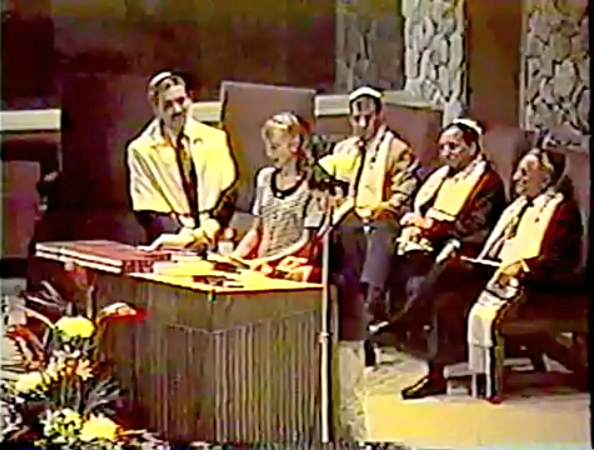
 

Speaking of comings and goings, it seems like just yesterday that I arrived here.  In fact, it was 30 years ago last month.  But since I was assistant rabbi for the first five years, my installation as senior rabbi of Temple Beth El occurred only 25 years ago - and the anniversary of that event is this Monday (Sept 11, 1992 - little did we know at that time how significant that date would be).  

Here is the program that was handed out that night.  Past President Alan Kalter chaired what was a most memorable evening.  A feature of the program was when representatives of many different groups within the congregation came up to the bima to present "offerings" of new siddurim that had just been acquired. Part of my "first hundred days" strategy was to finally move on from the old Silverman siddur; that along with not standing for the Sh'ma and ending the practice of having  the Men's Club having chicken dinners at Pelliccis.  I was very ambitious! In the photo above you can see Jill Rothkopf and Josh Donner, who were to become my "first" b'nai mitzvah as senior rabbi the following day.   So yes, Jill and Josh have a 25th anniversary to celebrate this weekend too!

The event was also videotaped, and you can see videos from that evening by clicking here.  Some other significant videos from my early years here are also found on that page.  Below are some more screen grabs from that evening.  See who you can recognize.


"Blessed be you in your coming and in your 
staying" 
About DACA...

 
At the rally supporting Dreamers 

And while we celebrate this week the comings and goings of those who are making choices as to where they will live, many are very concerned about the fate of the Dreamers, those who have lived in America for most of their lives, pay taxes and contribute to this country in so many ways, who are now being callously threatened with deportation to places they have never known.  I am proud to have been at Mill River Park on Tuesday to show my support, along with other religious and civic leaders. I will continue to stand up for the defenseless and innocent, as our sources compel us to do, not simply because we are commanded to "love the stranger,' - although the Torah does say that 36 times.  But in fact, DACA recipients are, culturally speaking, every bit as American as you and me.  They are not strangers.  They do not deserve to feel so threatened in their own homes.  We should embrace them because, in so many ways, their story is our story too.


Read "Top Ten Facts about DACA and Dreamers" (from the Bipartisan Policy Center)


Read about the Atlit camp in Israel, where Jews, desperate and homeless following the Holocaust, were rounded up and detained by the British after being caught trying to immigrate illegally to Palestine in the '40s.  Many of them were deported to Cyprus (think Ari Ben Canaan) while others were forced to go back to the very places in Europe that had devoured their families.

Read how, back in the '40s, British Foreign Secretary Ernest Bevin said sarcastically that the United States wanted displaced Jews to immigrate to Palestine "because they did not want too many of them in New York."  (It's been rumored that Bevin wanted to build a wall around Palestine and have the Haganah pay for it).


Read how Israel today is facing a migrant / asylum crisis that the government is handling in a controversial manner.

If any group should have compassion for the Dreamers, it is the Jewish people, we who know all about that knock on the door.


Our First Shabbat-in-the-Round
By Irma Ross

At the end of August, we experienced our first Shabbat-in-the-Round, a milestone event described below in this report compiled by Irma Ross, who has been instrumental in spearheading this project.  We are so grateful for Irma's positive energy and drive.  As we await with deep concern the predicted arrival of Hurricane Irma on the American mainland, be assured that this Irma and that Irma have nothing in common!

TBE's first Shabbat In the Round for 2017 was a wonderful spiritual, uplifting service and experience thanks to the beautiful music of Cantor Fishman with her gentle guitar playing and spiritual insights, the thought provoking teachings of Rabbi Hammerman, and the participation of the 45 people who came to pray together.

The schmooze portion (with coffee and) before services eased us into a warm and inviting space.

The informal setting, including pillows on the floor, allowed everyone an opportunity to be comfortable, and feel "at home."    It also allowed for some organic questions and discussion, and probing of the Torah portion.

Even the folks who are 'traditionalists" found the experience to be meaningful and loved the music added to the service.

Some feedback from the participants:

"What a wondrous idea to change things up and keep the Shabbat experience fresh.  The more informal setting provided connection and a spirit of community--a sense and a feeling we sometimes take for granted."

"I appreciated the special added prayers--they were refreshing and soul stirring."

"It was very spiritual and meaningful.  The readings and music were beautiful and appropriate.  I look forward to next time, and plan to tell others and encourage them to come."

"I loved the participatory nature and the communal feeling engendered by the service."

"I enjoyed the informal sitting in the round.  It enabled us to see each other and encouraged more participation. I liked the new prayer pamphlet--it was easier to follow. 
 I also like the group aliyot--it made it easier for people to come up to the bimah.  I'd like to see more of this format even with possibly having our traditional service in the round."

"I so appreciate all the work that went into making this service happen.  Can't wait for the next one!"

Please join us for our next Shabbat in the Round on Dec. 9th!
  

As we approach the High Holidays, some guidance on soul searching
From "Reclaiming Judaism as a Spiritual Practice"
by Rabbi Goldie Milgram

For someone to write a sefer, is more than to say they've written a "book." A sefer is an enduring gem of Jewish significance and one such was written in 1812 by Rabbi Mendel of Satanov. He created a new approach to the practice called Heshbon HaNefesh, "Accounting of the Soul." Reb Mendel teaches a 13-step program of journaling, self reflection, and planned personal change. Heshbon HaNefesh is a helpful method for those who choose to take on the Yom Kippur practice of feeling yourself participating in a Divine review of your ethical actions. Being only human, you will have errors on your record, and so it helps to have a sense that you will earn "extra credit" in your examination by showing a record of sincere efforts at introspection and personal change.

In order to be truly free, honest looking is needed into sensitive areas of self. This approach is not one of self-excoriation. Alan Morinis, author of Musar, explains: "We're seeking insight, so in a recording [journaling] practice you are to make note of what ever you see, positive, negative or neutral. That shifts this practice quite a bit towards a healthy pursuit of self-understanding as opposed to bare self reproach."

Dr. Gene Gendlin, author of Focusing, observes that to be able to undertake such a soul journey it is important to have something comforting to hold onto. Most likely, you can be even harder on yourself than others will be and you might want to find something real or conceptual to bring along that helps you be both tender and honest with yourself. What would be comforting for you? Bring it to your heart and let's continue.

Accounting of the Soul
While Reb Mendel and Alan Morinis are teaching the art of spiritual journaling, rather than replicate their work, here is another approach I've developed to Heshbon HaNefesh.

Equanimity. Ability to live in balance.
Tolerance. Growing pains lead to knowing gains.
Orderliness. Allocating time for living life fully with integrity.
Decisiveness. Acting promptly when your reasoning is sure.
Cleanliness. Modeling dignity in your ways and space.
Humility. Know you will always have much to learn and more opinions than answers.
Righteousness. Conducting your life such that you are trusted and respected.
Economic Stability. Safe guarding enough resources for yourself to live without debt.
Zeal. Living with gusto focused on purpose and care.
Silence. Listening and reflecting before speaking.
Calmness. Giving your needs and thoughts gently while being respectful and clear.
Truth. Speaking only what is fully confirmed in fact.
Separation. Focus on each strand in its own time, avoid multi-tasking.
Temperance. Eating and drinking for good health, not dangerous excess.
Deliberation. Pausing before acting, consider consequences, integrate heart and mind wisely.
Modest Ways. Eschewing crude, lewd and boastful mannerisms and practices.
Trust. Living in the spirit of knowing there is abundance in the universe and you are in the flow.
Generosity. Finding satisfaction in making much possible for others.

(Bold type, concepts of Reb Mendel, z"l; Regular type=interpretations of Reb Goldie)

First take any one of these qualities and reflect on its degree of presence and activity in your life.

(Next, you might sit with a friend, partner, class or child and discuss the quality. What are examples for it? Flesh out its meaning to you, find as many nuances of the quality as you can.

(Now, go into yourself and notice where in your body this quality resonates. The mind/body connection creates a short-cut to knowing. Is it lodged somewhere? Rather than thinking about the quality, listen to it, discover what your body knows about it. Then, take the information and gently set it before you and return to see if there is more, something new about this quality you can learn inside yourself.

(What is your desire with regard to this quality? Sit quietly with this question until a clear image forms, til you imagine a real probability. Invite strength and support for this intention from the great dynamic flow of all possibilities in creation.

The Path of Yom Kippur Preparation

Many think of Yom Kippur, known as the "day of atonement," as the annual day of repentance. Actually, each Yom Kippur is the apex of one year's cycle of serious self reflection. Judaism is bullish on humanity, passionate about our in-born ability to change for the better. And, it only makes sense that it would require far more than one day to fine tune your life for rebirth at a more expanded level for the next year. 

Accordingly, there are many days in the calendar where incremental Heshbon HaNefeshwork is traditionally practiced: Thursday evenings as part of lifting soul shmutz in preparation for Shabbat; every day (except Shabbat) of Elul, the month which precedes the High Holy Days. Some also observe Yom Kippur Kattan, "Little Yom Kippur," on the day before each new moon, and as Reb Mendel suggests, it is most effective when engaged in nightly.

The high holy day experience is often reported to be intensified in value and meaning for those with a regular Heshbon HaNefesh practice. Why? Because instead of leaping out of daily life and into the holidays, you will arrive prepared.
Shabbat Shalom
Rabbi Joshua Hammerman  

Sunday, November 13, 2011

7th Graders Plant Bulbs - Photos

Today our TBE 7th graders planted hundreds of bulbs in our Finkelstein Mitzvah Garden. The class decided that as their mitzvah project, they will donate the flowers to nursing homes and hospitals, and also sell some for Passover and donate the proceeds to plant trees in Israel. Before the planting, I spent time with the kids discussing Judaism's focus on envionmental sustainablilty. The garden, a centerpiece of TBE's educational programming, had been damaged severely by Hurricane Irene, but recently was fully repaired. Click on photo below for pics:

2011 November 13, 7th Graders Plant in Mitzvah Garden

Monday, April 11, 2011

Friday, April 8, 2011

Reflections on TBE @ 90: A Conservative Crossroads

Reflections on TBE @ 90: A Conservative Crossroads

Apologies for the length (but hey, no one's forcing you to read!)


Our 9oth anniversary, a year-long celebration, is coming to a climax, ironically during a week when our president, Eileen Rosner, announced to the congregation our departure from the United Synagogue of Conservative Judaism. We are truly at a crossroads. That notion is supported by other parts of her email, discussing our new nursery school and the hiring of our new Director of Community Engagement, Rabbi Michelle Dardashti, currently a Rabbinic Fellow at B'nai Jeshurun of NY. Read more about her impressive background here.


If you look at our first TBE bulletin in 1922, you'll see how many things have not changed, what with appeals for greater service attendance and membership recruitment. There were junior services and Sisterhood meetings and, yes, a United Synagogue convention.


But the world has in fact changed radically since then, and over the past decade, that pace of change has intensified almost immeasurably. We have worked hard over the years to keep up with that pace, and, wherever possible, to be ahead of the curve. When it became clear that synagogues had to open their doors to a wide array of Shabbat programming, we were among the pilots to introduce Synaplex. We were at the cutting edge in our movement's drive to be more inclusive of people of all faith backgrounds and sexual orientations. Before informal education was all the rage, we were taking every grade on Shabbatons. While others were still offering boring, hear-a-pin-drop, custom-designed private Bar Mitzvah services, we were able to synthesize the individual needs of the family with the collective goals of community building. We were also a pilot community for Birthright Israel, the JTS Mitzvah Initiative and over the past few years we have led the way in the engagement of Young Professionals and, all along, the use of technology.


Sometimes we are too far ahead of the curve. But I appreciate the fact that our leadership - and the vast majority of the congregation - have bought into the fact that if we aren't constantly looking at what's around the bend, the next generation will suffer the consequences. Even at the risk of the occasional flop, it's always best to keep innovating. People often ask me whether I take flak for some of the "out there" positions I occasionally take. Maybe it's because you're so used to me that you've stopped listening...but I believe it has more to with the congregation's buying in to the vision that I've been articulating for so long, a vision that we constantly are refining together. We simply cannot afford to stagnate. Because we have kept up with the torrid pace of change, we are well situated as we move toward our centennial year.


Take synagogue music, for example - and read this excellent backgrounder on the dramatic transformations that have taken place. The role of cantor, as we once knew it, is now virtually nonexistent, both in the liberal and Orthodox communities. JTS is trying to figure out what to do with its cantorial school. The role is being reinvented as we speak, and few have done that better than Cantor Mordecai. A decade ago, we were among the first congregations to bring Craig Taubman's "Friday Night Live" to the east coast (the first in the New York area) and now, with Cantor Mordecai, we stand at the cutting edge of the next phase of this revolution that is giving Jewish spiritual expression a global beat, authentic, yet very new. This pulsating music was pioneered by B'nai Jeshurun in New York (read about them in that same article) and our deepening partnership with BJ reaches a new level with this Sunday's concert. It is the music that is fueling our growth.


BJ, by the way, has a close affinity with the philosophy of Conservative leaders like Abraham Joshua Heschel, but they long ago left the United Synagogue. The USCJ's new strategic plan, in fact, is designed to lure creative, sacred communities like B'nai Jeshurun back into the fold.

Unfortunately, the United Synagogue of Conservative Judaism, to a large degree, has not kept up with that torrid pace of change. While we are living in a Facebook world, the USCJ still has the feel of our bulletin of 1922. For many years, I have stood behind our continued membership and it has been a lonely position to take at times, especially in an era of economic challenge. This year, we reached the breaking point. In order to pay the significant sums being asked of us, we would have had to abandon, to a degree, our pursuit of excellence. Were USCJ providing excellent service, that would not have mattered, but that has not been the case for some time.

The board's decision came as a last resort after repeated efforts to seek accommodation at a lower rate. A USCJ leader came here to present the organization's new strategic plan. The plan carries hope for significant reform, though many feel it does not go nearly far enough. Rabbis who helped to craft the plan have spoken publicly of their frustration that an opportunity to completely remake the movement was not seized. For the time being, the organization is in disarray, and our board felt that the considerable sums we are being asked to contribute in annual dues might better be invested in pursuing our goals here. There are lots of things we can do to strengthen Conservative Judaism. But what will help the most is what we can do best - be a role model of transformation, a magnet of energy and sanctity for all to see.


Meanwhile, we are still very much engaged with the Conservative movement through its many other arms, including J.T.S., where I serve on the Chancellor's Rabbinic Advisory Council, Masorti, Ramah, the Jewish Educator's Assembly, the Cantors' Assembly, Woman's League and the Rabbinical Assembly. One could say that part of the problem, in fact, is that there are so many avenues to connecting with the movement and no centralized address. But for now, it helps us. We are still most definitely a Conservative congregation in our attachments and philosophy. We are also working more closely with Conservative synagogues in Fairfield County and are planning joint activities for the coming year. Put Sunday, afternoon Sept. 18 on your calendar for the first such event.


A concern that I know others share is for our youth program. I grew up loving USY and long before this decision was made, was mourning the passing of its golden era. USY still does wonderful things, but, like its parent organization, it is a shadow of its former self (in contrast to the movement's other informal educational arm, Camp Ramah, which is independent of USCJ and is thriving). While regional USY affiliation has benefited many of our teens tremendously, including my own, I firmly believe that our youth program will become stronger over the coming year, even though we are now outside the USCJ orbit. Rabbi Dardashti, who will be youth director, comes to us with creative ideas and a desire to engage our teens to generate their own. And she currently serves a congregation that is unaffiliated.


My sense is that this period of disengagement will be relatively brief and I am hopeful that we'll soon be a part of a rejuvenated USCJ, a renaissance that, along with many other thriving Conservative communities, we'll help to inspire. Looking back at that 1922 bulletin, it is striking how the rabbi had to admonish young people to attend Friday night services more often. But that's the model we've come to accept. Jews everywhere think that going to services is like medicine. You gotta take it, but YUCKKK. We are building a new model here. In an era of what Arnold Eisen calls "The Sovereign Self," people pick and choose how to express their Jewish identities - or not. No one affiliates out of simple obligation. If it tastes like medicine, people will spit it out and flock for the exits. Everything we do needs to generate meaning, community and engagement. We need to connect with people of al types on all levels, intellectually and emotionally. I think we are most definitely on the right track.


As we continue to dream and reflect on what it means to build a sacred community, listen to this just-posted TED lecture by David Brooks: The Social Animal. Always insightful and humorous, Brooks offers ideas from his new book that are especially relevant to those whose lives are centered around groups designed to generate meaning, communities, like ours, that are built upon the power of connection and relationship. Let me know what you think.


I've had the honor of serving this congregation for a generation, and I have a great respect for what has come before. We stand on strong shoulders. But I also feel that our best days lie just up the road. In fact, we've reached them as we reach this crossroads. It is impossible to sway and sing at our Kabbalat Shabbat services each week and not think that this is the beginning of a an era where we will make a profound difference in the lives of all whom we touch.