


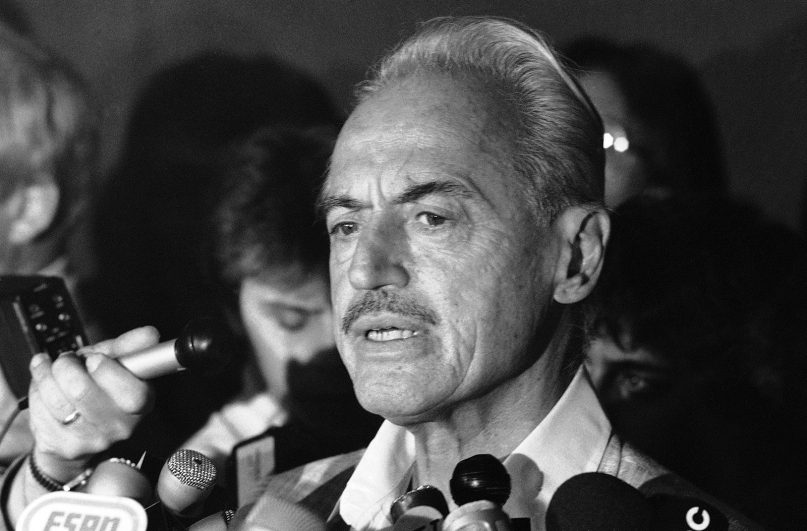
(RNS) — It was announced last month that Major League Baseball’s Hall of Fame Induction Ceremony, normally held in July, has been set for Wednesday, September 8, the second day of Rosh Hashana. To add insult to injury, one of the honorees is Jewish.
No, not Derek Jeter, who will also be inducted, but Marvin Miller, the legendary leader of the Major League Baseball Players Association, a modern-day Moses who released ballplayers from the shackles of bondage by fighting to overturn the dreaded reserve clause. Miller, who died in 2012, will become just the fifth Jewish member of the Hall.
On Rosh Hashana.
There are two scandals here: One, that baseball had plenty of dates from which to choose but opted for one of the three most consecrated days of the Jewish year for this sacred enshrinement. And two, that almost no one seems to think it’s a scandal, including most American Jews, whose silence on this matter has been deafening.
For generations, American Jews have been weaned on the stories of Sandy Koufax missing a World Series game in 1965 because it coincided with Yom Kippur. That gesture, more than the lefty’s four no-hitters, three Cy Young Awards, 2,396 strikeouts and multiple World Series heroics (including a Game Seven win that same year), cemented his spot in the American Jewish sports pantheon.
Koufax stands above those whose athletic feats were comparable, but whose dedication to Jewish principle and peoplehood may have been less exemplary. Olympic gymnast Kerri Strug’s mother said her daughter did not become bat mitzvah because “she was too busy.” Mark Spitz shortchanged his Jewish education in favor of swimming practice because, as his father said, “Even God likes a winner.” By contrast, Koufax’s willingness to stand up proudly for his people and tradition remains unsurpassed.
In Koufax’s day, rescheduling a World Series game to avoid Yom Kippur was never considered. Back then, no Jew would have had the audacity to ask for such a delay. They felt fortunate just to have been allowed entrance into America’s pastime. Just leave your tzitzit (fringes) at the door.
And it’s not as if the date of Yom Kippur wasn’t known in 1965 — it was set thousands of years ago. It just never occurred to anyone at MLB that Jews had a right to see their holy day respected.
But we live in more pluralistic times, when respecting sacred observances of minorities has become a means of reinforcing inclusiveness toward formerly marginalized groups. Juneteenth is the latest example of that, along with observances during the month of Ramadan.
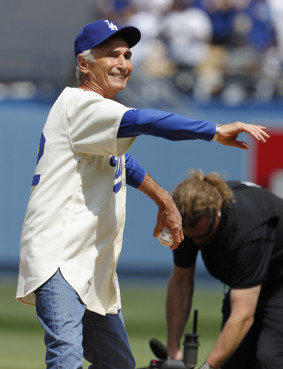
Former Dodger pitching legend Sandy Koufax throws out the first pitch during pre-game ceremonies before a game in Los Angeles, California, on April 1, 2013. Photo by Alex Gallardo/Reuters
And it’s not as if Rosh Hashana is a weak sibling to Yom Kippur. The 1959 World Series, which also included the Dodgers, coincided with Rosh Hashana, and because of that, Koufax did not pitch in Game 4 (he pitched a 1-0 shutout in Game 5). Also, in 1961 and 1963, Koufax skipped regular season starts that coincided with Rosh Hashana.
Regarding the Day of Atonement, Koufax told the UPI’s Milton Richman that “a man is entitled to his belief, and I believe I should not work on Yom Kippur. It’s as simple as all that, and I have never had any trouble on that account since I’ve been in baseball.”
An article on the Hall of Fame’s own website makes the case for respecting major religious holidays, reporting that the 1959 World Series was not the first time Koufax missed a game in favor of a Jewish holiday. On April 22 of that year, Koufax requested to skip a start scheduled for the first night of Passover.
Koufax was following in the footsteps of Hank Greenberg, another of the five Jewish inductees to the Hall of Fame. Greenberg played in the ’30s, when antisemitism was omnipresent — yet he had the courage never to play on Yom Kippur. In 1937, this may have prevented him from breaking Lou Gehrig’s RBI record. But he did play on Rosh Hashana during a heated pennant race in 1934, after much soul searching and some welcome support from his rabbi, who called Rosh Hashana a “festive holiday,” when playing would be acceptable. Greenberg hit two home runs, including a walk-off game winner. No doubt that rabbi’s lenient ruling was made with a wary eye trained on the Tigers’ unforgiving fan base, which included notorious antisemites like Henry Ford and Father Coughlin.
“I caught hell from my fellow parishioners,” Greenberg later said. “I caught hell from some rabbis.”
So what would Sandy Koufax do about this unforced error by Major League Baseball? What should Jews do? If we grant that a World Series game might not be easily moved from its natural October perch, the Hall of Fame ceremony, which typically is in July, most definitely could still be set for a day other than September 8, especially with someone Jewish being inducted, along with an all-time New York Yankee. I believe there are more than a few Jewish Yankee fans; don’t you think some of them might be perturbed by this?
Or maybe not. Which is my other concern.
Several weeks ago, a high school football coach in Ohio punished a Kosher-observant player by forcing him to eat pork. The coach and seven of his assistants were fired, but this story elicited a general ho-hum from the Jewish blogosphere. Granted, the player in question was a Hebrew Israelite and not technically a Jew, but pork is pork, humiliation is still humiliation, and this incident should have registered a big number on antisemitism’s Richter scale.
Hannah’s seven sons were martyred because they refused to eat pork, and that led to the Maccabean wars. The Spanish Inquisition used pork to “out” Jews. The Nazis force-fed Jews pork. It should bother us when people don’t respect our most core values and fundamental observances, like the Kosher laws … and Rosh Hashana.
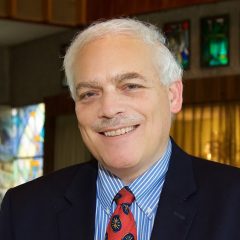
Rabbi Joshua Hammerman. Courtesy photo
But instead, people seem to be shrugging it off, saying, “Hall of Fame? No matter. Marvin Miller is dead, anyway. The football coach? No big deal on that either. And pass the pepperoni!”
(Rabbi Joshua Hammerman is the spiritual leader of Temple Beth El in Stamford, Connecticut, and the author of “Mensch-Marks: Life Lessons of a Human Rabbi” and “Embracing Auschwitz: Forging a Vibrant, Life-Affirming Judaism that Takes the Holocaust Seriously.” The views expressed in this commentary do not necessarily reflect those of Religion News Service.)
The Jews are history’s underdog. Similarly, the Red Sox are David to the Yankee Goliath. It’s the Red Sox and their fans whose long history of suffering, error, and perseverance in the conviction that redemption will come mirrors that of the Jewish people.
Why do we inflict this on ourselves?Why? I’ll tell you why, ’cause the Red Sox never let you down.Huh? I mean – why?Because they haven’t won a World Series in a century or so? So what? They’re here. Every April, they’re here. At 1:05 or at 7:05, there is a game. And if it gets rained out, guess what? They make it up to you. Does anyone else in your life do that? The Red Sox don’t get divorced. This is a real family. This is the family that’s here for you.
This is the city of Boston,The home of the bean and the codWhere Lonborg speaks only to Kennedy, TedAnd Yastrzemski is some kind of god
So a very close friend of mine, Yankee fan, called me yesterday and asked if I was preparing two Yizkor sermons for this morning, one for people and one for the Red Sox. I said no, I really don’t eulogize baseball teams. There are some things that are more important than even baseball, a thought that occurred to me quite a few times as I sat in the right field stands at Yankee Stadium on Thursday night.I’ve always felt that God truly doesn’t care about who wins the World Series – no Virginia, there really is no curse – at least for the Sox – the Cubs, that’s another story – God doesn’t care who wins the Series, but God cares that we care. For these bonds of passion are what anchors us through life’s tumult.My kids were not very happy yesterday – and I felt quite guilty for subjecting them to a lifetime of suffering, after all, they didn’t grow up in my ancestral neck of the woods – but their adopting my baseball team as theirs, much as in their adopting of my religious traditions, are what binds them in part to me. They are what binds father and mother to son and daughter.So it’s not really about the Sox and the Yanks. It’s about visiting the graves of our grandparents and saying to them, “You’ll never believe what Grady Little did this time.” It’s about the ongoing dialogue between the generations. It’s about my sitting in the sukkah and recalling my old synagogue back home, where we kids would stuff our tallis bags with the delicious marble cakes before running home to catch the first inning of the World Series. It’s all about love.And love is always good. Even when it is painful. Even when there is loss.
