Showing posts with label pluralism. Show all posts

Thursday, September 28, 2023

In This Moment: Israel's Culture War Explodes - Over Gender Segregated Prayer; All About Sukkot


In This Moment

Israel's Religious Culture War Explodes...on Yom Kippur!


Today's Jerusalem Post

Today's Ha'aretz (English)

Click here for more headlines


Headline of Yediot the day after Yom Kippur, speaking of Dizengoff incident:

"The Square of Strife!"


It's kind of stunning that when Israel's current internal tensions spilled over into a full fledged culture war, the match to ignite it was a staple of American Jewish life: mixed seating at prayer services. This issue combines many of the big ticket controversies that have embroiled Israeli society for years: sex-segregation in public places, the subjugation of women, and the encroachment of ultra orthodoxy into secular areas. It's one thing to have gender separation in public squares of B'nai Brak, or even parts of Jerusalem, but for it to happen in the heart of secular Tel Aviv feels like a deliberate provocation. As the Times of Israel reported before the incident:


On Friday before Yom Kippur, the Supreme Court rejected a petition to allow gender-segregated prayers in the square. The justices thus sided with the ruling of a lower court in favor of the Tel Aviv municipality, which forbade Rosh Yehudi from holding the event with a gender divider.


That ruling should have been the end of it, but it was barely the beginning. Israelis are not used to fighting over prayer spaces in public areas. It's not a major concern of theirs because each neighborhood follows its own customs. In Tel Aviv there is an enormous Friday night service with mixed seating at the port. There would not be a gender segregated service there, because Tel Aviv is the most progressive city in the country. In other places with larger Orthodox populations, services in public areas have gender separation. But to push this matter in Tel Aviv breaks what had been a long lasting status quo, an encroachment, with the intent of staking out new territory for Orthodoxy - to create a "fact on the ground." And the response to that was one of those "enough is enough" moments for the seculars. I do sympathize with that, having faced similar situations both there and here, but resorting to violence was not tactically smart. So the fact that fighting over a mehitzah (partition) became front page news in Israeli papers (and not just the English ones) was a big deal.


I concur with Yossi Klein Halevi, who wrote:


In past years, Tel Aviv on Yom Kippur was a model of tolerance. There was no secular outrage against a mechitza in the streets. What changed this year is the government’s war against liberal Israelis, who are fighting for the survival of their Israel, their ability to continue living in this country. This year a public mechitza in Tel Aviv was especially provocative, given the growing phenomenon of women being pushed to the back of the bus – metaphorically and sometimes literally – around the country. I wish the protesters had resisted the provocation of Rosh Yehudi, but I understand their desperation.


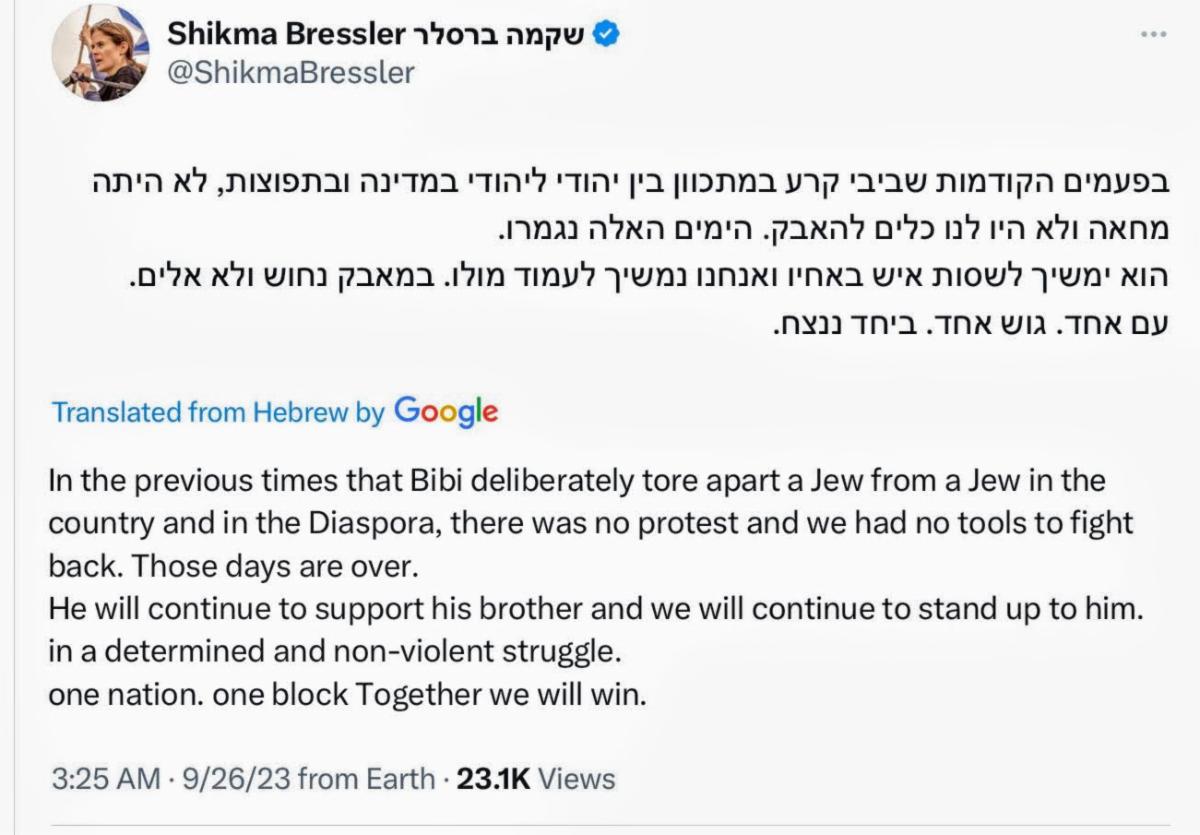
Read some of the reports below, and think about how unacceptable enforced separate seating has become in non-Orthodox settings here. What used to be tolerated as the "least common denominator" back in the days before women could be rabbis and count in the minyan, has now become, in the eyes of many, a moral outrage. It's just another example of the widening culture war among Jews. Right now, no one seems interested in bridging that gap. Prime Minister Netanyahu had an opportunity to be a statesman but instead tried to stoke the flames and tie this violence to the judicial reform protests, in order to divide and conquer, banking that some Israelis who resist judicial reform might also resist mixed seating and might be lured over to his side. Protest leader Shikma Bressler (whom I spoke about on Yom Kippur) had this response on X (see below; the Google translation isn't perfect - it's not "support his brother" but "pitting his brothers against one another").

I suspect this incident will recede as new stories involving the Supreme Court, the Saudis and instability along the borders fill the news cycle. I doubt the number of protesting marchers will be any smaller this Sat. night (remember, for Israelis, the second day of Sukkot is hol hamoed). But the line has drawn in the sand. Tel Aviv, for secular Israelis, is holy ground.


On Segregated Prayer: The TBE Experience


** Here are two incidents of where enforced gender separation disrupted the prayers of groups I was leading:


  • When I was in Israel with our New England “March of the Living” group in 2010, our mostly non-Orthodox group stayed in a nice Youth Hostel near the Biblical Zoo in Jerusalem. Our group arranged to have access to the hostel’s synagogue, a simple meeting room with an ark, for a private Kabbalat Shabbat service. No other group was in there at the time. The Orthodox members of our group decided to daven with a mechitza in another location in the building – it was an arrangement that worked well throughout our trip. About ten minutes into our egalitarian service, our group leader came up to me – as I was leading the service – and said that the hostel’s manager had told him that our service cannot continue unless we separate the boys from the girls. Now this was a group of seventy teens who were, for the most part, experiencing Israel for the first time. Just days before we had cried at Auschwitz and stood silently by the remnants of the Warsaw Ghetto. They were exhilarated to be in Israel and I was trying not to douse their enthusiasm by interjecting the sorry state of Israeli pluralism into their experience. So rather than tell this group that this state-run hostel was hostile to the way they pray, I looked for an escape hatch – literally. There was a door in the back of the room, leading to a large outdoor patio overlooking the city. The weather was perfect, and I had planned to take them outside for Lecha Dodi anyway, so I stalled for time until we got there (as my group leader stared at me nervously, I stared back defiantly), and then, as we reached Lecha Dodi, we danced out the door and onto the patio, where we danced and prayed for the remainder of the service.


  • For two thousand years men and women stood and prayed together at the Western Wall, right up front. Even after 1967, when a mechitza was installed, this practice continued farther back in the plaza. In 1987, I brought a group from my previous congregation to the Wall and we prayed, men and women together, about halfway back, nowhere near the segregated men's and women's areas, which we respected -- as we should. We even saw a Beth El group there, led by Hazzan Rabinowitz. It was just a few days before I was to come to Stamford. In 1994, my group from here was forced to end our Friday evening service abruptly by Haredim and police -- it was a shock to the children, and to me. Subsequent TBE groups, on Friday nights, prayed other locations entirely. If we had tried to gather at the Kotel, we wouldn't have had a prayer. But in 1994, we prayed in unison in Tel Aviv, right next to the beach. No one bothered us at all, though several onlookers stopped to see this curiosity of American Jews who prayed so differently from what they were used to seeing. And some stopped because they had no idea what we were doing.


In Stamford, there have been other issues that have made unified prayer difficult, and at times impossible. But we've also been able to work things out from time to time. See what I wrote about Shabbat Across Stamford in 2015. We just won't countenance what is demeaning to women anymore, even if some believe "separate but equal" is not.


Ha'aretz Editorial

All About Sukkot


Ushpizin - Welcoming Special Sukkot Guests

I'll be welcoming these heretics to our service on Sunday. We'll discuss whether or not they truly deserved their infamy and we'll decide who deserves to be our special guest heretic of the day. And who might be nominated from our day.

Yom Kippur Sermons


Video and text of my Yom Kippur sermons are now available online:


  • Kol Nidre: Counting to One - "Counting to One" - Seeing hope in Israel's moment of truth. Can unity emerge out of the attempted judicial coup and the unprecedented massive reaction to it? We cannot give up that hope. Nor can we afford to be late to the game. Our Israeli "achim" have taken to the streets. And they are waiting for us to join them. Teach us, O Adonai, to count to One.


  • Yom Kippur Day: The Keys - "The Keys" - In his final High Holidays message in Stamford, Rabbi Joshua Hammerman looks at what it means to be "all-in" in work and in life. Looking at key moments in his 37 years at Temple Beth El, he describes the existential dilemmas of his chosen profession, saying he would never recommend it to anyone, "but I wouldn’t trade these 40 years in the rabbinate for anything. It has made me a much better person than I ever would have been."


Temple Beth El
350 Roxbury Road
Stamford, Connecticut 06902
203-322-6901 | www.tbe.org
  
A Conservative, Inclusive, Spiritual Community

Friday, June 16, 2017

Shabbat-O-Gram for June 16


Shabbat shalom!
This Shabbat we celebrate with the family of Jason Busch, who becomes bar mitzvah.  Also, join us this evening as Meira Rosenberg, a longtime TBE member, will talk about her journey to authoring her new young adult novel, Indiana Bamboo.  Mazal tov to Jason and Meira (and you can read the d'var Torah of last week's bat mitzvah, Sarah Eisenstein, here).
This evening we'll also be featuring some fabulous new musicians, Vladimir Katz and Efrat Shapira. (See Efrat on YouTube).  

Looking ahead to next week, on Pride Shabbat, we will feature Brian Gelfand and the long anticipated return of world famous violinist Alicia Svigals.

As we celebrate Pride Month at next week's service TBE member Elise Feldman will share some personal reflections about her journey.  Many of us have come to know Elise well through her involvement in our choir, Hevre young families group and her leadership in any number of areas.  We are grateful to have her here!
On a related topic...
Hiddush, a watchdog for religious freedom and equality in Israel, just released a fascinating new survey stating that support for same-sex marriage/civil unions in Israel has reached a - record high of 79% of the Jewish Israeli public. This reflects a consistent increase in public support for the official establishment of state recognized same-sex partnerships in Israel, which stood at 76% in 2016 and in previous years ranged from 60-65%. These findings arose from a Hiddush-commissioned survey conducted by the Rafi Smith Polling Institute.  And as you can see below, this support runs pretty much across the political spectrum, except among the Ultra Orthodox.

 
That's the good news.  The rest of the story, as Hiddush reports, is not so good:
Israel not only denies same-sex couples the right to marry, against the clear public will, but also denies hundreds of thousands of heterosexual couples the right to family because it granted exclusive monopoly over Jewish marriages to the Orthodox Rabbinate. This political reality also forces more than a million and a half additional citizens to marry in ceremonies that do not befit their beliefs and lifestyles. The data prove that the establishment of legal marriage for same-sex couples and religious freedom in general have practically become the public consensus of the Israeli Jewish population. The public's will has never been translated into legislation because all successive Israeli Governments, from both the left and the right, have instead traded away the public's freedom of marriage and divorce to the Orthodox parties in exchange for their political support.
Israel remains the only Western democracy in the world, which severely restricts the freedom of marriage. In fact, nearly ten percent of the population cannot marry at all. 42 countries now allow for marriage or legal registration of same-sex couples. In other words, the gap between Israel and the rest of the enlightened world in the arena of LGBTQ rights is only increasing. 
The gap between the Israeli public and Israeli government on the issue of civil marriage and religious freedom is growing.  Last month Hiddush released a survey showing that well over half of Jewish Israelis would prefer that the Chief Rabbinate not have a monopoly on performing weddings.

 
And that, in my mind, is further good news, for although this unfair situation has been around since the beginnings of the state, the public push for change is eventually going to force that change to happen, as it did here in the US with interracial and gay marriage.  Marital freedom in Israel is something that American Jews need to see as our issue too, since questions of personal status speak to our legitimacy as Jews and the core values of the Judaism we espouse.  And the fact that Haredi Jews, who represent only ten percent of the population, can impose their will on everyone else, is very troubling and inherently undemocratic.
These issues should matter to those who really care about the future of Israel. That's why I've invited Rabbi Uri Regev, executive director of Hiddush, to speak here this coming fall.

A Trip of Many Lifetimes

Exactly two weeks from now, Mara and I will lead a group of 22 from our TBE family in TBE's first-ever Jewish Heritage Tour of Central Europe.
Some aspire to take the "trip of a lifetime," but the significance of this one will span hundreds of lifetimes, as we look back upon central events of Jewish history, bearing witness to some of our greatest triumphs along with undoubtedly the greatest tragedy the world has ever seen.  
Elie Wiesel believed that when we hear the story of a witness, we too become witnesses, and through us the story lives on; a living scroll ever unfolding.  "Because I remember, I despair," Wiesel said. "Because I remember, I have the duty to reject despair." 
As I remarked on Yom Kippur, Wiesel's death last year was the end of an era - he was our Survivor in Chief, representing all the witnesses.  He was our prophet, and the prophet's voice has now been silenced. But he charged us with the responsibility of being witnesses in his stead.  That is why this congregational trip is so important.  This is not merely a tour of places like Warsaw, Krakow, Budapest, Prague and Berlin - although we'll have lots of opportunity to enjoy these glorious cities.  Make no mistake, this is a pilgrimage, to places where Jewish civilization thrived for a thousand years, and to Auschwitz, where human civilization nearly died in a thousand days.
Auschwitz was the epicenter of it all.  It is a place where all civilized human beings must go, to remember, and pray, and to take upon ourselves the mantle of witness, to pick up the gauntlet from Wiesel.  It is not a burden, but an honor to respond to that sacred calling.
Ultimately, this "trip of many lifetimes"will direct our attention less to the past than to the future. 
The Jew has an obligation to remember, but then to shed the shell of victim, the confining shell of resentment and anger and despair, and to transform the disaster into an embrace of life and a relentless pursuit of justice and dignity for every human being.  For a Jew is responsible not merely to be a witness, but to dream, to imagine a better future, despite the darkness that surrounds us.  Shimon Peres, who also died last year, said we should use our imagination more than our memory.  "Optimists and pessimists die the exact same death," he said, "but they live very different lives!"
The message of this trip is this: To be a Jew is to live acutely, relentlessly and compassionately, and to be moving forward while always glancing over our shoulder...to be a witness to the past and a beacon toward the future.  To cling to life and purpose with all our might.   And all the while to be totally and unabashedly human.
This trip will hardly be a downer: Along the way our group will encounter some true heroes to inspire us - like Mordechai Anielevicz and Janusz Korczak in Warsaw, Rabbi Moshe Isserles and Oscar Schindler in Krakow, along with TBE's own Eric Strom, Hannah Senesh and Raoul Wallenberg in Budapest,  the Maharal of Prague and the beautiful children of Terezin - and then, in the supreme irony, we will go to Berlin, where the destruction began but where an incomprehensible Jewish renaissance is taking place, and where a new spirit of reconciliation is taking root.
Oh and we're going to have lots of fun. Still, as witnesses, we'll represent this community, and one of our missions will be to bring the rest of you along with us through what we send back to you in real time.  So in early July look out for photos, videos and words from me and the others, testimony that will go far beyond a few random Trip Advisor ratings, as we embark on this trip of many lifetimes.

So much of our purpose in taking this journey is embedded in Emil Fackenheim's idea of a 614th commandment (quoted below), never to forget the Holocaust and to prevent Hitler from gaining a posthumous victory.  We have many reasons to bear witness, ranging from the particularistic (preserving the Jewish people) to the universal (to prevent genocide from happening anywhere).  No doubt, though, that Auschwitz has become sacred ground - a holy place that every Jew - and every civilized person - should visit.


What does the Voice of Auschwitz command?
           
Jews are forbidden to hand Hitler posthumous victories. They are commanded to survive as Jews, lest the Jewish people perish. They are commanded to remember the victims of Auschwitz lest their memory perish. They are forbidden to despair of man and his world, and to escape into either cynicism or otherworldliness, lest they cooperate in delivering the world over to the forces of Auschwitz. Finally, they are forbidden to despair of the God of Israel, lest Judaism perish. A secularist Jew cannot make himself believe by a mere act of will, nor can he be commanded to do so....And a religious Jew who has stayed with his God may be forced into new, possibly revolutionary relationships with Him. One possibility, however, is wholly unthinkable. A Jew may not respond to Hitler's attempt to destroy Judaism by himself cooperating in its destruction. In ancient times, the unthinkable Jewish sin was idolatry. Today, it is to respond to Hitler by doing his work.
          For a Jew hearing the commanding Voice of Auschwitz the duty to remember and to tell the tale is not negotiable. It is holy. The religious Jew still possesses this word. The secularist Jew is commanded to restore it. A secular holiness, as it were, has forced itself into his vocabulary...
          Jews after Auschwitz represent all humanity when they affirm their Jewishness and deny the Nazi denial... The commanding Voice of Auschwitz singles Jews out; Jewish survival is a commandment which brooks no compromise. It was this Voice which was heard by the Jews of Israel in May and June 1967 when they refused to lie down and be slaughtered...
          For after Auschwitz, Jewish life is more sacred than Jewish death, were it even for the sanctification of the divine Name. The left-wing secularist Israeli journalist Amos Kenan writes: "After the death camps, we are left only one supreme value: existence."
  
Five Rabbinic Suggestions for Father's Day
 
 
My father, Cantor Michal Hammerman, on the right, 
with his two cantorial brothers, Saul and Herman, 1971

While Jewish mothers usually get all the attention, this is the weekend to celebrate Jewish fathers.
 
1) A child should not stand or sit in a place where his father is accustomed to standing or sitting (Kiddishin 31b).  Some call this the "Archie Bunker Law."
 
 2) A child should not support his father's opponents in a scholarly dispute. In other words, they forbade "Patrilinial Dissent." (Sorry for that groan-inducing pun)
 
 3) The rabbis praised Duma, a heathen who refused to awaken his father, although he needed a key lying under his father's pillow in order to conclude a transaction that would have netted him a profit of 600,000 gold coins. One can imagine how proud Dama's father was of his son when he woke up...
 
4) The rabbis state firmly that a child is obligated to attend to the material needs of his parents while they are alive and to mourn for them properly when they die.
 
 5) One more suggestion not mentioned in the Talmud: on Father's Day, let your dad sleep nice and late!
 
-          Also, read how Jewish fathers are the opposite of TV dads.
 
-          Check out this historical survey of Jewish fathers.
 
-          Two favorite articles I've written about fatherhood, following the births of my two sons: "Birth Rite" and "Fathers and Sons"
 
-          The Forward asked for Six Word Memoirs about Jewish fathers. Here are a few of them:
 
Actor, scrap man, embellisher of of stories.
- Ilene Stein, 64, Riverside, Calif., about Max M. Fields
 
He lives generously. That's my inheritance.
- Paula Chaiken, 42, Kingston, Pa., about Gene Chaiken
 
Dad's matzo balls? Hard. Heart? Soft.
- Cheryl Levine, 48, Yellow Springs, Ohio, about Barry Levine
 
Dad, homework done, healthy. Don't worry!
- Debbie Wasserman Schultz, 46, congresswoman, Weston, Fla., about Larry Wasserman
 
Always making puns, always causing groans.   (See "Patrilineal Dissent," above)
- Julie Grossman, 26, North Bethesda, Md., about Garry Grossman
 
Sense of humor, debt-free educations.
- Alexandra Schmidt, 44, Niskayuna, N.Y. about John Lutch
 
Eating ice cream in underwear. 5 a.m.
- Rich Cohen, 45, author of "Israel is Real," Ridgefield, Conn., about Herb Cohen
 
Zayde shined my shoes and heart.
- Donna Erbs, 52, Portland, Ore., about Max Joffee
 
Waiter, I ordered the kosher lobster.
- Shira Kaiserman, 28, New York, about Ronald Kaiserman
 
Clean linen handkerchiefs comfort me still.
- Roberta Rosenberg, 58, Clarksville, Md., about Harry Rosenberg
 
Brimming bookshelves - bent, leant and shmoozed.
- Wayne Firestone, 49, president of the Genesis Prize Foundation, Rockville, Md., about Bruce Firestone
 
Mel Brooks movie marathon: perfect Shabbos.
- Casey Stein, 25, New York, about Alan Stein
 
Dude dug prunes, melbas and mama.
- Henry Greenspan, 65, Ann Arbor, Mich., about Albert Lewis Greenspan
 
Theirs - writer, scholar, lecturer. Mine - Aba. 

Shabbat Shalom and Happy Father's Day!

Rabbi Joshua Hammerman

Friday, May 10, 2013

Shabbat-O-Gram for May 10: Moms, Movements, Moons, Mountains and Matriculation

Sanctuary picture
Shabbat-O-Gram

Mazal tov to our Sisterhood as tomorrow is our long-awaited, snow-delayed annual Sisterhood Shabbat.  A special mazal tov to Maureen Leffand, well-deserving recipient of this year's Rose Rosner Memorial Award for her stellar volunteer work.  We also wish mazal tov to our 7th grade class, who will be "moving up" at their Aliyah service this Tuesday night, the first night of Shavuot. Cantor Mordecai will also be leading a late night study session on prayer that night and on Wednesday, we'll have lots of kids and family programming, plus a dairy lunch, courtesy of Mia and Lonny Weinstein.  Thursday, the second day, will include lunch too, and Yizkor prayers plus the book of Ruth during the service.  

--------------------
Today is Rosh Hodesh Sivan, the new moon falling on this weekend of Mother's Day, as we approach Mount Sinai to receive the Torah once again next week on Shavuot, with many of our students stepping forward to graduate.  Can more drama can be poured into so few days? 

Some of these celebrations can be combined.  Many moms were at the Kotel this morning, where, unfortunately, the Women of the Wall's monthly Rosh Hodesh service was met with massive resistance from Haredim. Read this account and this as well.  As you can see, the police did their job - though there was still some violence - in attempting to protect the women, whose rights to pray in that spot with ritual garb were upheld by the Jerusalem courts in a landmark ruling a few weeks ago.


 today at the Kotel


On Tuesday night, we had an informative discussion here about pluralism, the Women of the Wall, and the Sharasnky plan, which is still taking shape, and now with a greater sense of urgency.  The plan calls for an egalitarian side of the Kotel to be constructed in the area of Robinson's Arch, of equal size to the current Kotel plaza (on the left), with one common entranceway and identical in all respects. 
  

All sides gave tentative approval to the plan, though the Women of the Wall still feel they have the right to wear tallit and read Torah in the traditional women's area.  The Robinson's Arch area would be for mixed davening (men and women together).  As you can see below, the view today is very different from that which our ancestors enjoyed in ancient times. The bottom diagram shows that today's Western Wall is only a small portion of a retaining wall that extended southward beyond Robinson's Arch (the bridge on the right) and northward well into what is now the Muslim Quarter.


 If you look at the photos below, you can see that historically, women and men prayed together at the Kotel. The top two are from the early 20th century, and men and women are praying together. It was never treated as a synagogue until after the Six Day War, and even then, if you see the bottom photo of my mother taken in the women's section in 1969 (Happy Mother's Day, Mom), there are some conspicuously male-looking creatures walking behind her. The separation of the sexes was not nearly as extreme as it is today.


Archeologists are very concerned that the Sharansky plan will run roughshod over priceless finds.  The area around Robinson's arch is filled with large stones that were thrown into the valley by Roman soldiers in 70 CE when the temple was destroyed.  They have remained in place ever since.  It's amazing to see and to pray there, as our groups have in recent years (see below).


Like the Western Wall, Israel itself must not become a synagogue.  A synagogue by definition has a single ideology and vision (even if that vision is itself inclusiveness, as it is here, it is still restrictive of contrasting visions).  Any synagogue has that.  A Jewish state cannot espouse one narrow religious philospohy.  It needs to be a state for all its inhabitants, including those Jews and non-Jews who do not subscribe to any particular Jewish religious ideology.  This is the first Israeli government constructed without Haredim in it.  Already there are signs of progress: Women's faces can now be seen on billboards in Jerusalem; school curricula are being changed to better integrate the ultra Orthodox.  And Sharansky has a plan.

As Shavuot approaches, let us hope that the Torah given to all the Jewish people can now be allowed to nurture each of us in our own way.  We were all at Sinai.  And now we are all at the Kotel.
   
Shabbat Shalom and Happy Shavuot!

Rabbi Joshua Hammerman

Tuesday, April 16, 2013

A Note from Natan Sharansky


Dear Friends,

As many of you have heard by now, in the last few days there have been some significant developments regarding the task that Prime Minister Netanyahu has asked me to undertake, specifically drafting recommendations for dealing with issues of access to the Western Wall. This is a good opportunity to thank the members of our Committee on the Unity of the Jewish People and especially its co-chairs Shoel Silver and Lori Klinghoffer, as well as Vera Golovensky and Yogev Karesenty for their invaluable assistance.

After spending a number of months researching and consulting with various stakeholders, Members of Knesset, representatives and leaders of various Jewish religious streams and organizations, we have established three guiding principles to create a suitable space for egalitarian prayer at the southern section of the Western Wall (Kotel).

These guiding principles are based on the notion of One Kotel for One People.  This requires a solution that respects the legitimate need for all Jews to be able to pray in accordance with their tradition. To this end, the proposed recommendations will focus on access, equality and unity.

The Western Wall was divided into two sections in 1968, not long after Israel liberated the Old City during the Six Day War. The northern section was designated for prayer and the southern section, adjacent to the Mugrabi Bridge, was set aside for archeological exploration. The excavations at the southern half of the Kotel have been completed. It is time that we transform the Kotel into a site dedicated to prayer as well a meaningful cultural and national symbol.

The southern end would then remain open for prayer 24 hours a day, seven days a week. A plaza would be constructed so it is equal in size and height as the northern prayer area. This will allow all people to touch the Kotel. Finally, there should be a single entrance to the entire Kotel plaza. All comers will then be able to choose the area where they will pray.

We have an historic opportunity to make the Kotel a symbol of Jewish unity and diversity instead of a place of contention and strife. I will continue to update you as things develop.

B’Shalom Uvracha,

Natan Sharansky

P.S. I am attaching links to the various stories that have been written on the issue during the last 24 hours.

http://www.nytimes.com/2013/04/10/world/middleeast/plan-to-resolve-western-wall-prayer-controversy.html?_r=0
http://www.thejewishweek.com/news/breaking-news/sharansky-recommend-equal-prayer-kotel
http://forward.com/articles/174503/sharansky-to-propose-egalitarian-section-at-the-ko/
http://www.jta.org/news/article/2013/04/09/3123886/sharansky-presents-plan-to-create-egalitarian-prayer-site-at-western-wall
http://www.jpost.com/Jewish-World/Jewish-News/Sharansky-proposes-egalitarian-section-at-Kotel-309285
http://www.jta.org/news/article/2013/04/10/3123886/sharansky-presents-plan-to-create-egalitarian-prayer-site-at-western-wall
http://www.ynetnews.com/articles/0,7340,L-4366197,00.html
http://www.chicagotribune.com/news/sns-rt-us-israel-judaism-wallbre939087-20130410,0,5028930.story
http://www.israelnationalnews.com/News/News.aspx/166970
http://www.washingtonpost.com/world/middle_east/rabbi-of-western-wall-backs-liberal-prayer-section-proposal-would-end-orthodox-monopoly/2013/04/10/516b2fb4-a1ca-11e2-bd52-614156372695_story.html
http://www.thejewishweek.com/editorial-opinion/editorial/historic-kotel-proposal-dont-divide-increase
http://forward.com/articles/174588/kotel-egalitarian-prayer-plan-set-in-motion-by-dra/
http://www.jpost.com/Opinion/Op-EdContributors/Article.aspx?id=309279
http://www.jpost.com/Headlines/Article.aspx?id=309354
http://www.timesofisrael.com/sharanskys-new-western-wall-prayer-area-could-take-years-to-implement/
http://www.salon.com/2013/04/09/is_a_more_egalitarian_western_wall_coming_soon/
http://www.jewishpress.com/news/breaking-news/western-wall-rabbi-can-live-with-non-orthodox-kotel-site/2013/04/10/?src=ataglance
http://www.njjewishnews.com/article/16949/compromise-at-the-wall#.UWWE9cr7BNE
http://www.onislam.net/english/news/middle-east/462182-israel-to-liberalize-al-aqsa-wailing-wall.html
http://www.thejc.com/news/israel-news/105152/sharansky-suggest-egalitarian%E2%80%99-section-western-wall
http://forward.com/articles/174538/women-of-the-walls-anat-hoffman-supports-plan-for/
http://www.tabletmag.com/scroll/128919/an-egalitarian-section-at-the-western-wall
http://www.timesofisrael.com/women-of-the-wall-supports-egalitarian-prayer-plaza/
http://www.timesofisrael.com/sharansky-reportedly-to-propose-new-egalitarian-section-at-western-wall/
http://www.jewishpress.com/news/sharansky-to-suggest-womens-kotel-prayers-away-from-main-plaza/2013/04/09/?src=ataglance
http://ejewishphilanthropy.com/utilizing-smoke-and-mirrors-sharansky-relegates-women-to-back-of-the-bus/