Showing posts with label space. Show all posts

Friday, August 12, 2022

A Moonshot for Planet Earth (Times of Israel)


A Moonshot for Planet Earth

The most consequential climate change legislation ever, designed to reduce carbon emissions by forty percent and solidify America’s position as the world leader in the fight to save our planet, is being called the “Inflation Reduction Act.”

Come again?

We should be shouting from the rooftops the pending enactment of the “One Earth Act,” or the “Planet Fitness Act,” or even the “Al-Gore-Was-Right-All-Along Act.”  But no. Reducing inflation is important, no doubt, as are the bill’s other features. But an earth-shaking $370 billion for climate change shouldn’t be slipped through the back door.

So here we go. This week’s liftoff was horizontal, not vertical, and the focus must turn now from outer space to inner space, from the planets and stars to the overflowing rivers and parched forests. But there is much that the prior moonshot can teach the current one.

Ron Howard’s new film, “13 Lives,” brings us back to the tense early summer of 2018, when an international team of experts and volunteers joined forces to rescue a boys’ soccer team stranded in a flooded cave in Chiang Rai province, in northern Thailand.

As I watched the film, I couldn’t help but note the similarities to one of Howard’s prior films, “Apollo 13,” where, using teamwork, ingenuity and outside-the-box thinking, another skilled team was able to bring home three astronauts from an equally dire predicament. In one case, adults were rescued from an infinite void, with no atmosphere, no climate, and no possibility of sustaining life. In the other, the rescued children were imperiled by a supercharged atmosphere driven by a changing climate.

The boys were trapped as the Chiang Rai cave was flooded very early in what turned out to be a particularly extreme monsoon season throughout eastern Asia that year. The rescue of the thirteen was cause for celebration, but it was a Pyrrhic victory when we consider the deaths of so many climate change victims before and since, including those who died these past few weeks in rain-drenched Kentucky, fire-torched California and sunbaked Europe.

There is a sense that the Earth itself is angry at our hubris and is sending us one final, ferocious warning before it all goes up in flames. In Howard’s new film, the wrathful rains are personified by the mythical princess Jao Mae Nang Non, also known as the “reclining goddess,” whose image looms over the mountain and cave (that both share her name) where the boys were trapped. Legend has it that her ill-fated love met a tragic demise in that spot. Villagers make offerings to appeal to her for mercy, while the rains fall like tears from her grieving eyes. She is a constant, visible reminder that we have made a mess of our relationship with nature, and now we are paying the price. 

Recalling last year’s metaphoric climate change film, “Don’t Look Up,” the message of “Thirteen Lives” is that we need to look down, into the darkest fissures of the earth, the caves and sinkholes, the submerged rice paddies and gushing tributaries.  Look down into the eyes of the princess– and look around – and follow the advice of the Psalm 115:16, “The heavens belong to the Lord, but the earth God gave over to us.” We need to fix what’s in our backyard and not to be distracted by the shinier objects above.

Both of Howard’s rescue films have the number thirteen in the title, which points to another shared lesson, that both the celestial and earthbound moonshots are profoundly spiritual missions, boosted by a fusion of humility and hope. “Who knows thirteen?” – Jews sing at the conclusion of the Passover seder. “Thirteen are the attributes of God,” referring to the thirteen qualities of mercy through which God governs the cosmos. Through these attributes, we can sense God’s presence and the unity of all creation.

This summer, the James Webb telescope enabled us to see galaxies being born and dying and light that was generated at the dawn of time, just after the Big Bang, thirteen (yes, thirteen) billion years ago. In the Israeli media, the Hebrew word used for this Webb’s eye view of the universe was Ein Sof, which in the secular context means “infinity,” but it is also well-known kabbalistic name for God’s most mysterious and unknowable essence. When we gaze back through those thirteen billion years, and slip the surly bonds of time and space, we approach the Face of God. The closer we come to seeing the Beginning – and touching God – the more we recognize that we are not God, and the smaller we feel.

That stunning vision from the heavens should fortify us with humility for the struggle that awaits; for back here on earth, the reclining goddess is growing impatient. In the Talmud, thirteen is also the age of responsibility. And what greater responsibility do we have than to take those God-like qualities of mercy and apply them to sustaining life here on our home planet? For while we look up and our Webb-enhanced view gets clearer and sharper, we look down and our view of what lies beneath us becomes muddier and murkier. And as more sinkholes start to appear, the ground gives way and the waters rush in. The princess is begging us to act.

“Chiang Rai,” the princess of the cave cries, “we have a problem!”

We need to summon the same dogged determination of Apollo 13 astronaut Jim Lovell and flight director Gene Kranz, as we grapple with humankind’s most intractable predicament. “From now on, we live in a world where man has walked on the moon,” said Lovell. “And it’s not a miracle, we just decided to go.”

And from now on, this generation’s moonshot will be to protect our own little livable orb. We can gaze up there, but only in as much as it inspires us to change things down here. For we have no choice.

Kranz put it best as he wrestled with the unmanageable challenge of bringing the boys home:

“Failure is not an option.”

Now the work can begin, at long last, thanks to the “Inconvenient Truth Act” of 2022.

Friday, February 5, 2021

In this Moment: Super Bowl and Jewish Pirates; Jewish Exceptionalism and the Space Laser

In ThisMomnt
 In This Moment
Shabbat-O-Gram, February 5, 2021

On Friday night we lifted our TBE Kiddush cups to celebrate the life of Gene Wendell, who engraved them for every Bar/Bat Mitzvah for the past 67 years before his recent death. 


Shabbat Shalom

And happy World Interfaith Harmony Week.  I hope to see everyone at Temple Rock on Saturday night.  It promises to be a super evening, and it will be nice to welcome back an old friend, musician Assaf Gleizner, who will be providing part of the entertainment.  A special thank you to the entire committee and all our volunteers, as well as to everyone who has participated philanthropically in making this event so successful.  And this year, for the first time, we don't have worry about the risks of scheduling a major event in the dead of winter. (I suppose I shouldn't have just said that).

Stuff to watch, hear or read...

Join us also for services on Friday evening and Shabbat morning for services.  Shabbat morning will be another Shabbat-in-the-Round, filled with more music meditation and conversation. Our Torah portion this week is Yitro, featuring the Ten Commandments.  Click here to see a comparison of the Ten Commandments to other world religions.  And click here to see a packet on the tenth commandment, the impossible one, the only one that prohibits an emotion, the one about coveting.

On Sunday morning at 10, our Men's Club will once again sponsor the World Wide Wrap with our B'nai Mitzvah families and anyone else who is interested in learning about the mitzvot of tallit and tefilin. Also on Sunday, an Escher exhibit is opening this weekend at the Columbia Art Museum in South Carolina and they have asked TBE member and noted Escher scholar Jeffrey Price to do a webcast at 3 PM to celebrate the show.  Access it here. It will only be available for live viewing.

Last night, I had the pleasure of moderating an important conversation on climate for the Hartford Seminary and Interfaith Eco-Justice Network, with two excellent panelists.  You can watch it here.  One of the panelists, Dr. Katharine Hayhoe, stressed the importance of speaking out on this topic as much as possible. Here's a list of some of the things religious institutions can do to fight Climate Change (many of which we are already doing).


Super Bowl 55

No prediction this year, but since the Buccaneers are so rarely in the Big Game, their appearance gives me the chance to note that there are some famous Jewish pirates (aside from Richie Hebner, who played baseball for Pittsburgh).  Take this guy, Samuel Pallanche, known as the Pirate Rabbi, who avenged the Inquisition on the high seas, attacking Spanish ships.   As an observant Jew, he made sure that his crew donated a tenth of their loot to charity (a Jewish custom known as ma'aser), and even kept kosher aboard his ship. As for theThou Shalt Not Steal part, well, the Spanish had done quite a bit of plundering of Jews as they were kicking them out, so the Pirate Rabbi was just reclaiming what was theirs. There were Jewish pirates of the Caribbean too, from this same era.  One might say that they were pre-avenging the genocide that would take place when the Spanish explorer named Columbus massacred the natives - including, one must add, their Chiefs.  

In Hebrew a pirate is a Shoded - which is interestingly also a word for filibuster.  perhaps that implies a slow moving game or that a team needs to score 60 points to win. Both teams can score, but if anyone's hitting 60, it's Kansas City.

There are lots of words for "chief" in Jewish sources, all of them more politically correct than the Kansas City team's name.  The most common are "Rosh" (head) and "Sar," (chief officer).

Incidentally, both teams have Jewish linemen, but neither will play due to injury. 

But who cares about the Super Bowl when there's always the Puppy Bowl!  Casey and Cassidy Hammerman got a head start this past week...


It's a fumble! 


Fear itself...

I don't know about you, but this week I'm in awe of the courage of Aleksei Navalny. Read the text of his courtroom speech and excerpts from his note from jail.  He said: "This is how it works: Imprison one person to frighten millions." And then those millions become prisoners too - prisoners of their own fear.  The Hebrew word "Yireh" means both "fear" and "to see." Once our eyes are opened to the consequences of our fear, we are able to overcome it.  For Russians today, just as for Israel during the Exodus, the consequence of paralysis was, and is, imprisonment.  In America, the consequences of fear are equally perilous.

Looking for an uplifting read? Read this story about a Jew who left his inheritance to a French town that protected him during the Holocaust. (Thank you to Donna Wolff for sharing).  And check out this Holocaust Denial Report Card put out last week by the ADL, measuring how social media platforms respond to the hatred that continues to proliferate online.  I'm happy to say that the streaming platform Twitch is at the head of the class - happy because that's where my son Ethan works, which gives me an opportunity to wish him a happy 30th (yes, 30th!) birthday on Sunday.  

Facebook - you've got some work to do!

Here's the thing.  Hate doesn't just happen; it's allowed to happen. And when it does happen, rapid response is essential.  Twitch is both strategically proactive and effectively reactive.  Facebook is neither.  

Of course, Holocaust denial is not the only crazy conspiracy out there that targets Jews.  Now we've got...


Jewish Exceptionalism and the Space Laser

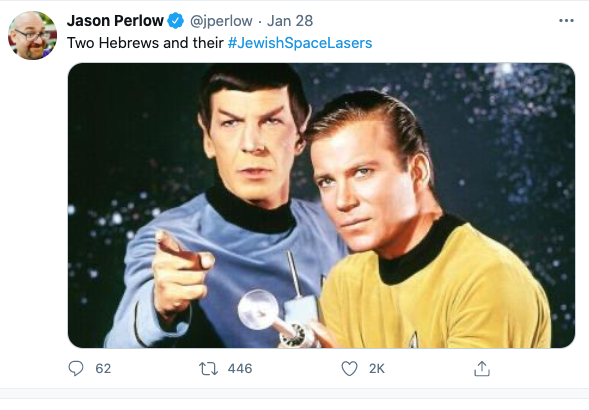
Jews are good.  One might even say we're exceptional.  How good are we? According to some conspiracy theorists, at least one of whom serves in the U.S. Congress, good enough to build a space laser capable of igniting forest fires in California. 

How good are we? We can act, write and direct movies with the best of them! (Win that Golden Globe, Shira Haas of "UnOrthodox!) 

And we can govern. Last week's Big Kvell was that President Biden's cabinet boasted a "minyan of Jews." 

How good are we?  We can do wonders to fight diseases. Israelis lead the world in Covid vaccinations per capita. 

All that, plus we've got one-fifth of all Nobel laureates (you can see the whole list here).

So we've got a lot to be proud of, Jewishly speaking.

But then I heard Donniel Hartman, a renowned Jewish thinker, say that what makes Jews exceptional has nothing to do with either accomplishments or acumen.

He states:

With Abraham and Sarah, we are not merely encumbered by a family connection. We begin to be encumbered to a particular story, and past. Over the next fifty chapters in the Bible, we are taught and told our story. It is neither a beautiful story, nor one which is morally uplifting. There is no attempt to beautify the troubling stories. By leaving it untouched our tradition is teaching an essential lesson of Jewish encumberedness. The beauty of the story lies simply in the fact that it is ours.   

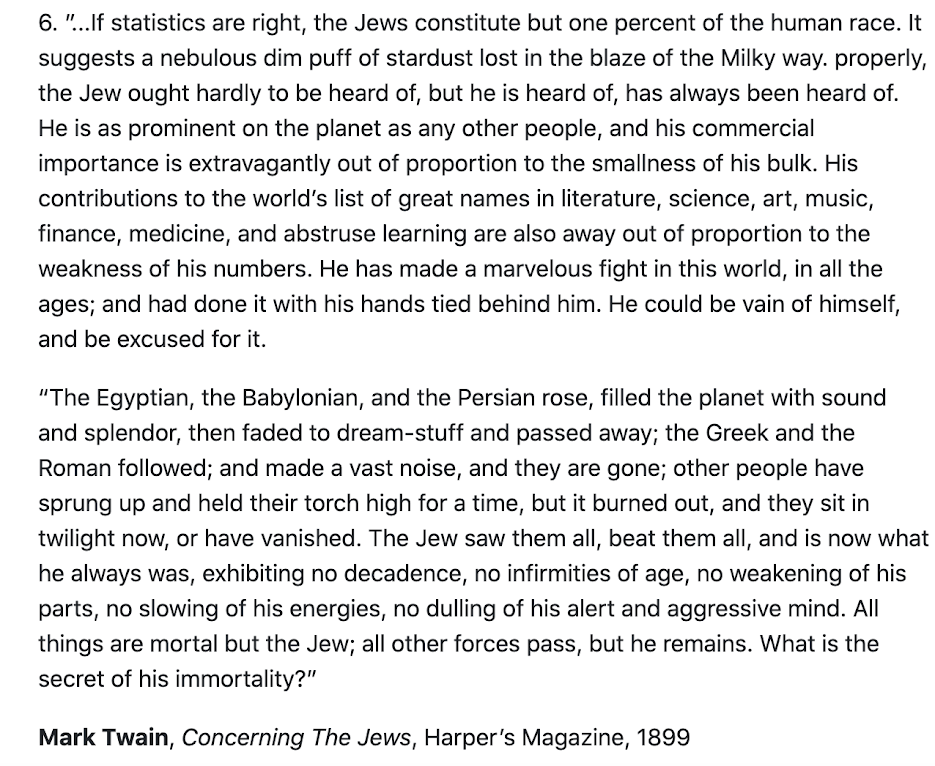
I discussed this surprising point at this week's class on Jewish peoplehood (see the video), "Together and Apart," and I contrasted it with some of the nice things said about us by some pretty famous people.  Just pick one or two of the quotes below.  No need to get a swelled head.


So what is it?  Is the Bible the Greatest Story Ever Told, the Best Book Ever for the Best People Ever, or is it all just hype?  Is the myth of Jewish exceptionalism in fact just more fodder for anti-Semites who fear our diabolical superpowers, when in fact we are just unassuming bunch of ex-slaves trying to do our humble best to make the world a little better?

This is no small matter at a time when the conspiracy theorists are winning the day, seizing every news cycle even as we discredit and mock them.  

My personal favorite parody response to this Q-Anon garbage came from the New Yorker:

And there's this, for Trekkies:


But we can take little comfort in how absurd these anti-Semitic claims are.  It seems that people will believe just about anything as long as it is repeated enough times. 

To quote Hannah Arendt:

"If everybody always lies to you, the consequence is not that you believe the lies, but rather that nobody believes anything any longer... And a people that no longer can believe anything cannot make up its mind. It is deprived not only of its capacity to act but also of its capacity to think and to judge. And with such a people you can then do what you please."

That's precisely the autocrat's playbook. I don't know if there is a sucker born every minute, but suckers can be mass produced with every tweet.  And that is why anti-Semitism has spread like - um - wildfire, at a time when anyone with a brain should know that Jewish financiers don't aim lasers at California forests.

So maybe we shouldn't be so dependent on Jewish exceptionalism in order to boost our self image.  Maybe it's time to stop patting ourselves on the back and understand that Jewish connection can be fostered in more authentic (and less obnoxious) ways.

When we open the Passover Haggadah, the story always begins in degradation with the darkness of slavery and the bread of affliction, and while the ending is happier, there is no "happily ever after." The Seder never brings us to the Promised Land. Jerusalem is there, on the horizon, but for "next year."  What's more, there is no Odysseus or Hercules to shepherd us over the finish line, all we've got is a little goat that daddy bought, and he stirs up a dystopian cataclysm.  Moses's role is downplayed in the Passover story.  Jewish heroism is consistently modulated in our texts, while human failings and moral complexities are emphasized.  Even stories that downplay God's role, like the Book of Esther, still feature flawed heroes. For all their courage, Esther and Mordechai come off looking like a couple of Bridgertons amidst the palace hijinks.

David, arguably our greatest hero, is also one of history's most tragic figures and callous sinners.  

We have no  super powers; we are in fact models of frailty.  But if we are are superhuman in any respect, it is that we are super at being human, or at least at trying to be. We elevate the experience of human resilience to an art form.

But despite our frailties, or perhaps because of them, our stories are still special to us and they would be even if we didn't find moral sustenance in their content; just as our more personal family tales are special to us not because our parents and grandparents were the most moral people ever, but simply because they are ours.  We are connected to our ancestors and the stories they've left behind.  We are, in Hartman's words, (based on the ideas of Michael Sandel) encumbered by them.

We gain strength from that grounding, the rootedness that gives us the confidence to reach out beyond our boundaries to help others.  That encumberedness is buttressed by the responsibilities of covenant, a covenant that was sealed at Sinai (the subject of this week's Torah portion of Yitro).

So let's not get caught up in all the banter of our supposed greatness.  We can take pride in Shira Haas because she is mishpocha.  Nothing wrong with that. But not because she is an example of some innate acting talent that Jews have cultivated.  That claim is a conspiracy theory waiting to happen: "Those shape-shifting Jews."

If our goal is to be exceptional, it is to be exceptionally human, always striving to become better.  Nothing more.  Nothing less.


Shabbat Shalom!
 

Rabbi Joshua Hammerman