
and our Cantor's Concert photo album
Shabbat shalom!
This Shabbat we celebrate with the family of Jason Busch, who becomes bar mitzvah. Also, join us this evening as Meira Rosenberg, a longtime TBE member, will talk about her journey to authoring her new young adult novel, Indiana Bamboo. Mazal tov to Jason and Meira (and you can read the d'var Torah of last week's bat mitzvah, Sarah Eisenstein, here).
This evening we'll also be featuring some fabulous new musicians, Vladimir Katz and Efrat Shapira. (See Efrat on YouTube).
Looking ahead to next week, on Pride Shabbat, we will feature Brian Gelfand and the long anticipated return of world famous violinist Alicia Svigals.
As we celebrate Pride Month at next week's service TBE member Elise Feldman will share some personal reflections about her journey. Many of us have come to know Elise well through her involvement in our choir, Hevre young families group and her leadership in any number of areas. We are grateful to have her here!
On a related topic...

Hiddush, a watchdog for religious freedom and equality in Israel, just released a fascinating new survey stating that support for same-sex marriage/civil unions in Israel has reached a - record high of 79% of the Jewish Israeli public. This reflects a consistent increase in public support for the official establishment of state recognized same-sex partnerships in Israel, which stood at 76% in 2016 and in previous years ranged from 60-65%. These findings arose from a Hiddush-commissioned survey conducted by the Rafi Smith Polling Institute. And as you can see below, this support runs pretty much across the political spectrum, except among the Ultra Orthodox.

That's the good news. The rest of the story, as Hiddush reports, is not so good:
Israel not only denies same-sex couples the right to marry, against the clear public will, but also denies hundreds of thousands of heterosexual couples the right to family because it granted exclusive monopoly over Jewish marriages to the Orthodox Rabbinate. This political reality also forces more than a million and a half additional citizens to marry in ceremonies that do not befit their beliefs and lifestyles. The data prove that the establishment of legal marriage for same-sex couples and religious freedom in general have practically become the public consensus of the Israeli Jewish population. The public's will has never been translated into legislation because all successive Israeli Governments, from both the left and the right, have instead traded away the public's freedom of marriage and divorce to the Orthodox parties in exchange for their political support.
Israel remains the only Western democracy in the world, which severely restricts the freedom of marriage. In fact, nearly ten percent of the population cannot marry at all. 42 countries now allow for marriage or legal registration of same-sex couples. In other words, the gap between Israel and the rest of the enlightened world in the arena of LGBTQ rights is only increasing.
The gap between the Israeli public and Israeli government on the issue of civil marriage and religious freedom is growing. Last month Hiddush released a survey showing that well over half of Jewish Israelis would prefer that the Chief Rabbinate not have a monopoly on performing weddings.

And that, in my mind, is further good news, for although this unfair situation has been around since the beginnings of the state, the public push for change is eventually going to force that change to happen, as it did here in the US with interracial and gay marriage. Marital freedom in Israel is something that American Jews need to see as our issue too, since questions of personal status speak to our legitimacy as Jews and the core values of the Judaism we espouse. And the fact that Haredi Jews, who represent only ten percent of the population, can impose their will on everyone else, is very troubling and inherently undemocratic.
These issues should matter to those who really care about the future of Israel. That's why I've invited Rabbi Uri Regev, executive director of Hiddush, to speak here this coming fall.
A Trip of Many Lifetimes
Exactly two weeks from now, Mara and I will lead a group of 22 from our TBE family in TBE's first-ever Jewish Heritage Tour of Central Europe.
Some aspire to take the "trip of a lifetime," but the significance of this one will span hundreds of lifetimes, as we look back upon central events of Jewish history, bearing witness to some of our greatest triumphs along with undoubtedly the greatest tragedy the world has ever seen.
Elie Wiesel believed that when we hear the story of a witness, we too become witnesses, and through us the story lives on; a living scroll ever unfolding. "Because I remember, I despair," Wiesel said. "Because I remember, I have the duty to reject despair."
As I remarked on Yom Kippur, Wiesel's death last year was the end of an era - he was our Survivor in Chief, representing all the witnesses. He was our prophet, and the prophet's voice has now been silenced. But he charged us with the responsibility of being witnesses in his stead. That is why this congregational trip is so important. This is not merely a tour of places like Warsaw, Krakow, Budapest, Prague and Berlin - although we'll have lots of opportunity to enjoy these glorious cities. Make no mistake, this is a pilgrimage, to places where Jewish civilization thrived for a thousand years, and to Auschwitz, where human civilization nearly died in a thousand days.
Auschwitz was the epicenter of it all. It is a place where all civilized human beings must go, to remember, and pray, and to take upon ourselves the mantle of witness, to pick up the gauntlet from Wiesel. It is not a burden, but an honor to respond to that sacred calling.
Ultimately, this "trip of many lifetimes"will direct our attention less to the past than to the future.
The Jew has an obligation to remember, but then to shed the shell of victim, the confining shell of resentment and anger and despair, and to transform the disaster into an embrace of life and a relentless pursuit of justice and dignity for every human being. For a Jew is responsible not merely to be a witness, but to dream, to imagine a better future, despite the darkness that surrounds us. Shimon Peres, who also died last year, said we should use our imagination more than our memory. "Optimists and pessimists die the exact same death," he said, "but they live very different lives!"
The message of this trip is this: To be a Jew is to live acutely, relentlessly and compassionately, and to be moving forward while always glancing over our shoulder...to be a witness to the past and a beacon toward the future. To cling to life and purpose with all our might. And all the while to be totally and unabashedly human.
This trip will hardly be a downer: Along the way our group will encounter some true heroes to inspire us - like Mordechai Anielevicz and Janusz Korczak in Warsaw, Rabbi Moshe Isserles and Oscar Schindler in Krakow, along with TBE's own Eric Strom, Hannah Senesh and Raoul Wallenberg in Budapest, the Maharal of Prague and the beautiful children of Terezin - and then, in the supreme irony, we will go to Berlin, where the destruction began but where an incomprehensible Jewish renaissance is taking place, and where a new spirit of reconciliation is taking root.
Oh and we're going to have lots of fun. Still, as witnesses, we'll represent this community, and one of our missions will be to bring the rest of you along with us through what we send back to you in real time. So in early July look out for photos, videos and words from me and the others, testimony that will go far beyond a few random Trip Advisor ratings, as we embark on this trip of many lifetimes.
So much of our purpose in taking this journey is embedded in Emil Fackenheim's idea of a 614th commandment (quoted below), never to forget the Holocaust and to prevent Hitler from gaining a posthumous victory. We have many reasons to bear witness, ranging from the particularistic (preserving the Jewish people) to the universal (to prevent genocide from happening anywhere). No doubt, though, that Auschwitz has become sacred ground - a holy place that every Jew - and every civilized person - should visit.
What does the Voice of Auschwitz command?
Jews are forbidden to hand Hitler posthumous victories. They are commanded to survive as Jews, lest the Jewish people perish. They are commanded to remember the victims of Auschwitz lest their memory perish. They are forbidden to despair of man and his world, and to escape into either cynicism or otherworldliness, lest they cooperate in delivering the world over to the forces of Auschwitz. Finally, they are forbidden to despair of the God of Israel, lest Judaism perish. A secularist Jew cannot make himself believe by a mere act of will, nor can he be commanded to do so....And a religious Jew who has stayed with his God may be forced into new, possibly revolutionary relationships with Him. One possibility, however, is wholly unthinkable. A Jew may not respond to Hitler's attempt to destroy Judaism by himself cooperating in its destruction. In ancient times, the unthinkable Jewish sin was idolatry. Today, it is to respond to Hitler by doing his work.
For a Jew hearing the commanding Voice of Auschwitz the duty to remember and to tell the tale is not negotiable. It is holy. The religious Jew still possesses this word. The secularist Jew is commanded to restore it. A secular holiness, as it were, has forced itself into his vocabulary...
Jews after Auschwitz represent all humanity when they affirm their Jewishness and deny the Nazi denial... The commanding Voice of Auschwitz singles Jews out; Jewish survival is a commandment which brooks no compromise. It was this Voice which was heard by the Jews of Israel in May and June 1967 when they refused to lie down and be slaughtered...
For after Auschwitz, Jewish life is more sacred than Jewish death, were it even for the sanctification of the divine Name. The left-wing secularist Israeli journalist Amos Kenan writes: "After the death camps, we are left only one supreme value: existence."
Five Rabbinic Suggestions for Father's Day
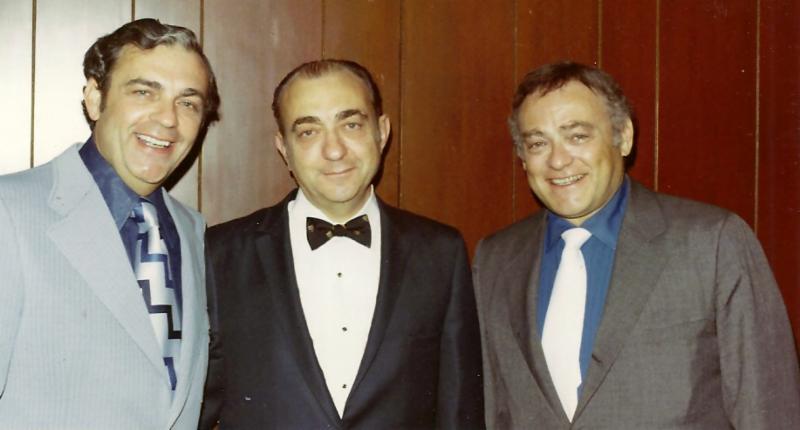
My father, Cantor Michal Hammerman, on the right,
with his two cantorial brothers, Saul and Herman, 1971
While Jewish mothers usually get all the attention, this is the weekend to celebrate Jewish fathers.
1) A child should not stand or sit in a place where his father is accustomed to standing or sitting (Kiddishin 31b). Some call this the "Archie Bunker Law."
2) A child should not support his father's opponents in a scholarly dispute. In other words, they forbade "Patrilinial Dissent." (Sorry for that groan-inducing pun)
3) The rabbis praised Duma, a heathen who refused to awaken his father, although he needed a key lying under his father's pillow in order to conclude a transaction that would have netted him a profit of 600,000 gold coins. One can imagine how proud Dama's father was of his son when he woke up...
4) The rabbis state firmly that a child is obligated to attend to the material needs of his parents while they are alive and to mourn for them properly when they die.
5) One more suggestion not mentioned in the Talmud: on Father's Day, let your dad sleep nice and late!
- Also, read how Jewish fathers are the opposite of TV dads.
- Check out this historical survey of Jewish fathers.
- Two favorite articles I've written about fatherhood, following the births of my two sons: "Birth Rite" and "Fathers and Sons"
- The Forward asked for Six Word Memoirs about Jewish fathers. Here are a few of them:
Actor, scrap man, embellisher of of stories.
- Ilene Stein, 64, Riverside, Calif., about Max M. Fields
- Ilene Stein, 64, Riverside, Calif., about Max M. Fields
He lives generously. That's my inheritance.
- Paula Chaiken, 42, Kingston, Pa., about Gene Chaiken
- Paula Chaiken, 42, Kingston, Pa., about Gene Chaiken
Dad's matzo balls? Hard. Heart? Soft.
- Cheryl Levine, 48, Yellow Springs, Ohio, about Barry Levine
- Cheryl Levine, 48, Yellow Springs, Ohio, about Barry Levine
Dad, homework done, healthy. Don't worry!
- Debbie Wasserman Schultz, 46, congresswoman, Weston, Fla., about Larry Wasserman
- Debbie Wasserman Schultz, 46, congresswoman, Weston, Fla., about Larry Wasserman
Always making puns, always causing groans. (See "Patrilineal Dissent," above)
- Julie Grossman, 26, North Bethesda, Md., about Garry Grossman
- Julie Grossman, 26, North Bethesda, Md., about Garry Grossman
Sense of humor, debt-free educations.
- Alexandra Schmidt, 44, Niskayuna, N.Y. about John Lutch
- Alexandra Schmidt, 44, Niskayuna, N.Y. about John Lutch
Eating ice cream in underwear. 5 a.m.
- Rich Cohen, 45, author of "Israel is Real," Ridgefield, Conn., about Herb Cohen
- Rich Cohen, 45, author of "Israel is Real," Ridgefield, Conn., about Herb Cohen
Zayde shined my shoes and heart.
- Donna Erbs, 52, Portland, Ore., about Max Joffee
- Donna Erbs, 52, Portland, Ore., about Max Joffee
Waiter, I ordered the kosher lobster.
- Shira Kaiserman, 28, New York, about Ronald Kaiserman
- Shira Kaiserman, 28, New York, about Ronald Kaiserman
Clean linen handkerchiefs comfort me still.
- Roberta Rosenberg, 58, Clarksville, Md., about Harry Rosenberg
- Roberta Rosenberg, 58, Clarksville, Md., about Harry Rosenberg
Brimming bookshelves - bent, leant and shmoozed.
- Wayne Firestone, 49, president of the Genesis Prize Foundation, Rockville, Md., about Bruce Firestone
- Wayne Firestone, 49, president of the Genesis Prize Foundation, Rockville, Md., about Bruce Firestone
Mel Brooks movie marathon: perfect Shabbos.
- Casey Stein, 25, New York, about Alan Stein
- Casey Stein, 25, New York, about Alan Stein
Dude dug prunes, melbas and mama.
- Henry Greenspan, 65, Ann Arbor, Mich., about Albert Lewis Greenspan
- Henry Greenspan, 65, Ann Arbor, Mich., about Albert Lewis Greenspan
Theirs - writer, scholar, lecturer. Mine - Aba.
Shabbat Shalom and Happy Father's Day!

