Friday, July 27, 2012

Olympic Dreams and Jewish Nightmares: Times of Israel


This essay was posted in the Times of Israel - Olympic dreams and Jewish nightmares
Falkner wrote, “The past is never dead. It’s not even past.”
In a passage found in this week’s Torah portion, (Deut. 1:19-25), Moses, speaking to the generation born in the Wilderness, the one that will cross over into the Promised Land, describes the travails of the prior generation, the one that died en route. Yet he uses the term “you,” implying that they themselves had experienced the events. For that generation, the past became present.
This weekend, for the entire world, the past will become present. As we focus on the opening of the Olympic Games in London, we’ll recall that in the heyday of the ancient Olympiads, every four years wars ceased for the moment while the spirit of athletic competition prevailed.
For Jews, the spotlight will be on events that took place simultaneously across the sea, at the western end of the Mediterranean, while the ancient Olympics flourished in Greece. In 586 BCE, the Babylonians sacked the Temple and destroyed Jerusalem. The spectacle of London on Friday followed by the sadness of Tisha B’Av on Saturday night will give us reason to reflect on the potential of nation states to live together in harmony – and to pummel one another into oblivion.
The modern Olympics began in Athens in 1896, precisely the year when Herzl published “The Jewish State,” responding to the anti-Semitism he witnessed while covering the Dreyfus trial in Paris for his Viennese newspaper. Herzl’s ideal was not unlike that of the Olympics. He envisioned a “normalized” Jewish nation, no different from all other nations. His Jewish State would have Jewish garbage collectors, Jewish journalists, Jewish prostitutes and Jewish athletes. He probably never could have imagined that his visage would grace a billboard for a falafel stand, but he probably would have liked the “normalcy” of the idea.

He envisioned a nation of “modern Maccabees,” and in that area, at least, Israelis have not disappointed. They’ve become adept at a number of Olympic sports, particularly sailing and, of all things, judo. I suppose it is appropriate that Jews are so good at “Jew-do.” Not only does the sport sound Jewish, but it celebrates the art of turning physical weakness to one’s advantage; its success is all about perseverance, strategy, mental toughness and balance. It’s a mind-body sport. We like those.
Ben Gurion said that the Land of Israel would not be delivered on a silver platter, but Yael Arad delivered a silver medal, Israel’s first-ever medal, at the Olympics in Barcelona in 1992, 500 years — almost to the day — after the Jews were evicted from Spain…on Tisha B’Av. It was a stunning way to say to the Spanish people, “We’re baaack,” and to cap a century of nation-building that began with Herzl.
So now Jews are normal again, just like the other nations. The Star of David will be held proudly with all the other flags on Friday.
But Herzl’s normalcy has brought the Jewish nation closer than ever to the kind of insecurity that plagued those who fought for national survival in 586 BCE and 70 CE, and 1948 and 1967. His modern Maccabees can’t live the carefree life that he imagined. Being normal has not yet yielded its fruit. Normal nations fall victim to great powers, get absorbed into empires and succumb to whims of warfare.
On Saturday night, as we begin the fast of Tisha B’Av, we’ll still be waiting for that glorious quadrennial ceasefire enjoyed by the athletes of ancient Olympia.
And all we’ll hear will be the lamentations of the widows and destitute of Jeremiah’s sacked and sackclothed Jerusalem.

Thursday, July 26, 2012

Munich Plus 40


Join us this Friday evening when, during Kabbalat Shabbat services at 7:30, we'll commemorate the 40th anniversary of the horrible terror attack on Israeli athletes at the Munich Olympics. While this stain on the Olympic movement will not be recalled officially at the opening of the London games, ours is the burden, obligation and gift of memory.  Memory leads to vision - and this is in fact the Shabbat of Vision (Shabbat Hazon).  And so, we'll remember.

Tuesday, July 24, 2012

Matisyahu (the Beardless One), My Rebbe (Times of Israel)


JULY 17, 2012, 7:37 PM 

I read with great interest the Times of Israel’s feature on Matisyahu, the “reformed-Hasidic” reggae singer who has shed his beard and simply refuses to be labeled.  My interest was piqued for two primary reasons:
-          I was at the concert described in the piece and absolutely stunned at the fervor of his fandom.
-          Now that he has shed his beard, he has become a model for a very different kind of Ba’al Teshuvah, one who sheds all masks while returning to personal authenticity.
I had never seen the singer in concert before and was excited that he would be coming to my home city of Stamford, a New York suburb turned corporate center that has attracted droves of young people with its revitalized downtown.  The outdoor concert (which took place in Columbus Park, not the Town Center, as the article intimated, but I nitpick) was part of a popular weekly summer series.  The Jewish community came out in droves, with the noticeable exception of the ultra-Orthodox, possibly because it took place during the Three Weeksand possibly also because of the artist’s mysterious recent transformation, his Yerida to beardlessness.
Matisyahu in Stamford, last week
I wondered whether he had been excommunicated to some corner of hell reserved forapikoroses, prime role models of Return that had somehow left that stereotypic fold.  Had he become like Elisha ben Abuya, the Talmudic sage whose forays into religious doubt had turned him into the original Voldemort in his colleagues’ eyes, He-Who-Must-Not-be-Named?  The Talmud simply calls Elisha “Aher,” the Other.  Should the Jewish community be ashamed of Matusyahu for this Spinoza-like independent streak?
We should be proud and he should be extolled.
At the concert, the throng of young fans were whipped into a frenzy, totally focused on the performer (as much as one could be given the  flasks of liquid refreshment being shared and some smoke that was not of the medicinal variety).  And they were singing about, well, the themes of the Three Weeks:
Jerusalem, if I forget you,
fire not gonna come from me tongue.
Jerusalem, if I forget you,
let my right hand forget what it’s supposed to do.
Put yourself in my shoes.  Any rabbi would absolutely sell his soul to be among thousands of 20 and 30-somethings, Jews and non Jews, swaying, hugging and singing about Jerusalem and other timeless Jewish themes.  He had us all lifting up our eyes toward the mountains as he quoted from Psalm 121.  He had us all dreaming of a better world with his rousing finale, “One Day.”
Sometimes in my tears I drown
But I never let it get me down
So when negativity surrounds
I know someday it’ll all turn around because
All my life I been waitin’ for
I been prayin’ for, for the people to say
That we don’t want to fight no more
They’ll be no more wars
And our children will play, one day.
I turned to my college student son and asked, “Do his fans really know what they are singing about? Do they connect his music to Judaism?”  He assured me that they do.
Matisyahu, with or without the beard, is the best ambassador of Judaism to the younger generation that we have (with the possible exception of Natalie Portman), and he takes his role seriously. But without the beard, he is something more.  He is real.
The Beardless One still observes Shabbat and eats kosher.  He sends his kids to Jewish schools.  He honors his parents.  And he prays, though not as consistently.
But the Beardless One does things that the Ba’al Teshuvah could not do.  His transformation communicates a passionate desire to continually grow and never to fall into stale patterns.  He’s become the Jewish Madonna – oh wait, she’s Jewish too; OK, Lady Gaga – never allowing his physical appearance to BECOME him. He has forsaken dogmatic certainty and halachic purity for a pinch of doubt and a dose of theological humility, and these have brought him to a deeper, more spiritual and more authentic Jewish place – more authentic for himself and for his children.
As he states in the Times of Israel interview:
“When you are raised in a religious family, you learn that there is no alternative. That there is one ultimate truth.  And you can see it might come in various shades and colors. At the end of the day there is one truth and that one truth is this.  I’ve had to talk to my kids and explain that maybe that’s not so. Basically what I tell them is that no one can ever be sure of anything — and in this life, your teachers, parents, yourself — you can have your own ideas, your own opinions, intuitions feelings, etc., whatever it is. But never to be too sure of yourself, and never to be too sure of anyone because, at the end of the day, we don’t know.”
I was always suspicious that Matisyahu would veer toward fundamentalism, which, given his popularity, could have dangerous repercussions.  But now he has forsaken the messianic for the messy and shed his 18th century Polish garb and the Brooklyn beard for the windblown blonde coif of a newly minted Californian.
No doubt the facial hair will return, as he himself as promised.  But that’s OK.  He’s already shown us that Crown Heights is not necessarily the journey’s end for any Ba’al Teshuvah, and that the process of Teshuvah in fact never ends.  It involves an eternal struggle with a tradition that is itself constantly evolving and with an elusive God who persistently refuses to be painted in anything other than infinite shades of gray.
He is relatable, he is approachable and he communicates the message that there are many ways to be Jewish – and, equally important, that there many ways to LOOK authentically Jewish.  Some might consider that heretical.  I consider it heroic.
Matisyahu, the Beardless One, is my rebbe.

Tisha B’Av And The Numbing Of America: Jewish Week


Tisha B’Av And The Numbing Of America: Jewish Week

Perhaps spurred by the trial over Michael Jackson’s death, there has been increasing concern over what is being called a painkiller epidemic. A Los Angeles Times found that deaths from prescription pain medication far surpass those from heroin and cocaine combined. An estimated 50 million Americans live with chronic physical pain, and countless more are facing emotional distress. Many of them are people are doing all they can to deaden their torment, and their doctors are obliging.

We are witnessing the Numbing of America. 

Judaism advocates just the opposite, encouraging us to engage the pain head on, echoing the advice author Jonathan Franzen recently gave to a group of graduates, “To go through a life painlessly is to have not lived.” Jews spend nearly half the summer in an uncomfortable state of mourning over tragedies that occurred centuries ago, culminating in the fast of Tisha b’Av. Leviticus 16 commands us, regarding Yom Kippur, “Afflict yourselves,” and from the Hebrew word “afflict” we get an entire Talmudic tractate called “Ta’anit,” which describes numerous fast days prescribed by the rabbis particularly in times of drought. The rabbis were gluttons for fast days, it seems. More pain, more gain — and more rain.

Reb Nachman of Bratzlav would go to extremes to torture his body. He would fast for days on end to control hunger. Legend has it that he would roll naked in the snow to manage his physical desires (and this is without having a hot tub on the backyard). Most amazingly, he never scratched himself. Never. Over the centuries, Jews have had lots of practice in the art of managing the pain caused by others. The sages called divinely inflicted trials “Yisurim shel ahava,”“Afflictions of love.” Thank you very much, God. And “Ta’anit” extols the person who joyfully bears the misery that befalls him.

Late last summer, I gained a new perspective. One Friday evening during services, I began to experience severe discomfort in my abdomen and headed for the emergency room, where the problem was diagnosed as a kidney stone. I spent the next three nights in the hospital, where managing the pain from that stone became the defining factor of my life.

The nurses kept asking me, on a scale of one to 10, how much pain I was feeling. I was never sure what to answer. If I said “10,” I’d come off as a wimp. Football players feel more agony than this while they’re still singing the National Anthem. But if I said “two,” they’d wonder why I’d even bothered to come. I hovered at somewhere around a 6.5 but really just wanted to say, “a lot.” All I can say is that the morphine didn’t help.

I’m not sure pain can be quantified. The throbbing of a kidney stone can’t be compared to the agony of a broken leg, the breakup of a marriage or a sudden death in the family. It all hurts. But for me, the proper number at that moment was infinity. All that mattered was the pain. Everything else became secondary.

I’ve made hundreds of hospital visits over the years, but never before was I the one in the bed. I thought of that old joke where the shul president visits and tells the rabbi the good news that the board passed a resolution calling for his full recovery, by a vote of 8-5. But with Hurricane Irene roaring outside, no one could visit, not my president, not my family. It was just me, my kidney stone and my Percocet.

By the third day, I was attuned almost exclusively to the rhythms of my own distress. With the hospital on emergency power, the world around me was tuned out. The same nursing staff cycled back a few times, so I got to know them. But interestingly, no one asked what I do. It’s just one of the ways pain transports us to a totally different world, one that bypasses the outer trappings of a life and cuts right to the core, stripping us, Job-like, as naked as we were at birth.
In a moment of weakness, I remarked to a nurse, “This is a nightmare.” She looked somewhat taken aback. And then I heard a voice within me, the voice of the guy who has been on the other side of that bed for all these years:

“Idiot! Are you kidding me? THIS is a nightmare? Walk down the hall and I’ll show you a real nightmare. You call yourself unlucky? You’re walking out of here. There are people dying and you’re carrying on and kvetching because of a little pebble. Get a grip! Man up!”

After that, I was OK. Grubby, but OK. I realized my pain would in fact recede. It gets better. For those with kidney stones, it really does.

So I stopped complaining. I left the hospital with a supply of pills and managed my pain until the stone finally slid from my body three weeks later. My personal Passover — it passed, and it was over!

Judaism is not sadistic, but it does encourage us to confront our own pain, right from day one (or more accurately for boys, day eight) because only then can we become more attuned to the suffering of others. Percocet has its place, but pain does too. And so does Tisha b’Av — it reminds us of the unbelievable courage of so many and of our miraculous ability to heal.

Rabbi Joshua Hammerman is spiritual leader of Temple Beth-El in Stamford, Conn.

Friday, July 13, 2012

Abortion and capital punishment: Developing a Jewish culture of life


Last April, my home state of Connecticut became the 17
th state to eliminate the death penalty in future prosecutions, the fifth in the past five years. Nationally, the tide appears to be turning away from the death penalty as even some death penalty supporters are beginning to be troubled at the extent to which human error has claimed innocent life. Since 1973, 138 prisoners sentenced to death were later exonerated. And those are only the mistakes that were caught in time. We have no idea how many were not.
It was an aptly timed move, as the Connecticut legislature cast its vote during Passover, a holiday commemorating the prime biblical example of capital punishment on a national scale. But the Destroyer of Exodus fame was not a human judge, jury or executioner, and therein lies the core Jewish belief that such punishment is best left in divine hands.
Judaism has much to teach on that score, and some of those lessons could help bridge the gap between social conservatives and liberals. The current American election campaign is being waged primarily on economic issues, but those core matters of life, death and faith, abortion, birth control, euthanasia and capital punishment, are never far from the surface. It is only a matter of time before they re-emerge, as recently happened with the spat with Catholic bishops over family planning coverage and the health care law.
Since the days of the Bible, Jews have always been reluctant to impose the death penalty. The Torah mandates the death penalty for 36 offenses, ranging from murder to kidnapping, adultery, incest, rape, idolatry, apostasy, disrespecting parents and desecrating the Sabbath. But during the rabbinic period, the sages effectively abolished capital punishment, understanding that while most convicted murderers may indeed be guilty, if only one innocent person is hanged by the state, all citizens of that state are guilty of murder. We can quibble about God’s role in the tenth plague, but there is no denying that Judaism is sending a clear message about human fallibility. If we kill someone innocent, we’ve committed the ultimate crime. And human judges, precisely because they are not God, will make mistakes.
human judges, precisely because they are not God, will make mistakes.
human judges, precisely because they are not God, will make mistakes. (justice image via Shutterstock
Rabbi Moshe Feinstein asserts that the Torah promotes capital punishment for so many crimes in order to educate people about the severity of the offenses, rather than to end the lives of the offenders. That practice has continued to this day in modern Israel, where not even terrorists with blood on their hands are put to death. Only those convicted of crimes against humanity (i.e. Adolf Eichmann) have been executed. But otherwise, we always need to err on the side of life. Judaism is, in the truest sense of the term, “pro-life.”
One staunchly pro-life Connecticut legislator, Republican T.R. Rowe, a Catholic, crossed party lines to support the repeal, seeing it as consistent with the “culture of life” he seeks to promote. He challenged that those who protect the “worst of the worst” should also protect the ones who are most innocent of all: those not yet born. It is a challenge that both liberals and conservatives need to take seriously.
In this polarized political climate, one legislator’s crossing of the aisle is nearly as noteworthy – and miraculous – as the crossing of the Red Sea. Rowe is to be commended for pushing us to step out from behind political and denominational barricades to seek a church-state dialogue that aims to protect innocent life while also safeguarding our precious liberties.
We can find that in the Jewish approach. Judaism always seeks to defend the imperiled, even to the point of allowing the desecration of the Sabbath when it can save a life. But the threat must be immediate, not potential or theoretical.
Even were capital punishment proven to deter potential murderers – and that is not the case – the prospect of potentially saving a life in the future is trumped by the very real possibility that an innocent life, that of the wrongly accused prisoner, might be taken now. A culture of life suggests that the death penalty either be repealed or, if remaining on the books, rarely be implemented.
But what of abortion? Here too, for Judaism, the immediate trumps the theoretical. The sages did not advocate abortion on demand. They just simply made it clear that when the choice is between saving a real human life, in this case the mother, or a potential human being, the unborn child, the real takes precedence over the potential. The prevailing Jewish view is that a fetus is not a fully realized human being until it is born. Since it is not human at conception or while in utero, a culture of life would imply, from a Jewish perspective, that the focus be on the life of the mother. For many rabbis, that concept extends to less immediate but still perilous threats to her physical and mental health. As long as the fetus remains in her body, it is the mother’s life that matters most.

A culture of life would imply, from a Jewish perspective, that the focus be on the life of the mother. (abortion image via Shutterstock)
It is possible for our society to promote a culture of life regarding both capital punishment and even abortion, but only when there is first a culture of dialogue and consensus building. Rep. Rowe has courageously demonstrated that such potential exists, even in this polarized environment. Religious groups can set an example by engaging in vigorous interfaith dialogue rather than latching onto one political party or another and attempting to impose their own parochial vision on the state. Where there is first consensus building, religious values can inform public policy-making.
There is a broad consensus that the state must protect innocent human life. No government should be guilty of allowing an innocent human being to die. It’s a good place for a respectful dialogue to begin, one where religious groups can be active participants, as voices of conscience and wisdom, promoting reasoned argument rather than partisanship. But the state should not attempt to define conclusively when human life begins, since there is no consensus on that issue. That is a matter between pastor and congregant, a question of personal conscience rather than public law.
A culture that reveres life is a worthy goal. To get there, we must first cultivate a culture of dialogue.
Originally posted on the Times of Israel site

Friday, June 22, 2012

Where summer dwells, Bialik’s bird returns: Times of Israel

Originally published in the Times of Israel blog -

On a wing and a prayer


JUNE 20, 2012, 9:06 PM 2

Joshua Hammerman
Rockower Award-winning journalist, father, husband, son, friend, poodle-owner, Red Sox fan and rabbi of Temple Beth El in Stamford, CT

On this first day of summer, with the thermometer stretching toward record highs, my mind is piqued by pastoral visions. Heat rises, and it lifts our senses with it — and our gaze. With vacation beckoning, gas prices lower, and nature as green as it gets, things here in New England are literally looking up, at least until you turn on the news.
From my Boston area perch, I grew up entranced by Bialik’s bird. Hayyim Nachman Bialik’s first published poem, “El ha-Tzipor” (“To the Bird”), written in 1892 in frigid Russia, was as much a part of my childhood Hebrew school curriculum as the Sh’ma and learning how to properly remove chewing gum from the underside of a desk. Here, in translation, is a selection from that 16-stanza early Zionist classic:
“Greetings! Peace to you, returning
Lovely bird, unto my window
From a warmer clime!
How my soul for songs was yearning
When my dwelling you deserted
In the wintertime.
…Do you bring me friendly greetings
From my brothers there in Zion,
Brothers far yet near?
O the happy! O the blessed!
Do they guess what heavy sorrows
I must suffer here?
Do my brothers know and could they picture
How many rise against me,
How their hatred swells?
Singing, singing O my birdling,
Sing of the wonders of the land where
Spring forever dwells.”
Bialik was just 19 when he wrote this. The depth of his torment resembles that of the two separated young lovers of the Song of Songs, his mood swinging furiously between the extremes of youthful passion and despair. The poet, envious of the bird’s seasonal migrations to Zion, languishes in bitter exile.
Times have certainly changed. There is envy still, but for me it is more focused on the bard than the bird, for Bialik was able to yearn for Zion with an ardor that so few contemporary Jews express openly. I envy that passion. Meanwhile, that swelling hatred, once directed at Bialik’s generation in Russia, now is focused primarily on those very brothers and sisters in Zion that the poet yearned to join.
If Bialik’s bird could talk, it would tell us that spring still forever dwells in that Land, and that we in the Diaspora must re-intensify our yearning to be there. Even amid the rockets, the social inequities, religious intolerance and Byzantine politics, somehow, spring happens.
Spring among the rockets (photo credit: Tsafrir Abayov/Flash90)
And, if that bird were alive today, it might add something else, something Bialik could never have imagined: Spring also dwells in the very Diaspora that the poet yearned to flee.
From May to September, when the weather permits, my congregation often takes advantage of our synagogue’s rustic surroundings and prays outdoors. When we do, our chanting of “Lecha Dodi” is augmented by a chorus of birds overhead, including those man-made ones departing from LaGuardia, Kennedy and Newark, en route to Boston, Europe, and points east. And each week, like Bialik before me, I look up, marveling at what these migratory creatures might say if they could speak of their wondrous adventures.
When I was younger, I used to dream of being on those planes and flying to the most magical spots on earth, maybe even to Israel itself. In the cold northeast winters of my childhood, I imagined that each aircraft aloft, like Bialik’s bird, was most certainly headed to a place filled with palm trees, exotic music, and eternal spring – and possibly Herve Villechaize shouting out, “De plane! De plane!”
Then, one gorgeous midsummer Shabbat eve several years ago, as I was finishing the silent Amida with my congregants in the synagogue garden, I looked up, fixed my gaze upon a high-flying jet, and my perspective changed completely. Rather than speculating about it, I imagined a passenger on that plane looking down at us: a Jewish businessman, headed to London to close a deal, sipping his Dewars and missing his family, ungrounded, untethered to his past, and unaware that the Shabbat bride had just entered his air space.
So he looks down and sees a synagogue; he figures it’s a synagogue because there is no cross and, hey, it’s Friday night, and isn’t that when Jews pray or something? And outside on the lawn there’s a group of people, of all ages, singing together.
He sees us swaying, in harmony with the rhythms of the week and the seasons, encircling one another while gazing both upward and eastward. He squints and sees children laughing, and thinks of his own kids, who are probably playing Mortal Kombat or live-steaming “The Hunger Games” at that moment, or screaming at the dog. He swallows hard, leans back in his chair, and wistfully recalls those pointless bar mitzvah lessons of his childhood, and a young adulthood sacrificed to the rat race, wondering how everything got so crazy.
Like Bialik, he longs for a Promised Land he never knew. He wishes, more than anything else, that he could be on the ground, grounded, rooted, with us.
This man on the plane is now a bird of pray, gazing in astonishment at the scene of serenity below. Like Balaam, the biblical Moabite prophet (sent not by Bialik but by Balak, the son of Tzipor, I might add), this outsider wishes so much to reject what he is looking at, but as he opens his mouth, all he can do is echo the sweet song he is hearing in his mind’s ear, “How delightful are your sanctuaries, O Israel.” The bird sings.
There are Jews out there who have never heard of Hayyim Nachman Bialik, who yearn for grounding every bit as much as Bialik longed for flight. We know from the recent New York Jewish Community Survey that there are many more ungrounded Jews out there than there used to be. We’ve got to extend a hand and help them down from their perch. Whereas a century ago the bard was so envious of the bird, the roles have now been reversed. And where Bialik’s Zionism was rooted in the need for a Jewish refuge there, in Israel, the most Zionist thing we can do now is to make the Jewish pulse beat more vibrantly right here, and to lure back those who have long since taken flight from our synagogues and schools. They want to return — almost as much as they need to return — to us, and then, with our help, to Zion.
They gaze at us from far above, from first class or coach, in their offices or at home, with their perpetual jet lag and their unfulfilled lives.  Wherever they are, Bialik’s new birds are listening closely for us to sing, of the wonders of the land where spring forever dwells.
That springlike land is still to the east, but we still can build delightful and vibrant communities here in the west.
On the first day of summer, for their sake, we need to spread our wings.

Shabbat-O-Gram for June 22


This will be the final Shabbat-O-Gram before the annual summer hiatus.  I'll be writing to you from time to time, especially from Israel in August, and I'll continue to communicate throughout via Facebook postings (you mean you haven't friended me yet?) and Tweeting, as this promises to be a verrry interesting summer.  Of course our doors are open daily for services and schmoozing, so if you are in town, don't be stranger!

Meanwhile, a few thoughts with which to send you off....

-          Mazal tov to Steve Lander and family on his grandson's bar mitzvah this week, and to Rachel Leiterstein and Gadi Zohar, who will be celebrating their ufruf this Shabbat morning at TBE.

-          You MUST see this video of Gaby Baum, one of our TBE students, who as you can see, turned her very serious health challenge into a mitzvah with this Allergy Awareness Walkathon.  I cannot be more proud of Gaby, having seen what she has (begun to) overcome and the courageous way she's addressed it.  Also see  Alexa Karp's recent Bat Mitzvah commentary  on Beha'alotcha.

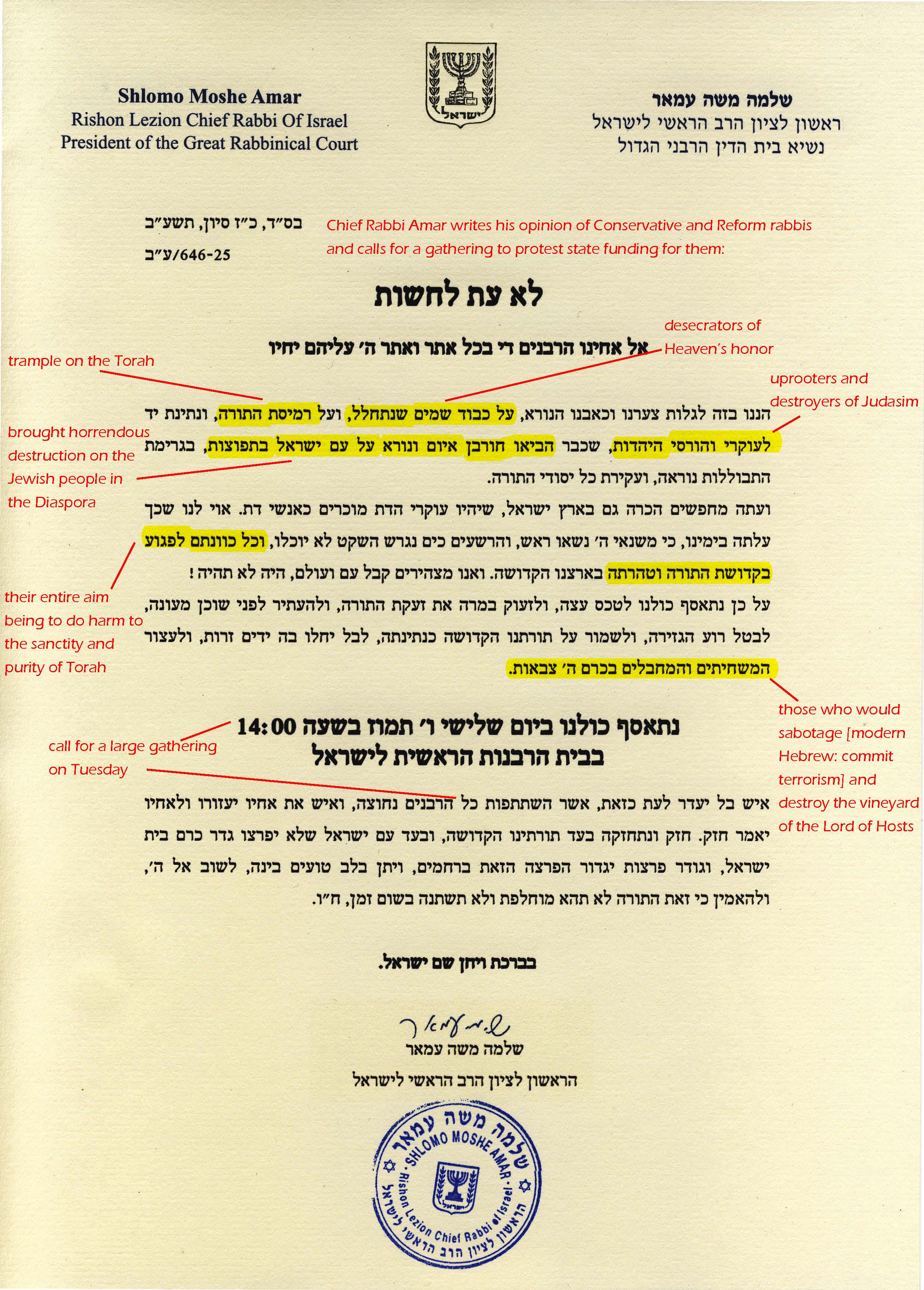
-          This week has been marked by strong reactions to an outrageous statement made about Conservative and Reform Jews by Israel's Sephardic chief rabbi, following a landmark Supreme Court decision peeling away at the terrible inequalities afflicting non Orthodox movements in Israel.  See the letter, written on Israeli government stationery, and read the strong responses from national Federation leadership and the Rabbinical Assembly.  You can also read media reactions to the pluralism decision.  Also this week, adding insult to injury, another woman was arrested for wearing a tallit at the Western Wall.  Israel is the only democracy on earth where some Jews of liberal denominations are not free to practice their faith as they choose. 

-          Along that line, you can read my latest featured op-ed on the "Times of Israel" site discussing how both in Israel and the Diaspora, we all need to focus on helping disaffiliated and disaffected Jews to find their way home.

-          Israel faces numerous other challenges as we head into the summer.  First and foremost is Iran.  It looks like the clock is running out on a negotiated solution, though there are faint hopes that when severe sanctions set in next week, Iran might be nudged into greater concessions.  Israel faces a number of other serious threats, including the growth of Al Qaeda groups in the increasingly lawless Sinai; an attack occurred on that border this week, along with a barrage of rockets from Gaza.  Plus there are the escalating uncertainties in Egypt and Syria.  These are matters of great concern, but we should have great confidence in Israel's ability to keep its citizens safe. See AIPAC's latest "ACTION ALERT" to see what you can do to confront the Iranian threat.  We'll explore the topic of Iran at tomorrow morning's service in our Torah discussion, "Korah and the Limits of Dialogue." 

-          In addition to all of the above, this week another mosque was set aflame on the West Bank.  The arson appears to be one in a series of "Price Tag" attacks, in which settler extremists (as opposed to the vast majority of Israelis living in the territories, who are law-abiding and peaceful) use violence to try to fight off policies they dislike.  Observers are worried that violent outbursts will increasingly be a part of the Israeli political discourse. That risk is real: During the past two years, Price Tag attacks have left ten mosques desecrated, Palestinian olive trees uprooted, shops vandalized, senior IDF officers threatened and IDF bases attacked. The potential for violence looms large in light of court orders requiring the Israeli government to evict settlers from two locales in the West Bank this summer.  This violence is a threat to the moral fiber of Israel, to its Jewish and democratic character, and to the security of its citizens.  The New Israel Fund gives us ways to respond constructively to this threat.

-          Back to Beth El, some noteworthy High Holidays news.  Rosh Hashanah services will now begin at 9 AM - on Yom Kippur morning we'll still begin 8:30.  Children's and family services will begin at 10:30 AM all three days.  For everyone, it is important to plan to get here by 10:30, as the prime section of the service will begin around then.  On Rosh Hashanah, the sermon will now be delivered in the middle of Musaf, roughly at 11:15 AM, with the service's conclusion to follow.  The service will still end at 1 PM or shortly after, but with the sermon now in the middle, we're hoping to reduce that mad rush to the exits that used to occur at the conclusion on Rosh Hashanah.  Also note that a large number of our new Machzors have not yet been dedicated.  There is no better way to honor a loved one then to dedicate a bookplate in that person's honor/memory.

-          Otherwise, we move into the summer in a very good place.  Shorashim registration is proceeding apace - and have you seen our Shorashim preschool's new website?  Our membership is on the rise, and we've just announced major new incentives for people to affiliate, including free membership for all unaffiliated Day School families with a student entering K,1 or 2. We already have a similar offer for new Hebrew School families. Tell your friends about all these things!  The buzz is out there about the exciting things happening here.

-     For the coming year we intend to upgrade (even more) our Shabbat offerings.  If you have suggestions regarding Friday night or Shabbat morning services, let me know.  Next year's schedule is already filling up with great events here. Among them will be special Beth El Cares Shabbats dedicated to various segments of our community, including a conversation on the future of our local federations as well as a focus on education, featuring an appearance by our newly elected Superintendent of Schools, Winifred Hamilton. "Beth El Cares" about our community and we all should be grateful to be living in such a fascinating, diverse place. I caught some of "Alive at Five" downtown last night and was pleased to see the Kosh booth there. Now you can get a kosher hot dog at "Alive at Five" while listening to Matisyahu in a few weeks.  What a country!  

As we go off to our various summer escapes, it's always nice to know that the place we're escaping from 'aint so bad.   Stamford is a great place to live and, in particular, to be Jewish. We have so much to be thankful for.

Shabbat Shalom and enjoy the summer!

Rabbi Joshua Hammerman            

Wednesday, June 20, 2012

Game On: Chief Rabbi Statements Draw Rebuke


The Sephardi Chief Rabbi this week slammed the court order requiring funding for non Orthodox rabbis in Israel,  calling for for an emergency meeting of rabbis to combat what he sees as a threat to Orthodox Judaism.  Amar called non-Orthodox rabbis "destroyers of the religion." In his letter, which you can see above, Rabbi Shlomo Amar wrote, 


"We hereby express our sorrow and terrible pain over Heaven's defiled honor and over the trampling of the Torah, and the hand given to the uprooters and destroyers of Judaism who have already wrought horrible destruction upon the People of Israel in the Diaspora by causing terrible assimilation and the uprooting of all of the Torah's precepts."
"And now they seek recognition in the Land of Israel as well, to be destroyers of the religion who are recognized as clergy. Woe unto us that in our day such haters of the Lord have raised their heads… We declare to the nation and the world: This will not pass!"
Click here for a full translation of the letter.


The Jewish Federations of North America issued the following statement in response to those comments.
“The Jewish Federations of North America condemns in the strongest terms the statement reportedly made by Israel’s chief rabbi, Shlomo Amar. It is a fundamental Jewish virtue to ‘love your fellow as yourself.’ We condemn comments that disparage fellow Jews and, in particular, well-established branches of Judaism that represent 80 percent of North American Jewry. Federations believe in a pluralistic, inclusive Jewish people and work hard to bring members of our people closer to their heritage. We know that the Chief Rabbi's comments and language are completely rejected by the millions of Jewish people whom we represent from all streams, including our Orthodox brethren. Statements such as those made by Rabbi Amar only serve to alienate our fellow Jews from our religion, our people and the Jewish State.”
In the past, the Federations stayed out of most of these pluralism fracases, with some notable "Who is a Jew" exceptions; and in the past the Israeli government has buckled under to haredi blackmail.  But things seem to be different now.  We'll see if the new coalition is able to withstand the heat from Shas and other parties. 


The Rabbinical Assembly has also chimed in:


The Rabbinical Assembly is outraged by a letter issued on official Israeli government stationery by Chief Sephardic Rabbi of Israel Shlomo Amar calling for a rally at his office this coming Tuesday. The language used in the statement is inflammatory and inciting, referring to our members as "terrorists" whose "sole intention is to do harm to the holiness of Torah." 

The State of Israel and the Jewish people have learned the most bitter lesson in the murder of our beloved Prime Minister Yitzchak Rabin (z"l) that incendiary language can result in devastating consequences. We speak as a worldwide Conservative community in demanding that this threat to Masorti rabbis' physical safety, not only their personal integrity, be defended. The Talmud (Arakhin 15b) teaches that hateful speech has the potential to kill. Rabbi Amar's language places all Jewish people at risk of violence, all because Israeli Attorney General Yehuda Weinstein directed that non-Orthodox rabbis in agricultural communities could be paid salaries from non-religious budgets. 

The vast majority of the world's Jews do not conform to the unfathomably hateful language of one of the two chief religious leaders funded by the Government of Israel. We ask that the resources of the Jewish state be devoted to teaching and propagating a love of Judaism and the Jewish people. As the Talmud concludes (Arakhin 15b), "What is the remedy for slanderers? If he be a scholar, let him engage in the Torah, as it is said: The healing for the tongue is the tree of life."

Rabbi Gerry Skolnik, president
Rabbi Julie Schonfeld, executive vice president


As a wise man once said (long before his untimely death this week), "Can't we all get along?" Evidently the answer is no.  As long as letters such as this one can be printed on official stationery of the state, with the Israeli state seal on top, hatred and bigrty will be allowed to reign unchecked.


But maybe last week's court ruling, the one which drew so virulent a response, drew that response precisely because it does mark the beginning of a change - a change for the better.