Tuesday, March 26, 2019

TBE Bar/Bat Mitzvah Commentary: Sawyer Price on Tzav


Shabbat Shalom!

My portion of Tzav describes the sacrifices that took place in the temple back in ancient times.  One of them was called Todah – the sacrifice of thankfulness.  They were brought to express gratitude after surviving dangerous situations or unusual circumstances or coming home from a journey.

A couple of months ago, my family went on a journey – we took a cruise to central America.  It doesn’t exactly qualify as a dangerous journey,  to be on the deck of a Royal Caribbean ship. One of the excursions from the boat touched me deeply.

We were in Honduras, riding on a rickety old bus on bumpy roads and suddenly, 4 or 5 little kids were standing on the side of the road.  They were no older than 2 or 3.  The bus stopped, and the kids started dancing to the sounds of drums that some older kids were playing. Then, to no one’s surprise, they held out their hands for money and we decided to give them some. 

It made me feel sad, to see their ragged clothes and realize how they were so poor that they needed to ask for handouts. At the same time, it made me appreciate all that I have.

When I got home, I decided that for my mitzvah project, I would help kids in our own community who are less fortunate.  And that’s exactly what I’m doing.  I’m volunteering at the Ferguson Library and  collecting books and other supplies which I will donate to Reading Partners, a program of the United Jewish Federation.

That mitzvah project has become, in a way, my Todah, my thanksgiving offering.

Today’s service is too, because sacrifice was replaced by prayer after the temple in Jerusalem was destroyed.  Counting blessings has become a big part of my life, bigger than I even knew.

You see, my greatest passion is swimming – I’ve been swimming competitively for the past three years - and I’ve discovered that swimming and counting blessings have a lot in common. 

In Hebrew, a swimming pool is called a “Braycha.”  That word is spelled exactly the same as the word “Bracha,” which means blessing.

So the question is, how is a braycha like a bracha – how is a pool like a blessing.

When you jump into a pool you bend your knee, which is exactly what we do when we say a prayer like the Amida or the Barchu. You bend your knee – ready to spring into action, and as a reminder always to express gratitude, to always count your blessings, like I did when I was in Honduras.

There are other ways that swimming is a lot like praying.  For one thing, it’s something that, while I’m doing it, it gives me a chance to focus my thoughts.  Both activities require concentration.  Also, when you are swimming,  and praying too you are by yourself, but at the same time you are alongside other people.  It’s a team sport that you do alone.   When you daven in a minyan, you are going at your own pace but you hear everyone around you and you are somehow connected to them.  When you are swimming, you are keenly aware of who is next to you, even though you are by yourself.

With swimming, just as with prayer it’s less important to rush through and do things quickly than to do them well – and to always strive to improve.

It’s important not just to improve my own life, but the lives of others as well.  That’s a lesson taught to me by the little dancing children on Honduras.

Monday, March 18, 2019

TBE Bar/Bat Mitzvah Commentary: Matthew Goodman on Vayikra / Shabbat Zachor


Shabbat Shalom!

Today has been a great day for me.  But really, it’s been a great year, especially for sports.

-       First, last March, my JCC basketball team won the county championship.
-       Then, in June, my little league team won the Stamford American little league championship and I pitched a complete game for my team.
-       Then, in the fall, my house soccer team won the soccer finals for the fourth time!
-       And, oh yes, I’m a big Red Sox and Patriots fan, and we know what happened there. A World Series and Super Bowl in the same season.

Yeah, yeah…I see your eyes roll!

I have to say, I am one lucky kid.

But with my teams winning, there are a couple of lessons that I have learned.

Lesson number one:  Winning takes a lot of hard work, focus and determination. Always try your hardest. When you are trying to win a championship, you can’t take your foot off the gas, or be satisfied before it is over, and expect to win.  Look at the Patriots. A few years ago, they were losing 28-3 in the Super Bowl. They kept working hard when the other team took their foot off the gas and thought it was over. The Patriots came back and won.

My haftarah continues the story of Amalek that was also the subject of the maftir Torah reading.  Amalek attacked Israel right after they left Egypt.  They did not fight fair – as they attacked them from behind. Israel defeated them in the Wilderness; but in my haftarah, King Saul, who was ordered to destroy them completely, let’s their king, Agag off the hook.  Because of that, the nation of Amalek survived, and their descendant, Haman, nearly destroyed the Jewish people.  The holiday of Purim, which we celebrate this week, tells that part of the story.

A second lesson that I’ve learned about winning is that you need teamwork. The winning teams that I have been on had kids that worked together and didn’t rely on one player to win. Plus, it’s important always to be humble and support each other.

In soccer and basketball, you can’t score without passing.  And in baseball, you’ve got to work together in the field to get the out and encourage teammates who are up at bat to get a hit.
Eventually, the Jewish people came together through teamwork and support for each other and defeated the evil Haman.

For my mitzvah project, I am working with two organizations. First, I am working with an organization called Little Wonder. Little Wonder helps people with cancer enjoy themselves a little bit as they go through treatment. They get tickets to local sporting events, shows, and other entertainment to give to people with cancer. Little Wonder is currently working with 21 hospitals in the state of Connecticut. This Mitzvah project is dedicated to my grandparents Beverly and Fred, who I never met because they both passed away from cancer before I was born. Thanks to you, my family and friends; I was able to achieve my goal of raising 1000 dollars in total (I have actually raised over 2000 dollars so far!).

The second organization I am supporting is called Leveling The Playing Field, which provides sports equipment to children who wouldn’t otherwise have the right equipment to play. Most of you know that I love sports and I am lucky to have the equipment that I need to play. Others are not as lucky as I am. So I am collecting sports equipment to donate to them. In this way, I’m playing a small part in doing what real winners have to do – which is to help others to become winners too.

Please consider donating if you haven’t already and thank you to those who have already donated.

Sunday, March 17, 2019

Interfaith Council Statement after Christchurch

From the Rabbi's Desktop


Here is the Interfaith Council of Southwestern Connecticut's statement following the massacre of 50 innocent human beings at worship in New Zealand, at the hands of a terrorist wedded to an ideology of xenophobia and hate; whose manifesto calls refugees "invaders" and stokes the same "replacement"  fears that  became the battle cry of White Nationalists against Jews in Charlottesville and that inspired the synagogue massacre in Pittsburgh.  This attack that took place on the other side of the earth was, make no mistake about it, an attack on us, as Jews, as decent, peace-loving people, and as members of the human family.

The statement has been posted by the Stamford Advocate. I signed it without hesitation.  May it be the last one of its kind that I ever need to sign.

-----------------
On Friday, March 15, 2019 some 50 Muslim worshippers were brutally - at point-blank range - murdered in a mass shooting at two mosques in Christchurch, New Zealand. Twenty others have been injured. They include toddlers and teenagers, mothers and fathers, brothers and sisters, grandparents and friends - people like you and us.
The Interfaith Council of Southwestern Connecticut condemns this hate and atrocity, stands with our Muslim sisters and brothers and sends our solidarity and deepest condolences to our Christchurch, New Zealand, family. We send more than condolences to our communities and our elected officials. We send us all a wake-up call, a call to action - prevent gun violence through education, coalition, public awareness, effective law enforcement and sensible legislative change NOW.
Mass shootings have disrupted and brutally ended the lives of worshipers in Tree of Life Synagogue in Pittsburgh, Penn., First Baptist Church in Sutherland Springs, Texas, Emanuel African Methodist Episcopal in downtown Charleston, S.C., the Sikh Temple in Oak Creek, Wisc., and a mosque in the Sainte-Foy neighborhood of Quebec City, Canada. Gun violence is a horrific, an immoral and an unacceptable act anytime, anywhere. It is especially monstrous in places where communities gather to learn, love and worship.
We stand brokenhearted but not broken-spirited with our Muslim sisters and brothers after the Christchurch tragedy. As faith leaders and community members, we are united in condemning these acts of hate, intolerance, immorality, amorality and xenophobia. We are one family.
The Board of Directors of The Interfaith Council of Southwestern CT
Kareem Adeeb, Ph.D., president, Muslim
The Rev. Mark Lingle, executive director, Christian
Azra Asaduddin, Muslim
Inni Kaur Dhingra, Sikh
Sara Hakim, Treasurer, Baha'i
Rabbi Joshua Hammerman
The Rev. Michael Hyman, Secretary, Baptist Christian
Peter Lilienthal , Jewish
Regina Miolene, Roman Catholic Christian
Betsy Nagurney, Roman Catholic Christian
Marie Orsini Rosen, vice president, Jewish
The Rev. ReBecca Sala, Unitarian Universalist

Friday, March 15, 2019

Shabbat-O-Gram for March 15 - Beyond Articulation

Shabbat-O-Gram

...join us for a wine-and-cheese launching on March 28 at 7:30!


-----------

The Shabbat-O-Gram sponsored by 
Beth and Jeff Goodman in honor of their son, 
Matthew, becoming a Bar Mitzvah


Shabbat Shalom!

Shabbat shalom!

Mazal tov to Matt Goodman and family as he becomes bar mitzvah this Shabbat morning.  Join us then, and tonight for Kabbalat Shabbat at 7:30.  Tomorrow we also have another Shabbabimbam for young children. Last week's Bar Mitzvah speech by Zachary Price can be found here.  The Times of Israel featured my commentary found in last week's O-Gram.  You can read "Dual Loyalty - Dual Love" here.

Beyond Articulation - and Some Hope

This week we read the first portion of Leviticus, which includes descriptions of the ancient sacrificial cult.  In Leviticus 1:9 we encounter a term for the first time, one that seems inocuous here 

ט וְהִקְטִיר הַכֹּהֵן אֶת-הַכֹּל הַמִּזְבֵּחָה, עֹלָה אִשֵּׁה רֵיחַ-נִיחוֹחַ לַיהוָה.  {ס}1:9 and the priest shall make the whole smoke on the altar, for a burnt-offering, an offering made by fire, of a sweet savour unto the LORD. 
The offering made by fire was entirely consumed on the altar.  The devastation was complete.  Nothing remained for the priests to eat. The word for "consumed by flame" - Isheh - is a derivative of the word esh which means fire.  A later derivative of this root word is Shoah - so it is from this utter devastation at the altar that we first glimpse the word that would come to be associated with the Holocaust.  In fact, some translations, especially those written before World War Two, call this sacrifice, in English, the Holocaust offering.

Looking at an etymological dictionary, you find several shadings of meaning for this root word, including "lays waste," and "ruins."  But additionally you find words like "wonder, "astonished" and "amazed," 

The Hebrew word "Mishta'eah," another derivation of Shoah, is especially apropos today.  It means "to be rendered empty of thought."  The Holocaust remains, even 75 years later, not merely beyond explanation, but beyond thought, beyond articulation.  Words can't come close to expressing the horror.

That's how we feel today after the murderous rampage at mosques in New Zealand.  Reading the first reports of the hate-filled ideology of the perpetrators, I am reminded that this is Shabbat Zachor, the Sabbath of Remembrance, when we read the instruction to remember the evil perpetrated by Amalek in the Wilderness.  There's a lot of evil to recall at this time of year, and it's a reminder that today is far from the first time Muslims have been murdered in their place of prayer.  29 were killed in Hebron by Baruch Goldstein in 1994.  Goldstein was driven to his hateful deed after misreading the book of Esther on Purim, failing to understand that the mitzvah to destroy Amalek is not calling on us to kill people, but to kill off hatred itself, the Amalek within.  

We have a long way to go.

But meanwhile, this horrible tragedy leaves us all "beyond articulation."

Now for a hopeful sign:

With today's news it becomes even more important for us to stand up against hate no matter where it is found.  This week, the Stamford Board of Reps provided a refreshing bipartisan break from the typical political rancor, by joining in an overwhelming censure of one of their members who had spread vile messages against Muslims and others in social media postings.  I attended the meeting and was moved at the presentations made.  Very little grandstanding, even though cameras were present.  Some of the speeches were very very personal, detailing heartbreaking experiences of prejudice.  As I sat next to my Muslim imam friend, I reflected that this us just another example of why Stamford is a fabulous place to live.  See the coverage of the meeting on WABC.   

PURIM!!!

Purim falls this coming Wednesday evening.  Join us at 5:30 for the Family Megilla Reading followed by the always-great carnival, and Purim for Adults, with a full Megilla reading at 8:00. 

Here is some Purim info from MyJewishLearning.com


Beyond Articulation #2

Last weekend, I sent out one of the saddest e-mails I've ever had to deliver, the news of the tragic death of Mike Sverdlove, beloved grandson of TBE's Andrew Sverdlove.  You can read some of the coverage in the Israeli press.  Andrew spoke so proudly of Mike's love of Israel at services.  Mike's father posted on Facebook a moving account of what transpired. "Moving" doesn't quite describe it.  This is what "Beyond Articulation" would look like if it could be articulated.  It's a glimpse right into the thundering Isheh offering - and to the core of an aching father's soul.  Our deepest sympathies to Andrew and family.  

Recalling Hanna Senesh's immortal words:


Blessed is the match, consumed in kindling flame.
Blessed is the flame that burns in the heart's secret places.
Blessed is the heart that knows, for honors sake, to stop its beating.
Blessed is the match, consumed in kindling flame.

Shabbat Shalom
Rabbi Joshua Hammerman

Wednesday, March 13, 2019

Hate has no home here


Below is WABC NY Channel 7's coverage of the Stamford Board of Rep's censure of a member for hate-filled social media postings:


Sunday, March 10, 2019

Dual loyalty — or dual love?


FEATURED POST

Dual loyalty — or dual love?https://blogs.timesofisrael.com/dual-loyalty-or-dual-love/

America is our home, where we live our lives; and Israel is our canvas, where our lives will have mattered a millennium from now
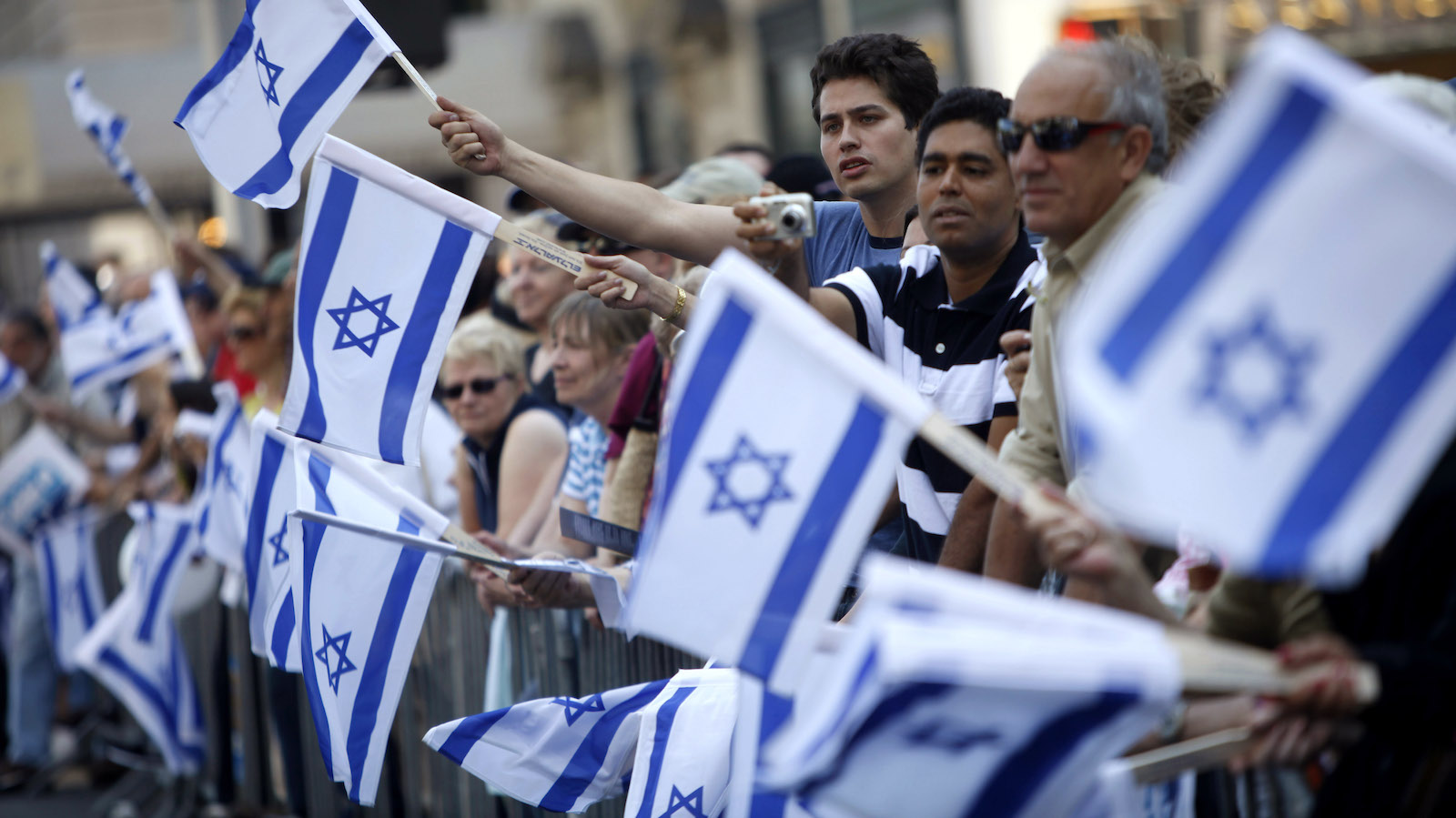
People wave Israeli flags while watching the Salute to Israel Parade in New York, May 31, 2009. (AP Photo/Seth Wenig)
Why do American Jews feel such an attachment to Israel (though sadly, not as much as before)? Contrary to analogies I’ve been reading, it is not comparable to Irish Americans longing for Ireland or Italian Americans caring about Italy. For us, the commitment is not merely ethnic or ancestral, it is also spiritual and existential. It is not a matter of dual loyalty, in fact, but dual love. It’s a relationship that should not cause inner conflict or embarrassment, but great pride. Israel is, without doubt, the Jewish people’s most impactful contribution to civilization since the Talmud was completed 15 centuries ago.
It seems to me that when people are looking back at the Jewish contribution to this historical epoch a thousand years from now, they will speak of Einstein, Freud, and Marx — and their impact on the world at large. But our descendants will point toward Israel as our generation’s most original, revolutionary creation.
Israel is our Book of Psalms and our Job, our magnum opus.
That is why Israel matters to Jews, no matter where we live. That is why things like elections matter, and religious freedom and planting trees and ensuring equal rights for women, LGBTQ and minorities in Israel. That’s why free speech matters, and that people who disagree with a government policy shouldn’t be detained at the airport. These things matter to Diaspora Jews. And if they don’t, they should. And it should matter to Israelis that it matters to Diaspora Jews.
For American Jews, America is our home. But Israel is our canvas. The former is where we live our lives. The latter is where our lives will have mattered a millennium from now. Whether or not American Jews actually vote in Israel’s elections (and I believe we should have that right), American Jews should participate in shaping Israel’s destiny.
That is why Israel’s security also matters to us, and why it needs to maintain a qualitative military edge over its neighbors.
Yes, America is a grand experiment too, one that American Jews cherish and also view as a great work of art. The past few years have reminded us that we can never be complacent in sustaining American democracy. As an American Jew, I love all that America stands for, even when she struggles to find her way, in the same way that my love for Israel remains unconditional, even when she disappoints and struggles. It’s possible to love both grand experiments, America and Israel — AND chew gum — at the same time.
In America, I am one of 325 million “tempest-tost,” who have come from everywhere to bathe in the glow of a lady with a lamp, to become a beacon of hope to the world. And with Israel, I am one of a mere 13 million Jews gathered from everywhere, part of a people who have walked this earth for over 3,000 years — and survivors of the greatest evil the world has known — determined to kindle a “light unto the nations” in an old-new land where ideals of the biblical prophets spring to life.
It’s not a matter of dual loyalty, then, but dual love.