Wednesday, July 17, 2019

Friday, July 12, 2019
Midwest Book Review: Mensch-Marks is "...an extraordinary and potentially life enhancing read"
And Midwest Book review just shared:
The Judaic Studies Shelf
Mensch-Marks
Joshua Hammerman
Health Communications, Inc.
3201 S.W. 15th Street, Deerfield Beach, FL 33442-8190
9780757321771, $14.95, PB, 240pp, www.amazon.com
Synopsis: "Mensch-Marks: Life Lessons of a Human Rabbi―Wisdom for Untethered Times" is Rabbi Joshua Hammerman personal memoir told as a sacred story, as how-to book, as a series of personal vignettes in dialogue with one another over the span of decades, resonating with eternal ideas that span centuries.
"Mensch-Marks" traces Rabbi Hammerman's own personal growth while providing a road map for people of all backgrounds seeking a life of moral vision. The wisdom is shared not from a pulpit on high, but rather from an unfolding story of a fellow traveler, one who has stumbled, failed, and persevered, struggling with the questions large and small. Through it all, Rabbi Hammerman has tried to live with dignity and grace, what he calls the "nobility of normalcy."
The central message of Rabbi Hammerman's "Mensch-Marks" is that we can turn things around, one mensch at a time!
Critique: Inherently interesting and ultimately inspiring, "Mensch-Marks: Life Lessons of a Human Rabbi―Wisdom for Untethered Times" is an extraordinary and potentially life enhancing read that is unreservedly recommended for community and academic library Contemporary American Biography collections, as well as Judaic Studies supplemental studies lists. It should be noted for personal reading lists that "Mensch-Marks" is also available in a digital book format (eTextbook, $10.99).
Editorial Note: A celebrated rabbi and award-winning journalist and blogger, Joshua Hammerman, has served Temple Beth El in Stamford, Connecticut, for over three decades. His essays have appeared in The New York Times Magazine, The Washington Post, Times of Israel, The New York Jewish Week and many other places. Rabbi Hammerman was a winner of the Simon Rockower Award, the highest honor in Jewish journalism, for columns on the Bernard Madoff case. In 2018, he received an award from the Religion News Association for excellence in commentary. Rabbi Hammerman received ordination from the Jewish Theological Seminary after getting an MA in journalism from NYU and a BA, magna cum laude, from Brown University.
Thursday, July 11, 2019
Another Glowing Review of Mensch-Marks
Review of “MenschMarks: Life Lessons of a Human Rabbi – Wisdom for Untethered Times” by Rabbi Joshua Hammerman. It appeared in the July 12, 2019, issue of the Jewish Federation of Greater Binghamton’s The Reporter, located in Vestal, NY. You can also find the review on The Reporter’s website at www.thereportergroup.org/Article.aspx?aID=5242.


Book Review: Trauma and everyday life
By: Rabbi Rachel Esserman
Sometimes the most important teaching a rabbi does occurs outside the classroom – when giving sermons and lectures or during counseling sessions. Two rabbis offer the lessons they learned over the course of their rabbinate in two new works: Rabbi Tirzah Firestone, Ph.D., discusses how to overcome traumatic experiences in “Wounds into Wisdom: Healing Intergenerational Jewish Trauma” (Adam Kadmon Books/Monkfish Book Publishing Company), while Rabbi Joshua Hammerman focuses more on everyday living in “MenschMarks: Life Lessons of a Human Rabbi – Wisdom for Untethered Times” (Health Communications). Both rabbis hope their thoughts will help readers live more meaningful lives.
Much of Firestone’s work is based on what is known as the epigenetic factor, the idea that experiences – particularly traumatic experiences – can be passed through the generations even though the experience does not change their DNA. What the trauma does do is change people’s body chemistry and reactions that are then passed to their descendants. She sees this most clearly with the families of Holocaust survivors when the second and third generations’ react to events based on what happened to their parents and grandparents, even when they are unaware of exactly what they suffered. However, those are not the only traumas she discusses: Firestone also interviewed Israel soldiers who suffer from post-traumatic stress and Israeli parents who lost children during their army service or because of terrorist attacks.
The first section of her work contains stories of people Firestone counseled or interviewed for this book. She looked for people who overcame trauma, not by ignoring it, but by realizing the power the trauma had over them and finding ways to limit its effects. She notes that most people’s natural first reactions – to either isolate themselves, be hyper vigilant or numb one’s feelings – not only don’t help in the long run, but create more problems. The second section focuses on ways to heal from trauma, including the importance of facing a loss and then harnessing the power of pain. She also notes the need to find a community that can help one to heal and to stop identifying as a victim. Other suggested ways to find wisdom in trauma are to resist falling into a blaming stance, since dehumanizing others only serves to increase trauma, and to take action to put this newly found wisdom into helping others.
Firestone’s original interest in learning about trauma comes from personal experience. The discussions of her family – her parents and siblings – were the most interesting in the book. She notes the traumas her parents faced and how their reaction to them affected her and her siblings. After one brother committed suicide and another sister began to experience symptoms of mental illness, Firestone found herself looking for answers to their dilemmas in order to save herself. Her original journey took her far from Judaism, but she then came to realize the benefits of Jewish religious practices – although not the same ones as her parents – something that led her to become a rabbi.
While Firestone’s focus is on people who have suffered major traumas, Hammerman looks more closely at how to become a mensch – a good person – during regular, everyday life. Over 42 chapters (which represent the 42 stops the Israelites made when wandering through the desert toward the Promised Land), his mostly brief essays suggest ways to attain personal growth. What makes these essays work is that Hammerman is not preachy: he clearly acknowledges his own faults and how he has struggled to overcome them. Sections focus on such themes as work, loving, pain, belonging, the importance of normalcy, failure and forgiveness.
The most interesting chapter (MenschMark 34) looks at Hammerman’s own crisis, one that occurred after he wrote a satirical article about religious extremism and sports fanaticism. The backlash was quick and fierce. In fact, the article was mentioned on national television, but the comments were not positive. Hammerman admits that he went too far in his satire and began reaching out to evangelicals in order to better understand their thoughts. He does receive (sometimes lukewarm) support from his congregation and greater support from the interfaith group to which he belongs. The author turned his experience into a sermon the next High Holidays – not to justify what he wrote, but to note that everyone makes mistakes. While he emphasizes the need to hold ourselves to high standards, he also discusses how we must learn to forgive ourselves and others.
Other essays that struck a chord include:
MenschMark 6, which includes a list of subjects that are usually considered taboo to speak about on the High Holiday and the reasons it’s important to talk about them.
MenschMark 13, when Hammerman writes about the dilemma of having your child in the hospital at the same time one of your congregants is also having a medical crisis in the same building. What is more important in this case: being a parent or being a rabbi?
MenschMark 14, when he writes about his developmentally disabled brother and the fragility of life.
MenschMark 16, which talks about the beauty and necessity of boredom, and how it can enrich our lives and lead us to be everyday heroes.
MenschMark 24, which tells of a funeral Hammerman performed for a gay man who requested that his homosexuality be outed during the eulogy in the hope that it would help those who were unable to accept their true sexual nature.
Hammerman ends his work writing about how important it is to find meaning in our lives. He echos what his father used to say to him – “be a mensch” – and questions whether or not he has attained that status.
Both Hammerman and Firestone hope their readers will emerge better and wiser people.
Shab-Not-O-Gram for July 12
Shab-Not-O-Gram


A great time was had by all at our recent Shabbat-at-the-Beach at Cove Island
Shabbat Shalom. (Not)
Since there are no official Shabbat-O-Grams in the summer months, this is not one; but I do want to highlight a couple of things before I head off for my summer break.
1) This Shabbat Morning
This Shabbat morning will feature not one, not two, but THREE ufrufs! All three couples are very special and they are connected to the TBE family in very different ways. Join us this Shabbat as we celebrate with Jennifer Greenman & Matt Sakofs, Claudia Lubin & Mark Creedon, and Hope Stanger & Brian Steranka - and make sure to warm up that throwing arm, as the candy will by flying all morning long.
At this service, we'll also be hearing from TBE congregant Belle Horowitz, who heads up our TBE Immigration Task Force. Belle returned recently from a trip to the US-Mexican border and I've asked her to report back to us on what she saw. This is especially important in light of recent reports by journalists and government sources, including a government report, detailing squalid conditions. Fittingly, this week's Torah portion introduces the legend of Miriam's Well, which nurtured the Israelite refugees during their wanderings toward the Promised Land. This mythical well, which stopped providing water after Miriam's death, has gained deeper meaning over the centuries. Click here to read more about Miriam's Well in this week's Parsha Packet. We need to apply Miriam's nurturing, maternal instincts wherever we find wanderers, the tired, the poor and huddled masses yearning to breathe free - especially when they are children.
2) Friday Night
Join us also on Friday night, when Beth Styles will once again co-lead the service with me. It's been wonderful to see continued excellent attendance on Friday nights, even into the typically slower summer season. Over the past few weeks, we've been introducing various innovations designed to foster the kind of intimacy that promotes a prayerful experience. The early reviews have been very positive. Let us know what you think - and my thanks in advance to all those who will be leading services during the weeks when I'll be away.
Incidentally, it's also important to support our morning minyans and Shabbat morning services, especially during the summer, when some "regulars" are away. Please pick a day - or a week - and support our services!
3) Next Summer's Europe Trip
People have been asking - so here it is! The itinerary for next summer's Eastern Europe trip is now available at THE TRIP'S WEBSITE, WHICH YOU CAN REACH BY CLICKING HERE. Pricing and other registration info will be available from that site soon as well. Once the site goes "live," reservations will be taken on a first-come-first-served bases, as it has been for our (now full) March Cuba trip.
4) Some exciting news!
I'm proud to announce that I have been selected as a finalist for the 2019 Religion News Association Awards for Religion Reporting Excellence. Winners of this year's awards - which showcase religion journalism excellence in the news media among 20 categories of print, online, multiple media, broadcast, book and student entries - will be revealed Sept. 21, at the RNA Annual Conference Awards Banquet in Las Vegas. You can see the names of the finalists here (some pretty steep competition): Here are the three articles of mine cited in the Excellence in Commentary category:

Enjoy your summer and Shabbat Shalom!
Rabbi Joshua Hammerman
Monday, July 1, 2019


Friday, June 28, 2019
Honored to be a finalist for another Religion News Association award - and in great company
|
|

Thursday, June 27, 2019
Shabbat-O-Gram for June 28
Shabbat-O-Gram
Shabbat Shalom!
Join us Friday evening at Cove Island for our Shabbat at the Beach. Steve Epstein and Natasha Fenster will lead music for the kids at 5:30 and at 6:30 (note the time), Steve will assist me for a relaxing, family style Shab n' Surf (not "surf n' turf") service. The service is for all generations and the yahrzeit list will be read. The forecast is for clear weather, so join us! From the parking lot at Cove (and we have special permission to park without a sticker), simply walk to the right until you find us on the beach.
During the summer, the Shabbat-O-Gram is typically on hiatus. So this is the final official one until Labor Day, though I'll be sending out periodic reminders and special messages. The world does not stop during the summer, and that means, sadly, that it may be important to share important perspectives on current events, such as the statement from the Conservative Movement leadership that you will find elsewhere in this email. And don't forget to join us for services all summer long. One highlight will be on July 13, when we'll have three ufrufs - a TBE first!!
Last week I mentioned that we would be receiving a photo of the secret synagogue of Terezin taken by noted photographer Daniel Bogaev. Well, it has arrived and you will soon be able to see it in our lobby. For those looking for more background on that synagogue - and why it is so inspirational - here is the backstory.

As i announced last week, we will be doing another trip to Poland, Budapest, Prague and Berlin a year from now, in the summer of 2020.
More information will be forthcoming over the next couple of weeks (and yes, the Cuba trip set for next March is still good to go). Let me know if you are interested. This trip is for all ages (except for young children), and the Holocaust Memorial Committee is offering significant scholarship assistance for those teens and college students who join their parents on this journey, in tribute to Dr. Hesh Romanowitz, of blessed memory. We feel it is a very important trip for all Jews to take.
Summer Camp Transformations and Hebrew
This week's Canadian Jewish News scoured the internet for Jewish summer camp experiences. And lo and behold, the writer found something I wrote over a decade ago. It still rings true today. I shared a letter that I sent home from camp:
"Dear Folks,
I REALLY am sad now. I need more food because I haven't had anything to eat. My swimming teacher is making me jump into the water but I don't want to. I'm scared of putting my clothes into the laundry because I'll lose them and they'll come back different colors. Send ear plugs."
What's funny is that I actually loved camp-even that first year-because I discovered there what children have been discovering about summer camp for decades, and what Jews have known for millennia: When you leave home, you can reinvent yourself. As Eric Simonoff wrote in his book about the American summer camp experience, "Sleepaway," camp was the place, "where I knew I wouldn't be that weird, bookish kid who always had his hand up in class-where, instead, I would be the popular kid, the lifelong camper who knew all the counselors, all the camp songs."
Summer camp is, in short, a transformational experience.
This week, Tablet Magazine features an article about how some Jewish summer camps tried to create a Hebrew speaking utopia in the heartlands of America, particularly during the baby boom years after World War Two. The birth of Israel had just transformed us from perennial victims to victors. I was part of that experiment, attending Camp Ramah in New England, though at a time when the use of Hebrew was not quite so doctrinaire as it had been in '50s. (You can read about the Ramah movement's history and vision here)
The Tablet article talks about the phenomenon of Hebrew Infusion. Interestingly, the Hebrew that was taught at Ramah and other camps developed a life of its own. I suspect many Israelis would not recognize aspects of it. But I still can hum the lyrics of West Side Story in Hebrew - we performed the musical when I was in 5th grade.
 |
| Cameri Theatre of Tel Aviv - America - West Side Story |
And I can umpire an entire game of softball without ever once reverting to my native tongue. What's a ball? Ka-Door. An out? Yitzi-ya. What about a home run? The same term used for circling the sanctuary with the Torah is used for circling the bases: Ha-ka-fa.
When speaking a new language becomes as natural as circling the bases (and I was quite the athlete back in my camp days), something transformational has happened.
And something else transformational happened to me as a counselor at camp.... I met Mara - and our anniversary is tomorrow!
So what are some of your memories of camp? And what made summer camp so significant in your growth?
Wherever you are and wherever you go, have a transformational summer!
And as a public service, here is a brief lexicon of summer-y words in Hebrew. See how many you can use over the coming weeks!
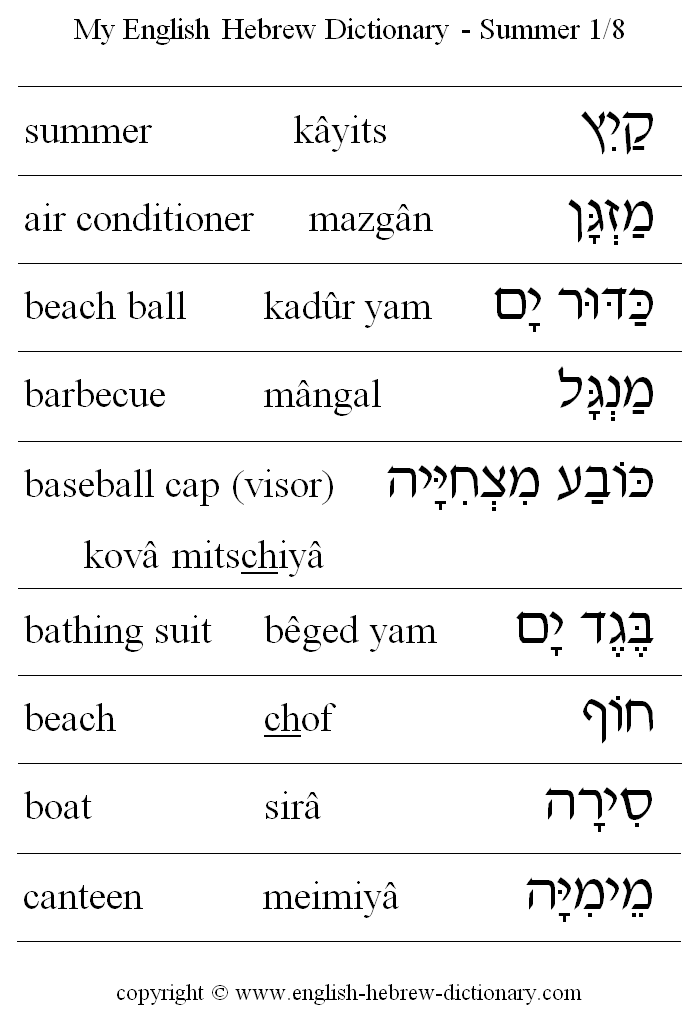
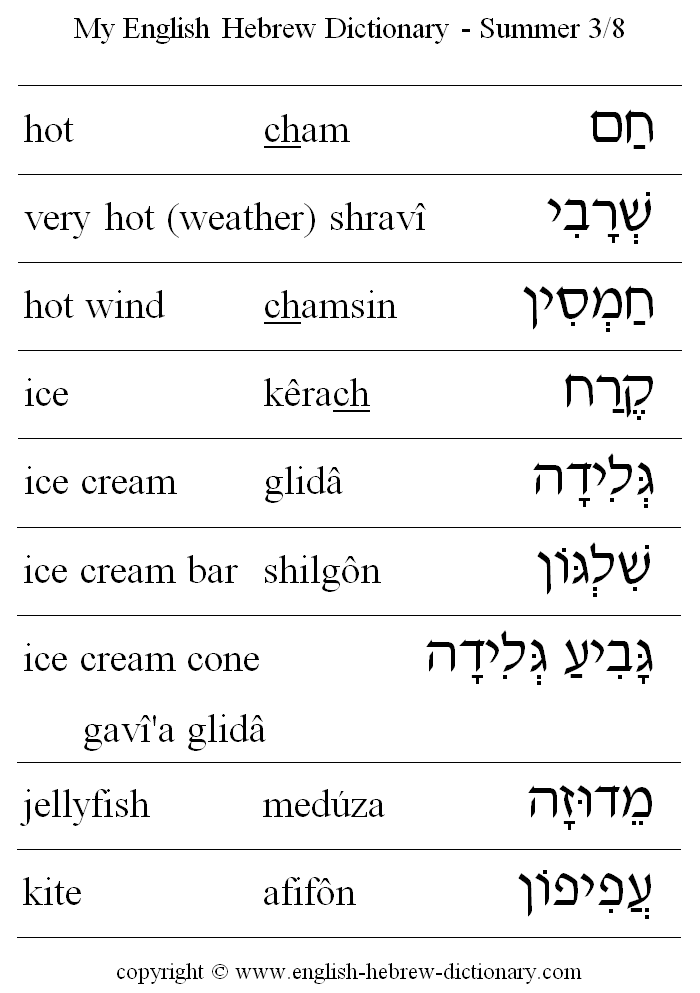

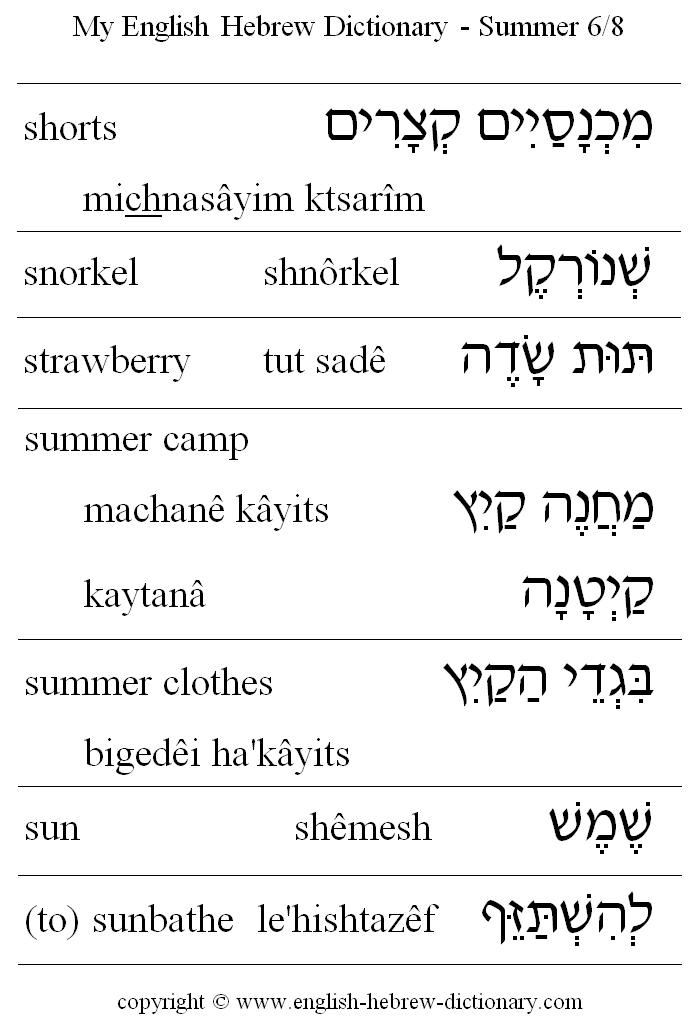
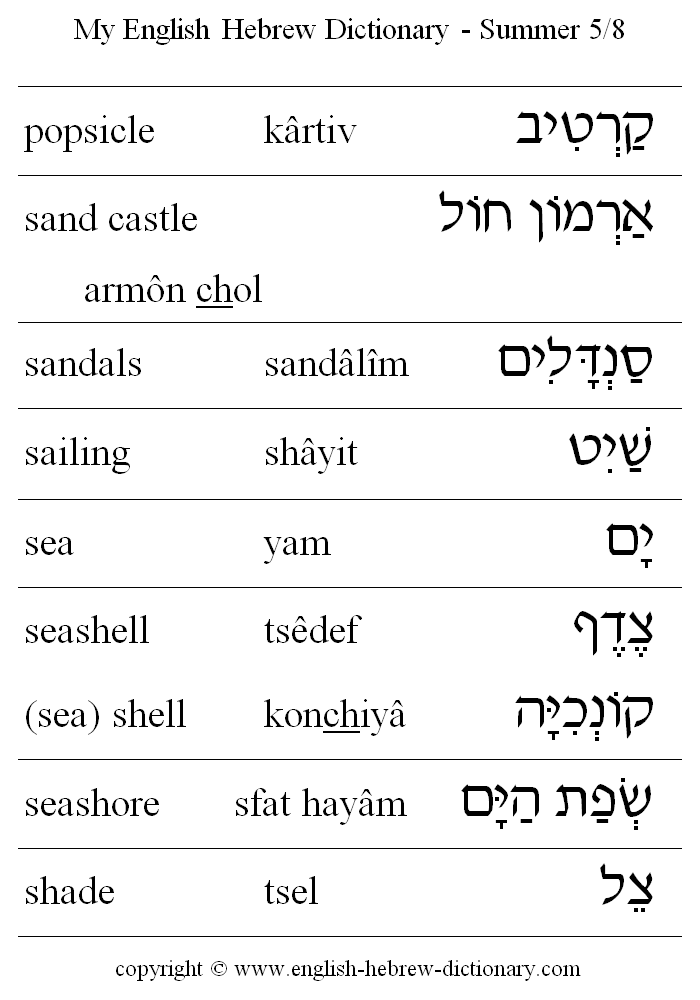

And your word for the day is GAL-SHAN - surfboard.
 |
dani sanderson - my surf board
|
Conservative/Masorti Movement Expresses Anger at Immigrant Detention Centers
The Conservative/Masorti movement of Judaism expressed intense anger today at the status of immigrant detention in the United States, particularly reports of children being held in inhumane conditions and that a former internment camp used during World War II for Japanese-Americans at Fort Still, Oklahoma is now slated to be used as a new detention center for immigrant children.
The movement issued the following joint statement:
"Today, most Americans recognize the 1940's internment of American citizens of Japanese descent as immoral, illegal, and certainly lamentable. How tragic that America is again on the verge of incarcerating a new generation, this time of would-be immigrants. Hundreds and thousands of people are so desperate for a better life that they flee to the United States of America - knowing that the country's leader says they are not wanted - and once here are placed in pens, cages, jails and prisons. Our government is paying for-profit companies with arguably no supervision and no oversight to hold these human beings - for unlimited time in subhuman conditions.
Judaism has a strong tradition of calling for loving the stranger (Deut 10:19) because we were strangers in a strange land. Two of the most powerful values Judaism teaches are the dignity of all creatures (k'vod habriyot) and b'tzelem Elohim, the firm belief that each and every human being is created in the image and likeness of God.
Our tradition values children. They are our future and our hope. Yet today in this country, we leave them in outdoor detention pens - with no diapers for babies, no toothpaste, no soap, often no clothes to speak of, and certainly no toys.
Children must be reunited with their families immediately and everyone seeking asylum at our borders deserves a fair hearing. We need more judges and more adjudication of asylum seekers at our borders, not more camps. We need more humanity and sympathy. Not more camps.
Further, we continue our support for a fair immigration policy that guarantees due process in immigration proceedings and protects the civil liberties of immigrants. We vehemently oppose capricious immigration raids like the one recently proposed.
To detain human beings in prison-like conditions, for undetermined amounts of time, despite the fact that they are not charged with any crime is unconscionable. Today's transfer of children is only the first of many critical steps needed. The detention centers must be closed. Now. The United States of America and the Jewish community know this all too well from our histories. When we say never again, we mean it."
Rabbinical Assembly
United Synagogue of Conservative Judaism
Cantors Assembly
Jewish Educators Assembly
The Jewish Theological Seminary
Jewish Youth Directors Association
Masorti Olami
MERCAZ Olami
MERCAZ USA
Seminario Rabinico Latinoamericano
The North American Association of Synagogue Executives
United Synagogue of Conservative Judaism
Cantors Assembly
Jewish Educators Assembly
The Jewish Theological Seminary
Jewish Youth Directors Association
Masorti Olami
MERCAZ Olami
MERCAZ USA
Seminario Rabinico Latinoamericano
The North American Association of Synagogue Executives
Letters FROM My Palestinian Neighbor
This week's Tablet Magazine features a video essay marking the publication in paperback of Yossi Klein Halevi's Letters to My Palestinian Neighbor, which broke important ground when first published last year. At that time Klein Halevi practically begged for a Palestinian to engage him in dialogue, distributing the book for free in Arabic.
Much to his delight, many letters came in, and an extensive selection of them is printed in the book's recently released paperback edition. As the Tablet article points out, one letter in particular stood out: Its author was Mohammed Dajani Daoudi, an Al-Quds university professor and former hardliner who, five years ago, took a delegation of Palestinian students to visit Auschwitz. To capture their exchange, author and producer Peter Savodnik put together a three-part mini-series. No matter where you stand on the Israeli-Palestinian conflict, that such a conversation is even possible ought to make you pause and reconsider.
 |
| Neighbors: Yossi Klein Halevi's Palestinian Neighbor Writes Back, Episode 1 |
 |
| Neighbors: Yossi Klein Halevi's Palestinian Neighbor Writes Back, Episode 2 |
 |
| Neighbors: Yossi Klein Halevi's Palestinian Neighbor Writes Back, Episode 3 |
More Mensch-Marks
I'll be discussing my book Mensch-Marks next week at Atria on 3rd St. Contact Atria for more information. Meanwhile, I've been getting some interesting feedback from readers too (though nothing as interesting as Yossi Klein Halevi's). The JCC of Suffolk County sent me a chart, "The Alef Bet of Being a Mensch," filled with menschy quotes for each letter of the Hebrew alphabet. And a reader in Westchester came up with his own Mensch Matrix, based on the Periodic Table for Being a Mensch found in the book.

These are the prime qualities of being a mensch and how they interact. Click here for an enlarged, clearer version of the chart and here for more details. And thanks to Jonathan Gellman for putting this together.
Have a wonderful summer and Shabbat Shalom!
Rabbi Joshua Hammerman

Sunday, June 23, 2019

Wednesday, June 19, 2019
Shabbat-O-Gram for June 21
Shabbat-O-Gram

Shabbat Shalom!
Suddenly summer is upon us. But before we all load up the car and head to the beach, it's great to look back at what has been a fantastic spring. See our End of Year photo album, and our Cantor's Concert album, along with Liav Vadel's Bar Mitzvah commentary on Naso from last Shabbat. Special thanks to Aviva Maller Photography for all the concert photos and many others from the past few months.
Please join us for Pride Shabbat on Friday at 7:30. Katie Kaplan will be our cantorial soloist and Chris Coogan our guest musician. We will spend Shabbat enjoying rich music and conversation about the Blessing of Difference in celebration of Pride 2019! There will be a short talk and Q&A with Sontaia P. Briggs, Executive Board Member, of Parity, an organization that celebrates the spirituality, faith, and religious expression of LGBTQ people. She will address the challenges Parity faces in dealing with religious groups that have bias against LGBTQ and consider it sinful.
Along those lines, I recommend a recent article in the Washington Post asking how Americans' views flipped so quickly on the topic of LGBTQ rights, especially in light of how other prejudices - like anti-Semitism - have stubbornly resisted such change. The gay rights movement has managed to change people's minds faster than any other civil rights movement in memory. Still, this rapid change has not eliminated homophobia. Far from it - as we have seen in the Administration's efforts to roll back a number of transgender rights. So the battle begun a half century ago is not finished. But the progress has been remarkable and something for people of all backgrounds to celebrate.
We'll do that on Friday night!
And of course, join us on Shabbat morning as well, when I'll be looking at the portion of Beha'alotcha and discussing how to take your Judaism "on the road" as you head out in your travels. See the Parsha Packet: "Jewifying" Your Summer Vacation, which includes a selection from my book Mensch-Marks (chapter 19, "The Power Grid.") along with tips on how to bring Jewish values into the Wilderness.
"There are Stars whose radiance..."
"There are stars whose radiance is visible on Earth though they have long been extinct. There are people whose brilliance continues to light the world even though they are no longer among the living. ... They light the way for humankind."
Those immortal words were penned by Hannah Senesh, the great poet and hero who died trying to rescue Hungarian Jews during the Holocaust.
Mina Roth-Dornfeld, a member of TBE, has a grandson, Daniel Bogaev, who is a noted photographer. You can see his website here. Mina is presenting TBE with a framed photo that was part of a recent exhibition of Daniel's. See a facsimile below.
For those who joined our TBE Jewish Heritage Tour of Europe in 2017, perhaps this photo taken at the same site will jog your memory.

It was taken at the secret synagogue in Terezin, which Jews defiantly decorated and utilized for prayer right under the noses of the SS. Somehow they were able to envision a better future as they looked up at those painted stars, despite knowing that their own fates were almost certainly sealed, knowing that they would become extinct soon - but that maybe there would be a brighter future for humanity and the Jewish people. Having this photo in our building enable those who have been to Terezin to explain to others just how sacred that synagogue is - and enable the rest of us to dream of reaching out to the heroic victims, and, in their name, reaching for the stars. We are the stars that they envisioned.
I'm delighted to announce that, at the request of a number of congregants, we will be doing another trip to Poland, Budapest, Prague and Berlin a year from now, in the summer of 2020.
More information will be forthcoming over the next couple of weeks (and yes, the Cuba trip set for next March is still good to go). Let me know if you are interested. This trip is for all ages (except for young children), and the Holocaust Memorial Committee is offering significant scholarship assistance for those teens and college students who join their parents on this journey, in tribute to Dr. Hesh Romanowitz, of blessed memory. We feel it is a very important trip for all Jews to take.

"We, a community, we, a spirit"

Photo by the Stamford Advocate
Sam Essenfeld, President of the Senior Class at Westhill and TBE teen, had this to say to his fellow graduates at the Westhill graduation this week. Mazal tov to Sam and to all our graduates!
Goooood morning Westhi- sorry force of habit. Gooooood Evening Class of 2019! Welcome graduates, parents, families, friends, board of education representatives, Mayor Martin, Dr. Hill, and Westhill teachers, staff, administrators, and alumni (hi dad).
Since freshman year, we have defined ourselves as role models, showing the rest of the school that we are capable of doing big things, as emphasized on our senior t-shirt, and have always supported each other along the way. Anyone can be a role model - so who are we? If our class had a motto that could really encompass us, what would it be? Some might say, "Westhill and Proud". How about "Nos, civitas, nos, spiritus" meaning We, a community, we, a spirit, or "Bonum Mane, Patria Maris Borealis", meaning good Morning Viking Country! Let's focus on the former.
I say "we, a community, we, a spirit" because whenever I think about us - the class of 2019 - I see everyone as friends and peers. Whether we see each other at the beginning of the day or walking the halls, I can only think of the warm welcomes and passing "hellos" with a smile. This is what I consider to be our Viking spirit. This spirit is not just what we bring to the Purple Pack in the form of chants and cheers. It is a presence that surrounds us each and every day. Its presence is felt at every painting and Viking emblem in the school. It guards our gates and grows on the trees in the courtyard. Our spirit radiates from each and every one of us in the classroom, as we travel through the Finch and Raynor buildings, onto the fields, and throughout every corner of the campus. Now, being graduating seniors, we have accumulated a true spirit that binds us together as a community.
We, the class of 2019 who have gotten up every morning for the past four years to be here today know that simply stating the word "community" doesn't quite embody this experience of graduating Westhill and Proud with our best friends, enthusiastic teachers, and nurturing mentors around us. Would we have the sentimental feelings of reflection that most of you are probably feeling right now if we were not wholeheartedly invested in our academic and extracurricular journey these past four years? I don't think so. That is community.
Principal Rinaldi's sunrise posts from the front steps of the school every morning, rain or shine, inspire us to carry on his Viking spirit and join together as a community. The more we say, "Good Morning Viking Country", the more we feel united. Who here hasn't felt energized after speaking that mantra? Together, day by day, we have built the motto "Nos civitas, nos spiritus", "We, a community, we, a spirit".
Together, we, the class of 2019, have become artists, actors, activists, and athletes who have received accolades. We, the class of 2019, have become entrepreneurs, environmentalists, and engaged thinkers who know that excellence is the point. We, the class of 2019, are creative writers, coworkers, captains and class clowns, culminating this chapter currently in our caps and gowns. We help each other develop our unique skills and encourage each other to keep our hands stretched out, reaching for the goal. Our community of determined spirits is an essential part of who we are. We care for ourselves, as well as others around us. We give, but we don't give up.
When was the last time you said "remember when I..." Isn't it almost always "remember when we...": "remember when we did that activity in our world language class sophomore year?", or "remember when we decorated the halls for the lip dub?" That speaks volumes about who we are as classmates, but more importantly, as a Viking Country.
When you think about your experiences at Westhill, where do you see yourself? In a particular class? At lunch with your friends? Seeking advice from your guidance counselor? This thought has come to you for a reason. These images in your mind and feelings in your heart have influenced your high school experience. In essence, this is your Viking spirit.....
Had to have high high hopes for a living... sorry its still stuck in my head ...
I have full confidence that we, the class of 2019, are going to use our civitas and spiritusto achieve our goals. We all have a path to walk down, that is, after receiving our diplomas. It's been an honor to serve as your class president.
I would like to extend our sincerest thank you to all of the administrators, teachers, staff, families and friends for helping us get here, to this moment sitting out here on the football field. Thank you, mom, dad, and Ethan, for all of your enthusiasm. Thank you, Mr. Rinaldi, for bringing your spirit every day and being an outstanding leader. Thank you, Mr. Wax for being an amazing class administrator who continually provides us with tremendous support. And thank you, Ms. Miraballes and Mrs. Grant, for being awesome class advisors and the driving force behind our class' success. Have a marvelous Monday Westhill!
Best wishes for a relaxing summer.
Rabbi Joshua Hammerman
And mark your calendars for next week's...

Subscribe to:
Posts (Atom)