Friday, January 17, 2020

Shabbat-O-Gram: MLK - Heschel Shabbat; Spiritual Audacity; Moses and the Mysterious Midwives

Shabbat-O-Gram 

The first conference on religion and race took place in Egypt. The main participants were Pharaoh and Moses. Moses said, “Thus saith the God of Israel, ‘Let My people go.’” And Pharaoh answered, “Who is the Lord that I should heed His word? I will not let them go.” The outcome of that summit meeting has not come to an end. Pharaoh is not ready to capitulate. The Exodus began, but it is far from being complete. 

-Rabbi Abraham Joshua Heschel

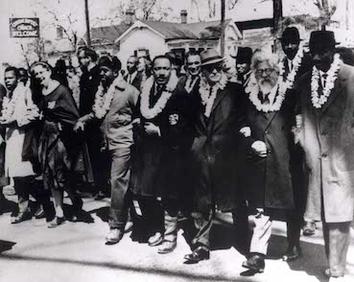
Abraham Joshua Heschel at a convocation at Congregation Kehillath Israel in Brookline, MA in the 1960s.   That's my father, Cantor Michal Hammerman, leading the procession.


We received this lovely thank-you note from the staff of Building 1 Community 
after the holiday party we prepared for them in December. B1C  facilitiates the successful immigration of immigrants and their families to our area. We are proud to work with them toward that end, so that all who reach our golden shores will feel embraced by their community.


Shabbat Shalom

Every so often the stars align, where MLK Weekend coincides with the yahrzeit for Abraham Joshua Heschel and the portion of Shemot - the first portion of the book of Exodus.  That's the part where the Israelites are enslaved and Moses receives the call the prophecy.  Such is the case this year.  Heschel's yahrzeit was this week, on the 15th - coinciding with King's actual birthday.  In honor of that yahrzeit, I'm focusing on Heschel in this O-Gram.

Both great leaders were prophets who spoke a lot about the ancient Israelite prophets, who, according to Heschel, were the ones who first commented on the evil of indifference.  They also walked together in Selma.
 

On Friday night, Beth Styles will again join us, and she has produced a very special MLK Weekend service, assisted by Jason Terry and the New World Chorus.  It will be a Gospel-Jewish Mashup, worthy of Heschel, King, and, for that matter, Moses.  This is something I approached her with months ago - a way to celebrate this special weekend as it needs to be celebrated: with a love that reaches beyond one faith group within our community.  We will be sprinkling in relevant quotes and thoughts related to one of Dr King's most lasting speeches, culled from the Talmud of MLK, a recent project of the innovative Jewish startup, "Repair the World."

Not to be outdone, on Shabbat morning we'll have another Shabbat-in-the-Round, where I will be joined by Cantor Deborah Katchko-Gray.  As we explore the portion of Shemot, a special point of emphasis will be the role of heroes, both known and unknown, in particular, Moses himself and the heroic Israelite (or Egyptian?) midwives Shifra and Puah, who saved Israelite boys from drowning at the hands of Pharaoh's evil decree.  Join us for breakfast - service begins at 9:45, and then a kiddush lunch follows.  Read more about those mysterious midwives from TheTorah.com and the Jewish Women's Archive, and here's another feminist take on the story. And preview the parsha packet here.


Also on my recommended reading list this week:
Secular Synagogues Taking Root in Israel (Tablet magazine) My own take on this phenomenon is that it's not far off from what many congregations here are doing, echoing ideas expressed a century ago by Rabbi Mordechai Kaplan, author of "Judaism as a Civilization."
How Shall We Pray During Impeachment? (Religion and Politics)  
Bitterly Funny Eretz Nehederet Israeli Show Spoofs "Elections 2030" and Absurd Political Reality (JPost)  I watched it on Israeli TV - really funny - and it's good to know that Israelis still know how to laugh at themselves.  Over here, SNL is still struggling to find its voice.
Fifth World Holocaust Forum (Yad Vashem website) will take place on Jan 23, next Thurs., and world leaders will converge on Jerusalem as the world commemorates the 75th anniversary of the liberation of Auschwitz the following week. The event will include speeches by will include speeches by Heads of State from France, Great Britain, Russia (yes, Putin will be there), the United States (VP Pence) and Germany.  


Middah Yomi:  Daily Dosage of Jewish Values for 2020
This week's focal point for character building:  

Spiritual Audacity: 
The Legacy of Abraham Joshua Heschel


So what is there to say about Abraham Joshua Heschel's legacy, 48 years after his passing?  
His accusations against the American Jewish establishment were piercing, often characterizing it as shallow, materialistic and indifferent.  He was also critical of rabbis and synagogues, saying:
Quote #1: "Has the synagogue become the graveyard where prayer is buried?  Are we, the spiritual leaders of American Jewry, members of a burial society?  There are many who labor in the vineyard of oratory; but who knows how to pray, or how to inspire others to pray?  There are many who can execute and display magnificent fireworks; but who knows how to kindle a spark in the darkness of a soul?"    

His daughter, Susannah Heschel, wrote the following in Tikkun on the occasion of his 25th yarhzeit, summing up his many contributions:

Quote #2"So much of what Jews have created in the last 25 years stems from Heschel's inspiration: the Havurah movement, social-conscious political activism, the revival of Jewish spirituality, renewed interest in Hasidism, creative Jewish theology, the renewed pride in being Jewish.  What we are missing today, however, is the voice of moral leadership that we heard with Heschel, and, I add, with Martin Luther King. His prophetic tradition has been replaced by voices of witness that describe anti-Semitism, voices of doom that decry statistics of assimilation, and voices of anger that insist on narrow definitions of Judaism.  They leave us with a cynical taste in our mouths; none that gives us the transcendent vision we need.  Today, in celebrating my father's memory, we have to bring to life the joyful and thoughtful aspects of Judaism he taught and exemplified: that we are all made in the image of God, that God's creation is filled with wonder and awe and that God needs us as partners in caring for our fellow human beings and all of creation."


And now, with a full generation having grown to adulthood since Heschel's death, it is easier to see just how profound and lasting his influence has been. The activism that this generation of rabbis (and many of their congregants) espouse is Heschelian activism, as distinguished from the New Dealism that characterized the prior generation.  It still trends to the left politically, but it is based on a vision steeped in Heschel's Hasidic roots, his joyous spirituality, his unabashed love of Judaism and his unbending willingness to speak truth to power.  Heschel practically invented the modern notion of "Tikkun Olam," joining it to Martin Luther King's bending the arc of history.  He was the one who "prayed with his feet" at Selma and who, in protesting against the Vietnam War, said famously:

Quote #3 "In a free society, some our guilty, all are responsible."

Heschel was an unashamed Zionist and even saw glimpses of messianic fulfillment in Israel's 1967 reunification of Jerusalem.  Still, he was clear that "We do not worship the soil," meaning that the land is not holy; it is, he affirmed, a place where holiness is to be created. So, although he did not live to see the results of Israel's continuing possession of the Territories and the failed attempts at peace, it is fair to speculate that he would not be a supporter of holding on to the biblical land of Israel for religious purposes. It is also fair to say to suggest that Heschel's activist legacy is directly responsible for the civil disobedience of the "Women of the Wall," which has long sought opening of the Western Wall to egalitarian prayer.

In his essay, "Existence and Celebration," (found in the collection "Moral Grandeur and Spiritual Audacity," Heschel distinguishes between Jewish survival and renewal. It is an important distinction, one that we should draw, because American Jews have gotten stuck in a survivalist trap.  Heschel writes that it is more productive to be preoccupied with enhancing the present than to nurture fears about the future. Here we are, living not in the moment, not in awe of the moment and of God's presence in this moment, but living in utter fear of whether our great grandchildren will have a Christmas tree.  Heschel would advise us to let the future take care of itself.  He scoffed at surveys. 

Quote #4: "Our community is in spiritual distress," he said, "and some of our organizations are often too concerned with digits."  He bristled at the stifling of criticism within organizational life, the "dogma of infallibility," as he called it. The true problem, he said, is not how to survive, but what to survive for.

Heschel did not live in a world of potential Iranian nukes, but Israel was no safer then than it is now. The existential dangers to Jewish survival are, in fact, far less severe now than at any time in Heschel's life. But even while the Holocaust was still going on, he quoted the Ba'al Shem Tov in stating,

Quote #5: "If a man has beheld evil, he may know that it was shown to him in order that he learn his own guilt and repent; for what is shown to him is also within him." 

To that Heschel added:

Quote #6: "Soldiers in the horror of battle offer solemn testimony that life is not a hunt for pleasure, but an engagement for service; that there are things more valuable than life.... Either we make (the world) an altar for God or it is invaded by demons. There can be no neutrality. Either we are ministers of the sacred or slaves of evil. Let the blasphemy of our time not become an eternal scandal. Let future generations not loathe us for having failed to preserve what prophets and saints, martyrs and scholars have created in thousands of years."

In words spoken at the General Assembly of North American Federations toward the end of his life, he waxed prophetic about what it meant to be part of a Jewish community in America. What Heschel said then, and what is true now, is that Jewish institutions have fallen victim to what he calls "a campaign of spiritual liquidation," a malaise of hopelessness that leads only to more blaming and bitterness, to a basic view of Jewish existence that sees only the negative, that speaks only in material terms.   He said:

Quote #7: "Our institutions maintain too many beauty parlors.  Our people need a language and we offer them cosmetics.  Our people need style, learning, conviction, exaltation and we are concerned about not being admitted to certain country clubs.  To paraphrase the words of Isaiah: What is to me the multitude of your organizations says the Lord.  I have had enough of your vicarious loyalty.  Bring me no more vain offerings; generosity without wisdom is an evasion, an alibi for conscience....We are ingenious in fund raising, which is good; we are shipwrecked in raising our children, which is tragic.  We may claim to be a success, but in the eyes of Jewish history we may be regarded as a failure."


If we are to bring the spirit of Heschel into our Jewish communities, we must place spiritual growth above all other goals, including survival itself.  For without God, without a sense of covenant, without Torah and Sinai in our midst, there is nothing to survive for.  The human being without God, he exclaims, is merely a torso.  We have built a fine midsection.  Have we lost the head?  Have we lost the heart?  Have we lost the soul?

Shabbat Shalom  

Rabbi Joshua Hammerman


To sign up for our Eastern Europe trip, 

Friday, January 10, 2020

Shabbat-O-Gram for January 10: Sanity and Sanctity: To Shame or Not to Shame; No Hate, No Fear, No Empty Seats

Shabbat-O-Gram 


Photos by Aviva Maller from last Sunday's "No Hate No Fear" rally, 
held at Temple Beth El, and convened by the United Jewish Federation, 
assisted by the Interfaith Council, Board of Rabbis, AJC and other groups.
Audio and other photos from this historic event can be found here


Shabbat Shalom

Services on Friday night, led by myself and Katie Kaplan, will be family style at the special time of 6:30 - it will be the only Kabbalat Shabbat service we will have this week and will include the calling of Yahrzeit names. If you wish, join us for an informal bring-your-own dairy or vegan Shabbat dinner beforehand, at 5:30.  It's a great chance to meet new people and bring the warmth of a Shabbat community into our lives - and don't we need it! 

On Shabbat morning, Cantor Debbie Katchko-Gray will be with us.  Lot's of action on the adult ed front.  This week's Torah portion is Vayechi.  We'll be discussing how anti-Semitism distorts our vision, and we'll see an interesting example from Torah commentaries. Preview the Parsha Packet here.  Also, see last week's parsha packet, looking back at the 2010's and calling on us to take the long view

Join me and Rev. Shelley Donaldson of the First Presbyterian Church (the "Fish Church") for a six part interfaith conversation on the biblical books of Psalms, Proverbs, Lamentations, Job and Ecclesiastes, to be held at Edgehill Retirement Community on Palmers Hill Rd in Stamford.  The mini-series, organized by the Interfaith Council, runs on Thursday afternoons from Jan 16 - Feb 20, form 2-3 PM and is open to the public.

And our JTS "Beyond Dispute" series finally gets underway this Tuesday at 7:30. after some weather delays.  Read about it here.  We've got about 20 registrations already.

A must-see article:

 "I never anticipated feeling that the allegations against my father would bring me such sorrow and purpose. I see now that the place that has brought me the greatest pain has also empowered me to offer strength to others who are also in great pain. My music has forever been changed by this hard learning. My very voice is not the same." Read the whole essay

NYT's 52 Places
The New York Times just published its 52 Places to Go in 2020 and low and behold, you can visit one of them, Krakow, with us this summer.  Check out our TBE Eastern Europe trip!  Caesarea, Israel is also on the list.

No Hate.  No Fear.  No Empty Seats.

We had well over 500 people at last Sunday's community vigil (see photos above), and it was especially gratifying how many of our non-Jewish neighbors came, along with an extraordinary turnout of state, local and national politicians and law enforcement representatives.  Ariel Sobel wrote in the LA Jewish Journal that what really made the "No Hate, No Fear" event in New York monumental was that in these past three years, no one has wanted to march with the Jews.  So often, as other worthy causes gave rise to protest marches, Jewish groups have been told "thanks but no thanks."  But that changed this week.  And here as well, to see faith leaders across the board grace our bima and take time out on a Sunday night to join in the cry of outrage against anti-Semitism, that was really important.
  
And everyone spoke so movingly.  You can hear the audio for yourself and see what I mean. This did not sound at all like a political event.  The support was unconditional and across the board.The love was real.  So were the tears.

Thank you to Diane Sloyer and the UJF for their instrumental role in making this event come about.


Wendy Miles' Daf Yomi Experience

TBE's Wendy Miles just completed the 7 1/2 year cycle of Talmud study called Daf Yomi (a page each day).  Here's what she has to say about the experience: 

I started studying Dof Yomi at a time in my life when I felt I needed some structure. Do to my work schedule I don't attend everyday, but I do attend 4-5 times each week. I started about 14 years ago. I missed 3 years out of the 14 years do to having to say Kaddish. I enjoy the group I study with because each day a different person leads the learning, including lay people as well as rabbis from different denominations. I feel you could be an agnostic/atheist and still gain many insights from the Talmud. The most important thing that I gained from my study is to try like the great sages of the Mishnah/Gemarah (Talmud) to examine each situation from all different directions.  Even when you examine things from the top,bottom,front,back,left and right you may not necessarily come to a conclusion, and to have the confidence that it may be revealed at a later time. It is imperative to view things in all directions to even begin to make an informed decision.

Obviously, Daf Yomi is not a method of study for everyone. There isn't any subject you can think of that is not addressed in the Talmud. Though this great body of work goes back almost 2,000 years it still has relevance today , even though many of the topics are  not things we deal with nowadays . As a woman I had to accept the very different cultural in which this body of work was written . Though this is also true of all history from this time.
Like the Torah , each time you read the Talmud new ideas are revealed.
I can't wait to begin again at a celebration (Siyyum) on Sunday .

Here's what comedian Rob Kutner wrote about it for the Hazon newsletter:

As strange as it might sound, doing Daf Yomi has a lot of connections to Hazon's mission. First of all, the very idea of introducing a daily discipline, changing your lifestyle habits, is at the core of building a more sustainable world. Second, the idea of undertaking a 7 1/2 year commitment is so out of step with our modern world, and yet so necessary to taking the long view of the world that we must. As for the content, it provided me endless views into more ancient, pre-industrial worldviews that in some ways would benefit us to reconsider. It exposed me to a dizzying range of discussions as to what constitutes "Jewish values," showing that they are ultimately not set in stone (besides those, you know, tablet things) but must be grasped and shaped in each generation. And finally, studying Daf Yomi put me in connection and conversation with a wider variety of Jews than I normally traffic with.

Last week, I shared the exciting news that we can now do Daf Yomi on our own.  First, read here what the Talmud is all about.  And if you click here, you can find out how you can receive via email a daily dose of Talmud.  I've pasted below one of those daily doses, which happens to be the first one (delivered last Sunday morning).  You can find the actual page from the Talmud here.  Take a look at the text and commentary.  Sign up for the emails.  If there is interest we can facilitate group conversations as well.

 
Berakhot 2

Welcome to our first day of Talmud study! Let's begin at the very top, with the first words of the first mishnah. The question at hand is what time to say the Shema, one of Judaism's most fundamental prayers, recited twice daily:

From what time does one recite Shema in the evening? 
From the time when the priests enter to partake of their teruma.
Until the end of the first watch - this is the statement of Rabbi Eliezer.
The Rabbis say: Until midnight.
Rabban Gamliel says: Until dawn.

There is some technical stuff in here. You might be wondering what time "the priests enter to partake of their teruma" or when we might expect to encounter "the end of the first watch"? Turns out, the rabbis of the Talmud also aren't sure either; the Gemara asks these same questions.
 
Notice something else: The mishnah opens the discussion with a flurry of opinions. How late is too late to recite the evening Shema? Until the end of the first watch! Until midnight! Until dawn! This gives us a big clue to what the Talmud is: a complex, often free-wheeling inter-generational discussion. And as we'll see repeatedly, the goal is rarely to simply answer the question.

The Shema is one of the most important prayers in Judaism, and it is traditionally recited twice daily, morning and night. You might expect that the Gemara would begin by sorting through the different answers to the question of exactly what time one should recite it and tell us which is correct. But it doesn't. Instead, it asks an additional question, a meta-question: Why does the Mishnah start with a question about the evening Shema? Wouldn't it be more natural to start with morning Shema? 

The Gemara then offers two answers to its own question. The first is this: The Torah states that the Shema is recited "when you lie down and when you rise up" (Deuteronomy 6:7). Since the Torah mentions lying down first, the rabbis follow suit and explain the evening Shema first. This already tells us a lot about the rabbis: they take the Torah - God's word - very seriously, subjecting it to a microscope and drawing meaning out of every single word (even, in some cases, every letter). Nothing in the Torah is too insignificant to escape their notice. As we will see in the course of this series, they are pretty creative in how they do it.

But one answer is not enough. The Gemara gives a second answer to the question of why the Mishnah interrogates the evening Shema before the morning Shema. In the Torah's account of the creation of the world, each day was "an evening and a morning." That is, the Jewish day begins not at midnight or sunrise, but at sundown. That's why Shabbat and other Jewish holidays begin with lighting candles at dusk. So evening really is the beginning of the day, and that makes the evening Shema the first act of prayer on any given day. 

So let's review: The Mishnah begins with a question and multiple opinions. Rather than choosing the right answer, the Gemara asks another question and then gives two more answers. That's typical of how the Talmud works, which is why it is often compared to an ocean, churning with questions and discussions. And congratulations, we've just dipped a toe! In the coming weeks, we'll wade in further and see what this proliferation of questions and answers is all about.
 
A final note for those wondering why our first email is on Berakhot 2. We didn't miss page one! We're starting on page two because in printed editions of the Talmud, page one is a cover page.
Meanwhile, here is a character-based alternative for daily reflection during this pivotal and turbulent year, something I introduced last week:

Sanity and Sanctity: To Shame or Not to Shame
Middah Yomi:  Daily Dosage of Jewish Values for 2020

This week's Middah (character trait) - 
Do not embarrass others (mostly)


Here are your seven doses of sanity for this week, demonstrating Judaism's focus on not embarrassing others.  Some have gone to extraordinary lengths to avoid shaming.

1) Once when their teacher had left the room for a few moments, Rabbi Moshe Feinstein's students once accidentally spilled a bottle of ink on a volume of the Talmud on the rabbi's desk.  Everyone freaked out, worried because this was the rabbi's most beloved set of books.  When Feinstein returned to the room, he saw the new blue page and said, "Doesn't this passage look wonderful in blue?"

2) The Talmud exclaims that "It is preferable for an individual to throw himself into a burning furnace rather than to publicly mortify his companion."  Public embarrassment is forbidden.  

3) Pirke Avot (3:15) lists embarrassing one's neighbor as one of five acts that will prevent someone from having a share int he World to Come. 

4) Maimonides concurs, saying, "One must not call another by an embarrassing name, nor relate a shameful matter in their presence, whether one be of greater or lesser stature."  

5) Even in private, the 19th century sage known as the Chafetz Hayyim states that it is transgression to speak to a sinner in a harsh manner.  

6) Rabbi Jonathan Raziel of Ma'aleh Adumim discusses the question of whether the listeners in synagogue should correct a Torah reader, even when this could embarrass the reader. Raziel's answer: Not embarrassing the reader takes precedence over hearing the Torah being read correctly.

7) It seems clear that had social media existed in their time, Maimonides and the Chafetz Hayyim would have stayed off of Facebook or Twitter, where public shaming is commonplace and vitriol is viral.  Or they would have helped to civilize it.  Long before Facebook existed, the rabbis recorded in the Midrash (Bereshith Rabbah 98:23), "What is spoken in Rome can kill in Damascus." Now, with that same distance traversable in a millisecond, all the more so, these words can kill.

All of that said, I think there are times when shaming is absolutely called for.  The photos of the devastating wildfires in Australia have been heartbreaking.  See this CNN report about a "kangaroo killing field," a completely destroyed habitat.  Yet, as Paul Krugman wrote in the Times today, the Australian government refuses to take responsibility.  My proposal is that we start naming natural disasters after those whose activities are putting us and our children in such peril.  We can begin with hurricanes, wildfires, floods, heatwaves and droughts. Maybe blizzards too.  There are enough deniers to go around.  Would the rabbis agree?  Well, if what's spoken in Rome can kill in Damascus, what's legislated in Canberra can kill here.  So, yes.


As Australian Wildfires Rage On, Rescuers Race To Save Animals | TODAY
As Australian Wildfires Rage On, Rescuers Race To Save Animals 


Shabbat Shalom  

Rabbi Joshua Hammerman

Friday, January 3, 2020

Fighting Anti-Semitism - No Hate, No Fear


Audio for "No Hate No Fear" Rally at Temple Beth El, Stamford, Jan 5, 2020

The rally, held at Temple Beth El, was convened by the United Jewish Federation, 
assisted by the Interfaith Council, Board of Rabbis, AJC and other groups.

Report on News 8 on Meeting of Jewish and political leaders discussing anti-Semitism
Photos from the Jan. 5 rally (most by Aviva Maller Photography).  Click to enlarge each photo.