Thursday, May 19, 2022

In this Moment, May 19 - Lag B'Omer: A Hilula-Hootenanny; Hoodwinked into Hate; the Reconquest of Jerusalem Day


In This Moment

The Shabbat-O-Gram is sponsored
by Aviva and Greg Lederman in honor of their son,
Jacob, becoming a Bar Mitzvah.

A Hilula-Hootenanny

Shabbat Shalom and Happy Lag B'Omer

Lag B'Omer, the Jewish version of May Day, began Wednesday night and continues through Thursday. We watched live coverage of some of the proceedings from Mount Meron at the conclusion of our weekday minyan on Wednesday. Click on the photo above to see some of the dancing in real time. You can read all about this quirky, obscure minor holiday, known for bonfires, weddings and haircuts, here.  Fortunately, there was no repetition of last year's tragic accident at the mountain, which is near Safed, when a crowd crush at the site killed 45 in Israel's worst civilian disaster. This year, only about 16,000 people are permitted to be on the mountain at any given time, compared to about 70,000 in previous years.

We're celebrating here on Thursday night with a Hootenanny. According to WikipediaHootenanny is an Appalachian colloquialism that was used in the early twentieth century U.S. to refer to things whose names were forgotten or unknown. In this usage it was synonymous with thingamajig or whatchamacallit, as in: "Hand me that hootenanny" (which makes me wonder whether the Little Mermaid came from Appalachia). But it also is an old word for a party with lots of folk music.

In Hebrew, a Hilula for Lag B'Omer is pretty much the same, a big party with tons of Klezmer and other folk music - except the party is in honor of the anniversary of a great sage's death, the Rashbi (Rabbi Shimon Bar Yochai). Are we the only people that celebrates the anniversary of a death with song and dance? Yahrzeits are always a little sweet-bitter, but not normally cause for such crazy merry-making. Kabbalists believe that Shimon Bar Yochai wanted people to rejoice on the anniversary of his departure from this world. The Zohar uses the term “hillula,” which is like a wedding celebration, in the belief that clinging to the Shechinah (God's Presence) in this world is like an engagement, while clinging to that Presence in the next world is more comparable to marriage.

According to the work "Peninei Halacha" by Rabbi Elezar Melamed, in Kabbalistic lore, death is perceived differently in this world than it is in the next. In this world, when a tzaddik (holy person) dies they leave a great void, but in the supernal world, the tzaddik is freed from the shackles of this world and is privileged to absorb the full light of Torah. This is especially true of tzaddikim who engage in the esoteric side of the Torah, for they are mainly involved in the inner, hidden light of the soul. As long as they exist within the physical confines of this world, they cannot absorb the full inner light. However, when they depart this world and go beyond its physical boundaries, the gates of wisdom and the inner light are opened wide before them. Then, they understand the depths of the secrets they studied during their lives. Already on the day of death, it is possible to discern that the “walls” and “barriers” of this world are fading away. Accordingly, Idra Zuta relates that on the day Rashbi died, he revealed deep and wondrous secrets that he was not allowed to reveal beforehand, and he [simultaneously] cried and laughed. (See the full text in the original and translation - also download the pdf. It is like nothing you've ever read in your Jewish studies).

Hoodwinked into Hate

As Jews, we tend not to see death as a release for the suffering of life. But in light of the senseless hatred that continues to infect our world, as evidenced once again in Buffalo last weekend, it is hard to argue with the Kabbalists' contention that our earthly vision is constrained by the physical limitations of our mortal existence.

Human beings are severely limited. We are lacking the moral clarity that only reaches us when it is too late to do much good down here. How else do we explain how so many otherwise intelligent beings are hoodwinked into hate? This month, the Philippines elected the son and namesake of the one of the worst dictators of the 20th century, as their new leaderBy a landslide! How insane is that? Russian citizens and soldiers are blindly devouring their dictators' poisonous lies and leaping into a genocidal abyss. Repeating the sins of their Soviet ancestors' decimation of Ukraine in the 1930s. And in this country, Replacement Theory has replaced the Protocols of Zion as the most lethal and dangerous pack of lies ever to be spread on a mass scale - and increasingly it is being given legitimacy by those in power who refuse to discredit it.

The perpetrator of the Buffalo murders bought into focus this pack-O-lies, replete with racism, nativism and antisemitism. For those who are keeping score, Jews are mentioned more than a hundred times in this hater's "manifesto."

The Forward adds: "In a Q&A in the document, he identifies proudly as an antisemite and as a supporter of neo-Nazism. He misquotes the Jewish sacred texts, writing: “The Talmud (or the rabbi’s holy book) teaches Jews that they are God’s chosen people and they are permitted to hate and exploit the goyim, and to allow pedophilia. Jews will tell you that they do not support these any more, but in reality this is what they all seek.” He continues: “For our self-preservation, the Jews must be removed from our Western civilizations, in any way possible.”


But he is not alone in espousing these beliefs, which can no longer be called a fringe phenomenon. Yair Rosenberg wrote this week:
Scrolling through the shooter’s fulminations about people like me, I felt a certain ironic detachment. It was impossible to square his dark delusions with my actual existence. By day, I’d been trying to amuse my 16-month-old, because her mother has COVID and is staying isolated in our bedroom. By night, I am sleeping on the couch. Like most Jews, I have not exactly had time to plot and perpetrate white genocide.
Shimon Bar Yochai taught, "A person on a boat began to bore a hole under his own seat. The passengers protested: ‘Unfortunately, when the water enters, the whole boat sinks.'”

Bar Yochai understood that we are all in the same boat. Maybe that was the secret he could only reveal at the moment of his death - that idea that we are all interconnected. He discovered an intersectionality of souls. The single light that shines on the righteous also disinfects the rest of us. The hatred exhibited by this Buffalo murderer was too great to encompass just one ethnic group. The attack on a Black neighborhood in Buffalo was an attack on all of us. All Jews and Blacks were in the crosshairs, as well as everyone who has ever been perceived as "different,"

So by all means, let's celebrate a Hilula-Hootenanny on Lag B'Omer. But at the same time that we dance around the flames of redemption, we need to become aware of the truths are being revealed each day in our imperfect, unredeemed world. Unlike Bar Yochai, we do not have the luxury of freeing ourselves from the shackles of our world, our bonfire of venalities. We've got too much work to do and we can't wait for death to provide the answers.

We've got to figure out what makes people so susceptible to lame-brained conspiracies, social media trolls, power-hungry TV hosts and cynical authority figures bent on seducing or cudgeling them into to doing unthinkable things to their neighbors.

Maybe on this Lag B'Omer, Simon bar Yochai can reach down to us with some guidance from heaven. Because right now, humanity hasn't got a clue.

The Re-Conquest of Jerusalem Day

The air over Jerusalem is saturated with prayers
and dreams
like the air over industrial cities.
It's hard to breathe.                          - Yehuda Amichai
Jerusalem Day, the anniversary of the unification of Jerusalem in 1967, falls on May 29 this year. It marks 55 years since the day that changed everything. Most holidays tend to be reinvigorated over time. Lag B'Omer is a perfect example, assisted by an increased interest in Kabbala and the need to get outside as the weather warms.

Jerusalem Day, alas, has become diminished as it has been usurped by Israel's right wing in its desire to push an in-your-face assault on the city's Arab population with obnoxious marches through Muslim neighborhoods. That will continue to be the case this year. In an analysis in Ha'aretz, "Year After Gaza War, Right-wing March Endangers Not Only Jerusalemites," Nir Hasan writes that "politicians have no choice but to allow the parade, which is often accompanied by violence and racist chants, year after year." This year's "celebration" began early, with the push by Kahanists to pray - and sacrifice goats - on the Temple Mount during Passover.

It's sad, because Jerusalem Day celebrates a modern miracle, the fulfillment of a 2,000 year old dream, and it is a day all Jews should celebrate. Rather than allowing the Kahanists to become the Grinch that Stole Jerusalem Day, we should find way to reclaim it.

So let's do that. Click here for a map of the battle of Jerusalem and here to see video of the historic moment when the Israeli troops liberated the Western Wall. See also a packet of historical maps, poetry and information that I prepared For big newspaper fans like me, this site has newspaper front pages and major stories from those fateful days in June. In this L'Chayim interview marking the war's 40th anniversary, about seven minutes in, you can see my personal reflections on how 1967 changed my life.

For a more balanced perspective, see these sobering reflections that were published five years ago, as we marked the Jubilee (Yovel) of the Six Day War, or read this Yovel sampler containing text study and poetry. This week's portion of B'har actually introduces the concept of Jubilee, the fifty year mark that ideally brings about complete liberation for the land and its inhabitants. Despite Jerusalem's miraculous liberation, we are not there yet.

I believe the time has come to restore Jerusalem Day to its former glory, much as the city itself has been restored in so many ways. But the way to do that is through reflection and dialogue, and the understanding that the best things in life are those things that are shared.

Stones (Shirley Kaufman, 1996)

When you live in Jerusalem you begin
to feel the weight of stones. You begin to know the word
was made stone, not flesh.

They dwell among us. They crawl
up the hillsides and lie down on each other to build a wall.
They don’t care about prayers,
the small slips of paper
we feed them between the cracks.

They stamp at the earth
until the air runs out
and nothing can grow.

They stare at the sun without blinking
and when they’ve had enough,
make holes in the sky
so the rain will run down their faces.

They sprawl all over the town
with their pitted bodies. They want
to be water, but nobody
strikes them anymore.

Sometimes at night I hear them
licking the wind to drive it crazy.
There’s a huge rock lying on my chest
and I can’t get up.  
Recommended Reading
(and Listening)
Lecha Dodi

  • Who owns women’s bodies? (Alicia Ostriker - Shalom Center and Bible Review) The age-old answer is that women are the property of fathers, brothers, husbands, who are entitled to buy and sell them, or even, as in “honor killings,” to kill them.  Here in America the idea that women can be proud owners and caretakers of themselves and their own bodies has been taking hold gradually—and with many setbacks, such as we see being played out in the issue of abortion presently before the Supreme Court.Judaism has a lot to say about women’s bodies, and some of the stories preserved in Torah are truly shocking.  For me, one of the most painful and provocative texts in scripture is the story of Jephthah’s daughter in the Book of Judges (Judg. 11: 30-40). The story is worth remembering because it is so stark—yet it leaves open a gate for healing.


  • When New Seat Belt Laws Drew Fire as a Violation of Personal Freedom (History Channel). A thought experiment, as we face the daunting reality of yet another Covid surge. While no one wants to go back to full lockdowns, a little sechel (common sense) is in order, especially with regard to simple safety measures like wearing masks. So replace the word "mask" with "seat belt" in any conversation about these lifesaving contraptions. As in: "How dare the government force us to wear seat belts!" You can also substitute, "...tell us where we can smoke" or "force us to drive under 100 miles per hour!" Really! What nerve! See also, Before face masks, Americans went to war against seat belts (Business Insider).

  • WZO strongly condemns the violence towards Women of the Wall (Merkaz Olami) An unusual event occurred at the Western Wall on Monday, May 2, 2022, Rosh Chodesh Iyar. Women of the Wall, who have been persisting in their prayers every Rosh Chodesh for almost 30 years, and who often are faced with curses, spitting, and physical violence, were amazed that this time, some of the offenders did so with the World Zionist Organization (WZO) flag in their hands. The investigation of the incident revealed that two departments in the WZO, departments whose leaders are affiliated with Eretz Hakodesh and with Shas Olami, initiated cooperation with the extremist organization Leeba Yehudit (Mercaz Liba), and in fact approved the WZO sponsorship for its violent activities against Women of the Wall. 
  • Leeba Yehudit is an extremist and zealous organization, which has waged a struggle against Jewish pluralism and against the Reform and Conservative movements in particular; Against the Kotel compromise; Against the LGBT population; Against women's service in the IDF, and more. The activities of the organization are often of an abusive and violent nature.
  • This was the case when their people corrupted and tore dozens of siddurim of Women of the Wall during a Rosh Chodesh prayer in June 2021. This was the case when they broke out on the evening of the 9th of Av and erected a partition at the egalitarian Kotel and prevented the Masorti movement prayer in July 2021, and this is what happens routinely - groups on their behalf simply come with a mechitza (gender partition) to the egalitarian Kotel only to disrupt prayer. 
  • We are proud to announce that the executive of the World Zionist Organization convened today and made a significant decision that strongly and unequivocally condemns the occurrence of and violent behavior that took place under its auspices and uses its symbols, and establishes a total ban on collaborations with bodies that condone violence, contempt, harassment or violation of the legitimacy of members or bodies in the Zionist movement in their activities, and from this it goes without saying that the World Zionist Organization will not cooperate with Leeba Yehudit and similar organizations.
  • We thank the chairman of the World Zionist Organization, Yaakov Hagoel, for examining things in-depth and for partnering with us in leading this important decision that will prevent the recurrence of such cases in the future.For the decision in full click here.
Shabbat Shalom!

Rabbi Joshua Hammerman
Temple Beth El
350 Roxbury Road
Stamford, Connecticut 06902
203-322-6901 | www.tbe.org
  
A Conservative, Inclusive, Spiritual Community

Thursday, May 12, 2022

In this Moment, May 12 - The Greatest Shul on Earth; Scenes from a Marriage I and II


In This Moment

Scenes from a Marriage I
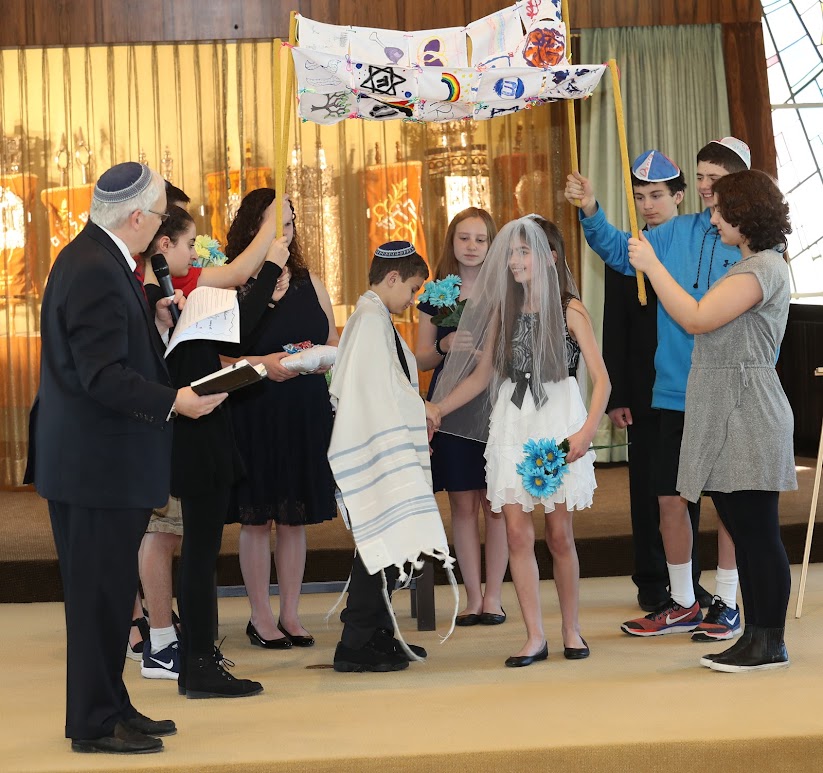
Who needs Ingmar Bergman when our seventh grade classes have been celebrating Jewish marriage for a decade and a half! Year after year, classes have worked tirelessly to prepare their mock wedding ceremonies as part of the grade's innovative Jewish lifecycle curriculum, which was first developed in 2008 by educational director Eran Vaisben, along with Mara Hammerman. This year's class celebrated its mock wedding last Sunday. We did the class bris during the winter, the World Wide Wrap (the B'nai Mitzvah unit) a couple of weeks ago, and for their final lifecycle unit, on death, they will be visiting the cemetery next week. Despite all the challenges of this hybrid year, we got through the entire lifecycle. Birth, B'nai Mitzvah and death are all important, but the wedding always brings out their best! You can see below the lovely ketuba and huppah that the students prepared for last week's ceremony.

Each year, the class discusses the wedding customs in great detail and decides how to stamp their own mark on the proceedings. In a nod to to our commitment to egalitarianism, this year's students decided to have the bride and groom each break their own glass, simultaneously.

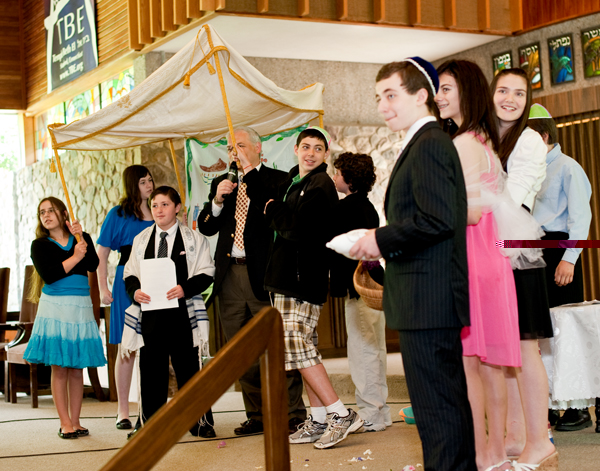
To celebrate the 15 years of seventh grade marriages, and the kids, parents and educators, and the teacher who led all of them, I've put together an album of assorted photos from 7th grade weddings, which you can access by clicking here.

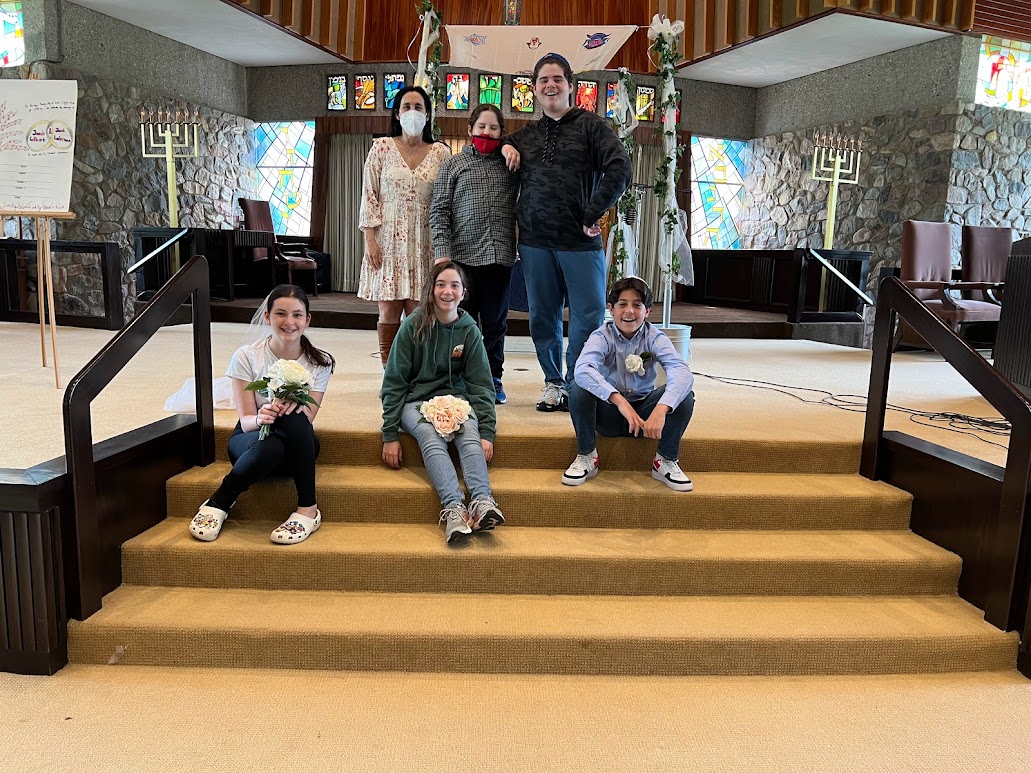
Below are some pics from last week.
If you want to take a trip down memory lane, here's our collection of current and past 7th grade lifecycle albums. Somehow 2009-2010 has gotten lost in the shuffle - if you have any photos from that year, please send them my way.


Someone asked me recently if any of the couples from prior years' class weddings have ever gotten married in real life. As the great 20th century theologian Franz Rosenzweig replied when asked about whether he puts on tefillin every day:


But as for the future, who knows?


Screen grab from last week's Sisterhood Shabbat.
Yashar Koach on a fantastic service!
Shabbat Shalom
Just so no one can accuse our services as being run like a circus, we have installed our own Big Top. Now we can truly be the "Greatest Shul on Earth." A floor has been put down, wi-fi access strengthened, sound systems prepared - and plans are for the TBE Ohel to be fully operational within a couple of weeks. In Hebrew, "Ohel" means tent, and a whole lot more.

Joel Hoffman, in his Jerusalem Post language columnwrites:
[W]hen Israelis greet one another on the streets of Jerusalem or Tel Aviv, it is not shalom or a longer variation of it, but rather the colloquial "ahalan" that is most often heard. Ahalan, borrowed directly from Arabic, comes from ahal, one of many words for "family." (The cognate Hebrew word, ohel, means "tent," that is a place where a family lived.) What better greeting could be offered to a weary desert traveler than to be welcomed into the protective shade of a tent or the warm company of family. Indeed, Abraham is known for his generosity in welcoming strangers into his family tent. And though tents are now rare in Israel, the cordial greeting pays homage to a form of ancient hospitality. Some speakers add wasahlan, "and to the plain," perhaps contrasting with, say, rocky mountains, and therefore alluding to a place of comfort. A loose translation of the pair might be, "make yourself at home" and "make yourself comfortable. Klein writes that ohel is "usually connected with but probably not related to Arabic 'ahl (= relatives, kin, kinsfolk, adherents, inhabitants, people)."

So a tent is all about hospitality, comfort, family and warmth (and I suspect it will be pretty warm in ours at times), all qualities that we seek to bring into everything we do, particularly services. I'm especially excited that we will be able to have a number of our hybrid Shabbat services there during the coming months, so that we can gather with the safety that outdoor ventilation brings. We'll continue to use other venues for services as well, including the sanctuary, and when the weather is nice, our cozy outdoor spot on the other side of the sanctuary windows. The goal is always to pray with feeling - Kavvanah - which literally means intent. So we'll pray in-tent (and sometimes out-of-tent) with intent. But with the breeze of outdoor ventilation, our intentional, in-tent praying does not need to be so intense, so filled with anxiety as so many indoor gatherings are now, with Covid rates moving upward again.

The family and friends of Alan Kalter, as well as others who participated in the paddle raise, helped to make this possible, and in doing so, will keep us safer and possibly save lives. But whether or not lives are ultimately saved, doing all we can for safety's sake affirms the Jewish value of protecting those whom we love. In the topsy turvy world we live in, we can now find some comfort under the Big Top.

Scenes from a Marriage II
Intermarriage and Conservative Judaism
Veteran journalist Debra Nussbaum Cohen wrote a lengthy update in the Forward this week on how Conservative leaders are dealing with the tricky topic of intermarriage, in light of the movement's longstanding ban on rabbis' officiation. A number of rabbis are quoted in the piece, spanning a wide variety of viewpoints. The matter has been long since resolved in both Reform and Orthodoxy; but one of the great assets of Conservative Judaism is its desire to forge consensus through dialectic. There is always tension between tradition and change, and that tension is what fuels the movement's creative energy.

Can the center hold? And more to the point, should it, at least on this issue? Holding the line against performing intermarriages has been a contributing factor in the shrinking of the movement. Is a leaner - and some might say meaner - Conservative Judaism a good thing?

Nussbaum Cohen writes:

Rabbis on either side of the debate say its outcome will be consequential for the Conservative movement, which represents about 20% of American Jews, and is shrinking. Those who want to lift the ban say it alienates Jews who want to intermarry, pushing them to other movements where rabbis are free to officiate at these weddings — or away from Judaism altogether. Others maintain that lifting the prohibition would signal that Jews are free to bend Judaism to fit personal preferences, and result in a weakened commitment to Jewish life. And what meaningful distinction between Reform and Conservative Judaism will remain, others ask, if Conservative rabbis do not draw the line at interfaith marriage?

“The number of rabbis grappling with it is growing,” said Keren McGinity, who was hired by the United Synagogue of Conservative Judaism, the congregational arm of the movement, to serve as its part-time interfaith specialist in 2020. This year, her position was made full time.

The article shows that there has been considerable movement toward leniency over the past several years and that the time has come for a more intense conversation, which could lead to more dramatic change. The 2020 Pew Research Center’s survey of the American Jewish community found that 61 percent of Jews married since 2010 wed non-Jews. We can't just dismiss out of hand nearly two thirds of the Jewish population - and a much higher percentage of the non-Orthodox population.

Our congregation continues to refine our vision, defining who we are and where we stand on the denominational spectrum. At TBE, we've always been on the more inclusive side of Conservative Judaism, and in recent years we have gone out of our way to welcome dual faith households, in ritual and worship and in our bylaws. We offer free membership for a year to all newlyweds, including those where one spouse is not Jewish. We offer special blessings for dual-faith couples here at the temple and worked closely with groups like 18 Doors, which provides guidance to couples and families.

For a wedding a few weeks ago, I wrote a congratulatory message that was read to the couple under the huppah. How could I not? I've known the bride since she was a child. In fact, the couple even used my father's portable huppah, which I've discussed in this context before. A few days later, I worked with another TBE-related interfaith couple about to be married, to develop their ceremony. It was a wonderful - and hopefully helpful - conversation.

Still, I've also had to deliver heartbreaking news to couples who have asked for my direct participation in their ceremony, and I've not been able to cross that line - a line that would likely result in my expulsion from the Rabbinical Assembly. I'm not prepared to leave the Movement.

In the end, for the most part, those who grew up here know that they will never be rejected by their home congregation and rabbi, even if I can't perform the wedding. Most understand that 20 minutes under a huppah cannot outweigh decades of unconditional love and support both before and after the wedding day.

The USCJ has had its own issues over the years, and TBE's departure from it years ago was justifiable. We've done just fine carving out our own identity - our niche in the local and national Jewish spectrum - with our unique approach to prayer and focus on cutting-edge traditional music. But it always helps to have a national movement to fall back on. And through my association with the Rabbinical Assembly, we have that. I'm not willing to let that go.

There are lots of wonderful things about Conservative Judaism, though I'm not crazy about the name and it can be a little wishy washy at times (OK, all the time). But it challenges us to be the adults in the room, to be thinking beings who take Judaism seriously and are willing to grapple with tough questions. We take tradition seriously; it anchors us, immersing us in authenticity, linking us to ancient stories and ethics - to Israel and to our eternal Hebrew language.

There are so many ways that Conservative Judaism is the right choice for today, embracing change and justice, while keeping Torah as our GPS - I'm not willing to give that up. Nor am I willing to be the reason TBE gives it up. With a nod to Women's League and Federation of Men's Clubs, it is really through its rabbi and cantor that TBE is bound to the Conservative Movement.


TBE is embarking on an important process of strategic planning. We need to. Our "2020 Plan," devised in 2012, expired two and a half years ago. The world has changed quite a bit even since 2020, all the more since 2012. But one thing that will certainly stay at the core of any updated plan that emerges, is the way we welcome the "stranger" into our tent. Now we even have the tent to prove it. How that spirit of inclusiveness aligns with our need to be part of something bigger than ourselves - a movement - has yet to be determined.
Recommended Reading
  • The ADL’s Crazily Irresponsible Crusade Against anti-Zionism - Is the ADL bending over backwards too far in its recent equating of anti-Zionism on the left with white supremacist antisemitism on the right? The arguments below have validity, but during a week after the Harvard Crimson endorsed BDS it is easy to understand why the ADL felt the need to make an adjustment to refocus on the dangers coming from the left. The authors write: By erroneously equating left-wing human rights activism to the powerful and fast-mounting threat of anti-democratic authoritarianism on the Right, Greenblatt and the ADL are actually helping to shift the focus on antisemitism away from where it belongs, undermining the much-needed concerted effort to protect the imperiled foundations of multiracial democracy in the U.S.


  • Pregnant women in America and Israel face starkly different choices – The Forward - America is the worst place in the Western world to be a mother. If Roe falls, millions of American women will have this broken system forced upon them. A better way for families is not an impossible dream — it’s what your Israeli cousins and colleagues live with everyday. Compared to Israeli policy, and the policy of every other wealthy country in the world, American policy is staunchly anti-family and anti-Mom.  


Shabbat Shalom!

Rabbi Joshua Hammerman
Temple Beth El
350 Roxbury Road
Stamford, Connecticut 06902
203-322-6901 | www.tbe.org
  
A Conservative, Inclusive, Spiritual Community