I initially posted a version of this a couple of years ago, but it is even more relevant now (and I have a whole lot more subscribers). Paul Krugman, newly liberated from the corporate media, contributed a tour de force on the topic of gambling in his Substack this morning, also including the stock market and crypto. Krugman’s points are well taken. My focus is on how the religious community has totally blown it with regard to this epidemic - and how there is no better week on the calendar to discuss it, especially for Jews, for whom both Hanukkah and Christmas are associated with gambling. Christmas, you say? Read on!
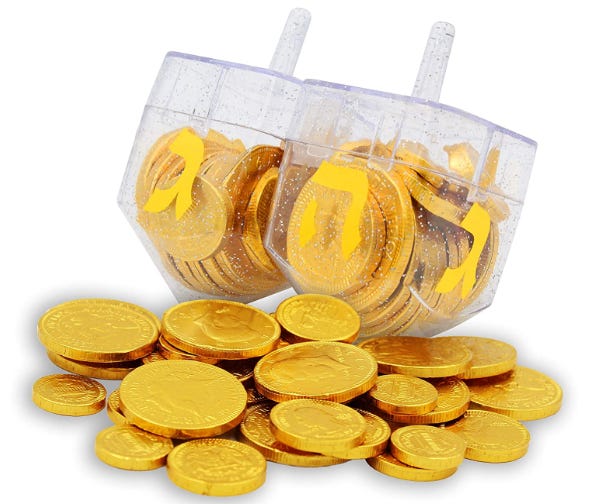
Hanukkah celebrates miracles of human heroism and divine providence. But it also celebrates incredible good fortune - pure luck - in life's game of chance; for the festival teaches that life is one continuous game of dreidel. You never know where you are going to land, but no matter what, you keep on spinning. Although this four-sided top has roots far removed from Judaism, the dreidel has landed on our space and has become a valuable means of teaching new generations of Jews to stay in the game.
But now a culture of gambling has overrun us and set our heads spinning faster than any dreidel can. It may be time to cash in our golden chocolate coins and look at the dreidel not as tool to counter assimilation but a reminder to defend those most vulnerable to addiction.
To gamble, in Hebrew, is l'hamer, which may derive from the three letter Biblical root heh-mem-resh connoting a torrent of gushing waters.
What a perfect metaphor. Gambling, like so many addictive activities, provides a rush every bit as exhilarating as those gushing waters, leaving us thirsty for more. Biblical editors could not have known about Las Vegas slot machines, where, as with playing dreidel, one minute you can be knee deep in jackpot winnings of golden coins, and then a minute later, the flood recedes and you're left standing penniless in a parched river bed.
But more likely, the word comes from the three letter root mem-vav-resh, which speaks to the conversion of currency and money changing hands.
Note that there is no stigma attached to such transactions, and aside from the occasional oracle or lottery, gambling as we know it is not a prime concern in the Bible. Rarely is it the focus of opprobrium, either divine or human. Sodom and Gomorrah were not destroyed because of a backroom poker game. But later authorities took the dangers much more seriously. And so should we.
Did you see recent the 2022 New York Times expose on sports gambling? It was one of those revelations that could be characterized as "shocking, but not surprising." Ever since the Supreme Court opened the door to widespread sports betting in 2018, an onslaught of wagering became inevitable, bringing with it a gambling culture that has turned America into a continental casino. What happens in Vegas no longer stays in Vegas. It's happening on every couch and easy chair and barstool in America. Every football game - no, every play - is making someone, somewhere, a lot of money.
Here are the key takeaways from the Times' series:
Gambling companies and sports leagues had a field day with state lawmakers.
To lure customers, gambling companies have struck envelope-pushing partnerships.
State regulators have often found themselves outmatched and overwhelmed.
From the moral perspective, this passage from the series bites especially hard:
The sports-betting industry has been creative in devising ways to persuade people to keep betting even after they lose money, but tools to make it easier to quit — some run by gambling companies, others by states — do not always work. In Indiana, for example, people who sought the government’s help to prevent them from gambling found that they were still able to place bets. Dozens did so.
We were not prepared for this onslaught. It just appeared, suddenly. First there were all those cute ads with the Mannings and suddenly networks were cutting away from to offer in-game prop bets. The game itself has become secondary, part of the stage set, a background to the bets, a prop to the props.
Religious institutions were not prepared (and still are not) to play the role that we were designed to play, that of moral umpire. When the ball is hit, someone's got to cry "foul!" or everyone will just keep on playing. As of yet, no one has cried foul, until this series in the Times, that is, and the weakest among us are the ones who are suffering, those least able to resist the temptations. While some are losing their shirt, we are throwing in the towel.
When Caesars struck deals recently with Michigan State and LSU, no one seemed to flinch about the corruption that is sure to appear on a campus near you.
Okay, let's make sure all those students saddled with gazillions in loan debt will leave school with gambling debts to boot. Nothing bad can come of that…
Online gaming exploded in growth during the pandemic. Forbes reports:
For the first half of 2022 revenue for sports betting totaled just over $3 billion compared to $4.3 billion for all of last year.
Also, Morgan Stanley forecasts revenue to reach $7 billion by 2025.
And in 2021 Americans bet $57.2 billion on sporting events, a year-over-year increase of 165%.
A recent Pew report indicates that addiction is hitting hard among those not yet legally allowed to bet. Keith Whyte, Executive director of the Council on Problem Gambling, says 4% to 6% of high schoolers are considered addicted to gambling. “We believe that the risks for gambling addiction overall have grown 30% from 2018 to 2021, with the risk concentrated among young males 18 to 24 who are sports bettors,” he said.
So when did religious institutions stop caring about this? Why have they been so slow to respond? If greed is one of the seven deadly sins, right alongside lust, anger and gluttony, why does it seem like some sins are more equal than others? The deadly sins are primarily a Christian thing (I’m not talking about who does ‘em, just who talks about ‘em), but there are Jewish parallels. So why does gambling receive such little attention when pastors break out their fire and brimstone?
Perhaps because some of these other societal issues have hit closer to home for religious groups, from the sex abuse scandals involving clergy (one database counts 6,000 Catholic clergy alone who have been implicated), to the excessive drinking encouraged in many synagogues (via those infamous behind-the-bima "Kiddush Clubs" or groups luring underage students to boozy Shabbat dinners). It cuts across denominational lines.
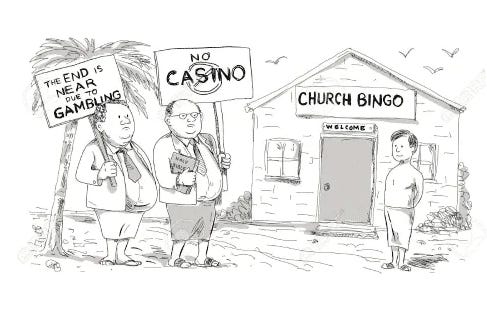
All too often, religious groups have been part of the problem rather than the solution. That's also been true with regard to gambling, but the stakes were never this high. For decades, religious institutions have been sustained by Bingo games and other small-scale wagering, but those foibles seem quaint when compared to sex abuse, embezzlement, intolerance and other assorted hypocrisies.
Also, we clergy have tolerated gambling because, well, we can't oppose every form of pleasure. If we become morality police, we'll end up like the Morality Police itself, which the Iranian government just had to disband. Evidently even the mullahs don't like being disliked. If our entire culture is leaning toward a wholehearted embrace of gambling, which one of us wants to be the killjoy, putting the breaks on this high speed - high stakes enterprise?
I mean, ESPN has essentially become a subsidiary of Gambling Inc. They now have an entire channel devoted to it, ESPN BET, “the official sportsbook of ESPN.” And since ESPN is owned by Disney, what small-town pastor wants to go up against Mickey Mouse? I hear they’re giving Gaston 2-1 odds against the Beast.
Better to simply lean back and enjoy the ride and not be the prophet calling out in the wilderness that this is going too far too fast.
Think of how things went for those clergy who tried to convince congregants that Covid dangers were still very real. As Covid fatigue set in in 2022, people in the pews began stripping off masks with the liberating abandon of the cast of Hair. And for the most part, religious leaders were too beaten down to resist. These days, we're doing everything with abandon. So why not gambling? Why should clergy stand in the path of fun? One reason I left the brick-and-mortar pulpit was that I just kept having to bump heads with those promoting gambling, drinking, mask tossing and, in a word, “fun.”
Maybe it's time for synagogues to start selling ad space for Caesars too, like LSU and Michigan State. Maybe it's time to hold services at Foxwoods. I live just down the road.
Hey, what could be so bad? Some of our best jokes are about gambling. And Jewish sources do not prohibit pleasure, but they are all about moderation. Natural urges like hunger and lust are not considered in themselves evil, and in fact often yield positive results. Without lust, for instance, there would not be procreation. A little gambling shouldn't hurt anyone, right? Is it wrong to play dreidel? For Jews in the shtetls of Europe, gambling on Christmas Eve was part of the annual "Nittel Nacht" celebration - their version of going out for Chinese food and a movie to wile away the loneliest night of the year.
While few rabbinic authorities have a problem with recreational dreidel games, one rabbi suggests that all winnings must be given to tzedakkah (charity) for it to be kosher. Quite often, the charity is the synagogue itself, but most Jewish sources do not endorse gambling as a means of fundraising. Many rabbis through the ages, including the venerated commentators Rashi and Maimonides, have considered it to be a form of robbery, since the losing party to a bet gives up their money against their will.
The Talmud posits that those who gamble should not be allowed to serve as witnesses. One opinion states that this is true only in the case where the gambler has no other occupation and contributes nothing useful to the world. Another sage suggests that since gambling is a form of robbery, even an occasional gambler cannot serve as a witness.
A Rabbinical Assembly responsum on the topic from 1981 urges rabbis "to be alert to the evils of gambling in general, and to oppose not only the more obvious problems of involvement with individuals or groups making a profession of gambling within the synagogue, but even more so the subtle and decidedly unwholesome consequences of gambling as a mainstay of synagogue fiscal management."
Other clergy leaders have been vocal in their opposition as well. In a 1987 address, Mormon Elder Dallin H. Oaks echoed some of the Talmud's points in saying:
Gambling is a game of chance that takes without giving value in return. Gambling puts money or other things of value into a pool and then redistributes it on the basis of a roll of the dice, a spin of the wheel, or a drawing of a number. Nothing of value is produced in the process. What does gambling do to its participants? The attitude of taking something from someone else in order to enhance our own position—the essence of gambling—leads us away from the giving path of Christ and toward the taking path of the adversary. The act of taking or trying to take something from someone else without giving value in return is destructive of spiritual sensitivities.
Many other religious groups concur with this message (with Native Americans being a notable exception), and so does law enforcement. Gambling is still considered a "vice," right alongside prostitution, illegal drugs and porn. But few government officials seem inclined to speak out against its unprecedented and unrestrained growth.
Corruption still very much exists, but what has nearly disappeared, aside from religious, judicial and political resistance, is local investigative journalism. So religious institutions need to fill in for the gaping holes where judges and journalists used to tread. We've all dropped the ball on gambling, just as we did with alcohol, greed and sexual abuse. But we can change things.
I’m not advocating that we all vie to be the next Bible thumping minister in “Footloose,” but religious leaders in America have a morality problem. Our collective integrity has been compromised so often that it dilutes our ability to call out society's moral shortcomings. Yes, there is a slippery slope when it comes to holding high moral standards. Some slip down the slope leading to intolerance and vindictiveness. But others slide into acquiescence, into a world with no moral standards at all. I realize that my concerns regarding sports betting reflect the positions of those on a side of the political spectrum where I don't usually dwell. But I don't feel this should be a partisan issue. It's not an all-or-nothing thing. Sports betting is here to stay. But it needs to be checked and balanced by those few societal forces with the power to do so.
That’s where organized religion is dropping the ball.
So what can religious groups do about it? For one thing, stop glorifying betting. Be a counterpoint. Be a pain in the neck to authorities and even to our own congregants. If we are promoting small-change gambling at our events, let's include disclaimers. Let's put out information for recovery support services on a table in the back. It might make us a little less "cool" but I'll take that exchange, if it will enable us to fulfill our obligation as a voice of an ancient tradition that promotes good health practices and moderation - and values taking care of our neighbors who have vulnerabilities. Religious institutions should always be looking out for the most vulnerable among us, in everything we do.
But we also need to roll up our sleeves and take on some of the big boys, for the sake of those college kids at Michigan State and LSU who are about to lose their shirt.
The next time you see a new commercial involving any of the Mannings - even Cooper - just turn it off. We need to pay attention to the growing dangers around us and deal ourselves into a game with far higher stakes than a four-sided Hanukkah top. When it comes to being a check on our society’s moral excesses, we should be relentless. We should never stop spinning that dreidel.
And one more thing. if you are ever offered a wager on the length of my sermons, always take the “over.”