In the midst of the wars in Iran and Lebanon and with Passover fast approaching, the Israeli government last week quietly cemented its legacy as the most destructive, corrupt, racist and un-Jewish in the nation’s history. It passed a budget that amounted to an enormous extortion payoff for the ultra Orthodox, and it passed a new capital punishment law1 that has enraged human rights advocates all over the world, including many in the Jewish diaspora2, along with many in Israel3.
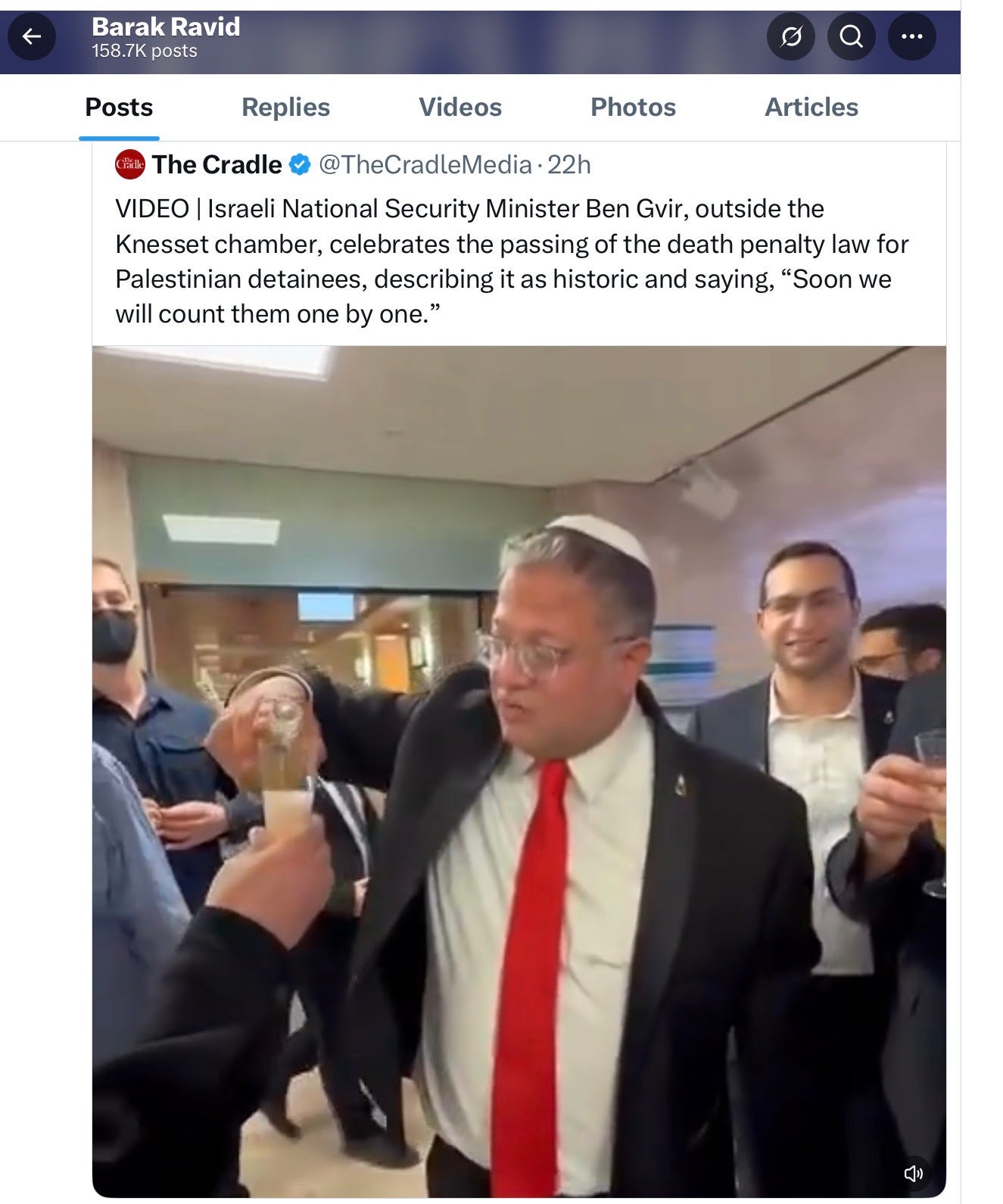
But for the law’s champions it was cause for celebration and clinking glasses of champagne, even as rockets continued to drive their harried constituents into bomb shelters. “We’ve made history today,” exclaimed Itamar Ben Gvir with glee as he poured glasses of bubbly. “Death to terrorists!”
In Israel’s history, despite countless atrocities committed against its people, and some, unfortunately, also by its people4, only Adolf Eichmann and one other have received the death penalty.5 The reasons for that go way back to Judaism’s biblical and rabbinic heritage, as I’ll explain below.
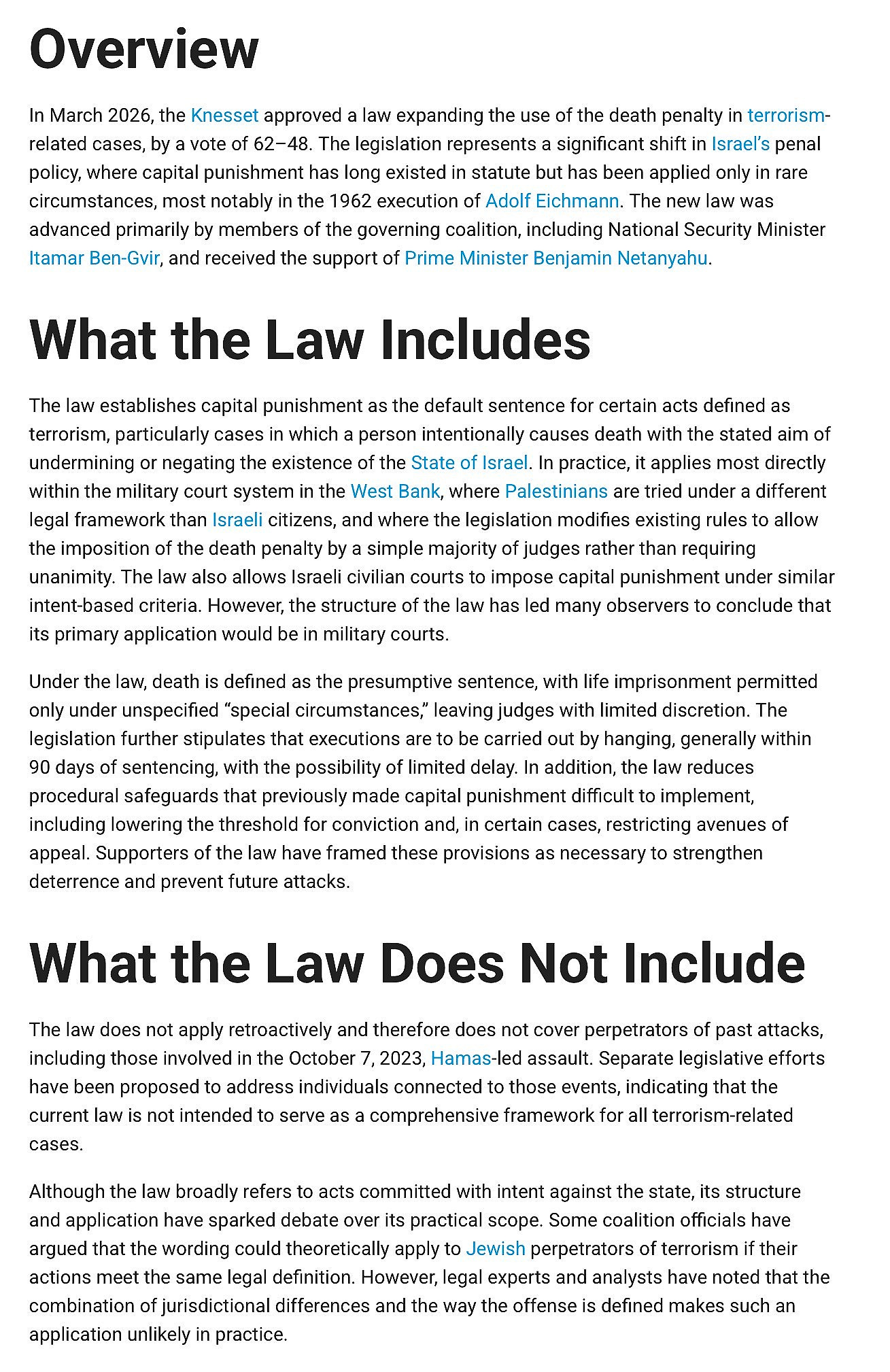
Meanwhile, here is an explainer of the new law, from the Jewish Virtual Library (which, notably, while well-researched and comprehensive, often has a pro-government slant).6
And just in case you are thinking this new law can’t possibly be as bad as it seems, here’s the headline of the Times of Israel.
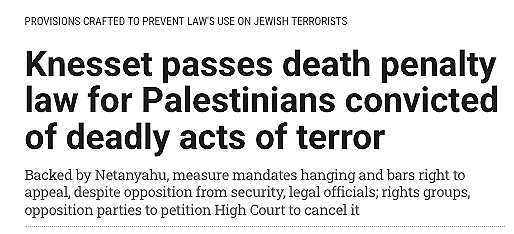
“…measure mandates hanging and bars right to appeal.” In laymen’s terms, that’s a rush to judgment, show trials, no appeal, no High Court review and ya gotta hang ‘em.
And this passed? In an election year? Are they serious? Stalin would be proud. For the rest of us, it’s not good noose and some of Israel’s staunchest defenders have admitted that.

The American Jewish Committee called the bill “troubling” and called out the “glorification of death” as exemplified by the noose pins being worn by Ben Gvir and his cronies, as “morally repugnant and fundamentally at odds with Jewish and Israeli values.” Even right-wing pundit Seth Mandel in Commentary, who tried to explain the law as “performative,” intending to discourage lopsided, mass prisoner swaps, couldn’t bring himself to fully justify it. 7
AIPAC? Far as I can tell, crickets. If they could defend it, they would. But even they can’t.
Here’s what they can’t say, but I’ll say it plainly: The bill is shameful.
So here’s what’s happened. A movement that was banned from the Knesset decades ago has now shepherded through that very same Knesset its most racist, hate-inciting, discriminatory law ever.
Jewish law opposes capital punishment in practice while keeping it on the books
So here is the Jewish story with regard to the death penalty. What’s been on the books legally has been primarily off the books historically.
The Torah mandates the death penalty for 36 offenses, ranging from murder to kidnapping, adultery to incest, certain forms of rape, idolatrous worship and public incitement to apostasy, from disrespecting parents to desecrating the Sabbath. But the rabbinic sages effectively abolished the death penalty in practice centuries later.
The sages understood that while most convicted murderers may indeed be guilty, if only one innocent person is hanged by the state, all citizens of that state are guilty of murder. We can quibble about God’s role in the tenth plague, but there is no denying that Judaism is sending a clear message about human fallibility. If we kill someone innocent, someone created in the divine image, we’ve committed the ultimate crime. And human judges, precisely because they are not God, will make mistakes.
Mishnah Sanhedrin 4:5 stresses the importance of presenting completely accurate testimony in capital cases, for any mistakes or falsehoods could result in the shedding of innocent blood. If any perjury were to cause an execution, “the blood of the accused and his unborn offspring stain the perjurer forever.”
In Talmudic times, capital cases required a 23-judge court, while only three judges sat for non-capital cases. Two or more eyewitnesses were required to testify to the defendant’s guilt, and their hands would, “be the first against him to put him to death” (Deuteronomy 17:6-7). In a capital case, a one-vote majority could acquit a defendant, but could not convict. Furthermore, if there was a mere one-vote majority or if any judge was undecided, additional judges were added in pairs until the majority ruled against conviction, or until one judge in favor of conviction was persuaded to err on the side of innocence (Mishnah Sanhedrin 5:5). A Jewish court that authorized the execution of one person in 70 years, Rabbi Elazar ben Azarya said, would be considered a "murderous" court, the equivalent of what we would call a “hanging judge.”
In practice, the death penalty became almost impossible to implement, though over the centuries there has been a diversity of opinion on the matter. Maimonides claims that murderers should not be executed if there was a question about how the trial was conducted. But if the trial was conducted properly there is no restriction even if it means that one thousand murderers are executed in a single day. The 20th century sage Rabbi Moshe Feinstein counters that the purpose of assigning the death penalty to so many crimes in the Torah is to educate people about the severity of the offenses, rather than to end the lives of the offenders.
Jewish law places the preservation of innocent life over almost everything else. Even were capital punishment proven to deter potential murderers – and that is not the case – the prospect of potentially saving a life in the future is superseded by the very real possibility that an innocent life, that of the wrongly accused prisoner, might be taken now.
In Israel, with few exceptions, only those convicted of crimes against humanity have been executed. In other words, Eichmann.
The un-banality of blood thirst

Hannah Arendt felt that the evil of totalitarianism could be traced not to maliciousness but to the dulling of the mind to policies that seem so ordinary and bureaucratic, leading to a virtual mental enslavement, the inability to think critically in the face of “orders.” She called it, “the banality of evil.”8 That may be true in the abstract but when I watch the champagne toasts of Ben Gvir and hear the taunting and trolling done by Trump9 (including his most-unhinged Easter morning rant) it is hard for me to believe that there isn’t a degree of maliciousness involved in their morbidity. As Rabbi Benny Lau of Jerusalem told the New York Times regarding the death penalty bill, “It’s clear that this is all about revenge. It’s a circus of violence pretending to be about security.”
Can blood thirst be banal? It is not banal to salivate over the lynching of your enemies. It wasn’t banal when done to Israelis on October 7 and it’s not unthinking now, to hang people “one by one” as Ben Gvir promises, and to murder Alex Pretti on the streets of Minneapolis and clap in celebration. I must add, blood lust is NOT American and it is NOT Jewish. It is the antithesis of both (and the it perpetuates antisemitic tropes.
But Israel’s new law and ICE’s new policies also arendt banal, Hannah.
It’s simply evil to make murder, which is bad enough, into a public spectacle, to prefer your guillotines with a side of glee.
It’s just like this classic photo of the lynching of Thomas Shipp and Abram Smith in Indiana in 1930, in which a white man can be seen grinning at the camera as he tenderly holds the hand of his wife or girlfriend.
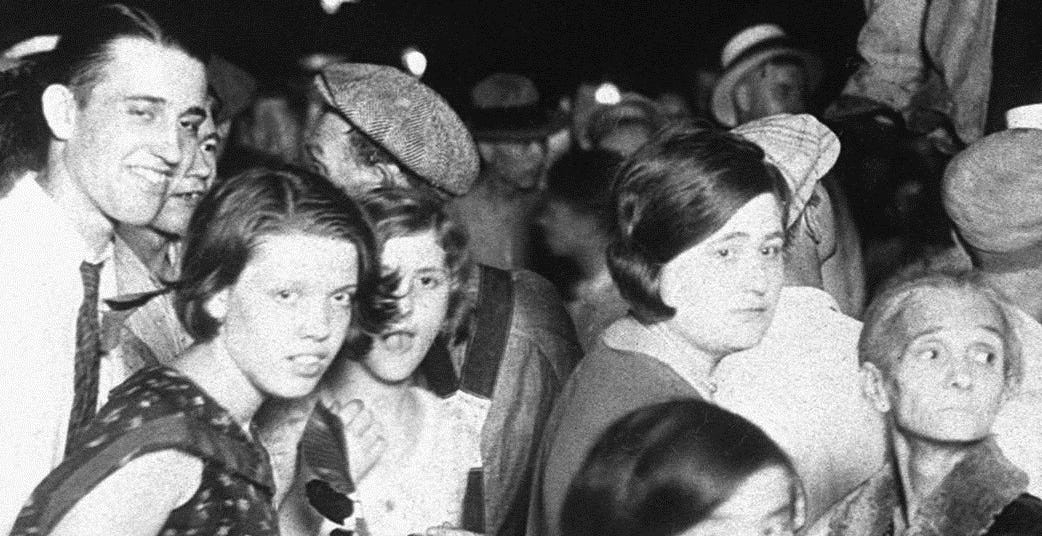
The dead man is dangling in the back.
Adam Serwer wrote that it’s not the burned, mutilated bodies that stuck with him when he viewed this photo. “It’s the faces of some people in the crowd.”
Is it banality or blood thirst to turn carnage into carnival?
Journalist Joshua Leifer wrote:
"Death to terrorists" has long been a slogan of Israel's far-right, a chant at Itamar Ben-Gvir and his Otzma Yehudit party's rallies, where the yellow flag emblazoned with a black fist and Jewish star – the banner of the banned Kach movement – billowed over seething crowds. For years, it was more a populist provocation than a serious legislative proposal, wielded by the Kahanist fringe to foment anti-Arab hatred and incite public anger, often in the wake of terrorist attacks.
So here’s what’s happened. A movement that was banned from the Knesset decades ago has now shepherded through that very same Knesset its most racist, hate-inciting, discriminatory law ever. It is Kahane’s crowning achievement, delivered by his apostles of anger, while the people were too exhausted and stymied by war and Iranian missiles to take to the streets.
That is how autocracy happens. War wears us down, and then the fascists pounce.
There was just a little too much glee going on in the halls of the Knesset when this law passed. A few days later, Israel’s most popular satire program ran a segment where interviewers asked people on the street how and where they would like public executions to take place. (Can the lynchings occur on Shabbat? Should the final meal be the ever-popular Hummus Achla?) It was hilarious, because everyone bought into how absurd it is - and how un-Jewish it all feels. I needed a break from the stress of war and Passover preparations. So I laughed. Public execution is simply not what Jews do - at least it’s not what Jews did.
A carnival of carnage at the auto-da-fé
But we know quite well how they’ve been done to us. We’ve seen so many over the centuries.
I recalled traveling to Spain several years ago, where I saw places where hundreds of crypto-Jews, or Marranos – swine – as the Spanish called them, were burned at the stake. I had a wonderful, most civilized spread of tapas at the beautiful Plaza Mayor in Madrid’s historic center - hundreds of tables lining a grand arcaded courtyard – and all I could think about (aside from the gorgeous weather and reminding the waiter, “No ham!”) was what took place in that exact spot three centuries before in 1680, on the exact same date that we were there, June 30. The Spanish decided to celebrate the marriage of the young Carlos the Second with Marie Louise d’Orleans and what better way to do that than with a typically grandiose auto-de-fe. Dozens were executed that night. Those who refused to confess their sin of maintaining a secret Jewish identity were burned alive at the stake. The ones who confessed were the lucky ones. They were granted pardon; then, as a special favor they were killed first with a lance through the heart before their bodies were burned at the stake.
And I sat there sipping my sangria (not thinking about the fact that the word sangria means blood) feeling great to be on vacation with my family - but just a little bit uneasy about it all.
Jews have long had secret identities, and the conversos were legendary for holding on to them for generations. There are only 50,000 Jews remaining in Spain. But there are hundreds of thousands of Jewish ghosts.
Over fifty years ago on Face the Nation, Golda Meir uttered what might have been her most famous quote: "We can forgive the Arabs for killing our children. But we cannot forgive them for forcing us to kill their children."
That statement rings true on so many levels then, and now one more. The hatred generated by terrorists has been the prime catalyst in the conversion of some Jews from the moral foundations of Judaism into a cult that I do not recognize, but one that is decidedly NOT Judaism.
There is still time to reverse this conversion, in Kahanist Israel and Trumpian America too, and we can begin by reversing this law.
And then we can begin to root out this evil completely, this fall at the voting booth.
News coverage from Ha’aretz and NYT:
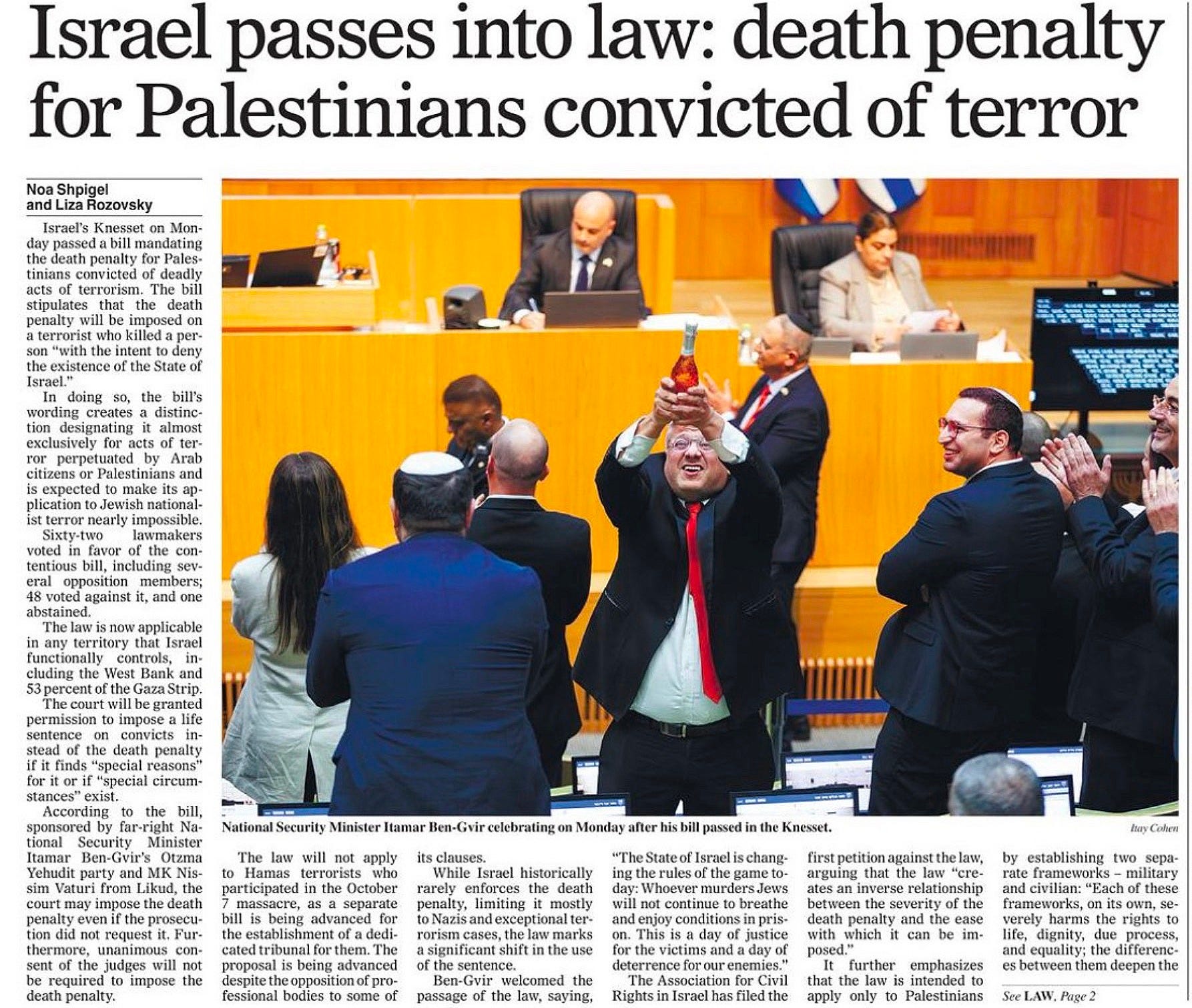
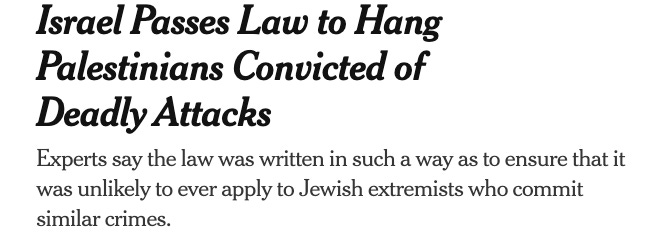
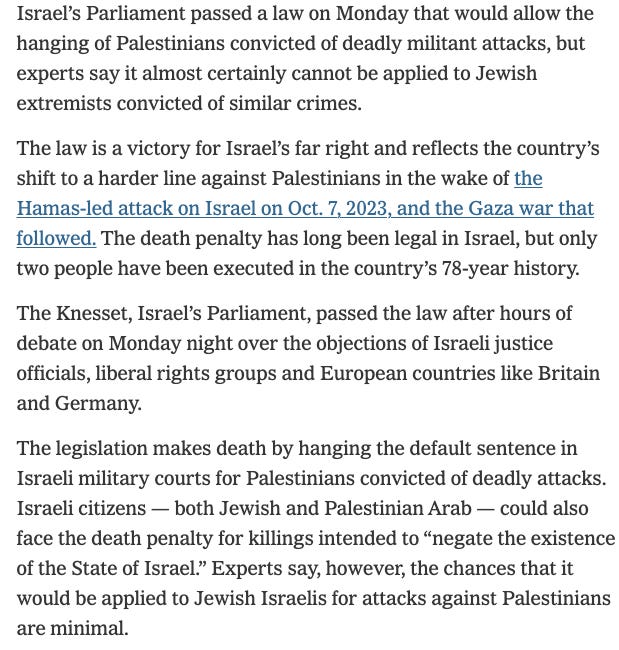
From Ha’aretz:
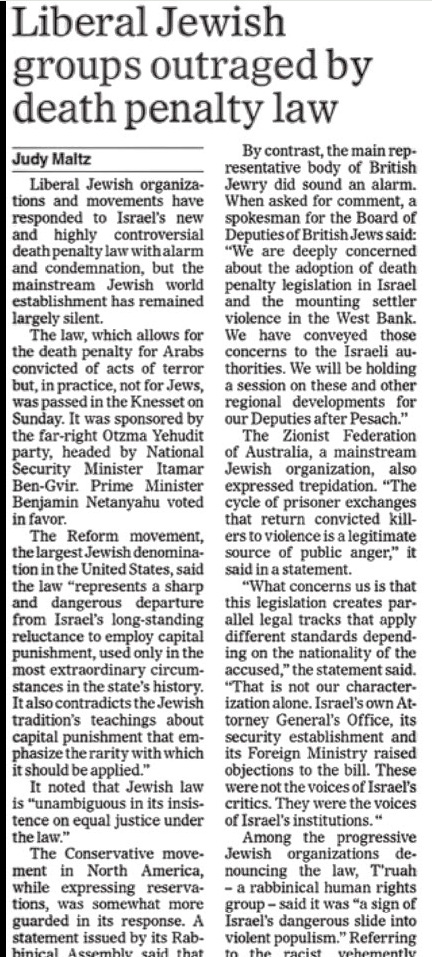

The Rabbinical Assembly (Conservative movement) statement includes this:
And yet, while Jewish law is ambivalent about capital punishment, it is not ambivalent about the centrality of a rigorous justice system. The law passed by the Knesset seeks to compel any court to impose capital punishment even against the court’s own judgment, and to do so speedily — prioritizing deterrence over due process.
Perhaps most egregiously, the law applies only to those who by definition are not represented by Israel: non-citizens and non-residents. While terror is truly a plague upon all Israelis, this law, which purports to fight terror, does so in a way that completely uproots justice.
Criticism in Israel and beyond, from Jewish Virtual Library:
Seven Palestinians murdered on the West Bank since the start of the Iran War, according to the BBC. See also NYT: Palestinian Brothers Killed as Settler Violence Surges in the West Bank
The other, Meir Tobianski (1948), an IDF officer executed for treason, has since been posthumously exonerated.
For a similar view from a more progressive perspective, that of the Reform Movement, click here. And for a detailed, nuanced Orthodox view of this complicated topic, click here.
Mandel writes:
The case of Khaled Najjar is the best example here. Najjar was convicted in a terrorist murder over 20 years ago. The victim’s family remembers Najjar taunting them at his sentencing as follows: “We will kidnap soldiers until the last of our prisoners is released. Seven life sentences? I don’t consider those numbers. I’m going to be released.”
And so he was. He was finally killed in an IDF strike in May 2024.
Then Mandel differentiates Palestinian murders from murderous West Bank settlers in this flimsy way, from which he backtracks at the end:
The sliver of young settlers terrorizing Palestinians in Judea and Samaria are easy to denounce from a moral standpoint: murder is evil, arson is evil, theft is evil. They are also worthy of denunciation from a strategic standpoint: blackening Israel’s name, inviting retribution, fomenting anarchy, forcing the diversion of IDF resources and manpower, etc. But the few violent settlers believe—wrongly, to be sure—that they are participating in an existing anarchy, not paving the way for a new lawlessness. They have weaponized the resentment some Israelis feel toward the system that ensures the most dangerous Palestinian terrorists will avoid their sentences and be freed to kill again and again.
Those violent settlers are in the wrong, full stop. Which doesn’t negate the fact that terrorists have gamed the Israeli justice system and Israeli leaders have been unable or unwilling to stop the manipulation.
A tactic now being turned on him by the Iranians, who appear to be very good at it.

No comments:
Post a Comment