Thursday, March 25, 2021

In This Moment, March 26: Kosher Pigs and the Passover Bunny


In This Moment


‌
Screen shot of Sylvie Rosenberg's first aliyah to the Torah last Shabbat morning (on Zoom), as she begins her Bat Mitzvah preparations. Join us each Shabbat on Zoom! And click here to see a video of Friday night's service, with the theme of the Lower East Side and the Immigrant Experience and my tribute to movie producer Joan Micklin Silver and her film, "Hester Street."
‌
I also had the honor of delivering a Lenten sermonette St. Francis Episcopal Church last Sunday. The topic was NOT Cancel Culture; but the sermon did speak of sin and repentance from the perspective of Psalm 51, which was a scriptural selection for that service. Click here to watch the video of the sermon, which was not about Cancel Culture, beginning about 18 minutes into the service.
Shabbat Shalom and Happy Passover!

Forget Passover; the big news this weekend is that Shtisel Season Three is dropping on Netflix.

But all kidding aside, the biggest news is that yet another community is grief-stricken this week. We grieve with the people of Boulder and resolve to do something about the continuing plague of gun violence. As we sit at our seders, we should be especially mindful of the Fifth Child, the one who is not at the table because their life was abruptly cut short by an AR-47. Ending this plague is a cry of our generation, a moral imperative and a Jewish imperative. This Passover, more than most, we will be thinking about who is not at the table.

It is not too late to sign up for the TBE Second Night Virtual Seder. To get the Zoom link, please go to this site and submit the reservation by noon on Friday. Once you get it, feel free to share it with relatives and friends; just please do not share it on social media.

And don't get too sedered-out. Join the over 300 government officials, faith and community leaders, and diplomats who will come together this Tuesday, March 30 for the AJC's virtual Interfaith/Intergroup Passover Seder celebrating the central themes of Passover: redemption, freedom, and education– themes that resonate far beyond the Jewish community and reach across religions and backgrounds. Register here.

Below you'll find an article I wrote about the oddities of Passover beginning on a Saturday night. It happens just 12 percent of the time, and hasn't occurred since 2008. For those looking for more on this, here is Rabbi David Golinkin's detailed ruling on how to prepare. What will it be on Friday night, Hallah or Egg Matzah?

And an even more unusual aspect of Passover's beginning on Saturday night is something called Yak'N'Haz.


No, it has nothing to do with sharing a chuckle on the bima with the hazzan; but it has lots to do with the beginning of this year’s first Seder. As we see often in our prayer books and in the Haggadah (check out the Ten Plagues), the rabbis loved utilizing acrostics and mnemonics, or whatever you want to call them, as memory-aids. Since Judaism has always looked for God “in the details,” and since the Seder means “order,” ways had to be devised to assist people in memorizing the correct order of detailed procedures.

When the first night of Passover this year is a Saturday night), there are a number of blessings to be recited right off the bat:

1) The Kiddush over wine (boray pri ha-gafen)
2) The additional blessing over the festival (recited typically as part of the Kiddush)
3) The Havdalah prayer, ending Shabbat, including the blessings over the fire of the Havdalah candle and the Havdalah blessing itself.
4) The Shehechianu blessing, always recited at the beginning of festivals and to mark other special occasions.

After much discussion, the Talmud opts for the exact order detailed above. It’s interesting to note how the lines are somewhat blurred between the ending of Shabbat and the beginning of Passover. So we have 1) Wine (Yayin), 2) Kiddush, 3) Candle (Ner), 4) Havdalah, and 5) The seasonal blessing (Z’man). Put it all together and you have YaK N’HaZ.

Now here is where it goes from simply interesting to downright bizarre. The Haggadah, more than any other document, reflects both the amazing continuity and equally remarkable diversity of Jewish expression over the ages. There are over 4,000 known versions, including a number of illuminated manuscripts from the middle ages that depict YaK N’Haz in an intriguing manner. In the 1560 Mantua Haggadah (found in the Israel Museum), the Prague Haggadah (1526), and the Rylands Spanish Haggadah (mid 14th century), among others, YaK N’HaZ is depicted in illustrations showing a hunter with a hound chasing a rabbit.

Come again? Do we believe in the Passover Bunny?

This, ladies and gentlemen, is a pictorial mnemonic, an instant reminder to our European ancestors as to what the verbal mnemonic was all about. Why? Because the German phrase “Jag den Haz” closely resembles YaK N’HaZ, and “Jag den Haz” means “hunt the hare.”

So when our kids start clamoring to watch the Rugrats Passover special or to sing one of those crazy newfangled Seder songs like “Haggadah Wash That Man Right Out of My Hair,” - and when you see this year's hilarious parody, "The Red Sea Shanty," think of those hunted hares in medieval Germany. And recall that the word Haggadah means “telling,” and the essence of the Seder, is that the ancient story be retold in ways that will resonate for this generation. Your Seder will not be exactly the same as your grandparents’, or as your neighbor’s down the street. But it will be representative of this generation – yet tied intimately to ancient traditions and an equally ancient story.

So if you’ll excuse me, I’ve got to go share some “Yucks with the Haz” up on the bima.

Below: Scene of a rabbit hunt from southern German Haggadah, c.1490
Why is this Israeli Election Different From All Others?
Israel's 4th election in two years yielded yet more uncertainty. Neither the pro-Bibi nor pro-change sides have enough seats to form a stable governing coalition. Note that the "camps" are no longer delineated on the traditional left-center-right axis. The determinant issue here is whether Netanyahu will continue as Prime Minister while under indictment, with his trial ramping up in earnest right after Passover. The introduction of the Kahanist - racist, virulently homophobic faction (the "Religious Zionism" party) into the Knesset for the first time, along with the complexity of the bifurcated Arab vote - along with the first-ever Reform rabbi becoming an MK - has injected more unpredictability into the mix. Bibi has been able to survive grave threats to his leadership before, but even he might have trouble creating a coalition dependent on uniting a party of racist homophobes and supporters of the Muslim Brotherhood (they actually agree on the homophobia). Bibi's opponents are also divided ideologically, but they all share a common purpose - and they might just be able to submerge their egos for just long enough to achieve it.

For those who are concerned that the peace process no longer is even discussed in Israeli election campaigns, you can take heart in the revitalization of some left and centrist parties this go-round, and in the increasing willingness of Jewish politicians to reach out to Israel's Arab citizens. The fact is that the old peace process has been moribund for some time. Shifting Middle Eastern alliances require nimble thinking, and changes in Washington have also altered the diplomatic landscape. The Palestinians are also approaching elections (we'll see if they happen) and they are not going away. Meanwhile, if the anti-Bibi group can take the reins without the Haredi parties and Kahanist extremists pulling all the strings, this might be the perfect opportunity for Israel to address some of its pressing social issues that have been ignored for too long. At the very least, they may be able to enact just enough legislation to assure that the next election will bring about a change at the top.

In Israel, as in America, it is vital that the rule of law prevail over the cult of personality. Right now the window is open - ever so slightly - for that to happen.

My bet right now is that Benny Gantz, the centrist of all centrists, will ride his surprising revival to become Prime Minister, at least on a caretaker basis, so that the healing might begin.
This Passover, kosher pig’s on the menu

My latest op-ed for the Religion News Service: See the web page here.

(RNS) — This year, Passover begins on a Saturday night, something we haven’t experienced since 2008. According to Rabbi David Golinkin, this anomaly occurs only 12% of the time.

And whenever it occurs, people invariably ask two questions: When should we stop eating hametz (prohibited leavened products)? And the corollary, by when should our house be completely clean for the holiday? On Friday morning or Saturday morning?

The standard response is the house should be ready on Friday, before Shabbat, instead of the morning of the Seder (this year Saturday), which is usually the case. For most Jews, who are secular in most respects, the premise is based on an utter inconsistency. Many will have their houses ready for Passover by Friday afternoon because they want to do Passover “right,” when in fact they’ll be rushing their preparations in order to keep Shabbat rules they don’t normally keep.

To be “consistent” with their normal practice, the non-Shabbat observer should consume leavened products until Saturday — not Friday — morning. Why should this Shabbat be different from all others? 

The late Rabbi Richard Israel once wrote a book titled “The Kosher Pig.” The intriguing title stems from a story he tells about a pious Jew who was told by his doctor he had a rare disease that could be cured only by eating pork. Now, Jewish law states that in order to save a life, virtually any of the law’s requirements can — in fact must — be broken. But that wasn’t enough for this man. He determined the pig had to be slaughtered in the kosher way, painlessly, before he ate it.

So he brought the pig to the local ritual slaughterer, who acquired a special knife that would never be used on a kosher animal. After slaughtering it in the “proper” ritual manner, the shochet examined the pig’s lungs to look for blemishes. He had no idea what he was looking at, but he finally concluded the lungs had no serious abrasions (and was therefore “smooth” or “glatt”).

“So, nu?” the man asked, “Rabbi, is this pig kosher?” The rabbi examined the lungs for some time and then declared, “It may be kosher, but it’s still a pig.”

Modern Jewish life is filled with kosher pigs, utter inconsistencies we sometimes hardly notice; but they are there, and they are enlightening.

Which brings me back to Passover. The same thing happens every year regarding dietary restrictions. On Passover, many Jews who otherwise do not keep the dietary laws in their everyday lives become fanatic about ridding their homes of leaven and bringing matzo sandwiches to the classroom or office. A ham-on-matzo sandwich is hardly an unthinkable scenario in this perplexing world of kosher pigs. It’s kind of like the guy who drives to synagogue on Yom Kippur but tells the policeman writing him a ticket he can’t put money in the meter on a Jewish holiday.

Some more gems from Israel’s book: “An observant Jew has just made a serious pass at me. Do you think he will want me to go to mikva (ritual bath) before I have an affair with him?”

And another: One commercial fisherman in California called his rabbi to see if it was kosher to use pieces of squid as bait when he goes fishing. An interesting question, because squid has no fins and scales and is therefore unkosher; but does it affect the Kashrut of the fish caught? A fascinating question, except he called the rabbi on Saturday morning to ask it.

Oy.

All of these people are, to some degree, serious Jews, and for that alone we must commend them. We might laugh at the inconsistency, we might even call it hypocrisy, but if they are hypocrites, we should all be so hypocritical. We all must learn the difference between pretending and striving, between going halfway in earnest and throwing it all away without giving it half a chance.

To be a hypocrite means at least we’ve set high, virtuous goals for ourselves, even if we don’t always live up to them. I’d rather do that, and fall short, than set no high standards at all. Most of us are so afraid of being called hypocrites we take the easy road. If we expect little of ourselves, we usually deliver.
So as we approach this unusual alignment of Passover and Shabbat, let’s allow for a little kosher pigheadedness. For those Jews and others who’ve rarely kept Shabbat in this manner before, don’t feel funny about keeping it a little more meticulously this time. It’s OK to be inconsistent.

You might even enjoy it.
Six13 - The Red Sea Shanty: A Pirate Passover

Shabbat Shalom and Happy Passover,
 
Rabbi Joshua Hammerman

This Passover, kosher pig’s on the menu (RNS)

This Passover, kosher pig’s on the menu

Modern Jewish life is filled with kosher pigs, utter inconsistencies we sometimes hardly notice; but they are there, and they are enlightening.

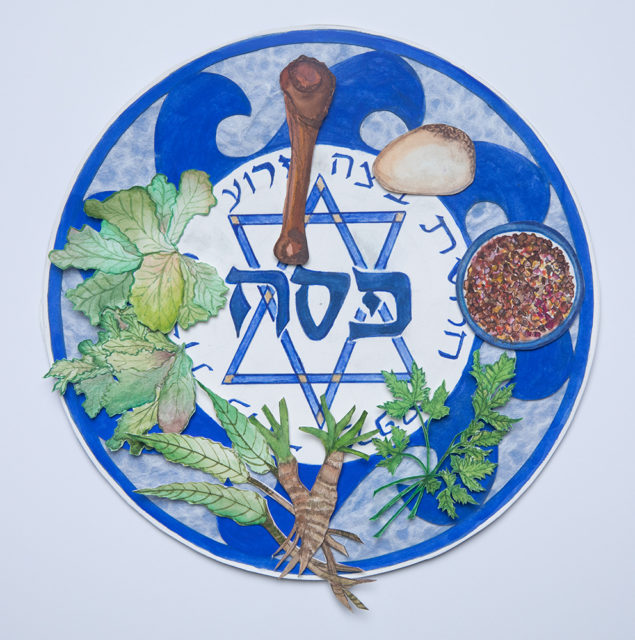
The Seder Plate holds all the ritual foods for the Seder. Image from “The Promise of the Land: A Passover Haggadah” by Rabbi Ellen Bernstein. Art by Galia Goodman

(RNS) — This year, Passover begins on a Saturday night, something we haven’t experienced since 2008. According to Rabbi David Golinkin, this anomaly occurs only 12% of the time.

And whenever it occurs, people invariably ask two questions: When should we stop eating hametz (prohibited leavened products)? And the corollary, by when should our house be completely clean for the holiday? On Friday morning or Saturday morning?

The standard response is the house should be ready on Friday, before Shabbat, instead of the morning of the Seder (this year Saturday), which is usually the case. For most Jews, who are secular in most respects, the premise is based on an utter inconsistency. Many will have their houses ready for Passover by Friday afternoon because they want to do Passover “right,” when in fact they’ll be rushing their preparations in order to keep Shabbat rules they don’t normally keep.

To be “consistent” with their normal practice, the non-Shabbat observer should consume leavened products until Saturday — not Friday — morning. Why should this Shabbat be different from all others?  

The late Rabbi Richard Israel once wrote a book titled “The Kosher Pig.” The intriguing title stems from a story he tells about a pious Jew who was told by his doctor he had a rare disease that could be cured only by eating pork. Now, Jewish law states that in order to save a life, virtually any of the law’s requirements can — in fact must — be broken. But that wasn’t enough for this man. He determined the pig had to be slaughtered in the kosher way, painlessly, before he ate it. So he brought the pig to the local ritual slaughterer, who acquired a special knife that would never be used on a kosher animal. After slaughtering it in the “proper” ritual manner, the shochet examined the pig’s lungs to look for blemishes. He had no idea what he was looking at, but he finally concluded the lungs had no serious abrasions (and was therefore “smooth” or “glatt”).

“So, nu?” the man asked, “Rabbi, is this pig kosher?” The rabbi examined the lungs for some time and then declared, “It may be kosher, but it’s still a pig.”

Modern Jewish life is filled with kosher pigs, utter inconsistencies we sometimes hardly notice; but they are there, and they are enlightening.

Which brings me back to Passover. The same thing happens every year regarding dietary restrictions. On Passover, many Jews who otherwise do not keep the dietary laws in their everyday lives become fanatic about ridding their homes of leaven and bringing matzo sandwiches to the classroom or office. A ham-on-matzo sandwich is hardly an unthinkable scenario in this perplexing world of kosher pigs. It’s kind of like the guy who drives to synagogue on Yom Kippur but tells the policeman writing him a ticket he can’t put money in the meter on a Jewish holiday.

Some more gems from Israel’s book: “An observant Jew has just made a serious pass at me. Do you think he will want me to go to mikva (ritual bath) before I have an affair with him?”

And another: One commercial fisherman in California called his rabbi to see if it was kosher to use pieces of squid as bait when he goes fishing. An interesting question, because squid has no fins and scales and is therefore unkosher; but does it affect the Kashrut of the fish caught? A fascinating question, except he called the rabbi on Saturday morning to ask it.

Oy.

All of these people are, to some degree, serious Jews, and for that alone we must commend them. We might laugh at the inconsistency, we might even call it hypocrisy, but if they are hypocrites, we should all be so hypocritical. We all must learn the difference between pretending and striving, between going halfway in earnest and throwing it all away without giving it half a chance.

To be a hypocrite means at least we’ve set high, virtuous goals for ourselves, even if we don’t always live up to them. I’d rather do that, and fall short, than set no high standards at all. Most of us are so afraid of being called hypocrites we take the easy road. If we expect little of ourselves, we usually deliver.

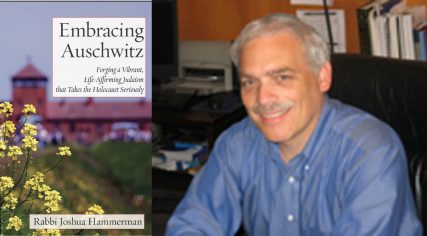
Right, Rabbi Joshua Hammerman and his book “Embracing Auschwitz”. Left image courtesy of joshuahammerman.com right image courtesy of Temple Beth El

Right, Rabbi Joshua Hammerman and his book “Embracing Auschwitz.” Left image courtesy of joshuahammerman.com; right image courtesy of Temple Beth El

So as we approach this unusual alignment of Passover and Shabbat, let’s allow for a little kosher pigheadedness. For those Jews and others who’ve rarely kept Shabbat in this manner before, don’t feel funny about keeping it a little more meticulously this time. It’s OK to be inconsistent.

You might even enjoy it.

https://religionnews.com/2021/03/25/this-passover-kosher-pigs-on-the-menu/

(Rabbi Joshua Hammerman is the spiritual leader of Temple Beth El in Stamford, Connecticut, and the author, most recently, of “Embracing Auschwitz: Forging a Vibrant, Life-Affirming Judaism that Takes the Holocaust Seriously.” The views expressed in this commentary do not necessarily reflect those of Religion News Service.)

Friday, March 19, 2021

In This Moment, March 19: Not Just Pickles: Celebrating the Jewish Immigrant Experience


Yesterday 7th and 8th graders and some adults took a virtual trip back in time, to the Tenement Museum on the Lower East Side. We "visited" this apartment, which was occupied by the Rogarshvsky family on Orchard Street in the early 1900s. Read about the family here.

In This Moment


Shabbat Shalom

As we move into the final weekend before Passover, we've been recalling in fondness past TBE president Herb Kahan, who passed away this week. Another former leader of the congregation also died; Paul Josephson left our congregation a lasting memorial - this parsonage I wake up in every day, which was his pet project. May their families be comforted among the mourners of Zion and Jerusalem, and among all the many families who have lost loved ones in recent weeks.

Not Just Pickles
A little while back, we decided that this weekend before Passover would be a perfect time to celebrate our roots by focusing our attention on the Jewish immigrant experience of the past century. We even arranged for drop-off deli dinners from Ben's (and dozens of you have taken advantage of that). Of course immigration has always been a hot topic in America, and with new legislation being passed just yesterday regarding Dreamers and other refugee concerns, now would be the time to sign the HIAS refugee welcome letter if you haven't already. When you go to the site, just pull down the tab and you'll find that TBE is one of the many participating congregations.

This evening at services I'll be speaking about how the immigration experience shaped who we are, both as Americans and as Jews, as reflected in the works of filmmaker Joan Micklin Silver, who sadly died several weeks ago. We'll be paying tribute to her by featuring her best known work, "Crossing Delancey," which will be discussed by our Movie Club tomorrow night as part of our theme-weekend. (Here's more about her life and legacy). The film involves a pickle guy courting an assimilated Jewish intellectual with a mischievous bubbe. It's a great movie, right down to the tip on how to get the smell of pickle brine of your hands (psst, it's vanilla).
But the Micklin-Silver film that encapsulates the Jewish immigrant experience most is "Hester Street," a gem that I rewatched this week. You can order it (and "Crossing Delancey" too) on Amazon Prime. Tonight we'll look back at what it meant to be "a stranger in a strange land," a line recited by Moses in Exodus, Tevye in Anatevka (mistakenly attributing it Abraham) by every Jewish immigrant on the Lower East Side and every refugee headed from anywhere to anywhere, ever. According to the UN, there are 80 million refugees around the world right now.
So let's join this weekend to celebrate the Jewish immigrant experience. Right down to the pickles. And let's learn from this how important it is to fight xenophobia wherever we see it - Click here to see a joint statement signed by the ADL on fighting anti-Asian hate.
‌


Did you read about the astounding now Dead Sea scroll materials just discovered? Click here to read about the newly-discovered artifacts

A Sweet Passover to all who will be joining us at our second-ever TBE Zoom Seder a week from Sunday night, at 7 PM. Let me be the first to say that I hope it is the last ever as well, though for our purposes this year, the online format will suit perfectly. if you have not yet registered, do so now (see flyer below).
 
Here's what will be happening:
 
1)    ARRIVE EARLY: We will start right on time at 7 PM. Please link up to the Zoom meeting at least 5 minutes beforehand to avoid an electronic bottleneck. 
 
2)    LENGTH: My best estimate as to the length is about 90 minutes, depending on how much people want to participate.
 
3)    PARTICIPATION: Active participant involvement is a cornerstone of TBE's philosophy, as well as the Seder's. But with Zoom we have to be creative. For the most part, participants will be muted while the leader leads.  If you are interested in leading a supplementary English reading, let me know. Also, I will throw out questions to the group where you will have the chance to share replies in the "chat" box.  We'll also do some video sharing - so, if you have a favorite Pesach heir loom, like a kiddush cup, Seder plate, plagues toy, pillow - or a special food that you've prepared (say, a unique family recipe for charoset), bring all of it to the table. With that in mind, it is really important that everyone be all-in for this Seder. In other words, if your computer has a camera, turn it on so we'll all see one another and share in community as best we can.
 
4)    WHAT ABOUT THE MEAL? This will not be a "soup to nuts" Seder, where we include every word of every page, the way Zayde used to do it. The format simply does not lend itself to that. And of course, neither soup nor nuts will be provided. We will go through the early parts of the Seder but skip past the meal, so that we can cover a few highlights from the latter parts of the Seder before wrapping up. There is no point in keeping a large Zoom meeting open while people are eating. One reason for the early start time is so that people won't get excessively hungry; however, I encourage you to have snacks available while we go through the first part. What do you think all that dipping is all about? Those are appetizers, and last I heard, a potato is a vegetable, so instead of parsley, grab a bowl of chips and you'll be fine. And as for the meal, you'll be able to privately Face-time or Zoom friends or family for that. Invite them to join us for the Seder too.
 
5)    WILL THIS BE A CHILD-FRIENDLY SEDER? We try to make everything child-friendly at TBE, but given this format, it will be hard for us to do that.  But I am looking for young volunteers to lead the Four Questions - please let me know ASAP!
 
6)    WHAT HAGGADAH WILL WE BE USING? - As long as you can follow the basic order of the Seder, you can use whatever you have at home. But this is the one I'll be using: Here's the one I'll be using. Download it and have it on your screen, or you can print it out in advance. But if you happen to be using one of the 4,000 other versions of the Haggadah that have been published, it's always interesting to hear different perspectives.
 
7)    Incidentally, I also will be using some of the supplementary readings below:

Urechatz - CLICK HERE  
Ha Lachma - CLICK HERE
Four Questions - CLICK HERE
Avadim Hayinu - CLICK HERE
Four Children - CLICK HERE
 
Plus, a new Rabbinical Assembly Seder Supplement has a number of readings and discussion themes that may be incorporated.
 
8)    Finally, a request. Make this Seder your own. Share observations in the chat box. Smile and sing along, even if no one can hear you. Let's make this the best Zoom Seder ever!
 
This will be truly a night unlike all other nights. There will be plenty of opportunity to reflect on the uniqueness of these two Covid Pesachs, but at the same time, we should be careful not to ignore Passover's more enduring messages that have gotten us through times far tougher than this (without minimizing the real suffering people are enduring now). Still, the hallmark of this holiday has always been in how it constantly reinvents itself, and that will certainly be the case here.

Finally, if you have trouble getting through to the reservation link, simply email me to let me know who is coming from your family.
 
Shabbat Shalom
 
Rabbi Joshua Hammerman

See below a chart of Israel's Knesset race, from the Economist,
with the country's 4th election in two years set for this coming Tuesday.

Friday, March 12, 2021

In This Moment for March 12: One Year In....

In This Moment
"That'll be a total of Four Zuzim, Abba!"
Two newborn kids, a sign of the season - and Pesach - from the Irish Times
‌
Shabbat Shalom!

This weekend is Shabbat Ha-Hodesh, the Shabbat before the beginning of the month of Nisan, the original new year, the month of spring and Passover, As we mark the end of the Year of Covid, before we rush headlong (yet cautiously) into our post-plague "Plegxit," we should look back and take stock, as we await a return to normalcy, whatever that is. Here are three suggestions:

#1) The TBE Covid Memory Project

A congregant has suggested an excellent way of capturing this moment in time before it has receded into memory. We would like to create a collection of personal essays about living with Covid – 19 for the last year.

We invite you to reflect on what has inspired you, what has saved you, what has given you hope, what has been lost. What would you like to remember and record about these many months. What wisdom have you gained? What survival techniques brought you to the other side of these dark days. What gave you hope? I know that our daily minyan, for instance, has brought huge comfort to many. What did zoom services mean to you during this year?

As a brief example, Marsha Matthews wrote of our daily Zoom minyan, "It helps to anchor my day...I certainly don’t have “big”plans these days, but I often make my little plans around the minyan... I enjoyed meeting the minyan “regulars”, most of whom were unknown to me, and about whom I now know a little bit...It feels good to be part of the community...It helps me feel linked to my Judaism."

We will assemble this collection of writings and share them with our members (and we'll assume that if you send it in you are OK with publication).

Please share your thoughts. Kids are invited to take part in this as well. Submissions should be 200-500 words.

Here's another way to look back...

#2) "Oh the Places We've been!"
‌
‌
One year ago, when we took our services out of the building and onto Zoom, I decided that a housebound congregation needed ways to expand its horizons, to take flights of fancy when physical travel was impossible.  

So each Shabbat - and at other times too - I've used the Zoom virtual background feature to take us to sacred places around the world. At a time when everyone was cooped up in quarantine, when even the New York Times' travel section was renamed "At Home," we needed that vehicle of escape. I know I did.

Visiting these holy places took some of the humdrum out of our day and added a sense of wonder. It also added a bit of intrigue to the service, causing people to ask, "Where in the world will the rabbi be today?" Or maybe you didn't. But for me, these fanciful flights helped me forge a new intentionality (kavvanah) as I prepared for each service. Without leaving my home, I was able to visit more places than Waldo or Carmen Sandiego. And since almost all of these photos were taken by me, each Shabbat I was whisked back to a key moment of my own spiritual growth. How better to celebrate Shavuot than to be on Mount Sinai, next to myself as a teenager. Or on Hanukkah, to be standing before the ancient temple model in Jerusalem. Or on Inauguration weekend, to be socially distant from Bernie Sanders, to celebrate our high school graduates with a trip to Hogwarts (and Rydell High too).

We communed with a cow in Varanasi, India's holiest city, on Shabbat Parah (the Shabbat of the Cow), we mourned George Floyd's murder at the Lincoln Memorial, and commemorated D-Day at the American Cemetery in Normandy and Pride Shabbat at the Stonewall Inn. We lifted our eyes to a sunrise in Nepal, and marveled at Victoria Falls; we celebrated Israel's birthday in Latrun and Yom Hashoah at Auschwitz and Terezin. Through these images, prayer was better able to lift us out of our cabin fever and send our souls soaring.

I can't wait to see more people in person - but I must confess, I'm really going to miss the ways Covid forced us to to be more creative in our worship, and we need to incorporate this into our plans as we return to our "new normal."
‌
‌
I’ve collected over 30 "on-location" screen shots of these virtual backgrounds in a blog posting. Feel free to peruse them all. And then choose your top three. Which ones sent you on flights of fancy of your own back at the service when that photo was featured. Which lifted you out of a rut at just the right time, or brought back memories of brighter days. Or tell us what that location means to you now. If you are really feeling nostalgic for the Covid year, I’ve archived many of our Zoom services and events from the past year, which you can access here.

So there you have it. Two ways we can capture the meaning of this Covid year.

And now, here’s a third way to mark this sacred transition as we begin to see that proverbial light at the end of the tunnel.
#3) The Gomel Project
Have you recently been vaccinated or survived a case of Covid? There is a prayer for that. It's typically recited right after coming up to the Torah for an aliyah. You can read about it here.
Here's a how-to video about Gomel
‌
What is the Birkat HaGomel? Jewish Blessing for Gratitude
As each of us becomes vaccinated, one at a time, now in growing clusters, some kind of communal moment of thanks is called for. So each week, beginning this Shabbat morning on Zoom, we are going to reserve one aliyah for those who wish to express thanks for having been vaccinated or having survived Covid to do so. And we will join you in being grateful for your health and well-being. So join us for a Gomel moment this Shabbat.
What Awaits Us...
Marc Schulman's Israel Update - "At this point, 90% of those over age 50 have been vaccinated; and we have passed 70% inoculation of the entire adult population. The cumulative effect of our astonishing success getting shots in arms has led to the near disappearance of critically ill patients, requiring hospitalization. On Thursday, the IDF announced that 81% of soldiers are now fully vaccinated, declaring itself the first army in the world to reach herd immunity. Pfizer claimed early Thursday that based on Israeli data, its vaccine is 97% effective in blocking severe illness, and 94% effective in blocking transmission."
‌
Last night in Tel Aviv the bars were filled. This is what the end of Covid looks like... if we will only be very careful for just a few more weeks, we will get there too. Our congregation's - and nation's - goal is that we all get there safely.
Passover Preparations and Other Reading
In Eastern Europe, historic synagogues are being sold for the price of a used car (Anyone interested in TBE restoring an Eastern European synagogue?)
Finally, see below, a tribute to our Mensch of the Week, Julian Edelman, who combatted an anti-Semitic slur by another athlete in the best possible way, with this open letter.

Shabbat Shalom!
Rabbi Joshua Hammerman