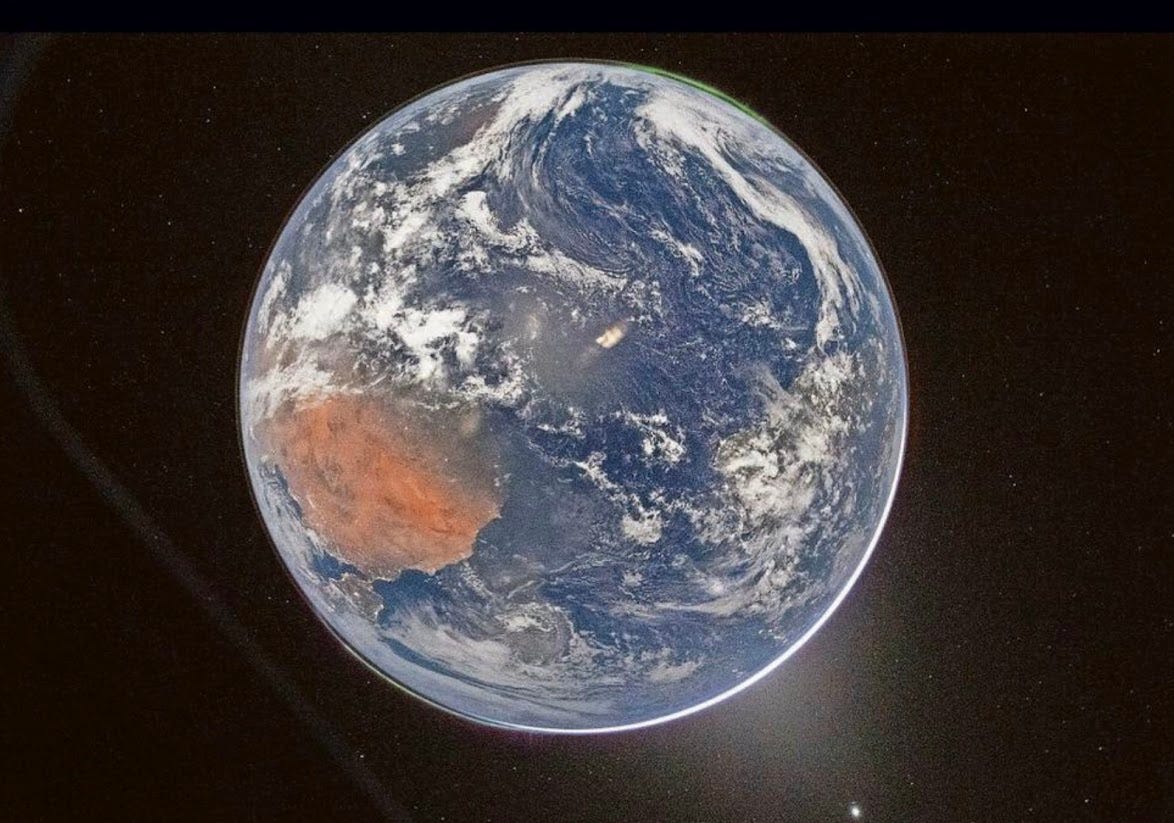
I’ve spent my life seeking out the world’s most sacred places, and I’ve managed to visit quite a few. But as I looked at this photo of earth from space last week, taken by the Artemis astronauts, I realized that all my travels had been unnecessary. That most sacred spot on earth IS the earth - it was the very spot I was standing on. The perfection and the beauty of that photo they took had little to do with its astounding symmetry and balance and the gorgeous earth toned blues and browns. It had more to do with the fact that all of us are in it. We are right there, without even knowing it. And we are dwelling on a fragile raft that has just enough of this and that to sustain life.
We humans crave connection and we have never been more connected - all of us together - than in that photo. And all the sacred places we’ve constructed, from the tabernacle in the wilderness to the Western Wall and Dome of the Rock, to the Vatican to Machu Picchu to Angkor Wat - all of which I’ve made pilgrimage to - are mere facsimilies in miniature of the Oneness depicted in that photo. The word religion, after all, comes from the Latin religare, meaning to connect.
Manly Hall, philosopher and seeker, wrote in The Secret Teachings in All Ages (1928):
True religion must be universal: Christ, Buddha or Mohammed, the name means little, for we recognize only the light and not the bearer. We worship at every shrine, bow before every altar, whether in temple, mosque or cathedral, realizing with our truer understanding the oneness of all spiritual truth.
The moon mission reminded us of our essential unity.
Yuri Artykin, a Soviet cosmonaut said, “It isn’t important in which country see you observe an oil slick, or in the forests of which country a fire breaks out. You are standing guard over the whole earth.”
I was skeptical about Artemis. It seemed anachronistic to retrace the steps of the ‘60s, in a bizarro way, no less, with a different senseless war and a crazier RFK, minus the Tang but with much better cameras.
And these days, rather than looking up, we’ve needed to keep our nose to the ground in dealing with the toxic mess we’re making of earth. But given yesterday’s earthshaking news out of Hungary, the irony was not lost on me that when he won in 2022, Viktor Orbán called it “a victory so great you could see it from the moon - and certainly from Brussels.”
And yesterday, in celebrating his win, Peter Magyar (whose last name means Hungary - it’s like calling him “Captain America” - retorted with this:
“Together, we have dismantled the Orbán system, liberated Hungary, and reclaimed our country. This victory is visible not from the moon, but from every Hungarian window—whether in the smallest rural home, a tower block apartment, a major city, or the countryside.”
Take that, Viktor! (and Donald and Vlad.)
Actually, Magyar’s statement isn’t totally true. Yesterday’s victory was so overwhelming that, unlike 2022, it should have been visible from space. And in fact, this drone footage indicates that it was.
The landslide broke the spell of inevitability for illiberalism. With a crashing thud, Putinesque autocracy was so thoroughly beaten that no one could even try to reverse engineer this election. The win was so enormous that it was un-riggable, even by Putin himself. We now know for November (and October in Israel), there is such a thing as unriggability. It begins with a landslide.
I marvel at the courage of Hungarian people, who, within the scope of a single century, have endured at least three brands of autocratic oppression and overcome them all: Nazi, Soviet and Orbanism - arguably the three most insidious and cruel incarnations of political evil this world has known over that span of time.
This landslide victory symbolized a return to the dream of a world with less rigid fences, where nationalism can nurture alliances rather than generate wars, and candles can illumine the windows of rural cottages and urban apartments with the light of peace. But the home writ large is earth, a home that we all share, a fragile, delicate, small and lonely place in a vast universe, a place where all humanity can be reminded that WE ARE ALL ONE.
Who could have known when Viktor Orban invoked the moon in his bombastic 2022 declaration of viktor-y that his downfall would coincide with the waxing of the lunar space program?
And as we watched this first wave of freedom sweep across the landscape yesterday, we were reminded, one and all, that this is what democracy looks like.
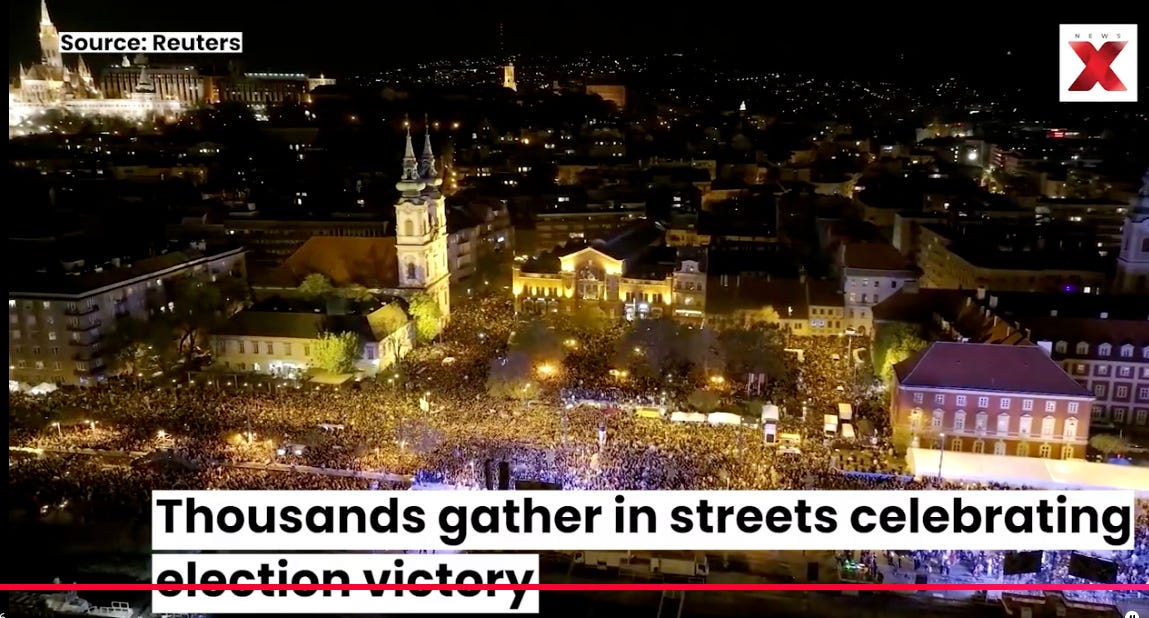
No wonder they call it the Blue Danube. Because last night was the first indicator of an oncoming Blue Wave.
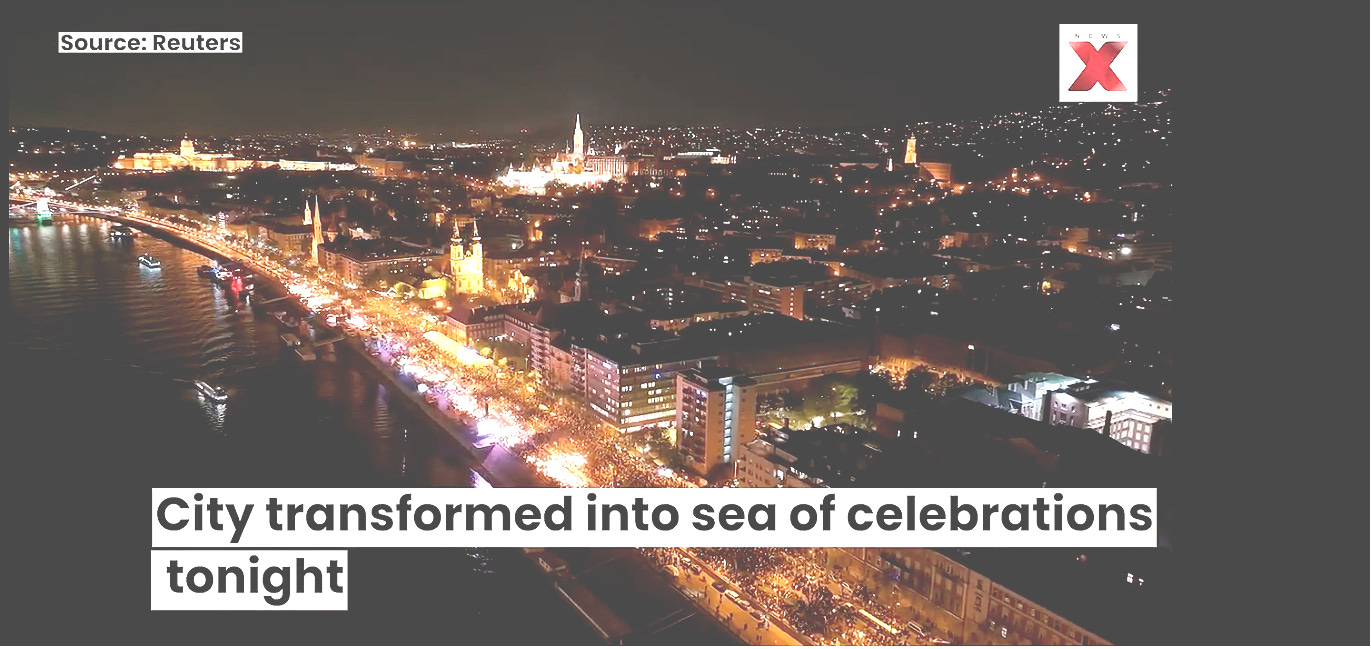
This was today’s headline from a newly liberated Hungarian press.

Budapest must feel like a Disney movie when the curse is broken. Everything has been unfrozen and all the kitchen utensils restored to their human form. We’ll know the feeling here when we get to take down the Arch-de-Trump and rename the Kennedy Center for JFK alone once again.
And even before Sunday’s news, when we saw those photos from space, suddenly we all got it. Maybe it was the competing front page news, where a guy was threatening to bomb a country back to the Stone Age and taunting the pope. But suddenly the world was looking up, not to check the sky for drones but because four human beings were looking down (or sideways) - at us. And the headlines took notice, nudging us from the Stone Age to the Space Age.
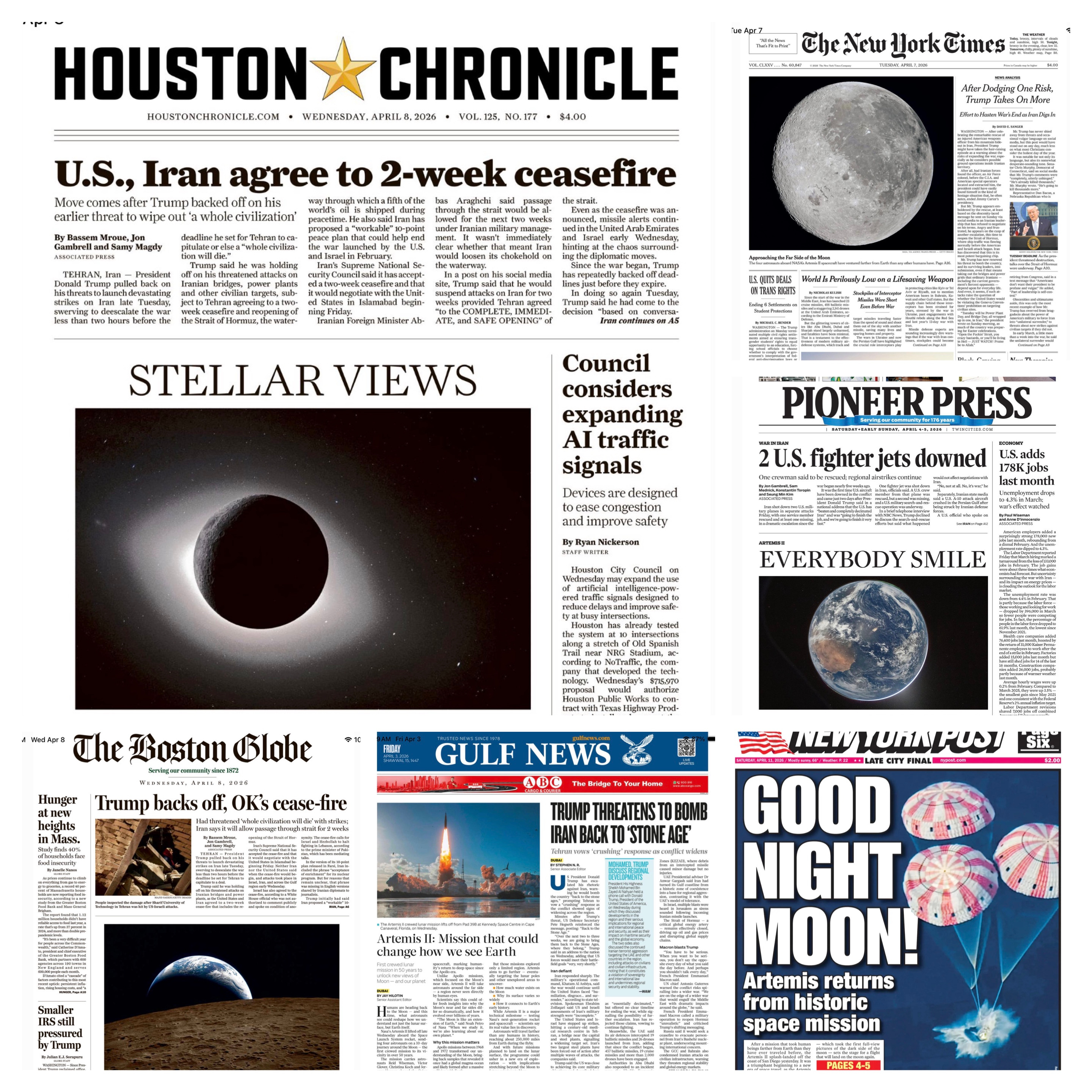
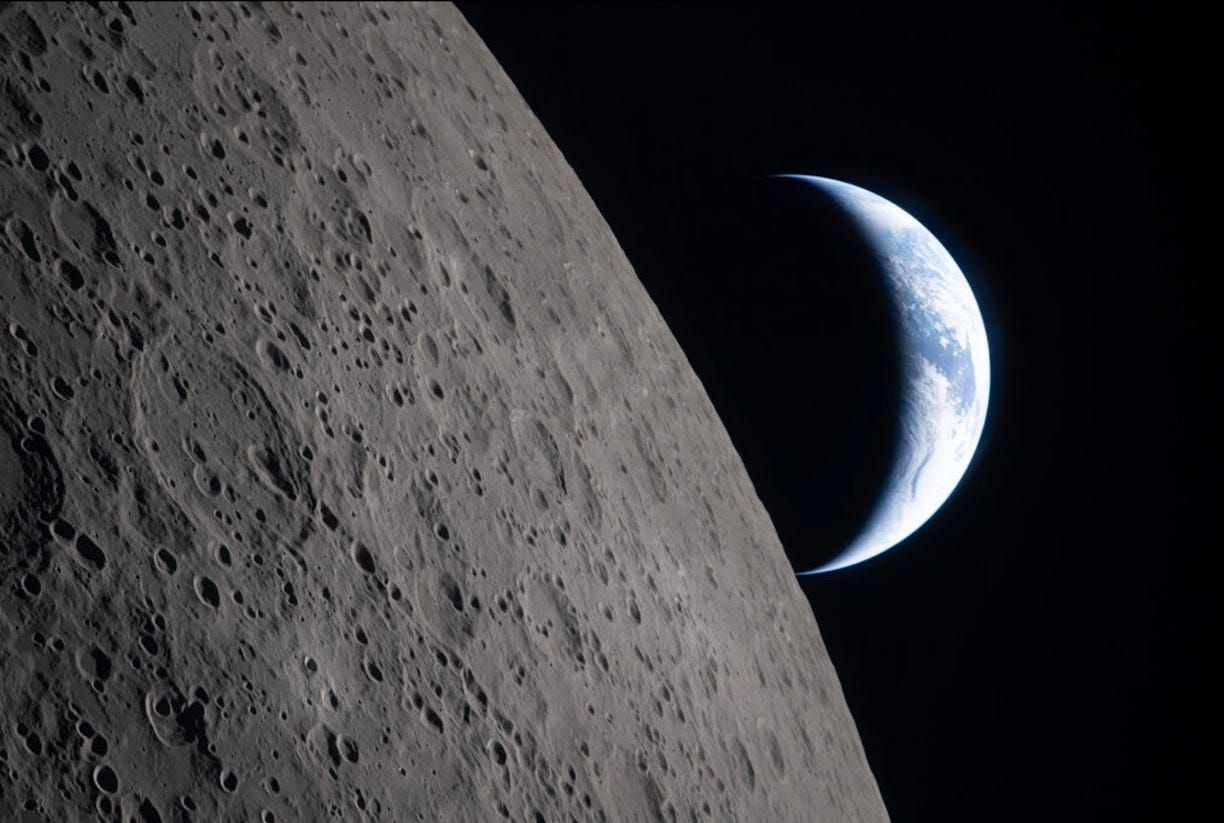
When I saw the photos, especially that one of the earth - and this one of the moon and earth rise - I was reminded of the grandeur of the universe, the emptiness of space and how small and unique - and united - we are.
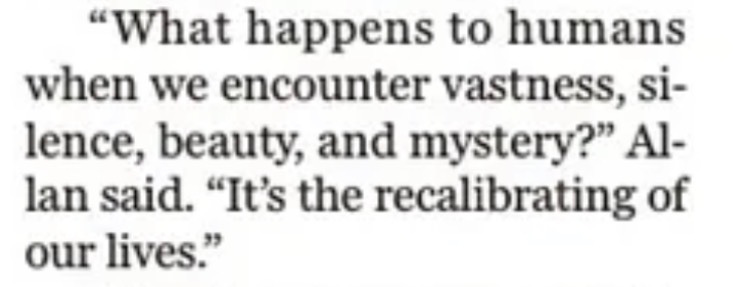
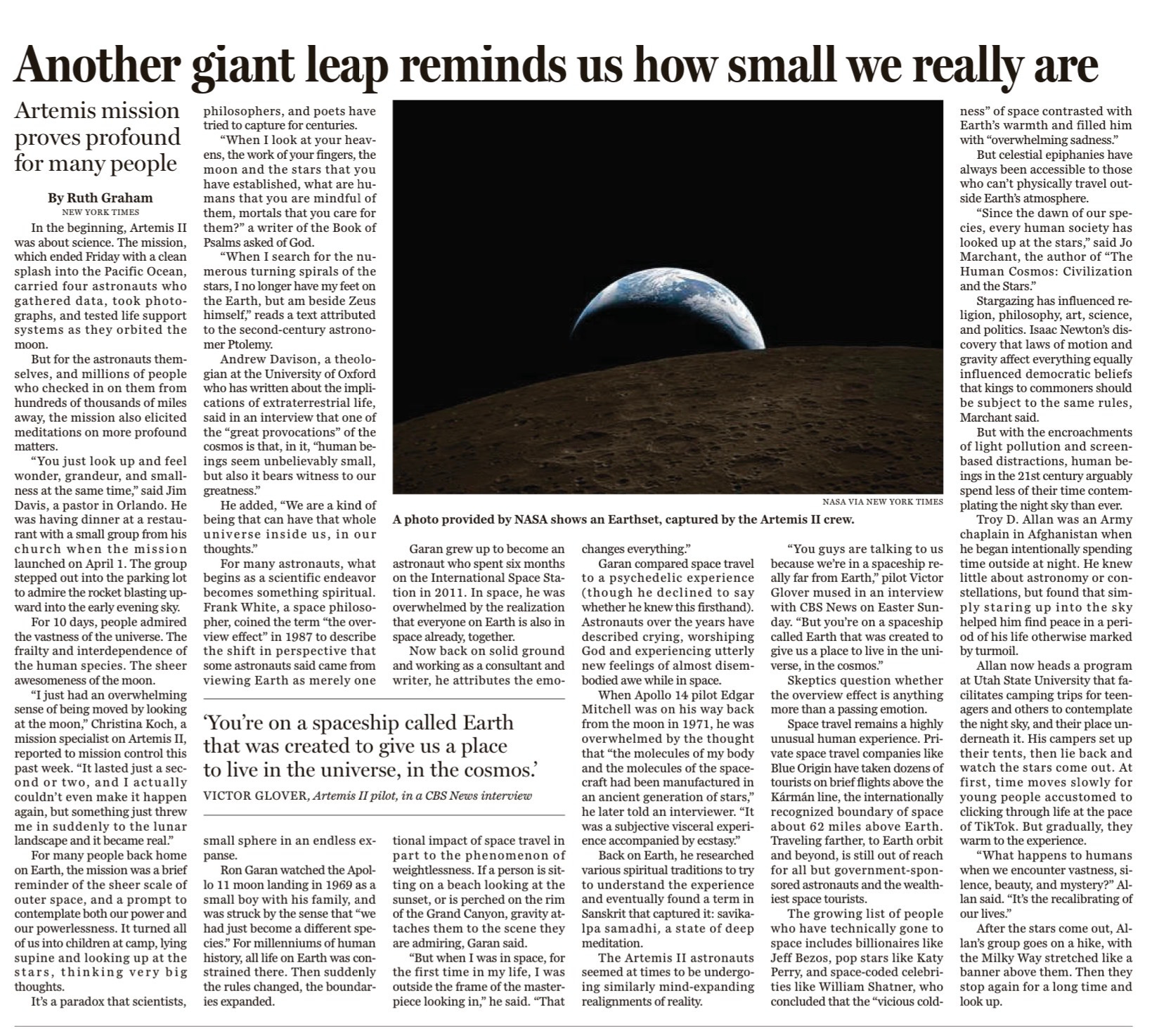
It was put perfectly by educator Troy D. Allen in the New York Times.1
And I heard the humility of the astronauts, reminding me of Apollo 8’s reading of Genesis as they looked down at the lunar surface and back at earth. And I was hooked.
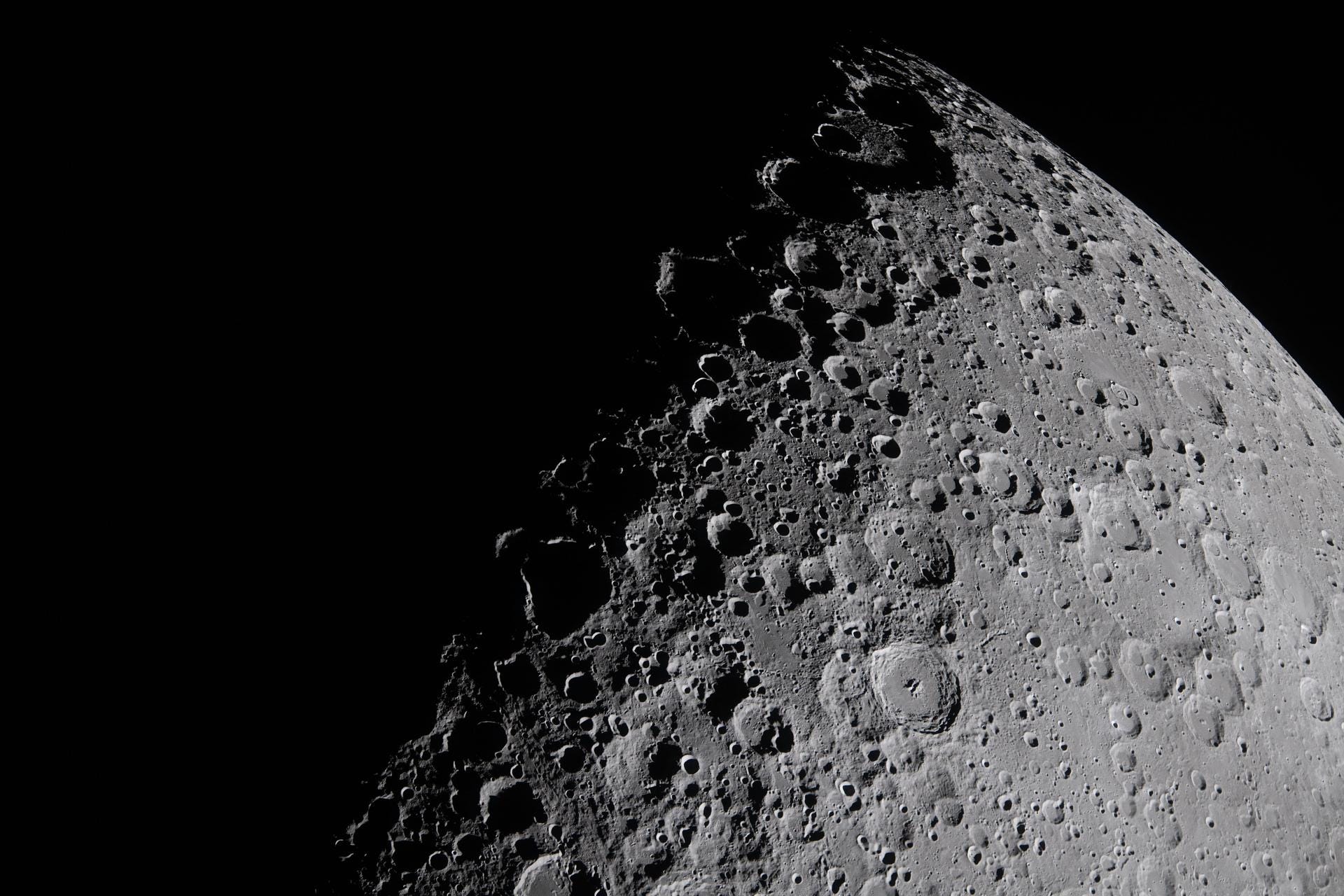
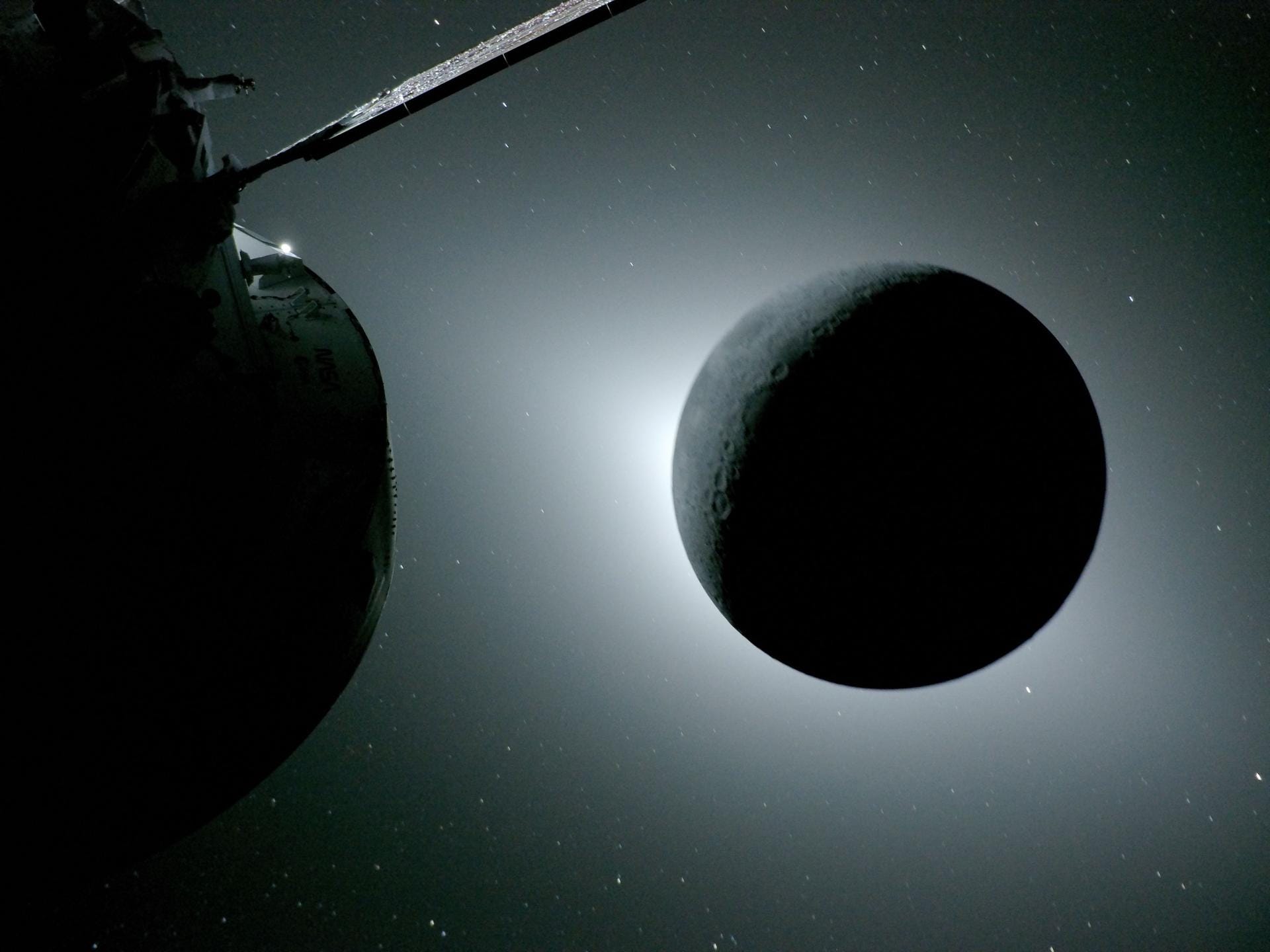
Those photos became my prayerbook this past Shabbat. Check out these photo albums:
And what better way is there to remind us to care for this planet, that it’s not merely our home, IT IS US.
The Home Planet: Our Holy Place
Back in 1948, British astrophysicist Fred Hoyle predicted that, “Once a photograph of the earth, taken from the outside, is available, a new idea as powerful as any in history will be let loose.” At the end of a catastrophic year, 1968, and just seven months before the moon landing, there was the flight of Apollo 8; we still don’t fully appreciate what it meant for humanity to see, for the first time, the earth rising, as the spacecraft emerged from the dark side of the moon.
And what did these awestruck astronauts do at that moment? They read from chapter one of Genesis, the story of creation. “To look out at this kind of creation and not believe in God is to me impossible,” John Glenn told reporters in 1998, just after returning from his final trip to space at age 77. “It just strengthens my faith.”
A while back, as the space race was winding down, a group of astronauts and cosmonauts came together to create a unique book called The Home Planet, a collection of their perspectives on what they alone have seen, the vision of earth from a distance. For Edgar Mitchell, an American astronaut, a revelation occurred when “looking at the earth and seeing the blue and white planet floating there, and knowing it was orbiting the sun, seeing that sun, seeing it set the background of that very deep, black and velvety cosmos, seeing – rather, knowing, for sure – that there is was a purposefulness of flow, of energy, of time, of space in the cosmos, and that it was beyond man’s rational ability to understand. I suddenly experienced the universe as intelligent, loving and harmonious.”
Yuri Artykin, a Soviet cosmonaut said, “It isn’t important in which country see you observe an oil slick, or in the forests of which country a fire breaks out. You are standing guard over the whole earth.”
And another cosmonaut said “One morning I woke up and decided to look out the window, to see where we were. We were flying over America and suddenly I saw snow. I’ve never visited America, but I imagine that the arrival of autumn and winter is the same there as in other places, and the process of getting ready for them is the same. And then it struck me that it doesn’t matter what country you look at; we are all children of our earth.”
And, the words of Sultan bin Salman al-Saud, an astronaut from Saudi Arabia: “The first day or so we all pointed to our country, the third or fourth day we were pointing to our continents, and by the fifth day we were aware of only one earth.”
Oh how I wish we could all get a single glimpse of what they have seen, of our fragile sacred ball of life. How I wish it. For if we could, there would be no more fear, no more hatred. No more war. In Hebrew, man is Adam and Earth is Adama. We are one with our planet and with all who share it with us.
In 2022 Viktor Orbán boasted of “a victory so great you could see it from the moon.” Magyar’s response yesterday: “This victory is visible not from the moon, but from every Hungarian window—whether in the smallest rural home, a tower block apartment, a major city, or the countryside.” But we actually could see it from the moon.
Earth Day and Yom HaShoah
Earth Day (April 22) is next week and Holocaust Remembrance Day is tonight and tomorrow. In Jewish tradition, respect for the health of the environment and concern for the dignity of human beings go hand in hand. The Nazis were notorious for their pillage of both the land and its inhabitants, and Eastern Europe is paying the price for that to this day. Judaism is so concerned about the earth that we have our own annual Earth Day, Tu b’Shevat, not to mention a weekly one, Shabbat.
Several years ago I visited the site of Dachau, the concentration camp just outside Munich. I say that I visited the “site” of Dachau, because it wasn’t Dachau. Yes, the name was there, right next to the infamous inscription, “Arbeit Macht Frei.” Yes, the barbed wire was there, and the barracks, remarkably well preserved, and the ovens. Yes, there were memorials to the dead, marking mass graves of nameless victims. But it wasn’t Dachau.

Dachau was hell and this wasn’t it. There were flowers at this place, surrounded by fresh-cut grass. The whole area is being marketed as an artist colony and tourism center. I could hear birds. I even saw a butterfly, which confirmed for me that this was not Dachau, for the famous Holocaust poem tells us that there were no butterflies in the death camps.
If this was not hell, then what was it, and why did it suddenly look so lovely, so natural? Was this a cruel trick by God, a vain attempt to reclaim that which God had ceded to the beast in humanity in 1933? Or was this God’s apology, this smattering of forget-me-nots and daisies embedded in cemetery sod, a plea for forgiveness, too little and too late?
Or maybe God was hoping, beyond hope, to give Jews one last chance to regain the illusion of an attainable paradise on earth, a thin veneer of April hope covering the reality of August hell.
“Here,” God is telling us, “I can’t give you redemption. All I can give you is this spring-like illusion. Let it ease the pain of your wanderings. Take it.”
On Yom HaShoah we say to God that this plan, however comforting and kind, can’t possibly work. We reject the illusion. We have seen hell first-hand; it won’t be forgotten. Time will not heal this wound. If renewal is possible following the Holocaust, a God who was absent during it cannot bring it about. God, who could not save the Jews, will also not redeem the earth. If renewal and hope are at all possible, only human beings can facilitate it.
Anyone can grow a few forget-me-nots.
There are two seemingly contradictory verses in Psalms: Psalm 24 tells us, “The earth is the Lord’s and the fullness thereof,” while we read in Psalm 115, “The heavens are the Lord’s heavens, but the earth has been given to humankind.” This discrepancy can be resolved by drawing from it this lesson: Once upon a time, the earth was the Lord’s, but since the Holocaust, it is ours and ours alone.
Before the Shoah, when the earth still belonged to God, we, who had once experienced Paradise first-hand, could only imagine Eden’s opposite. As David Grossman wrote in his masterful novel, See Under: Love, “We always pictured hell with boiling lava and pitch bubbling in barrels,” until the Nazis came along, “showing us how paltry our pictures were.”
Now, nothing is left to the imagination. The earth is ours and we are utterly responsible for all that happens to it; all of it, the people, and the flowers, too. Those flowers at Dachau have become a symbol of God’s ultimate helplessness and our ultimate responsibility. We still pray, though no longer for divine intervention, but in gratitude for the basic tools provided us: warm summer days, rain in its season, the miraculous ecosystem. We look to heaven for resolve but little else, for “the earth has been given to humankind.”
And the blood of our brother Abel is screaming from that very earth. We must care for the earth because our ancestors and martyrs are buried within it. The earth is not only their legacy to us; it is them — their bones, their blood, their illusions, their dreams, and their follies. Their cries seep through the ozone layer. Their tears fall as polluted rain. Defoliated rainforests uncover their nakedness. We cannot go anywhere without walking on their bones. We must tend to their graves.
The earth is not only ours, it is us. Chief Seattle, a Native American leader of the last century, wrote, “This we know, the earth does not belong to us; we belong to the earth.” And in time our bones will rest there too, serving as a firm platform upon which our grandchildren will walk.
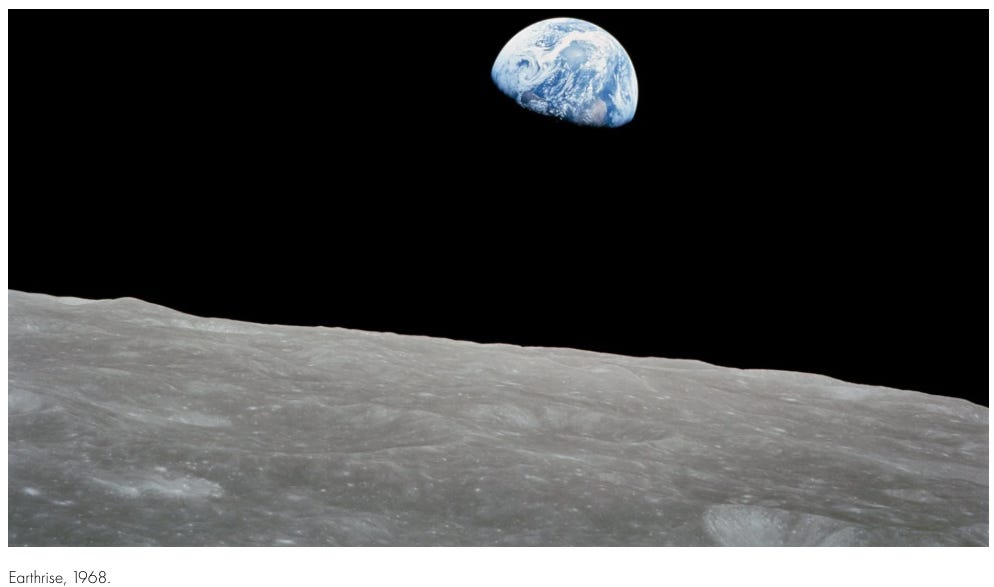
That is the earth that we see from space. Chief Seattle’s earth.
In caring for our planet, we sanctify the names of those who died and affirm life for those not yet born. We do it not out of the illusory hope that the world can be as it was, for we shall never return to Eden. We do it because we have to, because it is our responsibility. No one else will do it for us. And if we succeed, if the world becomes a better place for our grandchildren, then we’ll have taken a small step toward resuscitating a measure of hope. This is the best we can hope to accomplish in the aged of scorched flesh and earth.
As we look at our planet home from on high, doesn’t it seem a little silly for us to be squabbling over a few miles of water at Hormuz to transport a black crude that completely ruins the earth-toned hues of the Artemis photo. Why are we fighting in the sandbox for a few boats of oil to get through when we already have the means to resolve our energy and climate needs through wind and solar? Why are we killing one another over prehistoric fossils when the answer is being given to us right now, directly from God?
“From a distance, there is harmony,” penned Julie Gold in the song that eventually became a Grammy winner in 1991. This song, From a Distance, echoes that most Jewish of hopes, for unity and harmony, a vision that grows in the heart of everyone who has ever recited the Four Questions. From a distance, it all makes sense. Think of the satellite photo of a hurricane, taken from space. On earth, there is no force more chaotic and destructive. When viewed from space, nothing looks more orderly and perfect than a fully formed hurricane. Order and chaos, all at the same time. From a distance it all makes sense.
Artemis reminded us of that.
This year, I’ll mark Earth Day and Yom HaShoah with sadness and grim determination. And for the first time in quite a while, a touch of hope.
Because as a Jew, a human being and a guardian of the planet, I have no other choice.
Artemis reminded us that wherever we are standing is holy ground.
And the Hungarian people, who courageously overthrew dictators three times, reminded us that today, their sacred homeland is our Holy of Holies.
Allen quote in the Times:

No comments:
Post a Comment