Showing posts with label Jewish Week "On One Foot" articles. Show all posts

Tuesday, October 10, 2023

Optimism Now, Apocalypse Later (Jewish Week)


Israel can survive vigorous diaspora dialogue - it has for decades. But it cannot survive with people at the wheel who think God loves land more than peace, who deny the humane values that Jews have held for millennia.


I was scheduling a lifecycle event with a congregant the other day and we ran into a snag having to do with his 27-year-old daughter's vacation schedule.

"Oh, sorry rabbi," he said, "that weekend will be impossible. Amy will be trekking in Vietnam."

Come again?

It turns out that she'll be there with a friend, another young congregant who, as I recall, became bat mitzvah the day before yesterday. It also turns out that 'Nam has become an increasingly popular place to visit, to the tune of five million tourists this year, according to the Vietnam National Administration of Tourism, the highest number in two decades.

It used to be that most Americans 20-somethings who went over to Vietnam did so rather more reluctantly, many returning in body bags. But those who were once terrified of sending their sons are now freely sending their single young granddaughters.

If Americans can be welcomed as tourists in My Lai, it seems logical that Palestinians and Israelis might be able to sip tea together in Ramallah. Why not? As the world continues shrinking, the inconceivable is becoming routine overnight. Thirty-five years ago, when the last Americans helicoptered out of Saigon, who could have imagined a world where one could freely crisscross Berlin or buy matzah in Moscow. If the Pope can endorse condoms, then pigs truly can fly - or at least they can practice safe sex.

A new kind of domino theory is taking hold, replacing the antiquated ethos of the Cold War era. Everywhere we look, walls of separation are crumbling. France and Germany share the same currency, Turkey and Greece share tourists by the boatload and South Africans all share the same multicolored flag. Wherever you look, ancient feuds are melting away. Shimon Peres' vision of a New Middle East seems to actually be happening, at least everywhere but in the Middle East.

Israel long ago got aboard the global gravy train and the dissolution of international enmities has fueled its economic rise. Jews have always flourished in a world without walls. Now we hear that Israel's high-tech prowess might have yielded an enormous security dividend - the Stuxnet computer worm, rumored to have caused extensive damage to the Iranian nuclear program. Add to that the recent discovery of massive natural gas and oil reserves, along with the improved security and economic situation for West Bank Palestinians, and this year's Chanukah lights might just be signaling us to abandon cynicism and believe in miracles again. This time, the peace process could actually work.

After the collapse of Oslo, it's not easy to be an optimist. But guarded hopefulness should not be confused with messianic fervor. Messianism is in fact our greatest danger, for it leads to xenophobia and military adventurism. The rabbis understood that, which is why the name Maccabee, which they came to associate with such adventurism, was virtually expunged from the Talmud.

It's the messianic yearnings of those who detect darker trends in history that threaten to hijack the peace train. Fundamentalism in all its guises is the enemy right now. The Iranian mullahs and their Gazan and Lebanese proxies rank highest on that list - by far. Jewish fundamentalists, while far less destructive, also possess a dark vision of the world, one fueled by visions of apocalyptic devastation, conspiracy theories and a stark delineation of Us from Them, with the definition of "Us" growing narrower by the minute.

And because the haredim and nationalist extremists hold disproportionate sway in the Israeli government, they are especially dangerous. Each outrageous act only serves to isolate Israel more and more in the eyes of the world and American Jewry. If the greatest danger to Israel now is delegitimization, their provocations are only adding fuel to the Goldstone-stoked fire.

The squabble with the Obama administration over the settlement freeze would hardly have caused a ripple if it had not occurred immediately following last summer's Rotem Bill fiasco and the plethora of annulled conversions, the arrest of Anat Hoffman for carrying a Torah, the creeping haredi annexation of the Western Wall, the Jim Crow-like treatment of women on busses and public streets, and talk of loyalty oaths and the transfer of Israeli Arabs. Throw in the repeated insults to Joe Biden over Jerusalem construction and excuse us for wondering if Glenn Beck is running the show over there.

There's been much consternation lately over J Street. A synagogue near Boston even disinvited their president Jeremy Ben-Ami recently, sending a horrible message to turned-off Jews everywhere. But with all the questions raised about J Street, some quite justified, no one has asked how such a "radical, fringe group fronting for Israel's enemies" now counts over 500 in its rabbinic cabinet. I would venture to say that not every one of them is an unwitting lackey for the so-called "Puppet Master," George Soros. Some rabbis are actually fairly bright people.

I know why I was one of the signers, and why I did not disinvite Ben-Ami when he appeared at my synagogue just a week after the J Street-Soros connection was revealed.

I signed because my fear of an Israel driven by dark apocalyptic visions trumps my more limited fear that American Jews are speaking with multiple, conflicting voices.
Israel can survive vigorous diaspora dialogue - it has for decades. But it cannot survive with people at the wheel who think God loves land more than peace, who deny the humane values that Jews have held for millennia.

My concern for Israel is so deep that I am willing to proclaim publicly that the messianists could be messing up the last good chance for peace. I love Israel too much to stay silent.

Miracles happen, and all conflicts end, eventually. Even the Hatfields and McCoys signed a truce not long ago. Our girls are trekking in the very homeland of "Apocalypse Now." There's no reason this pig can't fly.

Rabbi Joshua Hammerman is spiritual leader of Temple Beth El in Stamford, Conn., and writes the Hammerman on Ethics column for The Jewish Week online. He and New York Times “Ethicist” columnist Randy Cohen will participate in a Jewish Week Forum on “Ask The Ethicists” on Tuesday, Dec. 7 at 7:30 p.m. at Temple Emanu-El, 10 E. 66th St. The event is free but reservations are suggested. Events@jewishweek.org.

Sunday, November 25, 2018

Should Jews 'Turn the Other Cheek'? (Jewish Week)


OPINION

Should Jews ‘Turn the Other Cheek’?


Rabbi Joshua Hammerman


Should Jews turn the other cheek?
Yes, it’s true, Judaism does take a different approach. The article goes on to explain, correctly, that the Jewish concept of teshuvah calls on the perpetrator to seek forgiveness from the victim before having any hope of absolution. Then it adds that Pittsburgh mourners “felt little instinct to forgive the person responsible for such horror.”
Clearly, there is a difference in how the victims of Pittsburgh and Charleston approached similar calamities. But whenever someone traces things back to the “retributive justice of the Old Testament God,” an enormous red flag is raised. There are many images of God depicted in the Hebrew Bible, some more vengeful and others more loving. The thunderous God of the Exodus Sinai narrative is later encountered by Elijah, in the very same place, as a “still, small voice.” And that kinder-gentler New Testament God seemed to conveniently forget to turn-the-cheek during the Crusades and Inquisition.

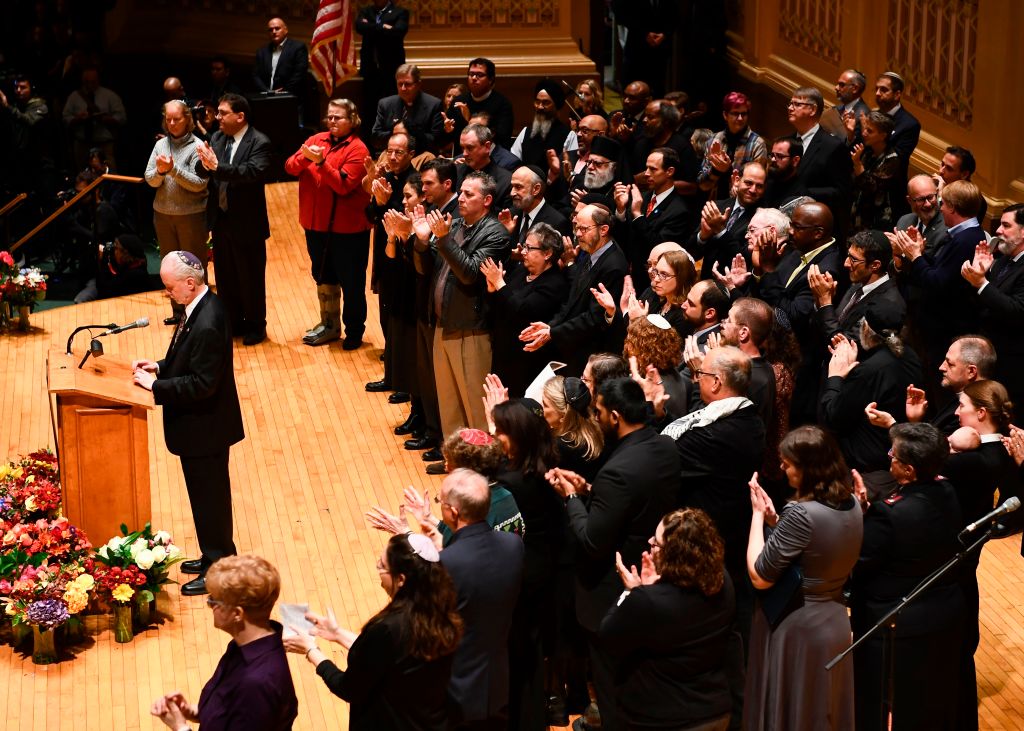
Rabbi Hazzan Jeffrey Myers, from the Tree of Life synagogue, speaks during a vigil, to remember the victims of the shooting at his synagogue the day before, at the Allegheny County Soldiers Memorial on October 28, 2018, in Pittsburgh, Pennsylvania. – A man suspected of bursting into a Pittsburgh synagogue during a baby-naming ceremony and gunning down 11 people has been charged with murder, in the deadliest anti-Semitic attack in recent US history. Getty Images
The notion of a perpetually vengeful Old Testament God has inspired stereotypic images of hard-hearted Jews, even though the Torah explicitly prohibits taking revenge and holding grudges.
Why does Judaism not encourage the unconditional embrace of your enemy? When you turn your cheek, you are no longer looking at your offender in the eye, face to face. True reconciliation can only occur when two human beings can truly see what is human in the other, and how each of us is created in the Divine image. But there are times when such authentic encounters simply can’t happen. The Pittsburgh perpetrator showed no signs of remorse during his appearance in court, and it is doubtful that he will when he stands trial. It would be a grave injustice to blindly forgive him.
After the Charleston massacre, I attended a prayer vigil, at which I heard a presentation by Inni Kaur, a representative of the Stamford, Conn., Sikh community, reflecting on her own faith group’s experiences.
It should be noted that the Sikh community suffered a similar massacre, at a temple in Oak Creek, Wis., in 2012. Unfortunately, no religious group is immune to such attacks. The image of people at prayer or study seeing their sanctuary violated, having the pastoral serenity and love of neighbor rendered instantaneously into a garish nightmare, is one that cuts across cultures.
My Sikh friend recalled Oak Creek, and how the community rallied together and preached love over hate, and, like Charleston, even forgave the perpetrator. She said, “These communities have shown us that faith helps endure any hardship, even the most unspeakable suffering. Faith does not mean we forget pain or grief. Faith means that we live free of hate. These monumental acts of forgiveness compel each and every one of us to work towards ending the racial terror that exists in our country today; to find ways to look beyond the boundaries of race, color, ethnicity and see the Oneness in all.”
So “forgiving” enemies is not about letting them off the hook — it’s about telling them, loud and clear, that they have not succeeded in driving a wedge between groups. It’s about achieving a greater societal goal by suppressing base urges. In Charleston, Oak Creek, Orlando and now Pittsburgh, the ideology of hate was drowned in a sea of love.
In Charleston, the victims’ supreme gesture of love yielded tangible results — the removal of the Confederate flag from the state capitol.  One hate-driven young man accomplished in one evening what Martin Luther King could not accomplish in a lifetime, at least with regard to the shunning of this symbol of hate.
One might say that for the bereaved of Charleston, forgiveness was the best revenge of all.
For the Jews of Pittsburgh, the best revenge against the particular hatred espoused by white supremacists has not been to turn the other cheek, but to build stronger bridges to other targeted communities, like African Americans and Muslims, who have shown such love in the wake of the attack.
And that love was reflected at the ballot box, where polls suggest that late deciders in the recent midterm elections swung away from the harsh nativism espoused by Republicans following the pipe bomb attacks on Democrats and the Pittsburgh pogrom. (Yes, these days pogroms no longer require angry mobs with pitchforks; now all it takes is a single crazy hater with an AR-15.)
As voters decided “enough is enough,” our newest Jewish martyrs changed America, while the bereaved turned not the other cheek, but perhaps the tide of history.
Rabbi Joshua Hammerman is spiritual leader of Temple Beth-El in Stamford, Conn. His upcoming book, “Mensch Marks: Life Lessons of a Human Rabbi — Wisdom for Untethered Times,” will be published in April by HCI Books.

Wednesday, August 29, 2018

Rabbis’ Moment Of ‘Truth Is Truth’ - Jewish Week


OPINION

Rabbis’ Moment Of ‘Truth Is Truth’


Rabbis everywhere are approaching the Days of Awe with more than the usual degree of trepidation. We always walk a tightrope, seeking that sweet spot balancing the timeless and the timely, the suffering soul and the body politic. But not since 9/11 has our mission been so clear. Feel-good sermons always feel good, but Rome is burning, and we’ve no choice but to talk about it. To ignore the proverbial elephant in the room would amount to spiritual malpractice. To mis-paraphrase Rudy Giuliani’s “truth isn’t truth” comment, this is our moment of “truth is truth.”
The key is to be able to deliver strong, pointed messages that are heavy on Jewish values while avoiding partisanship. No need to mention the upcoming elections or to cozy up to candidates; but common decency and the rule of law need our full-throated endorsement.
I led a congregational trip to Israel this summer. During a guest presentation, one of the members of the group (OK, it was me) asked how it is that Israelis could be so loyal to President Trump.  The speaker’s reply was a version of the standard fare diaspora Jews have heard for generations:
“While you are choosing to sit back and watch from the sidelines, we Israelis are putting ourselves on the line daily, in the roughest of neighborhoods. So, when someone comes along and acts so supportively, we can turn a blind eye to a few indiscretions.  Nobody’s perfect, after all.
My reply must have shocked him:
“Can you even begin to fathom the enormity of the battle we are waging right now? We are fighting for freedom of the press, for oppressed refugees, traumatized children and victimized women.  We are fighting for our planet. We are fighting for the future of democracy itself. And, oh, by the way, we are fighting for you.  Israel’s Trump-enabled anti-democratic slide is as much an existential danger as any external enemy. Because I love Israel, I fear that she will pay a very steep price when the Trump nightmare ultimately ends. So, while every day I pray for those who are defending Israel’s borders, you should also say a little prayer for us. While Israelis have been spending the summer skirmishing with Hamas and praising foreign autocrats, we Americans — Democrats, Republicans and Independents — have been fighting in the trenches of democracy’s Last Best Hope.
“So please don’t lecture me about sitting on the sidelines.”
As we enter the year 5779, across America, religion is becoming increasingly relevant. “Thoughts and prayers” are no longer sufficient in Congress, but here in the spiritual trenches they have never been more meaningful, because our prayers affirm the values of honesty, integrity and love that are being eroded every day.  Hymns that for decades were mumbled somnolently now have become arrows of defiance.
‘Religion, journalism’s First Amendment dance partner, has largely evaded Trumpian fusillades to this point.’
Rabbis are engaging in subversive acts every day, simply by doing our jobs. Just by standing up for decency and honesty — for being a mensch — I’ve become an accidental insurgent. Homilies that I have been delivering for decades, emphasizing basic values like humility and generosity, all now sound like a call to arms. Even the most pedestrian moral messages can be interpreted as zingers at the White House: “Love the stranger.” “Tell the truth.” “Be faithful to your partner.” “Words matter.” These have always been my bread and butter. Now they’ve become fodder for the resistance.
The resistance has even spread to the synagogue sandbox. When little Johnny is told to share his cookies with Sally, this seems countercultural at a time when the president is depriving Sally’s single mom of healthcare. When I ask little Sarah to say the prayer over fruit on Tu b’Shevat, I’m thumbing my pastoral nose at the person who wants to eliminate the EPA and ruin the earth.
So, rabbinic colleagues, there is no avoiding our task to deliver pointed messages this Rosh HaShanah. And if you are worried about being stung by those famous executive tweets, no need for concern. Religion, journalism’s First Amendment dance partner, has largely evaded Trumpian fusillades to this point. Like journalists, clergy affirm a higher truth, but they speak in a distinct moral voice that can’t easily be refuted or called “enemy of the people.”
In fact, we clergy might be Trump’s Achilles heel. He could claim — without even lying! — that many of our denominations are “failing.” He could attack any number of preachers whose carnal crimes exceed even his own. But while pastors have been organizing against the president with an intensity not seen since Vietnam and Watergate, he’s been reprimanding clergy even less than he’s been scolding Russia. He’s even spared liberal clergy — Trump seems to fear us.
It’s a longshot, but if enough clergy tell him he’s being a bad boy, maybe he’ll go to his room. LBJ knew he was sunk when he lost Walter Cronkite. Trump might feel the same if he knows he has lost God.
We are riding a holy wave that is neither blue nor red. It feels like a new Great Awakening. The entire religious landscape is being radically realigned before our eyes. Many Evangelicals are splitting from Trump over character issues. Catholics are incensed over the zero-tolerance immigration policies. Jews and Muslims, the strangest of bedfellows, have formed unprecedented partnerships that have grown deeper with each anti-Semitic incident, Islamophobic slur or act of white supremacist-inspired hate. People of faith are banding together. Shockingly, religion has become relevant again.
Jews will be looking to their rabbis for inspiration next week. We can’t flee like Jonah. There is no place to hide. Maybe that is the hidden blessing of this current moment — but only if we are ready to say “truth is truth” to power.
Rosh HaShanah 5779 is a moment, that, for rabbis, will define not just our careers, but — just maybe — our lives. 
Rabbi Joshua Hammerman serves Temple Beth El in Stamford, Conn.  His new book, “Mensch-Marks: Life Lessons of a Human Rabbi – Wisdom for Untethered Times,” will be published by HCI Books in early 2019.


Wednesday, October 25, 2017

Embracing Auschwitz


 October 24, 2017, 4:18 pm 

Rabbi Joshua Hammerman


Aa rabbi, I’ve long felt that the Holocaust took up far too much Jewish bandwidth, smothering our joy and replacing it with resentment. It posed questions that were unanswerable, eclipsed centuries of achievement, gave us a pretext to hate others and gave our children the excuse to opt out of this Debbie Downer of a religion altogether.
Get the JW Newsletter by email
and never miss our top stories
  FREE SIGN UP!
But recently I’ve come around to a very different perspective, one validated by the pending release, on Nov. 3, of a video game. Not just any video game, but “Call of Duty: WW2,” the long-awaited next installment of a series that has sold 30 million units worldwide. What makes this one different is that it will depict the Holocaust, a topic avoided in prior WW2 video games, and the creators indicate that the subject is being handled authentically and truthfully.
“We didn’t want to shy away from history,” creative director Bret Robbins told Mashable. “We wanted to be very respectful of it. Some very, very dark things happened during this conflict, and it felt wrong for us to ignore that.”
As a response to the recent surge of anti-Semitism, the Holocaust is increasingly being brought into the mainstream of popular culture. Aside from “Call of Duty,” this year’s hit conventional board game is called “Secret Hitler,” which simulates the rise of fascism. The subject has become so prevalent in social and political conversation that a rule was created, Godwin’s Law, asserting that if any discussion goes on long enough, eventually someone or something will be compared to Hitler.   
The Holocaust is everywhere.
Back in the 1970s, Elie Wiesel disparaged the lowbrow TV mini-series “Holocaust” as “untrue and offensive.” But the series was seen by 20 million West Germans, half the country’s population, which led to massive reforms in the German educational system. Hopefully after the release of “Call of Duty,” millions of fans will convert their gamer’s rush into a strengthened commitment never to let such evil prevail again.
Wiesel also said that anyone who hears the account of a witness becomes a witness. With Wiesel gone and the survivor generation dwindling, it is time for Jews to embrace Auschwitz and to fully assimilate the power of its narrative into our collective story. I believe Jews are finally ready to do just that — and that Judaism itself is adapting to prepare us for that role.
In the 2013 Pew survey of American Jews, what stood out most was the response to the question, “What does it mean to be Jewish?” Leading the way by a large margin was “remembering the Holocaust,” at 73 percent. If there is a core to the Jewish self-image, a consensus narrative, that story is far more likely to revolve around what occurred at Auschwitz than at Sinai.
Jews, like all people, crave to live lives of joy, love, acceptance, community and faith. After seven decades of going through various stages of grief, we are at last recognizing the potency of the Holocaust message and its potential to help us check those positive boxes. What used to evoke only guilt and vulnerability is becoming a source of vitality and inspiration. While the narrative remains utterly shattering, sparks of hope are beginning to emerge.
In a series of sermons over the recent High Holidays, I demonstrated how classical Judaism is now being interpreted anew through the prism of this epochal event, and a “Torah of Auschwitz” is emerging.
Keep in mind that I use the term “Torah” with some deliberate irony — it is intended to provoke thought, not to show disrespect. For in the broadest sense, the word means “sacred teaching,” and as a verb it connotes an ongoing, evolving process of discovery. I contend that such a “Torah”- like process of sacred discovery has been dramatically aroused by the epochal events of 70 years ago.
For example, in Leviticus 19:14, the Torah of Sinai says that we should not place a stumbling block before the blind. In Germany today, there are memorial plates in the ground for Jewish victims — “Stolpersteine,” or stumble stones, they are called, because when you stumble over them you have to notice. As of last January, there are 56,000 Stolpersteine throughout the country. So the “Torah of Auschwitz” offers this corollary to Leviticus: “Yes, you should place these stumble stones everywhere a victim lived, to remove blinders from the eyes of those who try to forget their suffering.” 
Or take Deuteronomy 17:19, the commandment to remember what Amalek did to Israel in the wilderness, attacking the meek and innocent.  For centuries, this has been interpreted as a call for vigilance in the face of evil. But in light of Auschwitz, this commandment has been reinterpreted, not as a call to punish the villains, but rather to remember the victims and to ensure that never again should a cry from the depths of despair, danger and loneliness, from anywhere and anyone, go unheeded. 
Sinai’s Torah also calls upon Israel to love the stranger — no fewer than 36 times — “because you were strangers in the land of Egypt.” Egypt was a living hell for the Israelites, as was Auschwitz for Jews. But in Egypt, save for Pharaoh’s daughter’s rescue of baby Moses, there were no Raoul Wallenbergs or Oskar Schindlers to buck the genocidal trend. 
In stark contrast, Yad Vashem has honored at least 26,120 Righteous Among the Nations from 51 countries. So, the “Torah of Auschwitz” states “Love the stranger,” because not only do you know how it feels to be a stranger who was hated, but you also know how it feels to be a stranger who was, occasionally and inexplicably, loved.
Just as the evil perpetrated by the Nazis has no historical parallel, so does the courage of that era dwarf anything we see in the Bible. As the decades pass, selfless supernovas like Janusz Korczac, Mordechai Anielewicz and Hannah Senesh will further brighten the midnight sky as their stories merge into the collective, sacred narrative.
Jews need to embrace this story with love, conviction and overflowing pride at the unfathomable fact that somehow we survived this genocidal onslaught. And we survived with one mission only: to tell the tale. As the release of “Call of Duty: WW2” demonstrates, the world has never been more receptive to, and in need of, that message.
Rabbi Joshua Hammerman is spiritual leader of Temple Beth-El in Stamford, Conn.


Thursday, April 13, 2017

Are Jews The Happiest People On Earth? (Jewish Week)


Are Jews The Happiest People On Earth?

 April 13, 2017, 10:16 am 

Joshua Hammerman
Joshua Hammerman


Just in the nick of time, with depressing headlines piling up, the annual World Happiness Report has come out. And lo and behold, Israel is still perched at No. 11 among the 155 countries surveyed.
Get the JW Newsletter by email
and never miss our top stories
  FREE SIGN UP!
Just to place that in perspective, the U.S. checks in at No. 14, and those countries ahead of Israel include places encircled by water, like Australia, Iceland and New Zealand and an assortment of Scandinavian nations, where the closest they’ve come to war lately was Prince Hans Westergaard’s royal coup in Disney’s “Frozen.”
And then you have Israel: calamitous, terror-filled and polarized, with the meshuggenah bus drivers and rude bank clerks. That Israel. It’s also the country where the tomatoes are more flavorful, the falafel crispier, the sunsets more spectacular, the people more welcoming, the children more playful and where life is, simply, sweeter.
Dan Barber, a chef and writer, wrote about an experiment he ran on a mokum carrot, which he was able to grow outdoors in the middle of a cold February. When it was ripe, he ran something called a Brix test, which measures the sugar content. It came to 13.8. Barber compared it to an organic carrot purchased from a Whole Foods, presumably grown in a much less hostile environment. That carrot measured 0.0. on the same scale.
No sugar detectable.
Why such a dramatic difference? He explains that the mokum carrot was feverishly converting its starches to sugars because, in those hard freezes, it didn’t want ice crystallization.
Why?
Because if it gets ice crystallization, it dies.
“What you’re tasting is sweetness,” Barber stated. “But what the plant, the root vegetable is telling you, is that it doesn’t want to die.”
Maybe that’s why we make such a big tzimmis about tzimmis on Jewish holidays. The sweetness we’re tasting is life itself.
Have you ever noticed how the sweetest things are produced under the greatest duress? The State of Israel, 11th happiest country on earth, which has never known a single day of complete peace, is our proof.
I think Americans are becoming mokum-like too. We’re appreciating life more because we’ve peered into the abyss and seen how fragile freedom can be. We’ve experienced life at the limits — and when lived at the limits, life is simply sweeter. We’re taking our challenges and photosynthesizing them into love — and not simply your garden-variety love. We’re talking about “love is love is love is love is love!” Americans can’t sleepwalk through life anymore, and in a perverse way, it’s making us happier.
I’ve been captivated by a book that I picked up recently, a bestseller sharing Danish secrets to happy living. It’s called “The Little Book of Hygge,” by Meik Wiking, CEO of the Happiness Research Institute in Copenhagen. “Hygge,” incidentally, is pronounced “hoo-gah,” and is translated as comfort, togetherness and well-being.
Predictably, since this is Denmark, the path to hygge is paved with hot drinks, sweet pastries (they don’t call them “Danish” for nothing), board games, woolen socks, bike rides, photo albums and cozy fireplaces. Oh yes, and candles. Lots of candles.
When you take a closer look at the keys to Danish happiness, it’s easy to see why Israel scores so highly. Factor in the difference in climate (meaning, factor out the fireplaces) and there are lots of similarities.
Let’s start with the candles. Twenty-eight percent of Danes light at least one candle every day, an amazing number; but on Sabbaths and holidays at least, Israel might give Denmark a run for its money. The warmth generated by lit candles cannot really be measured in pounds of wax. As poet Marge Piercy describes in “Wellfleet Shabbat,”
The sweet beeswax candles flicker
and sigh, standing between the phlox and the roast chicken. The wine shines its red lantern of joy.
One of my favorite Philip Roth passages is one of his earliest, from the short story “Conversion of the Jews,” where the boy Ozzie watches his mother lighting Shabbat candles:
When his mother lit the candles she would move her two arms slowly toward her, dragging them through the air…. And her eyes would get glassy with tears…. His mother was a round, tired, gray-haired penguin of a woman whose gray skin had begun to feel the tug of gravity and the weight of her own history. Even when she was dressed up she looked like a chosen person. But when she lit candles she looked like something better; like a woman who knew momentarily that God could do anything.
When Jews wish one another a happy Passover in a few days, they’ll say “Hag Sameyach,” but they could just as easily say “Hygge Samayach,” because, for all its obsessiveness, toil and gastric irritation, there is no hygge-er celebration on the Jewish calendar than Pesach.
Wiking’s Hygge wish list is a virtual seder checklist. Aside from candles (check), books (check) and cushions (check), he advises would-be hygge-ophiles to “think tactile” and focus less on how things look than how things feel. He notes, “Letting your fingers run across a wooden table, over a warm ceramic cup or over the hairs of the skin of a reindeer is distinctly different from being in contact with something made of steel, glass or plastic.”
Passover is less about what we eat than what we touch, particularly the rutted topography of matzah, the silky matzah covers, the cool silver wine cups (or hand-made ceramic ones) and the unmistakable texture of spoon slicing through a firm matzah ball.
Beyond the look, taste and feel, there is nothing that calls us home more than the mingling smells of ground chrain, hard-boiled egg, bubbling soup and fresh spring flowers.
While Jews complain endlessly about Passover, the secret sauce to our happiness is distinctly artisanal, pungent with horseradish, charred from slightly burnt shmurah matzah, sweet with carrots, softly illumined by candles and best served warm on a night different from all other nights.
And on that night, surprise of surprises, Jews just might be the happiest people on earth.
Rabbi Joshua Hammerman is spiritual leader of Temple Beth El in Stamford, Conn.