Shabbat Shalom - and I hope to see you at the Cantor's Concert this Sunday. How are we feeling this week? Like we're looking out at the world from the inside of a wood chipper (turned off, of course). Our rose colored glasses have gone all yellow-rose on us. And we ask, as we cough and choke from these Canadian wildfires...Is this what God intended when saying....
Isaiah 9:17 For wickedness burns like a fire; It consumes briars and thorns; It even sets the thickets of the forest aflame And they roll upward in a column of smoke.
Or, as Smokey the Bear himself would say...
!רק אתה יכול למנוע שריפות יער Rak Ata Yachol Limnoa Srayfot Ya'ar!
Except it's no longer true that only you can prevent forest fires. You can - if you can singlehandedly reverse decades of wasteful abuse and industrialization. Does Smokey understand the impact of fossil fuels and how a warmer, parched climate has caused the proliferation of wildfires, heralding our New Normal? Does Smokey know about how our destruction of the planet flies in the face of time-honored Jewish values (for more on that, see the article at the bottom of this email)? Smokey, who is actually called "Smokey Bear" (no "the") has a checkered history and has been accused of racism in his portrayal of Japanese in World War Two and his attitude toward indigenous populations. He's even been accused of helping to fuel the fires he's ostensibly trying to prevent. But I can excuse those youthful indiscretions, as long as he stays away from the pic-a-nic baskets in Jellystone Park. Right now we're in a state of emergency and we need all paws on deck. For as the prophet Joel warned:
Wildfire burns everything before this army and fire licks up everything in its wake. Before it arrives, the country is like the Garden of Eden. When it leaves, it is Death Valley. Nothing escapes unscathed. - Joel 2:3 |
|
I signed aboard some sea ships Just to see the ocean roll; I flew the clouds in airplanes Just to satisfy my soul. Up in that big blue heaven My hopes can freely roam I will build my sundried brickwall Where my soul can feel at home.
My angel, my darling, When that atom bomb does come; Let me be your pillow While this world’s on fire.
Wildfire will run crawling While the walls will come falling; |
| Lay your weary head down While the world’s on fire.
When the flames go creeping; When the smoke plume is leaping; We’ll play like we’re sleeping While the world’s on fire.
While the skies they’re clearing We’ll rise up dreaming; Build our city from the ashes When the world was on fire.
My angel, my darling, When that atom bomb does come; Let me be your pillow While this world’s on fire. |
|
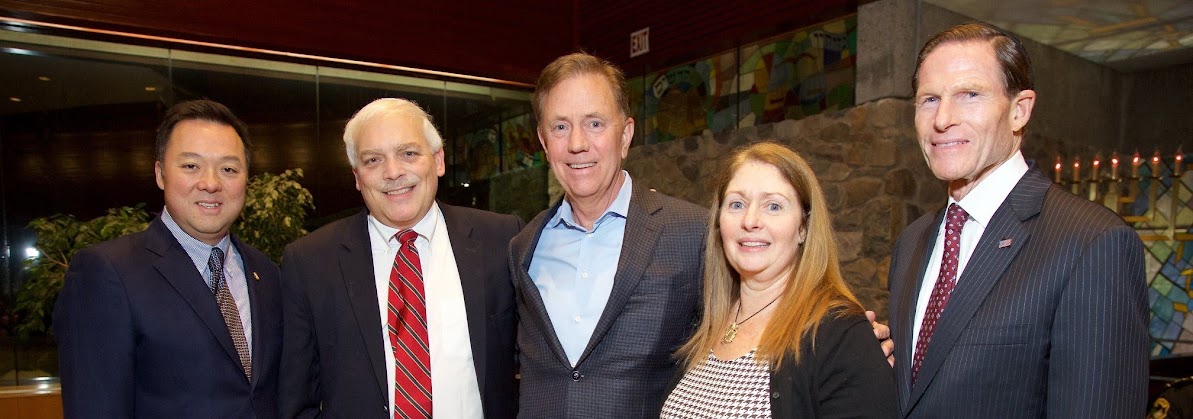
As I begin my 37th year at TBE, so many relationships have stood the test of time, including our ties to Senator Blumenthal and family. Evidently the editors of the (old) Jewish Voice were not yet familiar with the spelling of his last name, way back in 1988 when this photo was published. Below is a more recent photo, from the interfaith vigil organized by the UJF in early 2020, responding to a spate of antisemitic attacks. Our representatives have never let us down - even as the attacks have not let up. |
Listen to Rabbi Lauren Tuchman's superb Pride Shabbat talk here. She spoke of the Torah's ethic of inclusivity, compassion and love. |
"Woke," "P.C.," and God's Gender
While we've been preoccupied by the foul-smelling fiery air mass from Canada, a groundbreaking new translation of the Bible was announced this week.
- A ‘gender-sensitive’ translation of the Hebrew Bible has hit digital shelves. Not everyone is happy. (JTA) - A new Bible translation that eschews gendered pronouns for God is now available through Sefaria, the online library of Jewish texts, prompting backlash on social media from some who see the change as a sacrilege. The Revised Jewish Publication Society edition of the Bible, which the 135-year-old Jewish publishing house has released in partnership with Sefaria, is the first major update to the JPS translation of the Tanakh in nearly 40 years. So far, only the books comprising the Prophets, the Hebrew Bible’s second section, are available on Sefaria. The new English translation refers to individuals with pronouns that are consistent with traditional gender norms. But unlike nearly all translations of the Bible throughout history, the new edition, known as RJPS, does not refer to God with masculine pronouns. It doesn’t use feminine pronouns either: Instead, God is referred to simply as “God” throughout the text.For example, Isaiah 55:6 reads, “Seek GOD while you can, Call out while [God] is near.” JPS’ landmark 1985 translation, by contrast, reads, “Seek the LORD while He can be found, Call to Him while He is near.” See also: At an online Torah library, the people of the book confront book banning (Forward) - In the face a new gender-sensitive translation of Bible, some Orthodox rabbis call for a boycott of Sefaria
Funny thing. I got rid of the He's and Lords way back in the 90's when I was also abandoning the Thees and Thous. In 1991, I gave a sermon on political correctness, which you can read here, Long before any concept of "wokeness," there was P.C., though the roots are stunningly similar. Read the sermon and you will be shocked at how little has changed - except with regard to Bill Cosby.
I related a true story about how the Fresno Bee newspaper incorporated some P.C.-sensitive software into their editing process and subsequently ran a story about how Massachusetts could overcome a budget crisis and put itself "back in the African American," when it meant to say, "back in the black." Oops.
People fear change and the pendulum is constantly swinging back and forth between greater sensitivity in the use of language and an abusive overcorrection. I stand by most of what I wrote back then (which is amazing, because my views have evolved on a number of those controversial issues). Especially this quote, which has great resonance today:
The phrase "Politically Correct" has become a lethal weapon to silence anyone whose ideas you don't like. Many thoughtful citizens confront a dilemma. To protest demeaning language is to run the risk of being labeled P.C. But to not protest is to tolerate the intolerable.
The expression "political correctness" was invented at Brown, years after I graduated, but I tracked its development closely. This week, Pamela Paul wrote an op-ed in the Times about Brown and P.C., noting P.C.'s penchant for words like “womyn” and other idealistic but often ill-conceived efforts to reimagine the dictionary. I also made light of "womyn" in that 1991 sermon: |
 |
Here's how the sermon ended: |
Of the 134 High Holiday sermons I've given at TBE, this one resides in my personal top tier, as one that has stood the test of time.
As for the gender-neutral Bible, God was never a "He" in the original, just as the language itself was never masculine, even though it is called HE-brew. The sages understood that. Many, like Maimonides, either ran away from anthropomorphism altogether, or, like the Kabbalists, they envisioned God with a mishmash of qualities commonly associated with one gender or another (or more to the point, a combination of both). You can see it in this diagram of the Sefirot. Congratulations to J.P.S. and Sefaria for catching up, it's about time! |
A Joyous Awakening...A Field of Dreams Services OUTDOORS on Friday Nights Beginning NEXT Week |
 |  |
Back in the late '90s, we began a practice of having services outdoors every Friday night in the summer - weather permitting, and assuming the earth hasn't been consumed in a smoky haze. Even when the weather is just New Englandy quirky, once or twice each season we would have one of those pitch perfect evenings, when we would easily attain one of those "extra souls" reserved for Shabbat. This is the prayerbook Hazzan Rabinowitz and I put together (and happy 90th birthday, Hazzan!), with the gorgeous cover design by Harriet Lacker. Click on it to look inside. The Hebrew words on the cover, from Exodus 31:17 and the V'Shamru prayer, say "Shabbat Vayinafash," signifying how, for God and for human beings, Shabbat replenishes the soul. The prayer book was, for us, a huge leap forward in how it enabled us to delve more deeply into the prayers. I incorporated passages from the most innovative siddurim out there, especially the new (at that time) Reconstructionist book, Kol Haneshama, which used innovative, gender-neutral God language even back then. We loved being outside. The services were a hit. As planes flew overhead, I wondered what people looking down at us might think - even writing a column about it, called "Bialik's Bird."
So he looks down and sees a synagogue; he figures it’s a synagogue because there is no cross and, hey, it’s Friday night, and isn’t that when Jews pray or something? And outside on the lawn there, there’s a group of people, all ages, singing together.
He sees us swaying, in harmony with the rhythms of the week and the seasons, encircling one another while gazing both upward and eastward. He squints and sees children laughing, and thinks of his own kids, who are probably playing Nintendo at the moment, or screaming at the dog. He swallows hard, leans back in his chair, and wistfully recalls those pointless Bar Mitzvah lessons of his childhood, and a young adulthood sacrificed to the rat race, wondering how everything got so crazy.
Like Bialik, he longs for a Promised Land he never knew. He wishes, more than anything else, that he could be on the ground, with us.
So we'll be returning to that old TBE tradition on Friday, June 16, weather permitting. Each week the go / no-go decision will be made on Friday morning. Hopefully this summer, we'll be able to be outdoors more often than not, weather and wildfire permitting. Each service will also be live streamed. |
|
My year of saying Kaddish with Temple Beth El |
|
On the completion of her her year of Kaddish recently, I asked Gaby Rattner, a loyal online minyannaire, to share some thoughts about her journey. Here is her moving account.
Eleven months ago, my father became suddenly and tempestuously ill; he died nearly six weeks later, leaving our family devastated and shell shocked. So far, my experience, however painful, was not unique.
Growing up in an observant Conservative home, many of the mourning rituals were familiar; certainly the traditions associated with shiva and the always surprising (to me) insulation and comfort it provides. But I didn’t really know much about what would be required of me for the next year as someone mourning a parent. One thing I did know was that my father had said Kaddish for all four of my grandparents, the first time once a week, and by the last time daily, even while he and my mother were still working.
I am not as observant as some members of my family, but I wanted to make this same commitment. I was unsure I could see it through but was determined to try. One thing that would be necessary for this endeavor to be successful would be an online minyan. There were several reasons. I lead a small nonprofit organization in Greenwich and I had already missed weeks of work; I would not be able to leave my office every day, even if I could find a local daily minyan. Further, my father had not been inside a synagogue since COVID began so it felt right to pray virtually.
Where would I find a regular online minyan? Was there such a thing? My default position is to turn to Google, so I did, finding relatively quickly a listing for Temple Beth El’s mid-day service. Divine intervention! Begun during COVID as a way to keep people connected and enable them to pray together, this daily minyan is one of the more remarkable legacies of the pandemic. In fact, there are no other daily minyanim, live or virtual in our area.
This was exactly what I was looking for at exactly the perfect time of day. I reached out to Temple Beth El and received an immediate answer. It was July; I was expecting it would take a few days and I was under a bit of a deadline because there were only two days before shiva began and I would go internet dark for a week. But I was warmly invited to join and received the link to do so.
Shiva ended and the next day I logged on. I expected to feel like an outsider. I didn’t know anyone in the congregation, didn’t know the prayers, could barely stumble through Kaddish and couldn’t stop crying whenever I said the words. And there was this screen between us.
How completely wrong I was about all of it. I was so warmly welcomed; members of the Minyanaires or the Mincha Bunch as they variously called themselves, reached out to offer solace to a person they had never met. The service includes the onscreen presentation of each of the prayers and their translation. This was enormously helpful, especially in the beginning, when I didn’t know the order of the service or most of the words I prayed at Rosh Hashanah and Yom Kippur and the occasional bar mitzvah. As time went on, not only did I discover that I could locate the prayers in a book, but they began to take on real meaning as the daily ins and outs of a difficult year presented challenges for which the Amidah seemed to offer both words of supplication and words of comfort.
When my mother fell and broke her hip two months later, the beautiful melody of the Misheberach, sung sometimes by Cantor Kaplan and other times by Hope Stanger or Pamela Tinkham, helped me feel I was doing something to help her. The stories people were invited to share any time the Eil Malei was chanted were not only interesting history lessons, but helped me to see what life with memories of my father could be like on the other side of this year – focusing on the positive and happy times and not on the painful, ugly days of his dying. The tales they told helped me understand how a person remains with you for the rest of your life even if theirs has ended.
The year went by. I joined the minyan from parking lots when I was on the road at 1 p.m.; from airports; from foreign countries and from my son’s dorm room (sort of a foreign country). Somehow, when I felt I was least meeting my obligation, that day’s particular service would be especially spiritual or melodic (thank you Cantor Katie!) Or Rabbi Gerry would tell me that people had joined from way more far-fetched far flung places than I. When I had COVID, the minyan said a Misheberach for me! This group was just always there, always supportive, always interested and interesting! And always accepting.
We marked all the holidays together and I learned about ritual, history and culture. As the shock subsided, minyan became more than a comfort; it became an intriguing part of the day. Most days my mother joined me, which added more depth to the experience. Once again, the fact that the minyan was online made that possible. She could not have gone daily to a synagogue and we could not have gone together.
In total I missed one day of saying kaddish for my father, the day I spent with Mom in the emergency room after she fell. I am filled with gratitude for this wonderful minyan, which welcomed me, taught me, supported me, gathered ten people every day and Sundays too and through a computer screen made me feel so much less lost and alone. In the end, I believe this is the real purpose of the ritual of saying daily Kaddish – not just to honor your parent but to find connection after such a painful disconnection and to be drawn closer to observance even when you least desire it. Thank you so much Temple Beth El, its clergy and its members. This year was a surprising and unexpected gift. |
|
Recommended Reading
Today's Israeli Front Pages
Yediot Achronot Ha'aretz (English)
The Hebrew headline below reads, "Terror along the Peace Border," referring to the attack that killed three Israeli soldiers along the normally quiet (and long) border with Egypt. Meanwhile on the bottom, the headline "History!" celebrates what arguably was the greatest soccer victory in Israel's history, the 3-2 upset win over Brazil in the Under-20 World Cup quarterfinals. This is the first time Israel has even qualified for this tournament. The semifinal will be played in Argentina on Thursday (today), vs. Uruguay, at 1:30 PM on Fox Sports 2. |
|
Parsha Packets for Beha'alotcha |
|
Source Packets for Session Ten of the Intro to Judaism Class Ethics and Being a Mensch
See last week's lecture on God and Messiah below |
 |
- 120 Jewish Books For Every Age (MJL) - Reading is a lifelong Jewish practice, and great Jewish literature should grow with us over the years. Psalm 90, traditionally ascribed to King David, declares: “The span of our life is 70 years, or, given the strength, 80.” But Jews are an optimistic people. Moses lived to 120, and we wish the same for ourselves and those around us. Ad me’ah v’esrim — to 120! — is a common Jewish birthday wish. So here we offer recommendations of the best that Jewish literature has to offer, a book for every age, from birth all the way to 120.
- Online Religious Services Appeal to Many Americans, but Going in Person Remains More Popular (Pew) - About a quarter of U.S. adults regularly watch religious services online; 21% use apps or websites to help with reading scripture. Broadly speaking, the survey finds that most Americans who watch religious services on screens are happy with them. Two-thirds of U.S. adults who regularly stream religious services online or watch them on TV say they are either “extremely satisfied” or “very satisfied” with the services they see.
So proud to read this WaPo feature on TBE's own Sarna Lapine! |
 |
- ‘Sweeney Todd’ director Sarna Lapine found her own path to Sondheim (Washington Post) -Sarna Lapine is operating on little sleep as she sits down for iced coffee and an interview on a recent Saturday morning in Shirlington. The film and theater director has been awake since dawn packing up her nearby temporary housing, but her enthusiasm for unpacking the musicals of Stephen Sondheim is as tireless as ever. After this conversation, Lapine plans to oversee one last preview performance of “Sweeney Todd, the Demon Barber of Fleet Street” at Signature Theatre before catching her husband, actor Matthew Saldivar, in an evening performance of “Spamalot” at the Kennedy Center. The next day, she’ll board an early flight to Minnesota, where rehearsals for her production of “Into the Woods” at Minneapolis’s Guthrie Theater have already started. And this all comes shortly after she helmed “Sunday in the Park With George” at Southern California’s Pasadena Playhouse. When all is said and done, Lapine will have directed three Sondheim classics over five months and a trio of time zones.
|
Robert Kraft’s campaign against Antisemitism | Outside The Lines |
In March, Patriots owner Robert Kraft committed 25 million dollars to launch a new campaign called “Stand Up to Jewish Hate,” to drive home the message that antisemitism must not be tolerated. |
Below, Richard Schwartz, a leader in the fight against Climate Change from a Jewish perspective, makes his case for urgent action. With the air quality so unhealthy that the government is instructing us to say inside and close the windows, when, exactly is enough going to be enough? Click on the article for a clearer pdf version.
When the flames go creeping; When the smoke plume is leaping; We’ll play like we’re sleeping While the world’s on fire. |
|
Temple Beth El 350 Roxbury Road Stamford, Connecticut 06902 A Conservative, Inclusive, Spiritual Community |
|
|
|
|