Showing posts with label Ki Tavo. Show all posts

Thursday, September 15, 2022

In This Moment: Covid Finally Got Me....Or Did It? The NY Schools Shandeh

In This Moment

An article in Yiddish on the New York Times website? How quaint....until you realize that the article exposes one of the great scandals in this history of public Jewish education. The corruption that has cost thousands of students a chance to learn basic survival skills in a modern society is a great shame (in Yiddish, for you NYT typesetters out there, a "shandeh" - שאַנדע‎) for a people that prides itself on the value of education. And just in case you think the revelations from New York are unique, just today, one day after the NYT revelations, out of Israel's election campaign comes this story: Netanyahu-brokered Haredi unity deal would fund schools that shun secular subjects: Ultra-Orthodox factions agree to maintain UTJ alliance in exchange for letting schools eschew core curriculum and still get public money, should right-religious bloc retake power. (see the JPost article at bottom of this email) When I read stories such as these, I recall the visit to TBE of former Haredi Shulem Deen after the publication of his book, "All Who Go Do Not Return," which describes how he had to teach himself basic survival skills before venturing "Off the Derech" and leaving Haredi society.


Deen wrote a couple of years ago in an NYT op ed: 


When I was in my 20s, already a father of three, I had no marketable skills, despite 18 years of schooling. I could rely only on an ill-paid position as a teacher of religious studies at the local boys’ yeshiva, which required no special training or certification. As our family grew steadily — birth control, or even basic sexual education, wasn’t part of the curriculum — my then-wife and I struggled, even with food stamps, Medicaid and Section 8 housing vouchers, which are officially factored into the budgets of many of New York’s Hasidic families.

I remember feeling both shame and anger. Shame for being unable to provide for those who relied on me. Anger at those responsible for educating me who had failed me so colossally.


Now to see in black and white just how much the taxpayers of NY are complicit in destroying these kids' lives. This is a shandeh that rivals the Triangle shirtwaist sweatshop and Agriprocessors meat producers, a callous disregard for the welfare of the most vulnerable people. Read the essay by Gary Rosenblatt, former editor of the Jewish Week: Where Were Our Leaders Before The NYTimes Exposed A Chasidic Schools Scandal?  And here's a follow up: The Struggle To Reform Chasidic Schools Is Not New" Rosenblatt concludes his article by stating, "It's too late now to keep this embarrassing story from universal scrutiny, but it’s not too late to do the right thing: insisting on a basic Jewish tenet to obey the law of the land and give children their right to basic education."


Our obligation is to protect the innocent. As we read in this week's Torah portion: 

Shabbat Shalom

This week's portion is Ki Tavo


“To love is to suffer and there can be no love otherwise.”

― Fyodor Dostoevsky, Notes from Underground


Notes from the Bunker

They say that people plan and God laughs. So God decided that the only way to top last week's missive, in which I announced my future plans, was to afflict me with Covid, which is precisely what happened. Just yesterday, the W.H.O. director declared the end of the pandemic is 'in sight.' And the new vaccine booster, taking dead aim at Omicron variants, is just now arriving in Connecticut. Timing is everything, I suppose. Or as God would say, "Take THAT, scheming human."


This case will keep me in isolation through this coming weekend. Thus far the symptoms are mild, thanks to Paxlovid, the vaccines and boosters, and the fact that I managed to escape this plague for two and a half years. While the dangers are still there, particularly for people of my cohort, the risks are far less pronounced than they once were. One might say that, rather than Covid finally catching me, I managed to catch it on my own terms, outrunning it until it was weakened and more controllable. It's like having to face Willie Mays, but the Mays playing center for the Mets in the World Series of 1973, not the one playing center against Cleveland in 1954; or having to battle George Forman, but only once he stopped grilling opponents and started grilling hamburgers. So, to this point, I feel fortunate. I'll miss services and other events, like Selichot (in person - I'll be watching, though not seen), but I should be good to go for Rosh Hashanah, barring the dreaded Paxlovid rebound.


Last Shabbat we had a service on Friday night, outdoors, thankfully, and I kept some distance at a sparsely attended Shabbat morning service in the sanctuary. Thank God for sparse attendance! (Isn't that so screwed up?)


Please don't get the impression that I am happy that this chase is over and it finally caught me, because I know that the chase is not really over. W.H.O. optimism notwithstanding, this Wile E Coyote of viruses will keep on looking for new ways to insinuate itself into our lives. We're now better prepared to live in an endemic-pandemic world, but we are still at the very beginning of a long learning curve. We spend half our time closeted in bunkers and the other half in total denial. The good news is that the denial is no longer partisan, particularly in this election season. Discussing precautions and - God forbid - mandates among Covid weary voters has become as popular as discussing math scores among Hasidic Jews. No one from either party is even talking about Covid. It's just not a winner, so all parties party like it's 2019. 


But that denial places clergy in an especially precarious position.  This variant, while seemingly diminished in destructive capacity, is still extremely contagious, more contagious than ever, and there are people who should not be playing Russian Roulette with it. We still know very little about long Covid and I still can't taste my Cheerios, so if anyone is thinking that I'm now going to start wearing an "I Beat Covid" t-shirt to work, that's not going to happen. I've got my other t-shirt on right now, since I can't pet my dogs.

I will still advocate caution in much of what we do on the upcoming holidays - for instance, we will not have kissy-huggy Torah processions, even though I miss them more than anyone. I also will continue to really, really recommend masks indoors. And finally, you will not hear me trying to convince people to attend in person if they are remotely uncomfortable doing so. I love big crowds. I miss big crowds. But when I stand on the pulpit (God willing) I will not neglect those who are watching from home. You are part of our community too, and for the time being, we will continue to be a hybrid congregation, with no bias toward either in-person or remote. We will continue to aim to be excellent at providing guidance and inspiration for both.


As you can see - and you undoubtedly surmised from my note last week - I believe this pandemic has been extraordinarily destructive and corrosive for spiritual institutions and other living things. We've been so busy plowing forward - appropriately - that we've not yet stopped and looked back at the scorched earth Covid has left behind. Just the sheer number of people who have died. A million in this country, over 6 million around the world.

Since when do we, the Jewish people, toss off the deaths of 6 million human beings by ripping off masks and declaring victory? There is nothing to compare to the cruelty of the Holocaust, but the sheer numbers of those families who have suffered from this lonely, isolating, dehumanizing plague rises to an a total that is altogether too familiar.  I know we're exhausted, but I think we've been blasted by a combination of Covid brain fog and sensory overload at the sheer scope of what we have lost, how many we have lost and who we have lost. From the unknown to the noteworthy to the greatest of our generation. Doctors surmise that Covid might even have played a role in the death of Queen Elizabeth, It played a role in many deaths not recorded as Covid-related. Six million may be a vast undercount. Since 2020, wherever there was death, the shadow of Covid has lurked, but people have been too embarrassed to admit it. The true impact of Covid has been a conspiracy of silence and denial. Covid has besmirched our civilization, and where in nobler times that might have brought the world together, here we can't even get a third of America to take it seriously enough to mask up and vaccinate to protect the rest of us. 


“I say let the world go to hell, but I should always have my tea.”

― Fyodor Dostoevsky, Notes from Underground

Think what the spring of 2020 did to us. Just the memory of those trucks filled with bodies outside the emergency rooms. Just the fear of touching a doorknob, and the reluctance to open one for a stranger. The anger at those who seemed so selfish or politically cynical. Those who got going when the going got tough, and left their spiritual communities. Those who raked in the PPP dough when they didn't need it. For me now to pray that the sanctuary is NOT full, that everyone will sit apart and not sing - it is the complete antithesis of what my entire rabbinate has been about. It's not about me - it never has been - but these three years have caused considerable and perhaps irreversible damage to our souls. We trust less, we laugh less, we care less, we dream weirder, we hope less, we love less and we die younger - and more are dying.  Any good trends? There are some. Some interesting possibilities for synagogues too, including, ironically, the growing possibilities for virtual community, as we've demonstrated with our afternoon minyan and as we accomplished with well-attended Shabbat services before we went back in-person. But with each idea we generate to finally get beyond this thing, God laughs a little bit more.


So yeah, this is part two of last week's message. And I am hardly alone among clergy in feeling this way, as 38 percent have strongly considered giving up the ministry. Actually, that number has grown to 42 percent. 


There are two truths that are self evident:


  • One is that it is impossible for clergy to properly do their job in a mask. So much of what we are about is forging the kind of connection that can only happen when you see the face, the contours of a smile, the furrowed, empathic brow, the cheek damp from tears. Even when you give up the holding of hands, at the very least you need to see the face, and to hear an unmuffled voice. Kids need to see that especially. 


  • The second truth is that is is impossible to do our job properly these days without masking. We need to protect others by modeling caution and self care, and we need to protect ourselves so we will be there to share the most sacred moments of others' lives. A sick rabbi is a useless rabbi. I'm useless this week. I'm a spun dreidel, a windless shofar. Thankfully, a bar mitzvah scheduled for this Shabbat was recently postponed. Thank God there are no weddings. Because I'm useless.


Someone said, that if I managed to catch (or be caught by) Covid, anyone can, because I've been so "careful." It's true that among local public leaders, I've been on the more cautious side. And I've taken hits for that. I'd love a quarter for each time I've been told, "But Temple X or Church Y or school Z is back in person!" even early on, when the science strongly suggested it was not a good idea. Those arguments never moved me. Not once. I was never going to let peer pressure overrule my better judgment.  I did not want anyone dying on my watch.


But at times, when my job put me in positions that I felt were unreasonably risky, I've acquiesced out of a sense of duty, with little resistance. If someone is dying in the Covid section of the hospital and they allow you to visit, sometimes you just have to visit. So I would hardly say that I've been especially careful. Like all first responders, you gotta do what you gotta do. I've done funerals that filled our sanctuary, where despite my entreaties, few were masked. I've attended shivas at private homes where I've felt the hosts made a mockery of safety measures. That made me angry because it forced me to put my loved ones at risk, but I said nothing. I've been doing in-person burials since the very beginning (and there were so many in those first months); I had to do them. Until I was vaccinated, these funerals scared me to death, even when only a few family members were allowed to be present. And people have routinely tested positive after shivas, funerals and weddings that I attended, often mask-less. I was hardly a model of self-protectiveness.


So Covid, you got me. But not in the way you think. You actually had me at hello. Way back in March 2020, I always understood what you were - i never underestimated the damage you could wreak. I "got" you. As did the author David Grossman, whom I quoted back then in one of my earliest Notes from the Bunker:


Suddenly, a disaster of biblical scale has entered our lives. "Then the Lord sent a plague upon the people." And the world was plagued. Every person in the world is taking part in this drama. No person is excluded. There is no one whose intensity of participation is less than that of others. On the one hand, because of the nature of mass slaughter, the dead we don't know are only a number, they are anonymous, faceless. But on the other hand, when we look today at those who are close to us, at our loved ones, we feel how much every person is an entire culture, infinite, whose disappearance would dislodge from the world someone who is now and will always be irreplaceable. The uniqueness of every person suddenly cries out from within them, and just as love causes us to set apart one person from the masses that flow through our life, so, we see now, the awareness of death also causes us to do.


For many, the plague might become the fateful and formative event in the continuation of their lives. When it fades away, at long last, and people come out of their homes following a lengthy closure, new and surprising possibilities might be articulated: perhaps having touched the foundation of existence will foment that. Perhaps the tangibility of death and the miracle of being rescued from it will jolt and rattle women and men. Many will lose their loved ones. Many will lose their place of work, their livelihood, their dignity. But when the plague ends, there may also be those who will not wish to return to their former lives. There will be those - the ones who are able to, of course - who will leave the job that for years stifled and suppressed them. Some will decide to leave their family. To separate from their partner. To bring a child into the world, or precisely to refrain from that. There will be those who will come out of the closet (out of all manner of closets). Some will start to believe in God. There will be religious believers who will apostatize. Possibly a consciousness of life's brevity and fragility will spur men and women to set a new order of priorities. To insist far more on distinguishing the wheat from the chaff. To understand that time - not money - is their most precious resource.


Grossman's essay may or may not be prescient. We still haven't reached the end.


So we don't know yet what the future world will look like.


I do know that we will eventually dig out of this. There will be a future and it will be different. Very different. it already is.  


You finally caught me, Covid, but you didn't kill me yet. Come hell or high water, or God forbid even a Paxlovid rebound, I'll be out there on Rosh Hashanah, out from my bunker, my Doestoevskian dungeon, ready to welcome the new year, and the promise of a new future. Mask and all. There will be a future. It begins next week. 


A sweet 5783 to all.


Rabbi Joshua Hammerman

Recommended Reading

Chief Rabbi Lord Sacks' Tribute to Queen Elizabeth in 2012
  • (Video above) Chief Rabbi Jonathan Sacks' tribute to Queen Elizabeth in 2012. See also Where you find greatness there you find humility / and see also What Queen Elizabeth meant to a British Jew like me. Queen Elizabeth never made an official royal visit to Israel, which was a source of much controversy. Charles did attend the funerals of Rabin and Peres - an enormous morale boost - and hopefully he will return soon. But the first official royal visit to Israel didn't happen until Prince William went in 2018, and your TBE Israel group was there to see him at the Kotel, up close and in person -- really close.... like this close (I believe Cantor Kaplan took this photo)
  • Was Queen Elizabeth a successful monarch? 


Presumably the answer is an unequivocal "yes." But if she had been a rabbi, her contract would never have been renewed for another term: 


"Let's see, Rabbi Liz.... Nice High Holidays - you're great with pomp, but maybe a little more edginess to your talks wouldn't hurt. But otherwise, not a pretty picture.... since you took over, we've lost about a billion members. We've left Europe and isolated ourselves. Your family is an embarrassment. Can't you control your kids? The country is an economic mess, and environmental mess too. When you started out, the sun never set on us. Now the damn sun is burning us up!  Sun - Please set!  And you're obsessed with those corgis. Oh, and you're too old."


Fortunately, Your Majesty, your reign will not be assessed by historians according to the size of your empire, but rather the expanse of your heart.  in evaluating you, size does not matter.  Your ancestors might have been enslavers and plunderers of half the earth - but you were different. As everyone has been saying this week, unknowingly quoting "The Woman of Valor," from Proverbs, Eshet Chayil, you were "robed in strength and dignity." And you will be missed.


  • US Supreme Court decision says Yeshiva University must recognize LGBTQ club (TOI). OK, let's just say that this is embarrassing. Lots of non-rabbis go to Y.U., including my wife, who got her PsyD from Ferkauf. It's a top notch academic institution. So what the hell are they doing, denying support to students who don't fit their halachic mold? This and the NYT Haredi education piece in the same week? If ever I needed proof that the world has gone Covid crazy, this is it. This is Y.U's most inopportune decision since they took that investment call from Bernard Madoff.


  • Fewer than half of Americans may be Christian by 2070, according to new projections (RNS) - If current trends continue, Christians could make up less than half of the population — and as little as a third— in 50 years. Meanwhile, the so-called nones — or the religiously unaffiliated — could make up close to half of the population. And the percentage of Americans who identify as Muslims, Jews, Hindus, Buddhists and other non-Christian faiths could double. - 


I can hear the chant now building,with the tiki torches lit in the fields of Idaho:  "Nones will not replace us!" Well apparently, they will! 


it's time to....send in the Nones! 

Send in the Nones!


  • Blowing shofars, Jewish lawmakers, rabbis hold abortion rights ‘sho-test’ (RNS) - Blowing shofars, traditional Jewish instruments made from a ram’s horn, a group of Jewish lawmakers, rabbis and activists proclaimed their support for abortion rights outside the U.S. Capitol on Wednesday (Sept. 14), insisting that access to abortion is a Jewish value. The event was one of many demonstrations dubbed “sho-tests” to convene across the country by the National Council of Jewish Women in response to the U.S. Supreme Court decision in Dobbs v. Jackson Women’s Health Organization to overturn abortion rights and looking ahead to November’s midterm elections.


Temple Beth El
350 Roxbury Road
Stamford, Connecticut 06902
203-322-6901 | www.tbe.org
  
A Conservative, Inclusive, Spiritual Community

Tuesday, September 8, 2020

TBE Bar/Bat Mitzvah Commentary: Brandon Nadel on Tazria-Metzora AND Ki Tavo

 Shabbat Shalom!

I’m the lucky one who was originally assigned the Torah portions about leprosy and infectious diseases, and then, just to make it even more challenging, was next assigned the portion about a whole bunch of curses!    In all seriousness, I believe we can tie both portions together and receive some very important lessons.


I know a lot of people have suffered because of  COVID-19   The Torah teaches us not everything in life is supposed to be pleasant.  COVID-19 is anything BUT pleasant.   Due to COVID many loved ones were taken away too early.  Those who survived may still have long term symptoms.  And overall,  this disease has resulted in social isolation.   In order to protect one another, we wear masks, which is essential, but can make it difficult to hear others or interpret their emotions correctly.   


Social isolation is described in my Torah portion from late April, Tazria-Metzora.  The person who has leprosy is sent to live outside the community in isolation.  We too were called upon to socially isolate,  which was necessary, but can have emotional drawbacks and mental health implications.  


From the very beginning of Genesis, the Torah teaches  it is not good for human beings to be alone.  But during the height of the crisis and even now if someone is sick, there is no choice but to be alone and isolate.


So how does the Torah portion resolve this problem?  When the priest hears about the situation he is instructed to go outside the camp – to go to the afflicted people and not wait for them to come to him.


Hence, the lesson learned,  even when you feel  alone, you are not truly alone.  There can always be the support of your community and the warmth of your loved ones to be there for you.  The key to healing is to help the person maintain connections with other people.  The Talmud states  if you visit a sick person it cures 1/60th of the illness.   Even if you need to be six feet away. 


This week’s Torah portion, ki tavo, is about the laws of Judaism, as well as the curses and blessings  people will get if they obey or disobey.   We have seen this in the past few months with coronavirus.  When we disobeyed the scientists and doctors by opening up the economy too rapidly and became more lenient about social distancing, the numbers spiked.    We have collectively been cursed for not doing what would have kept our community healthy and alive.  . The curses have not been simple, random punishments, but direct consequences of bad choices.  


Likewise, New Zealand as well as many nations in East Asia had success in dropping the COVID case numbers, because these countries listened to their government’s isolation and distancing policies.  They understood wearing masks was a health and safety issue,  rather than a political issue.  Judaism teaches the importance of protecting our fellow people, and unfortunately in many regions in the United States,  we are now suffering the consequences of not protecting one another.   If we follow the best guidance, we will be delivered from the suffering.


Another way we can “reverse the curse”  is by following an  important law in the Torah: a ten percent tax that goes to those who may need it.   We have a religious and moral obligation to use our money to help the sick and poor.  

 Many of the less fortunate can’t afford to pay their rent and/or if inflicted with the disease, their hospital bills can be extraordinary.   To make matters worse, The government hasn't been providing adequate benefits for the unemployed and hasn’t provided enough free health care.  This broken system could be helped through the mitzvah of charitable donations. 


Lastly, this torah portion teaches us forgiveness, with the optimism wrong-doers can learn from their mistakes, but only after being accepted back into society.   When individuals do actions they realize now were wrong and can sincerely apologize, we are expected to pardon them. When we hold grudges, we often end up in conflict, and all sides get hurt.  Tying this back to the beginning of my speech, we are to forgive those who did not originally wear a mask or take the virus seriously.   If we forgive, one is more likely to obey the rules and wear a mask, rather than rebel.    I have found from personal experience forgiving others ends conflict between the two parties involved, and heals any inner turmoil as well.   


    For my mitzvah project, I’m donating books to Fairfield County Children’s shelters.  I love to read, and would love to encourage others to read as well – especially since books can be pretty good companions when one feels isolated.  Those kids who receive the books will know someone cared about them.


Thursday, September 19, 2019

TBE Bar/Bat Mitzvah Commentary: Maddie Winarsky on Ki Tavo


Shabbat Shalom. 

I would like to thank everyone who came to my Bat Mitzvah this morning.

In my torah portion, Ki Tavo, Moshe instructed the Israelites to bring the first fruits to G-d as an offering. Moshe also urged the Israelites to thank Hashem for all the good that he has done for them. He also lists the blessings where Hashem will reward the Israelites if they follow the laws of the Torah, and he then lists all the harsh consequences that will overtake them if they abandon his commandments. 

            One of the most interesting parts of this parsha is the idea of choice. 
Moshe clearly explains that the Jewish people have a choice. They can follow Hashem and be a holy nation, or they can suffer. He also says that the Israelites are G-d’s chosen people, but they also must make the choice to follow Hashem. 

Moshe clearly laid out BOTH the positives and negatives of following Hashem’s rules. If you choose to follow Hashem, you will be blessed, your land will be fruitful and your enemies will fall. If you choose not to listen to his commandments, then curses will overtake you, you will be returned to slavery, you will have terror, plagues and sickness.  These consequences are horrible, but Hashem still gives people a choice about whether or not to follow his instructions. 

This parshah relates to my life because there are many important choices that we must make everyday. If you choose to not listen to your parent’s rules, you will get in trouble.  If you choose not to study, you will receive bad grades. If you choose not to vote, your voice will not be heard. If you choose not to follow laws, you will be punished. 

Another choice that I have made over the past 8 years, is my choice to play the violin. Rabbi Hammerman and I discussed a great deal about the violin and its importance in Jewish culture. It is a fragile instrument that requires a great deal of balance and skill to produce a wonderful sound. 

I choose to attend group and private lessons twice a week. I also choose to practice every day so that I can improve my skills. I get to choose what pieces I perform for my solo concerts and by the effort that I put into my practice, I choose how they will sound. 

People make simple choices like what to eat for breakfast - cereal or waffles (waffles definitely!) and more important choices like choosing to study torah and follow Hashem. Today, I have made the choice to be a woman on the bimah who read torah. I have chosen to spend time studying and learning these traditions because they are important to me, my family and the Jewish people. I think it is important for both men and women to have the opportunity to study torah and become closer to Hashem. All of my Bat Mitzvah studies have allowed me to feel more connected to Hashem.  Now a Bat Mitzvah, I also plan on being a more active member of our Jewish community.

My mitzvah project is called “Hooties for Hearts” where I will be raising money for the Babies Heart Fund, and also donating mini owl plushies at New York-Presbyterian Columbia University Medical Center (Morgan Stanley Children's Hospital of New York) to children in the hospital who are having heart surgery. The reason this is my project is that when I was four years old, I was diagnosed with a heart condition called SVT, Supraventricular Tachycardia. This condition is where someone’s heart beats suddenly at a super rapid speed, which is very dangerous. Three years ago, I had cryoablation surgery at Morgan Stanley’s Children’s Hospital to correct the problem. At the hospital after my surgery, my parents gave me a stuffed animal owl that I named Hootie. I decided to name my project “Hooties for Hearts” where I will be donating owl toys to other kids who are having surgery at the hospital. If you would like to make a tax-deductible donation to the Babies Heart Fund, more information can be found in your program. 

Thursday, September 14, 2017

TBE Bar/Bat Mitzvah Commentary: Jake Rosner on Ki Tavo

Shabbat Shalom!
Those of you who know me know that I have a real interest in history and geography.  I love to learn about different cultures and countries all over the world.
So it was a nice coincidence that my portion begins with a history and geography lesson.
Back in ancient Israel, farmers would bring their first fruits to the temple in Jerusalem and when they presented them, they would recite a formula that begins with the words: “My father was a wandering Aramean…”
This verse takes the history of the Israelites from their roots in what is now Iraq and describes their adventures in Egypt as slaves; leading up to the Exodus, their wanderings in the wilderness of Sinai and eventually to their final destination – the land of Israel.
The early history of the Jewish people was one of wandering and persecution – and a key lesson of that history is to appreciate having found a home, and to be sympathetic to the needs of strangers – or others who are persecuted.
The geography part is to appreciate the chance to cultivate a land rich in produce with ample water.  The whole reason they went to Egypt in the first place was because of a famine, something not uncommon in that part of the world.
These historical and geographical lessons teach us, then, to be sensitive to those who are suffering, as well as to appreciate the bounty of a good harvest with enough water to survive.  That’s why the farmers made that presentation when bringing their first fruits.
You can learn a lot about a nation from its particular history and geography. 
For example, I’ve always been interested in North Korea.  From their geography, we learn that they also have lots of famines.  So no food, no water, and the people are totally isolated.   Add to that, they have little education (except for those in the capital city), no money and no hope.  You can’t cross into South Korea – the DMZ is arguably the most militarized border on earth.  And China controls their northern frontier and if anyone tries to escape their, they end up in prison camps.
Or take Germany and Japan.  They are two of the most powerful military forces in the world.  But their history has taught them important lessons about what can happen when you go too far.  So they are very reluctant to use force.
Poland is weak and for centuries it has been like a ping pong ball being squeezed by Germany and Russia.  That history has shaped them as a nation.
And take the nation of Malawi, in Africa.  My mitzvah project involves assisting the people of that country with medical supplies.  You can make a donation at https://www.gofundme.com/jakesmalawiproject.
Why did I choose Malawi?  Well, for one thing, it’s one of the poorest countries on earth, so the need is very great.  But it is also easy to send supplies there, because there is no major conflict going on currently in the area.  It’s located in southeast Africa, with Zambia on the west, Mozambique on the east and south and Tanzania on the north.  These are all pretty peace-loving countries.   The people are known as the “heart of Africa,” both in that that they are close to the middle of the continent and because they are kindhearted.  Their flag has a sunset – they have beautiful sunsets.  The people there, from what I’ve heard, are kind and warm.  That’s why I chose to help the people of Malawi.

So you can see how we can learn about a nation from its history and geography.  As I become a bar mitzvah, I hope to use my interest in these subjects to help make the world a better place.

Saturday, September 9, 2017

Shabbat-O-Gram for Sept. 8
Shabbat-O-Gram

The Shabbat Announcements are sponsored by Elisa Rosner in honor of her son, Jacob, becoming a Bar Mitzvah.

Shabbat Shalom

Shabbat shalom!

Mazal tov to Jake Rosner on his becoming Bar Mitzvah this Shabbat morning.  Our Parsha Packet for the portion Ki Tavo discusses Simon Wiesenthal's classic symposium "The Sunflower," a perfect topic for this season of introspection and forgiveness.  Preview it here. 

Along those same lines, click here to see our prior packet, "Can We Judge Ourselves?"  
Something else that came across my desktop this week, a gift from the Hartman Institute and the State of Israel: In the Gates of Jerusalem: Reflections on the Eternal City for High Holidays.
 

Comings and Goings

בָּרוּךְ אַתָּה, בְּבֹאֶךָ; וּבָרוּךְ אַתָּה, בְּצֵאתֶךָ
"Blessed are you in your coming in and in your going out"


Goodbye, Antonio; Hello David and Beth!

The above quote from this week's Torah portion (Deut. 28:6) is perfect for this weekend of comings and goings, After nine years of diligent service, Sunday will make the final day here for Antonio Avilos, who has been part of our maintenance team and TBE family since 2008.  He'll be returning to Colombia to open a restaurant.  

In a religious institution like ours, anyone on the staff is a a de facto educator, modeling, especially for our children, the values that we all cherish.  Antonio has done that to perfection.  He, along with Alberto Eyzaguirre (who has been here longer than I have), often faces inordinate pressure to accomplish so much in so little time.  Yet Antonio and Alberto pull it off so magnificently, and always with a smile.  Their work, so indispensable, is also often underappreciated.  It was a pleasure to bring them front-and-center to the bima during this year's cantor's concert honoring the Landers.  We had a staff lunch to thank Antonio last week; if you see him this weekend, let him know how grateful you are!

Antonio's successor just began working here this week.  His name is David (pronounced the Hebrew way, Da-VEED) Jimenez.  Please make sure to give him a warm TBE welcome when you see him in the building.  And also make sure to welcome Beth Silver, who is providing administrative support in several areas, including our education department.  Of course Beth has been a valued part of the TBE family for many years.

Best of luck to Antonio in his new venture - can't wait to book a table on Yelp!


Hello, 25 Years....
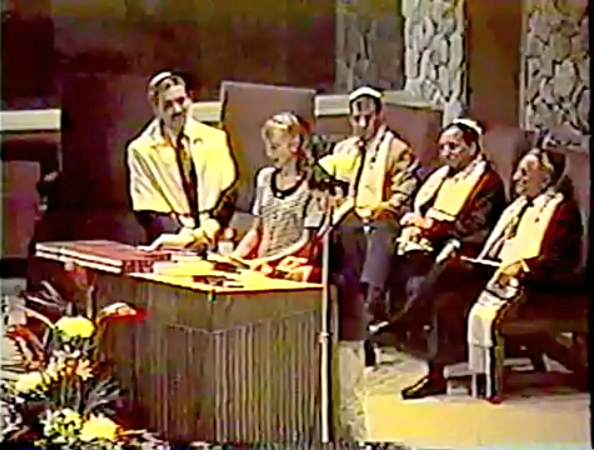
 

Speaking of comings and goings, it seems like just yesterday that I arrived here.  In fact, it was 30 years ago last month.  But since I was assistant rabbi for the first five years, my installation as senior rabbi of Temple Beth El occurred only 25 years ago - and the anniversary of that event is this Monday (Sept 11, 1992 - little did we know at that time how significant that date would be).  

Here is the program that was handed out that night.  Past President Alan Kalter chaired what was a most memorable evening.  A feature of the program was when representatives of many different groups within the congregation came up to the bima to present "offerings" of new siddurim that had just been acquired. Part of my "first hundred days" strategy was to finally move on from the old Silverman siddur; that along with not standing for the Sh'ma and ending the practice of having  the Men's Club having chicken dinners at Pelliccis.  I was very ambitious! In the photo above you can see Jill Rothkopf and Josh Donner, who were to become my "first" b'nai mitzvah as senior rabbi the following day.   So yes, Jill and Josh have a 25th anniversary to celebrate this weekend too!

The event was also videotaped, and you can see videos from that evening by clicking here.  Some other significant videos from my early years here are also found on that page.  Below are some more screen grabs from that evening.  See who you can recognize.


"Blessed be you in your coming and in your 
staying" 
About DACA...

 
At the rally supporting Dreamers 

And while we celebrate this week the comings and goings of those who are making choices as to where they will live, many are very concerned about the fate of the Dreamers, those who have lived in America for most of their lives, pay taxes and contribute to this country in so many ways, who are now being callously threatened with deportation to places they have never known.  I am proud to have been at Mill River Park on Tuesday to show my support, along with other religious and civic leaders. I will continue to stand up for the defenseless and innocent, as our sources compel us to do, not simply because we are commanded to "love the stranger,' - although the Torah does say that 36 times.  But in fact, DACA recipients are, culturally speaking, every bit as American as you and me.  They are not strangers.  They do not deserve to feel so threatened in their own homes.  We should embrace them because, in so many ways, their story is our story too.


Read "Top Ten Facts about DACA and Dreamers" (from the Bipartisan Policy Center)


Read about the Atlit camp in Israel, where Jews, desperate and homeless following the Holocaust, were rounded up and detained by the British after being caught trying to immigrate illegally to Palestine in the '40s.  Many of them were deported to Cyprus (think Ari Ben Canaan) while others were forced to go back to the very places in Europe that had devoured their families.

Read how, back in the '40s, British Foreign Secretary Ernest Bevin said sarcastically that the United States wanted displaced Jews to immigrate to Palestine "because they did not want too many of them in New York."  (It's been rumored that Bevin wanted to build a wall around Palestine and have the Haganah pay for it).


Read how Israel today is facing a migrant / asylum crisis that the government is handling in a controversial manner.

If any group should have compassion for the Dreamers, it is the Jewish people, we who know all about that knock on the door.


Our First Shabbat-in-the-Round
By Irma Ross

At the end of August, we experienced our first Shabbat-in-the-Round, a milestone event described below in this report compiled by Irma Ross, who has been instrumental in spearheading this project.  We are so grateful for Irma's positive energy and drive.  As we await with deep concern the predicted arrival of Hurricane Irma on the American mainland, be assured that this Irma and that Irma have nothing in common!

TBE's first Shabbat In the Round for 2017 was a wonderful spiritual, uplifting service and experience thanks to the beautiful music of Cantor Fishman with her gentle guitar playing and spiritual insights, the thought provoking teachings of Rabbi Hammerman, and the participation of the 45 people who came to pray together.

The schmooze portion (with coffee and) before services eased us into a warm and inviting space.

The informal setting, including pillows on the floor, allowed everyone an opportunity to be comfortable, and feel "at home."    It also allowed for some organic questions and discussion, and probing of the Torah portion.

Even the folks who are 'traditionalists" found the experience to be meaningful and loved the music added to the service.

Some feedback from the participants:

"What a wondrous idea to change things up and keep the Shabbat experience fresh.  The more informal setting provided connection and a spirit of community--a sense and a feeling we sometimes take for granted."

"I appreciated the special added prayers--they were refreshing and soul stirring."

"It was very spiritual and meaningful.  The readings and music were beautiful and appropriate.  I look forward to next time, and plan to tell others and encourage them to come."

"I loved the participatory nature and the communal feeling engendered by the service."

"I enjoyed the informal sitting in the round.  It enabled us to see each other and encouraged more participation. I liked the new prayer pamphlet--it was easier to follow. 
 I also like the group aliyot--it made it easier for people to come up to the bimah.  I'd like to see more of this format even with possibly having our traditional service in the round."

"I so appreciate all the work that went into making this service happen.  Can't wait for the next one!"

Please join us for our next Shabbat in the Round on Dec. 9th!
  

As we approach the High Holidays, some guidance on soul searching
From "Reclaiming Judaism as a Spiritual Practice"
by Rabbi Goldie Milgram

For someone to write a sefer, is more than to say they've written a "book." A sefer is an enduring gem of Jewish significance and one such was written in 1812 by Rabbi Mendel of Satanov. He created a new approach to the practice called Heshbon HaNefesh, "Accounting of the Soul." Reb Mendel teaches a 13-step program of journaling, self reflection, and planned personal change. Heshbon HaNefesh is a helpful method for those who choose to take on the Yom Kippur practice of feeling yourself participating in a Divine review of your ethical actions. Being only human, you will have errors on your record, and so it helps to have a sense that you will earn "extra credit" in your examination by showing a record of sincere efforts at introspection and personal change.

In order to be truly free, honest looking is needed into sensitive areas of self. This approach is not one of self-excoriation. Alan Morinis, author of Musar, explains: "We're seeking insight, so in a recording [journaling] practice you are to make note of what ever you see, positive, negative or neutral. That shifts this practice quite a bit towards a healthy pursuit of self-understanding as opposed to bare self reproach."

Dr. Gene Gendlin, author of Focusing, observes that to be able to undertake such a soul journey it is important to have something comforting to hold onto. Most likely, you can be even harder on yourself than others will be and you might want to find something real or conceptual to bring along that helps you be both tender and honest with yourself. What would be comforting for you? Bring it to your heart and let's continue.

Accounting of the Soul
While Reb Mendel and Alan Morinis are teaching the art of spiritual journaling, rather than replicate their work, here is another approach I've developed to Heshbon HaNefesh.

Equanimity. Ability to live in balance.
Tolerance. Growing pains lead to knowing gains.
Orderliness. Allocating time for living life fully with integrity.
Decisiveness. Acting promptly when your reasoning is sure.
Cleanliness. Modeling dignity in your ways and space.
Humility. Know you will always have much to learn and more opinions than answers.
Righteousness. Conducting your life such that you are trusted and respected.
Economic Stability. Safe guarding enough resources for yourself to live without debt.
Zeal. Living with gusto focused on purpose and care.
Silence. Listening and reflecting before speaking.
Calmness. Giving your needs and thoughts gently while being respectful and clear.
Truth. Speaking only what is fully confirmed in fact.
Separation. Focus on each strand in its own time, avoid multi-tasking.
Temperance. Eating and drinking for good health, not dangerous excess.
Deliberation. Pausing before acting, consider consequences, integrate heart and mind wisely.
Modest Ways. Eschewing crude, lewd and boastful mannerisms and practices.
Trust. Living in the spirit of knowing there is abundance in the universe and you are in the flow.
Generosity. Finding satisfaction in making much possible for others.

(Bold type, concepts of Reb Mendel, z"l; Regular type=interpretations of Reb Goldie)

First take any one of these qualities and reflect on its degree of presence and activity in your life.

(Next, you might sit with a friend, partner, class or child and discuss the quality. What are examples for it? Flesh out its meaning to you, find as many nuances of the quality as you can.

(Now, go into yourself and notice where in your body this quality resonates. The mind/body connection creates a short-cut to knowing. Is it lodged somewhere? Rather than thinking about the quality, listen to it, discover what your body knows about it. Then, take the information and gently set it before you and return to see if there is more, something new about this quality you can learn inside yourself.

(What is your desire with regard to this quality? Sit quietly with this question until a clear image forms, til you imagine a real probability. Invite strength and support for this intention from the great dynamic flow of all possibilities in creation.

The Path of Yom Kippur Preparation

Many think of Yom Kippur, known as the "day of atonement," as the annual day of repentance. Actually, each Yom Kippur is the apex of one year's cycle of serious self reflection. Judaism is bullish on humanity, passionate about our in-born ability to change for the better. And, it only makes sense that it would require far more than one day to fine tune your life for rebirth at a more expanded level for the next year. 

Accordingly, there are many days in the calendar where incremental Heshbon HaNefeshwork is traditionally practiced: Thursday evenings as part of lifting soul shmutz in preparation for Shabbat; every day (except Shabbat) of Elul, the month which precedes the High Holy Days. Some also observe Yom Kippur Kattan, "Little Yom Kippur," on the day before each new moon, and as Reb Mendel suggests, it is most effective when engaged in nightly.

The high holy day experience is often reported to be intensified in value and meaning for those with a regular Heshbon HaNefesh practice. Why? Because instead of leaping out of daily life and into the holidays, you will arrive prepared.
Shabbat Shalom
Rabbi Joshua Hammerman