Showing posts with label Women. Show all posts

Sunday, March 3, 2024

In This Moment: Will There Be A Ceasefire and Hostage Exchange? And if not, whose fault is it?; Women's History Month at TBE


In This Moment

Will There Be A Ceasefire and Hostage Exchange?

And if not, whose fault is it?


Those are the questions being asked today. The US and others have placed the blame squarely on Hamas for this delay. But some within Israel are claiming that PM Netanyahu is deliberately adding new conditions, which are only adding to the risk for those hostages who are still alive. Whatever everyone's motives are, heavy fighting has been reported, as Israel knows that time is fast running out to accomplish its war objectives. And Israelis are beginning to doubt that winning this war is possible.


A poll released today by channel 13 in Israel yields some interesting results: Marc Schulman reports:


When asked about their stance on a compulsory draft of the ultra-Orthodox, 67% of respondents said “Yes;” while only 21% answered “No.” Regarding the primary reason for Netanyahu prolonging the war, 53% of respondents are convinced it is to maintain power, whereas 35% believe it is to achieve total victory.


The bill to draft Ultra Orthodox could bring down the government when a renewal deadline is reached at the end of this month.


See the Tweet below for a clear, balanced perspective. And just below, a quote from David Grossman's must-read op-ed from today's NYT, "Israel is Falling into an Abyss."


The profound despair felt by most Israelis after the massacre might be the result of the Jewish condition into which we have once again been thrown. It is the condition of a persecuted, unprotected nation. A nation that, despite its enormous accomplishments in so many realms, is still, deep down inside, a nation of refugees, permeated with the prospect of being uprooted even after almost 76 years of sovereignty. Today it is clearer than ever that we will always have to stand guard over this penetrable, fragile home. What has also been clarified is how deeply rooted the hatred of this nation is.


Another thought follows, about these two tortured peoples: The trauma of becoming refugees is fundamental and primal for both Israelis and Palestinians, and yet neither side is capable of viewing the other’s tragedy with a shred of understanding — not to mention compassion.

Jewish Joke Night Follow-Up

And a Vision for Beth El


Last Friday's Jewish Joke Night was, um, memorable. The music was incredible and the joke session was filled with surprises (you'll just have to ask someone who was there). Given that it was my final J.J.N., I thought I'd share some of my favorite Jewish jokes from that night (including the winner), along with some other old favorites from past Jewish Joke Nights. You can find them here.


Also, another of the winning jokes, according to our three judges, was brought to us by Scott Sekuler. It's also one my all time favorites. You can here me recounting it in my Kol Nidre Sermon from 2008, about 17 minutes into the audio. And while you are at it, why not give a listen to the whole sermon. The topic is authenticity, a favorite theme of mine. And there is a Purim - Yom Kippur connection drawn in the sermon, as relates to the topic:


With so many people passing themselves as something they aren’t, we now can understand why Yom Kip-purim, which literally can be translated as “a day like Purim,” is considered the antidote to that holiday that seems its polar opposite. On Purim we put on masks. On Yom Kippur, we take them off.


And if you're nostalgic for old High Holidays sermons


- and who wouldn't be! - you can go right back to the first sermon cycle I shared as senior rabbi, in 1992, entitled, "A Vision for Beth El". It's both jarring and reassuring to read those words now, calling out to us from over three decades ago. Here are some excerpts:

Women's History Month

March is Women's History Month, and given our year-long look-back at my time at TBE, this would be a perfect opportunity to discuss a historic moment that we experienced here, the decision to be so inclusive of women that we didn't limit that inclusivity to living ones. We chose to include the Matriarchs, Sarah, Rebecca, Rachel and Lean, in the chanting of the Amidah. That decision was forged collectively and it took several years to gain consensus. But gain it we did, in the mid 1990's, when decisions like this were still controversial. In 2007, as part of our Synaplex programming, I collected some of the key source materials and discussed how the decision came about. You can read those source materials here, and at services this coming Shabbat morning, hear about what this historic moment meant for TBE.

Recommended Reading


Tomorrow's Front Pages


If Mpnday's front pages haven't been uploaded yet,

try clicking the same link later this evening.


Haaretz

The Jerusalem Post

Yediot Achronot


Temple Beth El
350 Roxbury Road
Stamford, Connecticut 06902
203-322-6901 | www.tbe.org
  
A Conservative, Inclusive, Spiritual Community

Monday, December 4, 2023

In This Moment: Is abuse of women wrong - except for Hamas? The cooperation between Arabs and Jews that you are NOT hearing about.


In This Moment


Israel released a travel alert, including a map of countries that its citizens should avoid. it's not a pretty picture. Great Britain, France, Germany, Brazil, Argentina, Australia and Russia are among the countries where the travel warning was raised to level 2, recommending increased precautions. Several countries in Africa (including South Africa and Eritrea) and countries in Central Asia (including Uzbekistan, Kazakhstan, Kyrgyzstan, and Turkmenistan) have been elevated to level 3, recommending reconsidering non-essential travel. In other words, orange is the new "don't come back." In all, threat levels were raised in 80 countries.

Basically, if you are a Jew these days, it's barely safe to leave your basement. It's nice to know, though, that Mongolia is holding on to it's shade of green. But Australia is a real disappointment - things have gotten rough for Jews there, with a large spike in antisemitism and Islamophobia. Apparently, Melbourne is the epicenter of neo-Nazi and far left activity. Given the choice, maybe this is the year to detour to New Zealand, where life is practically perfect.

Update on Bella

Bella, the dog who survived Hamas captivity for over 50 days, celebrated her first Shabbat back home, according to the headline seen above. Read how she survived. Hamas captors thought Mia was holding a stuffed toy in her blanket. She gave up part of their meager rations to keep her alive.

Did we teach our children too well - or not well enough?


A congregant sent me this thought provoking mini-essay, which, with his permission, I am sharing anonymously. We can discuss at an upcoming service.


Why are Jewish and other students protesting Israel’s Gaza operation? They may not be deluded or hateful; they may have absorbed our lessons too well. 
Jews, as a permanently oppressed minority, embraced universalism, human rights for all and tikkun olam. Especially in the U.S., that was “good for the Jews,” as well as consistent with religious values. And all but the most right-wing of Jews, not to mention most of American opinion, enthusiastically preached that.  
The core insight of Zionism, however, is that Jews can’t rely on universal moral consciousness to protect us. Only in a Jewish state where we can develop our own selves and protect ourselves are we and Judaism safe.  
From the beginning, Israel (“a Jewish and democratic state” as its Declaration of Independence affirms) has tried to reconcile Jewish particularism and democratic universalism. As long as Jews were seen as disadvantaged in the U.S. and in jeopardy in Israel, 
It was relatively easy to reconcile support for universal human rights with support for an expressly Jewish state and its battles.  
In this crisis, though, most Israelis and many, many Diaspora Jews affirm that Israel and Israeli Jews must come first. Our particular survival comes before universalism. Yet, we have taught our children that universalism is the highest morality and to uphold the underdog and the oppressed. How can we be surprised that many of them conclude that a strong Israel is acting as a systematic oppressor? And how do we elders, who still remember Jewish life and identity as precarious, now tell them the moral values we inculcated weren’t quite right? 
When I recite our pain and compassion for the Palestinian victims in Gaza to some of the young people I speak with and the responsibility of Hamas for starting the conflict, they reply that it sounds like crocodile tears in the face of scenes of death and devastation that far exceed the atrocities of October 7.   
As you know, from the beginning I’ve felt that the Gaza invasion was counterproductive. So all I’m left with, as a Zionist, is that “my side” comes first and that I have to support this mess because undermining Israel is even worse. I don’t think that’s very persuasive. And yes, I’m well aware of the humanitarian law of war and that there is precedent holding that Israeli strategy and tactics are legal. As Talleyrand supposedly said, though, it is worse than a crime, it is a blunder.  

Tomorrow's Headlines Today


Jerusalem Post

Ha'aretz (English)

Yediot Achronot


  • Did Hamas short the Israeli stock market before Oct. 7 to pay for their war? Per Marc Schulman: One story received a great deal of coverage in Israel today — a paper written by Robert J. Jackson, Jr., Joshua Mitts, and colleagues, titled “Trading on Terror?” which was published on SSRN on Sunday. Jackson, a former commissioner of the SEC, and Mitts, a Columbia professor specializing in short selling, discovered that someone had placed a significantly large short bet on an index of Israeli companies, known as EIS, in the days leading up to the October 7th Massacre. This short bet was 100 times the size of the daily average of shorts on EIS and expired on October 13th. They concluded that through intermediaries, Hamas placed this bet as a means to finance their terror operations. In several interviews, Mitts advocated for a thorough investigation into this matter by U.S. authorities. While placing a short is not against U.S. law, however, financing Hamas, which is designated as a terrorist organization, is undoubtedly illegal.


Recommended Reading


"We have not witnessed even one instance of violence by Arab citizens against Jews since October 7. To me, it says they have been as shaken up by what Hamas did as we have."

Shir Nosatzki

Partners in Fate - Arab citizens heroic rescue of Jews from the Be'eri Massacre


  • What We Know About Sexual Violence During the Oct. 7 Attacks on Israel (NYT) - Extensive witness testimony and documentary evidence of killings, including videos posted by Hamas fighters themselves, support the allegations. “We have come so far in believing survivors of rape and assault in so many situations,” wrote Sheryl Sandberg, the former Meta executive and a leading voice on women in the workplace, in an opinion piece for CNN. “Yet this time, many are ignoring the stories that these bodies tell us about how these women spent the last moments of their lives.” Not loudly condemning the rapes of October 7 — or any rapes — is a massive step backward for the women — and men — of the world,” Ms. Sandberg said. Many people in Israel and elsewhere have complained that it took too long for organizations like the United Nations to issue condemnations, a delay that they took to imply that the initial reports of sex crimes had not been believed.


Click for printable pdf of the reading below for candles by AJWS

Temple Beth El
350 Roxbury Road
Stamford, Connecticut 06902
203-322-6901 | www.tbe.org
  
A Conservative, Inclusive, Spiritual Community

Thursday, September 28, 2023

In This Moment: Israel's Culture War Explodes - Over Gender Segregated Prayer; All About Sukkot


In This Moment

Israel's Religious Culture War Explodes...on Yom Kippur!


Today's Jerusalem Post

Today's Ha'aretz (English)

Click here for more headlines


Headline of Yediot the day after Yom Kippur, speaking of Dizengoff incident:

"The Square of Strife!"


It's kind of stunning that when Israel's current internal tensions spilled over into a full fledged culture war, the match to ignite it was a staple of American Jewish life: mixed seating at prayer services. This issue combines many of the big ticket controversies that have embroiled Israeli society for years: sex-segregation in public places, the subjugation of women, and the encroachment of ultra orthodoxy into secular areas. It's one thing to have gender separation in public squares of B'nai Brak, or even parts of Jerusalem, but for it to happen in the heart of secular Tel Aviv feels like a deliberate provocation. As the Times of Israel reported before the incident:


On Friday before Yom Kippur, the Supreme Court rejected a petition to allow gender-segregated prayers in the square. The justices thus sided with the ruling of a lower court in favor of the Tel Aviv municipality, which forbade Rosh Yehudi from holding the event with a gender divider.


That ruling should have been the end of it, but it was barely the beginning. Israelis are not used to fighting over prayer spaces in public areas. It's not a major concern of theirs because each neighborhood follows its own customs. In Tel Aviv there is an enormous Friday night service with mixed seating at the port. There would not be a gender segregated service there, because Tel Aviv is the most progressive city in the country. In other places with larger Orthodox populations, services in public areas have gender separation. But to push this matter in Tel Aviv breaks what had been a long lasting status quo, an encroachment, with the intent of staking out new territory for Orthodoxy - to create a "fact on the ground." And the response to that was one of those "enough is enough" moments for the seculars. I do sympathize with that, having faced similar situations both there and here, but resorting to violence was not tactically smart. So the fact that fighting over a mehitzah (partition) became front page news in Israeli papers (and not just the English ones) was a big deal.


I concur with Yossi Klein Halevi, who wrote:


In past years, Tel Aviv on Yom Kippur was a model of tolerance. There was no secular outrage against a mechitza in the streets. What changed this year is the government’s war against liberal Israelis, who are fighting for the survival of their Israel, their ability to continue living in this country. This year a public mechitza in Tel Aviv was especially provocative, given the growing phenomenon of women being pushed to the back of the bus – metaphorically and sometimes literally – around the country. I wish the protesters had resisted the provocation of Rosh Yehudi, but I understand their desperation.


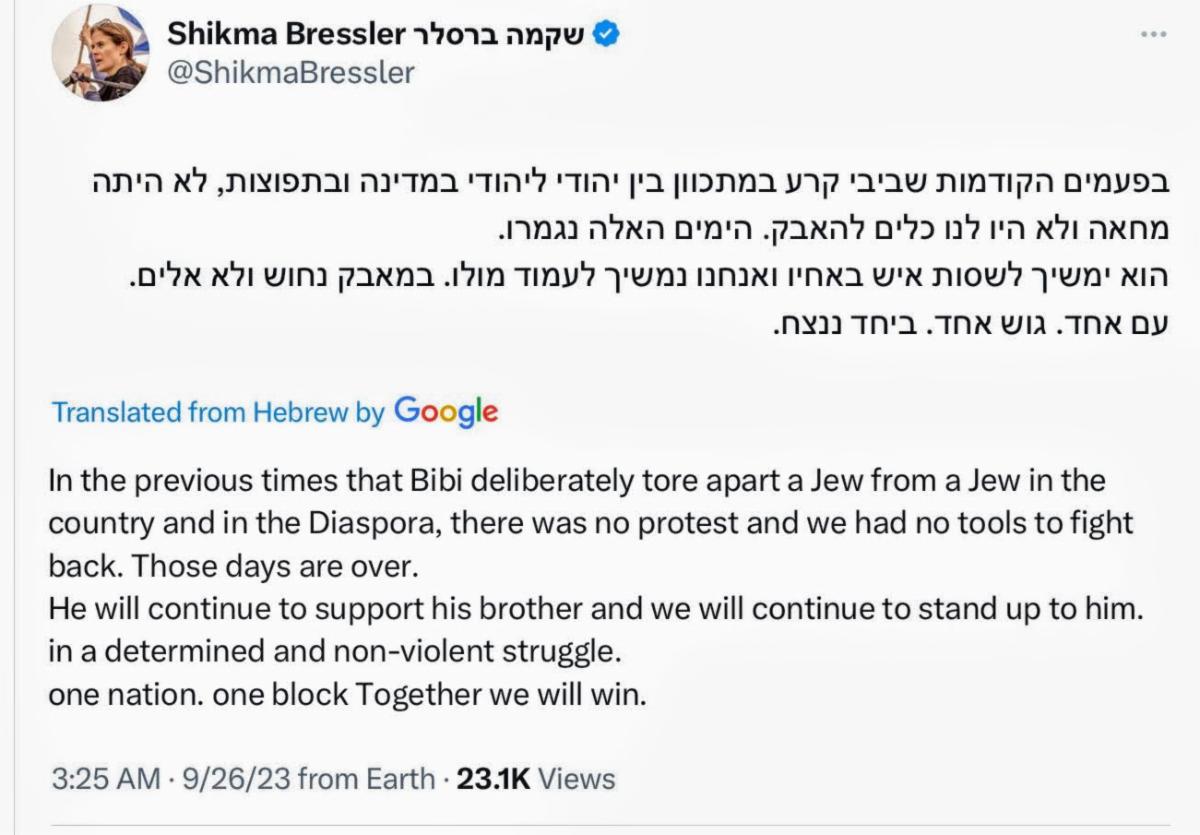
Read some of the reports below, and think about how unacceptable enforced separate seating has become in non-Orthodox settings here. What used to be tolerated as the "least common denominator" back in the days before women could be rabbis and count in the minyan, has now become, in the eyes of many, a moral outrage. It's just another example of the widening culture war among Jews. Right now, no one seems interested in bridging that gap. Prime Minister Netanyahu had an opportunity to be a statesman but instead tried to stoke the flames and tie this violence to the judicial reform protests, in order to divide and conquer, banking that some Israelis who resist judicial reform might also resist mixed seating and might be lured over to his side. Protest leader Shikma Bressler (whom I spoke about on Yom Kippur) had this response on X (see below; the Google translation isn't perfect - it's not "support his brother" but "pitting his brothers against one another").

I suspect this incident will recede as new stories involving the Supreme Court, the Saudis and instability along the borders fill the news cycle. I doubt the number of protesting marchers will be any smaller this Sat. night (remember, for Israelis, the second day of Sukkot is hol hamoed). But the line has drawn in the sand. Tel Aviv, for secular Israelis, is holy ground.


On Segregated Prayer: The TBE Experience


** Here are two incidents of where enforced gender separation disrupted the prayers of groups I was leading:


  • When I was in Israel with our New England “March of the Living” group in 2010, our mostly non-Orthodox group stayed in a nice Youth Hostel near the Biblical Zoo in Jerusalem. Our group arranged to have access to the hostel’s synagogue, a simple meeting room with an ark, for a private Kabbalat Shabbat service. No other group was in there at the time. The Orthodox members of our group decided to daven with a mechitza in another location in the building – it was an arrangement that worked well throughout our trip. About ten minutes into our egalitarian service, our group leader came up to me – as I was leading the service – and said that the hostel’s manager had told him that our service cannot continue unless we separate the boys from the girls. Now this was a group of seventy teens who were, for the most part, experiencing Israel for the first time. Just days before we had cried at Auschwitz and stood silently by the remnants of the Warsaw Ghetto. They were exhilarated to be in Israel and I was trying not to douse their enthusiasm by interjecting the sorry state of Israeli pluralism into their experience. So rather than tell this group that this state-run hostel was hostile to the way they pray, I looked for an escape hatch – literally. There was a door in the back of the room, leading to a large outdoor patio overlooking the city. The weather was perfect, and I had planned to take them outside for Lecha Dodi anyway, so I stalled for time until we got there (as my group leader stared at me nervously, I stared back defiantly), and then, as we reached Lecha Dodi, we danced out the door and onto the patio, where we danced and prayed for the remainder of the service.


  • For two thousand years men and women stood and prayed together at the Western Wall, right up front. Even after 1967, when a mechitza was installed, this practice continued farther back in the plaza. In 1987, I brought a group from my previous congregation to the Wall and we prayed, men and women together, about halfway back, nowhere near the segregated men's and women's areas, which we respected -- as we should. We even saw a Beth El group there, led by Hazzan Rabinowitz. It was just a few days before I was to come to Stamford. In 1994, my group from here was forced to end our Friday evening service abruptly by Haredim and police -- it was a shock to the children, and to me. Subsequent TBE groups, on Friday nights, prayed other locations entirely. If we had tried to gather at the Kotel, we wouldn't have had a prayer. But in 1994, we prayed in unison in Tel Aviv, right next to the beach. No one bothered us at all, though several onlookers stopped to see this curiosity of American Jews who prayed so differently from what they were used to seeing. And some stopped because they had no idea what we were doing.


In Stamford, there have been other issues that have made unified prayer difficult, and at times impossible. But we've also been able to work things out from time to time. See what I wrote about Shabbat Across Stamford in 2015. We just won't countenance what is demeaning to women anymore, even if some believe "separate but equal" is not.


Ha'aretz Editorial

All About Sukkot


Ushpizin - Welcoming Special Sukkot Guests

I'll be welcoming these heretics to our service on Sunday. We'll discuss whether or not they truly deserved their infamy and we'll decide who deserves to be our special guest heretic of the day. And who might be nominated from our day.

Yom Kippur Sermons


Video and text of my Yom Kippur sermons are now available online:


  • Kol Nidre: Counting to One - "Counting to One" - Seeing hope in Israel's moment of truth. Can unity emerge out of the attempted judicial coup and the unprecedented massive reaction to it? We cannot give up that hope. Nor can we afford to be late to the game. Our Israeli "achim" have taken to the streets. And they are waiting for us to join them. Teach us, O Adonai, to count to One.


  • Yom Kippur Day: The Keys - "The Keys" - In his final High Holidays message in Stamford, Rabbi Joshua Hammerman looks at what it means to be "all-in" in work and in life. Looking at key moments in his 37 years at Temple Beth El, he describes the existential dilemmas of his chosen profession, saying he would never recommend it to anyone, "but I wouldn’t trade these 40 years in the rabbinate for anything. It has made me a much better person than I ever would have been."


Temple Beth El
350 Roxbury Road
Stamford, Connecticut 06902
203-322-6901 | www.tbe.org
  
A Conservative, Inclusive, Spiritual Community