Showing posts with label interfaith relations. Show all posts

Sunday, November 12, 2023

In This Moment: We Are Not Alone


In This Moment


I updated this essay on my Substack page. Check it out - and subscribe!

Now we're learning what's really been going on in Gaza


Noa Tishby to the rescue! Click to watch video

Click below to see video

Going to the Rally in DC?

Be a Stringer for TBE!


Mark your place in history. Send me photos, short essays or anecdotes from the march. Email your fresh impressions to rabbi@tbe.org, on your way home if possible! They'll appear in this newsletter that same night! (Waiting for the next day is fine too). TEENS' AND COLLEGE STUDENTS' ARTICLES WILL GET PRIORITY PLACEMENT.


We Are Not Alone

Jewish Communities in Distress

In New York


Hundreds of anti-Israel protesters calling for the elimination of the Jewish state stormed Grand Central Terminal Friday night, furiously banging and kicking at a locked entrance of the station that was forced to temporarily close over the rowdy demonstration.


Montreal


Members of Montreal's Jewish community say they will not be intimidated into closing the doors to their establishments after a day school in the city's west end was struck by gunfire overnight for the second time in the past four days. 

Bullet impact marks were found on the facade of Yeshiva Gedola of Montreal, located on Deacon Road in the Côte-des-Neiges neighbourhood, Sunday morning. Shell casings were also found on the ground nearby. No one was injured.


London


The Sunday Telegraph splashes on the prime minister's remarks that both "far-right thugs" and "Hamas sympathizers" disrespected the nation's heroes on Armistice Day.

Melbourne


Synagogue’s president and rabbi say police, security team told worshipers to leave mid-service; clashes between Palestinian supporters, pro-Israel demonstrators erupt hours later

We Are Not Alone:

Our Interfaith Community Comes Together

I was asked by a congregant whether it would be more important for her to attend the solidarity march in Washington on Tuesday or our local interfaith vigil that evening at 7. I said that while both are important, Washington will be historic and there are multiple reasons to want a huge crowd there: to list the spirits of Israelis, to keep the hostages front and center on the world's agenda, and as a show of strength and unity in the face of inordinate pressure from Hamas's supporters.


What we're increasingly seeing is an axis of Russia, China and Iran trying desperately to carry Hamas over the finish line. But for much of the world, the support of Hamas is not full-throated, and we are beginning to see some differentiating of the Palestinian cause from the horrific tactics of Oct. 7, as more of Hamas's cruelty, in Israel and in Gaza, is slowly being uncovered. Even Turkish President Erdoğan distanced himself from Oct. 7. A show of strength on Tuesday in Washington will encourage Congress and President Biden to resume their full throated support of Israel in its campaign to dismantle Hamas.


I believe the tide is starting to turn in Israel's favor. This could change very quickly, but did you see that 180,000 rallied to support Israel in Paris today? A big turnout in D.C. will add to that momentum.


Still, there is much reason to be at our Interfaith Vigil if you are not in Washington. From a local perspective, this interfaith moment is very important, but for reasons that you might not expect. What it is not going to be is a shiva call for the Jewish community. We already had that. Instead, this is a chance for all faith communities to stand together, for hope, healing and mutual love, recognizing the unique pain of Israel right now, while also acknowledging the pain of others. Not just innocent Palestinians, but also Armenians, Nigerians, Ukrainians and so many others facing devastation.


There are two different remedies for our pain. One is to rally around our fellow Jews and rediscover what we've always shared. And another is to reach out beyond our pain to help others transcend theirs.


On Tuesday we'll be doing both.


Monday's Israel Headlines


Jerusalem Post

Ha'aretz (English)


If the current front pages aren't there yet, try again later.

Recommended Reading


  • The lonely people of history | Yossi Klein Halevi (TOI) - But for all the complexity of the Palestinian-Israeli tragedy, this is not a complicated moment. No, we patiently explain, the massacre was not in response to anything Israel does but to what Israel is. And yes, the suffering of innocent Gazans deserves the world’s urgent humanitarian attention, but not at the expense of moral clarity about the justness of this war.
Temple Beth El
350 Roxbury Road
Stamford, Connecticut 06902
203-322-6901 | www.tbe.org
  
A Conservative, Inclusive, Spiritual Community

Wednesday, March 28, 2018

Interfaith Seder: "With Open Arms"

Click here to access the supplementary materials used at last night's Interfaith Seder at Grace Farms.  Below are the Four Questions we used to base our discussion of the topic, "With Open Arms."

Four Conversations 

1. What is the meaning of home at a time when 65 million people are refugees and when the average American moves 11.4 times in his/her lifetime? There are now an estimated 258 million people living in a country other than their country of birth — an increase of 49% since 2000. An unprecedented 65.6 million people around the world have been forced from home. Among them are nearly 22.5 million refugees, over half of whom are under the age of 18. There are also 10 million stateless people who have been denied a nationality and access to basic rights such as education, healthcare, employment, and freedom of movement. The UN reports that nearly 20 people are forcibly displaced every minute. 

2. The Five Books of Moses instruct us to love three different things: God; your neighbor; and the stranger. But the command to love the stranger is repeated 36 different times. Why this added emphasis on the stranger? 

3. Why is it even more important now than ever that our society become radically inclusive? How can we do that? 

4. What are we to make of the following rabbinic commentary on what happened during the night of the Exodus? 

The Last Night in Egypt: Knocking in the Night 

When Moses said: “I will smite all the firstborn” (Ex. 12:12), some of the Egyptians were afraid and some not; those who were afraid brought their firstborn to an Israelite and said: “Do please allow him to pass with you this night.” When midnight struck, God smote all the firstborn; as for those who took asylum in the houses of the Israelites, God passed between the Israelites and the Egyptians, depriving the latter of life while leaving the Israelites alive. 

The preceding midrash (rabbinic story) describes what happened on the night of the last plague, the slaying of the Egyptian first born. Egyptian mothers have taken their first-born children to the homes of Israelites and beg the Israelites to take their children in so they will escape death. What would you have done? What should they have done? Keep in mind that a) these were their oppressors for 400 years, b) God’s plan was to smite them, so they were defying God if they took them in and c) historically, the midrash came from the 10th century (Exodus Rabbah 18:2), a time of considerable persecution. The Israelites tried to save the Egyptians but could not alter God’s plan. Even though it was doomed to failure, they had the courage to try. One wonders whether that was also part of God’s plan all along.

Monday, April 10, 2017

Shabbat-O-Gram for April 7


 Shabbat-O-Gram

Shabbat Shalom... 
And happy Passover!

Join us for a special Meditative Shabbat this evening.  Services will be at the regular time of 7:30 - it will be primarily our regular service, but with a more reflective flavor. Meanwhile, TBE's Pamela Tinkham will be featuring a sit-down Yoga session beginning at 6:30.  During the service, Pamela will speak about her new book, "Healing Trauma from the Inside Out: Practices from the East and West."

Services will be held Shabbat morning and on the first two days of Pesach, at 9:30 AM. Join us!  Gerry Ginsburg will deliver the d'var Torah on the first day (Tuesday). 

Our congregational Second Seder is now closed to reservations.  We'll have about 80 people here on Tuesday night.  For those who are signed up, please aim to get here BY 6:45 so we can begin on time.  Bring a personal item that tells something about your family's journey - in particular your Jewish journey.  We also are looking for more help in setting up at noon on Tuesday.  We are grateful to the Mann Family Foundation and NJOP for the grant money that has enabled us to do this Seder.

A night at Grace Farms...


Thank you to all who attended our sold-out Interfaith Seder at Grace Farms. It was a marvelous opportunity to get beyond our walls to a place that is all windows, and to hear the concerns of our neighbors.  


If the breathtaking setting and warmth of the diverse gathering didn't inspire us enough, some of the observations made by my colleagues, Rev. Mark Lingle and Imam Kareem Adeeb, most certainly did.  Here are some of the things that they and I discussed:

- The idea that spiritually we are the same, though our traditions may differ
- That simultaneously we are all saint and also sinner.  Each of the four children is in each of us - and we need to conquer our "inner Pharaohs" as well as the external sources of oppression.
- The Narrow Straits that confine us - that narrow our minds - we become
slaves to ourselves
- In a fast-integrating society, we need to develop a new community that extends beyond our own traditions
- Our demons are rooted in ignorance, manifested in darkness

This event has already inspired follow-up.  Several of our congregants sat with folks from St Francis Episcopal, Rev. Lingle's church, and began talking about how our two congregations might facilitate an ongoing dialogue.  And Dr. Adeeb invited us to join them for prayer when they meet.  Plus, a whole new audience from New Canaan and vicinity were introduced to us and to this conversation. It was wonderful to nurture TBE's connection to the people at Grace Farms.

Wait for it...

I shared a quote at the Interfaith Seder from the Rebbe of Gur: 

"The sigh, the groan and the crying out of the children of Israel from the slavery was the beginning of redemption.  As long as they did not cry out against their exile they were neither worthy nor ready for redemption."

I thought of this quote last night when at long last I took my family to see "Hamilton," as we celebrated Dan's birthday. Needless to say, the show did not disappoint.  Given the season, I listened especially for Passover allusions.

In the song "My Shot," Hamilton speaks directly to the Exodus theme, rapping the line: 

"Fools oppose us we take an honest stand, 

Of course Moses never made it to that land.  Nor did Alexander Hamilton achieve much of what he wanted to achieve, including, most notably for Passover, the elimination of slavery.  His friend John Laurens, who died in battle at the age of 27, shared that goal, saying (in the same song):


The overpowering certainty and randomness of death motivates Hamilton from the start:

Opposing Hamilton is the figure of Aaron Burr, who, in the play, takes great pride in rarely taking a stand.  His Hamlet-like inaction, like Hamilton's "non-stop" activism, stems from his fear of dying prematurely.  Burr sings:


For each of them it is the specter of premature death that motivates them, one toward passivity and the other to hyperactivity. While the Rebbe of Gur seems to be advocating an activist approach, Judaism is of two minds on these matters.  "Wait for it," could easily be a song about messianism. Talmudic rabbis and later sages fell on the side of "wait for it" in this eternal argument. How one answers the messiah question is a prime fault line in Jewish conversation today.

But for matters less apocalyptic, little things like responding to the groans of suffering neighbors and crying out against oppression and injustice, the Rebbe of Gur has a point.

Moses died without ever stepping onto the sacred soil of the Promised Land, but at least he set out on that journey.  Aaron Burr never would have left Pittom and Ramses.  At best, he would have been stuck at the shore of the Red Sea, waiting for it.

Curiously, Exodus 12:42 speaks of the night of Passover as a "Night of Watching," "Layl Shimurim."  But some translations call it a "Night of Waiting." On that night the Israelites had to "wait for it," for the Angel of Death to do its thing.  But it was also a night of keen observation - of listening to the muffled shrieks coming from their neighbor's homes, much as we heard those screams from Syria this week.  

Moses was there to help Aaron - his notoriously passive brother - cross the Red Sea. But Aaron Burr had no such brother in A. Ham, who could have helped Burr to throw away his fateful shot. Hamilton did not and paid the ultimate price.  Such is the tragedy of this first chapter of the American experiment.

 
Passover and other reading suggestions ("Hag'gadah Million of 'em")
 
Recently I shared a number of Seder suggestions for special Haggadah supplements. You can find them here.  See lots of social action supplements highlighted in 

See also:

Jubilee Haggadah - a new commentary commemorating the 50th Anniversary of the Six Day War, which will be a major focus of the next several months.  The reflections by many recognizable Israelis and American Jews help set the tone for this important anniversary.  Ha'aretz will be distributing 100,000 copies across Israel this Sunday.

HIAS Haggadah supplement: the horrific Syrian gas attack this week highlights once again the plight of Syrian and other refugees.  There's a nice reading on p.6 tied into Dayenu.  And speaking of that popular song...

Pardes Companion to the Haggadah - with top notch rabbinic faculty and a message of inclusion.
Dayenu - A Study Guide, a packet that we used during last week's service. By Sh'ma.


Beyond Passover... (there is life after the Angel of Death...)

Pew Research: The Changing Global Religious Landscape  - the latest trends. It's always both humbling and amazing to see where Jews fall on this pie chart.  Let's just say that if I ate only the Jewish sliver of that pie I would never have to worry about putting on weight. We're  0.01 percent of  the world's population, but what a fuss is made over us (and by us).

 
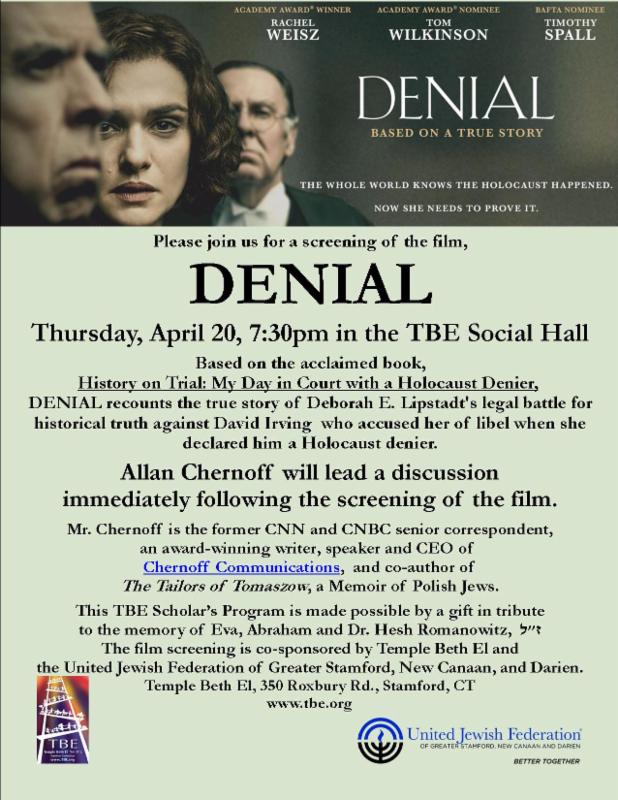
- I saw the film "The Zookeeper's Wife" and found it very worthwhile in how it portrays the Warsaw Ghetto from the perspective of a very righteous gentile.  Some have called it "Schindler's List" with pets," and there are similarities.  Download a reading guide to the book and movie by the Jewish Book Council.  and don't forget our showing of "Denial" on April 20.
Shabbat Shalom and Happy Passover to you and yours.


Thursday, March 21, 2013

Interfaith Seder Source Materials


Click here for the booklet of source materials from our Interfaith Seder, including quotes from Martin Luther King, Gandhi, Lau Tzu, the Quran, the New Testament and of course, many Jewish sources. Click here for photos of the event.


See also the Exodus Conversations website, where Muslim, Christian and Jewish representatives discuss aspects of the Passover story and Seder ritual.  Click here for my Jewish Week column, "The Fifth Child" and here  for my Stamford Advocate op ed on the Seder and gun violence. 


Thursday, February 21, 2013

Diverse city: Stamford demographics are reason to celebrate (Stamford Advocate Op-ed)


I've had the privilege of living in Stamford for 25 years. While the true natives will never consider me indigenous, I'm feeling more like a native all the time.

I was particularly interested to see The Advocate page-one story of Feb. 17, "Changing Tides," discussing the demographic shifts that have taken place in the public schools. I consider our splendid diversity to be among the most positive aspects of living here. But demographic heterogeneity, like biodiversity in an ecosystem, is fragile, and needs to be nurtured and carefully sustained in order to enrich the lives of all. My concern is that people fitting my demographic profile might read these statistics and choose to opt out of a community of unparalleled richness, for all the wrong reasons.

When you look at it objectively, there is simply no better place to bring up kids.

So much has changed in our city over the past quarter century, almost all of it positive. When I got here, no supermarkets were open all night, and, to be honest, there were hardly any supermarkets at all. When I got here, downtown at night was a dark, forbidding place, and it wasn't much better by day. Now it has become a mecca of entertainment and great food, pulsating with street life and youthful energy. Now we've got Chelsea Piers and the spectacular Mill River project and the Balloon Parade and "Alive @ Five," and it just keeps getting better.

Beyond its variety of age and ethnicity, Stamford has an unparalleled religious diversity too. Fifteen years ago, I became the first pulpit rabbi to serve as president of what was then called the Council of Churches and Synagogues of Lower Fairfield County. Back then, I considered it amazing that a rabbi could be warmly embraced in neighboring communities that have not always been so welcoming toward Jews. But now, interfaith cooperation has become the norm, and we've added Muslims, Hindus, Baha'i, Sikhs, Buddhists and others to the mix, and Spanish- and French-speaking congregations as well.

When we all get together, and we often do, the effect is spellbinding. On March 21, my synagogue will host our community's annual interfaith Seder, with this year's timely theme, "From Egypt to Sinai, Selma and Sandy Hook: Liberation from a Culture of Violence." At last year's Seder, we heard a Muslim talk about the figure of Moses in her tradition and members of a Spanish-speaking congregation talk about their recent pilgrimage to Israel. Such lessons in loving our neighbor cannot easily be taught in a homogeneous classroom. In Stamford, our diversity enables the city to become that classroom.

A few years ago I had an eye-opening experience as the rabbinic consultant to the all-city production of "Fiddler on the Roof." Students from every school in the city were in the cast, including public and private, parochial and day schools; a hundred of them on a single stage, kids from all religious and ethnic backgrounds. Tevya was Catholic and two of his daughters were African American and Asian; yet as a story of Jewish wanderings and perseverance, it all seemed to make sense.

Both my kids have attended Westhill and thrived there, socially and academically. They have been able to go as far as they wished and most of their teachers have challenged them to do just that. They both got into their first-choice colleges; but more importantly, they have been prepared for life, real life, in a nurturing atmosphere respecting difference and embracing diversity.

I do alumni interviewing for Brown University, speaking to students from all over Fairfield County, which includes some of the top private schools in the nation, and I can tell you that the students from Stamford's public schools often top my list. Why? Because not only are they highly motivated and wonderfully talented, they are interesting. Why? They can recount tales of family migrations and insurmountable challenges surmounted, they project a passion for learning and an ability to view the American experiment from fresh eyes, and their diverse community has prepared them perfectly for the interconnected, fully integrated 21st century global environment they will be entering. Colleges recognize that.

Those students who spend their formative years in cloistered, homogeneous settings are, frankly, at a disadvantage when they get out into the real world, into an America whose demographic makeup is fast coming to resemble -- drum roll please -- that of the Stamford schools.

Let me make it clear that I see great value in private and parochial schools too. They are part of the fabric of a diverse community -- my kids attended a local day school for several years and they received a superb education. We need both options in order to attract the widest array of families here, and we have them. If the kids don't meet in the classroom, they meet at dance class or on the ball field. Diversity is for everyone, not just the public schools. So I encourage people to move to Stamford and, if they've already set down roots, to stay.

I recall words I spoke 20 years ago at Stamford's other congregation across town with the same name as mine, Bethel AME, noting that our collective name, derived from Jacob's famous dream, means "House of God."

"Stamford has two very different Beth Els who wish to bring the entire city to an understanding of how we can build that ladder to heaven. We can become a healing city, a place where all citizens feel sustained and nurtured in its midst. We can become an organic city, not of disparate neighborhoods and conflicting groups, but a collage where the whole is far greater than the sum of its parts. If we can come together, the rest of the city will have to follow. If they see that we can care for each other, we who are so different, we who still have somewhat differing agendas, but we who do care for each other, if they can see us holding hands, if we can pull this off, the rest of the city will take notice."

Over the past two decades, that vision has been, to a large degree, fulfilled. While we still have miles to go, I, who have brought up two children here, from infancy to college, have seen the great power this community has to nurture its children to adulthood. And that power begins with its schools.

Who would not want to live in such an amazing place?

Read more: http://www.stamfordadvocate.com/opinion/article/Op-Ed-Diverse-city-Stamford-demographics-are-4297981.php#ixzz2LZoF5UK7

Sunday, April 1, 2012

"New American Haggadah" and Interfaith Seder - Shabbat-O-Gtram for March 30


Shabbat Shalom!

Just to let you know, our entire staff has pitched in for some lottery tickets.  if we win, next week's Shabbat-O-Gram will be written from Tahiti.  Check that - I mean GHOST written.  But while you fret about what it would be like for the entire staff to win multi-mega-bucks at the same time, you can take comfort in that each of us has pledged to donate a million to TBE if we win. I'm sure all of you would do the same (hint, hint)! 

Last night's Interfaith Seder was a fitting conclusion to our month-long "March to Passover."  Over 120 people representing many faiths, including about 15 clergy, gathered in our social hall to learn about the rituals and symbols of the Seder and share various perspectives on liberation, both personal and collective.  At how many Seders have you heard the Four Questions recited in Hindi?  This was a Seder that looked like America, with so many different voices heard, plus great music from Cantor Mordecai and the New World Chorus.  In addition the many Jewish lessons shared, We learned about the Last Supper as a Seder and how Moses is portrayed in the Quran.  I've uploaded some photos of what was a most memorable evening.  If you have pictures that we can include in our album, please send them to me.

The New American Haggadah (see  next blog entry for fmy full review
Much has been made of the newly minted "New American Haggadah," edited and translated by two shining stars of new American Jewish literature, Jonathan Safran Foer and Nathan Englander.  I can't recall a Haggadah receiving more widespread publicity in recent times (with the possible exception of one written for interfaith families by Cokie and Steve Roberts), with the editor appearing everywhere from Colbert to NPR's "Fresh Air" (hear NPR interviews here).  Even the President received a copy, from one of the commentators, Jeffrey Goldberg.   On the first week when the book came out, the only book to sell more copies was "The Hunger Games."  They sold out the first printing in days, but the publisher regrouped and a second printing was completed in time for the holidays.  I received my copy this week and will be discussing it at services tonight and on Shabbat morning. 


There are a number of Haggadahs I'd choose over it for my Seder table.  Topping them all is Noam Zion's "A Night to Remember: A Seder of Contemproary Voices," where you can read passages  by David Ben Gurion and Primo Levi, and poetry by Marge Piercy and Yehuda Amichai.  If you are looking for ideas for your Seder, you can see the entire book online.  This wonderful book is a better-crafted sequel to the popular "A Different Night" Haggadah, which we use at our TBE Seders.  I also recommend the Reconstructionists' "A Night of Questions" by Strassfeld and Levitt, and the more scholarly"Go Forth and Learn."  Though too expensive for use around the table, the best current commentary on the Haggadah is the two volume"My People's Passover Haggadah"  by Hoffman and Arnow.  

A lengthy review by Leon Wieseltier can be found here.  In the interest of giving equal time for the editor to give his slant, see a video of Jonathan Safran Foer's  streaming discussion held at JTS yesterday, where  he explains why Englander did not use gender neutral language.

And more for Passover....
-- Click here for the downloadable 2012 Rabbinical Assembly Passover Guide.
-- Click here for my "Passover Preparations Guide to the Perplexed"
-- And here for the 2012 Sale of Hametz form
-- And here for Rabbi Barry Dov Lerner's Seder supplement chock full of those silly songs and explanations everyone loves.


The Israeli Network Comes to Cablevision
Good news!  The Israeli Network is now being offered locally on Cablevision as part of its tier of international channels, at a cost of $15 per month.  I've been watching it religiously this past week.  At a time when Israel is so often in the news, Cablevision customers will now be able to see Israel's most popular nightly newscast with English subtitles and gain a greater understanding of the complex issues that confront the Jewish state.  Several news and entertainment programs will include subtitles, and others (sports, music) speak in a universal vernacular that all can understand.  Although much of the programming has yet to be subtitled in English, American Jews will be able to engage with Israeli culture in a manner never before so accessible to those not as proficient at Hebrew.  Read more here.
  
SHABBAT SHALOM! 
Rabbi Joshua Hammerman