
Showing posts with label teshuvah. Show all posts
Showing posts with label teshuvah. Show all posts
Wednesday, September 6, 2023

Thursday, August 31, 2023
In This Moment: Soul Searching in Elul; Sarah Sherman...Rabbi? Standing Up for Kaddish; Railing About the Tel Aviv Light Rail
| ||||||||||||||||||||||||||||||||||||||||||||||||





Friday, May 4, 2018
Shabbat-O-Gram for May 4
Shabbat-O-Gram
This Shabbat-O-Gram is sponsored by Marni Amsellem and David Amsellem, in honor of Nora's becoming Bat Mitzvah this Shabbat.

From last week's Sisterhood Fashion Show. Click here for the all the photos.
Thank you to Stephanie Zelazny for the photography
Mazal tov to Nora Amsellem, who becomes Bat Mitzvah this Shabbat morning. Join us Friday night as well - and don't forget our Lag B'Omer Fire Festival this Sunday, along with our Men's Club Blood Drive.
The Band's Visit
This week, "The Band's Visit" received multiple Tony nominations and is seen as a favorite in several categories. Last night, approximately 50 from TBE went to see it, as part of our new "Broadway Club," led by Cantor Fishman. A great time was had by all.

See more photos from last night in our Spring Album - scroll down to the end.
Donna Wolff commented, "I loved this show! So poignant, sweet and heartwarming. Nice to see Arabs and Israelis be kind and human to each other. This how to welcome the stranger. Hope they win some Tony Awards."
Heidi Ganz, who helped to coordinate the event, called it "magical, entertaining, and beautiful!" But even more than the show itself, "what everyone was raving about was the warm feeling of togetherness!" Cantor Fishman concurred, stating that what she loved even more than the show itself was "to look on the bus and restaurant and see people talking to each other."
Ironically, that is precisely what the show is about too.
I saw "The Band's Visit" last fall, right as it opened - and already was a big fan of the 2007 film on which the musical is based. But the addition of music makes the Broadway version even better. It's the story of an Egyptian police band that gets sidetracked to a dead-end Israeli development town in the 1990s. The acting is superb, the music spirited, the theme universal and the ambiance authentically Israeli.
The overarching message is of overcoming difficulties in communication and developing authentic relationships. The premise of the show is a mix-up at the border that sends the band to Bet Hatikva, instead of Petach Tikva, "with a P." English is the common ground where the Israelis and Egyptians meet, but it's also slippery ground for all of them, and the words never flow easily. Audience members get to feel that first hand, as some of the dialogue is in Hebrew and Arabic, and goes untranslated. BTW, understanding Hebrew - and Israeli culture - adds a whole new dimension to the experience of this play, and I assume that is the case with Arabic too.
In some ways, though, the communication issues are more acute among couples and families that have known each other for years in the town, who, in a literal sense, speak the same language, but really don't. It's nice to see a show about Arabs and Israelis where not a word is spoken about territories, terrorism or anything remotely political.
In the end, the languages that are truly universal are the ones that matter here the most: music and love.
Hebrew Expression of the Day: נסיגה לאחור
The expression means "backtrack," and we saw a number of examples of it this week, even a few that did not involve a certain former mayor of New York.
There was Mohammad Abbas, retracting one of the most blatantly anti-Semitic speeches ever given by a world leader. There was Paul Ryan, reinstating the House Chaplain who had been unceremoniously dumped, for what appear to have been all the wrong reasons. That one hit home for me. Boy, people say synagogue politics can be brutal, but imagine having as your bosses 435 people serving in the most hyper-political, dysfunctional place around. Kudos for Father Patrick J. Conroy for standing his ground and not allowing innuendo to trample upon his hard-earned reputation.
I hate it when my GPS inadvertently circles me back past my point of departure, but sometimes, once you've reached the destination, you realize that you were far better off at Square One. (Is it a mixed metaphor to use squares and circles in the same sentence?) It's axiomatic that sometimes the best decisions are the ones never actualized. But the corollary to that is true too. Sometimes the best decision is the one where you walk back your prior decision.
Jews have another word for backtracking - it's called Teshuvah, and it's not just meant to happen around the High Holidays. In fact, the High Holidays are discussed in this week's Torah portion of Emor, and we are half a year away!
It's the Torah's way of reminding us that it is never too late - or too soon - to back off false statements and come clean. In order to move forward, it's perfectly fine to backtrack - as long as the goal is to, at long last, get it right.
Toyota, Auschwitz and Chelm
Here's another in my series of personal favorites from yesteryear, as we all celebrate 30 years together. This article was written in 2010, just before I want to Poland for the first time. One particular stop in our itinerary made me reflect on matters both ridiculous and sublime:

This week, I'll be joining the March of the Living, an annual pilgrimage from Poland to Israel. The experience of the Holocaust stands alone in Jewish history, a godless counterpoint to all things sacred. Alongside the majestic peaks of Sinai and Zion, our view now includes this man-made mountain of children's shoes, empty luggage and echoing shrieks, a clump of human refuse that dwarfs everything around it, taller than Sinai, more imposing than Zion, more insurmountable than Everest.
As I prepare to face the enormity of Auschwitz for the first time, it occurs to me that since the Shoah, rabbis have become like Toyota salesmen. What, after all, are we selling, but a product once revered, but now proven to be a grand farce? The myth has been summarily detonated, the brand exposed. Just as "Made in Japan" now has reverted to its original derogatory, postwar meaning (cheap, fake, laughable), "Made at Sinai" now feels like its"Made in Japan."
Oh, we rabbis have been trained well. We've developed numerous diversionary strategies to refocus the question("Where was God? Well, where was man?") or simply to foster a perpetual state of denial ("We can't know God's ways"). Some have chosen to relinquish some of God's omnipotence, others go much farther. But for the most part, we focus on beating home the message that Judaism still has an important function to serve, even if there's a gaping hole under the chassis. Some deny that the hole exists, clinging naively to pre-Auschwitz fantasies. It is astonishing how many otherwise intelligent, modern, skeptical Jews buy this theological nonsense, slickly packaged by various ultra-Orthodox groups. But most rabbis, while not denying the seriousness of the challenge, prefer to set the questions aside, suggesting that maybe the next generation will solve the problem.
Over the decades, there have been brilliant attempts to deal with this dilemma. Some, like Richard Rubenstein's existentialist "After Auschwitz," have been powerfully honest. Such radical theologies proliferated in the '60s, during the so-called "Death of God" era. Since then, God has survived quite nicely, thank you, but those bold theologies have yellowed with age. The question of Auschwitz remains as vivid as ever, but after 65 years, we seem to be tiring of asking it.
It makes me wonder: If Toyotas never get fixed, but for 65 years company propagandists spew forth the message that the cars are really safe, will we start believing in them again? Will the producers just wear us down until we tire of asking the questions? That strategy seems to have worked with other products. Some people actually think that cable news is really news. Some Jews believe that the same God who was silent in Auschwitz actually caused Iraqi Scuds to miss their targets in Tel Aviv. The madness has worn us down.
Perhaps the antidote to such madness is a different kind of madness.
The day after we march on Auschwitz, my group will stop off on the way to Warsaw in a quaint town called Chelm, for Jews the eternal capital of absurdity. Chelmites are mythical Jews from a real town, known for their propensity to take logic to its bizarre extreme.
Two men of Chelm went out for a walk, when suddenly it began to rain.
"Quick," said one. "Open your umbrella."
"It won't help," said his friend. "My umbrella is full of holes."
"Then why did you bring it?"
"I didn't think it would rain!"
A New York-based klezmer group named Golem wrote a song recently about a Chelmite who leaves on a journey to Warsaw, gets lost and ends up back in Chelm. "He's so stupid that he thinks he's actually in Warsaw," bandleader Annette Ezekiel told SPIN.com. "The moral is any place can be any place else - it doesn't matter where you are."
But for me, it will matter a lot. I'll be coming from Auschwitz, the darkest place in Jewish history, and then I'll be staying over in Chelm, the funniest. Chelm will be the place where I wash my hands after visiting this countrywide cemetery, a way station before I head to Jerusalem for the second part of the March.
Two points about Chelm. First, laughter provided a great outlet for those suffering from hunger, poverty and hatred, as the Jews of Poland did for so long. But rather than laugh at real people, the Jewish genius invented a mythical community to laugh at. Not only is that practical (as opposed to laughing at Poles, who might respond by killing you), it is far more ethical to make fun of fake people than real people.
Second, Chelm might hold the key to our getting beyond the theological quandaries of our age. If the commanding voice of Auschwitz has muffled the God of Sinai for the time being, maybe we need to pay more attention to the God of Chelm. The Yiddish aphorism, "Man plans, God laughs," just might be the most apt theological response to an age of absurdity. It's not that God is laughing at us; it's simply that God has taught us that laughter is the only way one can respond to a world of unfathomable evil and unspeakable tragedy, while clinging to life and dignity. Maintaining some semblance of sanity requires a modicum of insanity, an art we've been perfecting for centuries, ever since we figured out how a poor peasant living in rags could be transformed into royalty through the simple act of lighting candles, drinking wine and blessing hallah. The first Jewish kid, whose life was replete with tragedy, was nonetheless named laughter (Isaac). We've been re-living Isaac's story ever since.
Would you buy a used Toyota from this God? Perhaps not. But at least the divine gift of laughter gives us the courage to stare directly into that gaping hole in the chassis and laugh at the absurdity of it all, while gasping in amazement that, despite everything, we are alive.
Shabbat Shalom,
Rabbi Joshua Hammerman
Saturday, September 9, 2017
Shabbat-O-Gram for Sept. 8
 |
Shabbat-O-Gram
The Shabbat Announcements are sponsored by Elisa Rosner in honor of her son, Jacob, becoming a Bar Mitzvah.
Shabbat Shalom
Shabbat shalom!
Mazal tov to Jake Rosner on his becoming Bar Mitzvah this Shabbat morning. Our Parsha Packet for the portion Ki Tavo discusses Simon Wiesenthal's classic symposium "The Sunflower," a perfect topic for this season of introspection and forgiveness. Preview it here.
Along those same lines, click here to see our prior packet, "Can We Judge Ourselves?"
Something else that came across my desktop this week, a gift from the Hartman Institute and the State of Israel: In the Gates of Jerusalem: Reflections on the Eternal City for High Holidays.
Comings and Goings
בָּרוּךְ אַתָּה, בְּבֹאֶךָ; וּבָרוּךְ אַתָּה, בְּצֵאתֶךָ
"Blessed are you in your coming in and in your going out"

Goodbye, Antonio; Hello David and Beth!
The above quote from this week's Torah portion (Deut. 28:6) is perfect for this weekend of comings and goings, After nine years of diligent service, Sunday will make the final day here for Antonio Avilos, who has been part of our maintenance team and TBE family since 2008. He'll be returning to Colombia to open a restaurant.
In a religious institution like ours, anyone on the staff is a a de facto educator, modeling, especially for our children, the values that we all cherish. Antonio has done that to perfection. He, along with Alberto Eyzaguirre (who has been here longer than I have), often faces inordinate pressure to accomplish so much in so little time. Yet Antonio and Alberto pull it off so magnificently, and always with a smile. Their work, so indispensable, is also often underappreciated. It was a pleasure to bring them front-and-center to the bima during this year's cantor's concert honoring the Landers. We had a staff lunch to thank Antonio last week; if you see him this weekend, let him know how grateful you are!
Antonio's successor just began working here this week. His name is David (pronounced the Hebrew way, Da-VEED) Jimenez. Please make sure to give him a warm TBE welcome when you see him in the building. And also make sure to welcome Beth Silver, who is providing administrative support in several areas, including our education department. Of course Beth has been a valued part of the TBE family for many years.
Best of luck to Antonio in his new venture - can't wait to book a table on Yelp!
Hello, 25 Years....
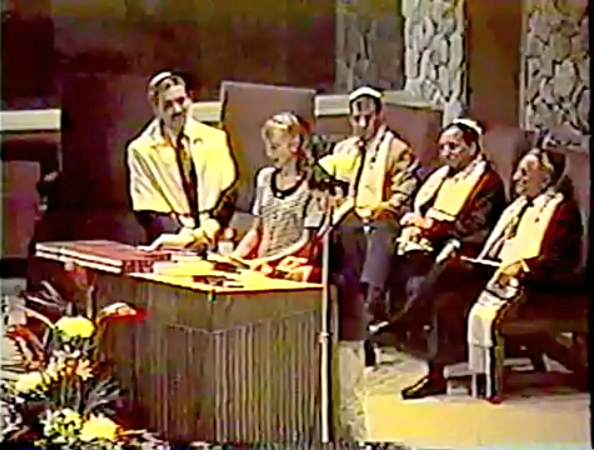
Speaking of comings and goings, it seems like just yesterday that I arrived here. In fact, it was 30 years ago last month. But since I was assistant rabbi for the first five years, my installation as senior rabbi of Temple Beth El occurred only 25 years ago - and the anniversary of that event is this Monday (Sept 11, 1992 - little did we know at that time how significant that date would be).
Here is the program that was handed out that night. Past President Alan Kalter chaired what was a most memorable evening. A feature of the program was when representatives of many different groups within the congregation came up to the bima to present "offerings" of new siddurim that had just been acquired. Part of my "first hundred days" strategy was to finally move on from the old Silverman siddur; that along with not standing for the Sh'ma and ending the practice of having the Men's Club having chicken dinners at Pelliccis. I was very ambitious! In the photo above you can see Jill Rothkopf and Josh Donner, who were to become my "first" b'nai mitzvah as senior rabbi the following day. So yes, Jill and Josh have a 25th anniversary to celebrate this weekend too!
The event was also videotaped, and you can see videos from that evening by clicking here. Some other significant videos from my early years here are also found on that page. Below are some more screen grabs from that evening. See who you can recognize.
   
"Blessed be you in your coming and in your
staying"
About DACA...

At the rally supporting Dreamers
And while we celebrate this week the comings and goings of those who are making choices as to where they will live, many are very concerned about the fate of the Dreamers, those who have lived in America for most of their lives, pay taxes and contribute to this country in so many ways, who are now being callously threatened with deportation to places they have never known. I am proud to have been at Mill River Park on Tuesday to show my support, along with other religious and civic leaders. I will continue to stand up for the defenseless and innocent, as our sources compel us to do, not simply because we are commanded to "love the stranger,' - although the Torah does say that 36 times. But in fact, DACA recipients are, culturally speaking, every bit as American as you and me. They are not strangers. They do not deserve to feel so threatened in their own homes. We should embrace them because, in so many ways, their story is our story too.
Read some statistics about these 800,000 individuals (from Newsweek)
Read "Top Ten Facts about DACA and Dreamers" (from the Bipartisan Policy Center)
Read about the Atlit camp in Israel, where Jews, desperate and homeless following the Holocaust, were rounded up and detained by the British after being caught trying to immigrate illegally to Palestine in the '40s. Many of them were deported to Cyprus (think Ari Ben Canaan) while others were forced to go back to the very places in Europe that had devoured their families.
Read how, back in the '40s, British Foreign Secretary Ernest Bevin said sarcastically that the United States wanted displaced Jews to immigrate to Palestine "because they did not want too many of them in New York." (It's been rumored that Bevin wanted to build a wall around Palestine and have the Haganah pay for it).
Read how Israel today is facing a migrant / asylum crisis that the government is handling in a controversial manner.
If any group should have compassion for the Dreamers, it is the Jewish people, we who know all about that knock on the door.

Our First Shabbat-in-the-Round
By Irma Ross
At the end of August, we experienced our first Shabbat-in-the-Round, a milestone event described below in this report compiled by Irma Ross, who has been instrumental in spearheading this project. We are so grateful for Irma's positive energy and drive. As we await with deep concern the predicted arrival of Hurricane Irma on the American mainland, be assured that this Irma and that Irma have nothing in common!
TBE's first Shabbat In the Round for 2017 was a wonderful spiritual, uplifting service and experience thanks to the beautiful music of Cantor Fishman with her gentle guitar playing and spiritual insights, the thought provoking teachings of Rabbi Hammerman, and the participation of the 45 people who came to pray together.
The schmooze portion (with coffee and) before services eased us into a warm and inviting space.
The informal setting, including pillows on the floor, allowed everyone an opportunity to be comfortable, and feel "at home." It also allowed for some organic questions and discussion, and probing of the Torah portion.
Even the folks who are 'traditionalists" found the experience to be meaningful and loved the music added to the service.
Some feedback from the participants:
"What a wondrous idea to change things up and keep the Shabbat experience fresh. The more informal setting provided connection and a spirit of community--a sense and a feeling we sometimes take for granted."
"I appreciated the special added prayers--they were refreshing and soul stirring."
"It was very spiritual and meaningful. The readings and music were beautiful and appropriate. I look forward to next time, and plan to tell others and encourage them to come."
"I loved the participatory nature and the communal feeling engendered by the service."
"I enjoyed the informal sitting in the round. It enabled us to see each other and encouraged more participation. I liked the new prayer pamphlet--it was easier to follow.
I also like the group aliyot--it made it easier for people to come up to the bimah. I'd like to see more of this format even with possibly having our traditional service in the round."
"I so appreciate all the work that went into making this service happen. Can't wait for the next one!"
Please join us for our next Shabbat in the Round on Dec. 9th!
As we approach the High Holidays, some guidance on soul searching
From "Reclaiming Judaism as a Spiritual Practice"
by Rabbi Goldie Milgram
For someone to write a sefer, is more than to say they've written a "book." A sefer is an enduring gem of Jewish significance and one such was written in 1812 by Rabbi Mendel of Satanov. He created a new approach to the practice called Heshbon HaNefesh, "Accounting of the Soul." Reb Mendel teaches a 13-step program of journaling, self reflection, and planned personal change. Heshbon HaNefesh is a helpful method for those who choose to take on the Yom Kippur practice of feeling yourself participating in a Divine review of your ethical actions. Being only human, you will have errors on your record, and so it helps to have a sense that you will earn "extra credit" in your examination by showing a record of sincere efforts at introspection and personal change.
In order to be truly free, honest looking is needed into sensitive areas of self. This approach is not one of self-excoriation. Alan Morinis, author of Musar, explains: "We're seeking insight, so in a recording [journaling] practice you are to make note of what ever you see, positive, negative or neutral. That shifts this practice quite a bit towards a healthy pursuit of self-understanding as opposed to bare self reproach."
Dr. Gene Gendlin, author of Focusing, observes that to be able to undertake such a soul journey it is important to have something comforting to hold onto. Most likely, you can be even harder on yourself than others will be and you might want to find something real or conceptual to bring along that helps you be both tender and honest with yourself. What would be comforting for you? Bring it to your heart and let's continue.
Accounting of the Soul
While Reb Mendel and Alan Morinis are teaching the art of spiritual journaling, rather than replicate their work, here is another approach I've developed to Heshbon HaNefesh.
Equanimity. Ability to live in balance.
Tolerance. Growing pains lead to knowing gains.
Orderliness. Allocating time for living life fully with integrity.
Decisiveness. Acting promptly when your reasoning is sure.
Cleanliness. Modeling dignity in your ways and space.
Humility. Know you will always have much to learn and more opinions than answers.
Righteousness. Conducting your life such that you are trusted and respected.
Economic Stability. Safe guarding enough resources for yourself to live without debt.
Zeal. Living with gusto focused on purpose and care.
Silence. Listening and reflecting before speaking.
Calmness. Giving your needs and thoughts gently while being respectful and clear.
Truth. Speaking only what is fully confirmed in fact.
Separation. Focus on each strand in its own time, avoid multi-tasking.
Temperance. Eating and drinking for good health, not dangerous excess.
Deliberation. Pausing before acting, consider consequences, integrate heart and mind wisely.
Modest Ways. Eschewing crude, lewd and boastful mannerisms and practices.
Trust. Living in the spirit of knowing there is abundance in the universe and you are in the flow.
Generosity. Finding satisfaction in making much possible for others.
(Bold type, concepts of Reb Mendel, z"l; Regular type=interpretations of Reb Goldie)
First take any one of these qualities and reflect on its degree of presence and activity in your life.
(Next, you might sit with a friend, partner, class or child and discuss the quality. What are examples for it? Flesh out its meaning to you, find as many nuances of the quality as you can.
(Now, go into yourself and notice where in your body this quality resonates. The mind/body connection creates a short-cut to knowing. Is it lodged somewhere? Rather than thinking about the quality, listen to it, discover what your body knows about it. Then, take the information and gently set it before you and return to see if there is more, something new about this quality you can learn inside yourself.
(What is your desire with regard to this quality? Sit quietly with this question until a clear image forms, til you imagine a real probability. Invite strength and support for this intention from the great dynamic flow of all possibilities in creation.
The Path of Yom Kippur Preparation
Many think of Yom Kippur, known as the "day of atonement," as the annual day of repentance. Actually, each Yom Kippur is the apex of one year's cycle of serious self reflection. Judaism is bullish on humanity, passionate about our in-born ability to change for the better. And, it only makes sense that it would require far more than one day to fine tune your life for rebirth at a more expanded level for the next year.
Accordingly, there are many days in the calendar where incremental Heshbon HaNefeshwork is traditionally practiced: Thursday evenings as part of lifting soul shmutz in preparation for Shabbat; every day (except Shabbat) of Elul, the month which precedes the High Holy Days. Some also observe Yom Kippur Kattan, "Little Yom Kippur," on the day before each new moon, and as Reb Mendel suggests, it is most effective when engaged in nightly.
The high holy day experience is often reported to be intensified in value and meaning for those with a regular Heshbon HaNefesh practice. Why? Because instead of leaping out of daily life and into the holidays, you will arrive prepared.
Shabbat Shalom
Rabbi Joshua Hammerman
|
Subscribe to:
Posts (Atom)