Showing posts with label blessings. Show all posts

Friday, April 17, 2020

From the Rabbi's Bunker and Shabbat-O-Gram, April 17: Mourning Has Broken, God's Quarantine

From the Rabbi's Bunker



TBE, looking lovely in mid-April bloom, on Tuesday afternoon
 
Also on Tuesday, Steve Lander brought down 61 more bags of food to the Food Bank and presented Kate Lombardo, executive director, a check for $1,426 from TBE members. "When I returned to the office," Steve adds, "there was another check for $1,000 for the Food Bank."
And check this out!
Be My Quarantine - Diana Sabreen and The Social Distance
"Be My Quarantine" - by TBE's own Diana Sabreen and The Social Distance (sister Amy is behind the camera)

 
First there were jackals in Jerusalem, 
now wild boars on the streets of Haifa, per this photo from Ha'aretz


Shabbat Shalom!

With Pesach now behind us, the Jewish calendar moves inexorably forward, toward Yom Hashoah, which falls on Monday night and Tuesday.  This year is the 75th anniversary of the end of the Holocaust and the liberation of the camps.  Our seventh graders, along with Katie Kaplan, will join me on Sunday at 1 PM as part of our regularly scheduled Sunday Healing & Hangout, to commemorate Yom Hashoah.  If you have a yellow candle or other yahrzeit candle, we will be lighting them at that time and it would be nice to see many lit together on the Zoom screen.
The Zoom link is here - Password: 095800  Meeting ID: 866 408 956 

Join Beth Styles and me tonight for Kabbalat Shabbat at 6 PM and Rabbi Ginsburg on Shabbat morning at 11 to discuss the Torah portion.  And on Monday evening at 7, I'll be joined by Rev. Mark Lingle and Dr Kareem Adeeb in an interfaith dialogue on the spring holidays and the coronavirus.

Some recommended reading and viewing:
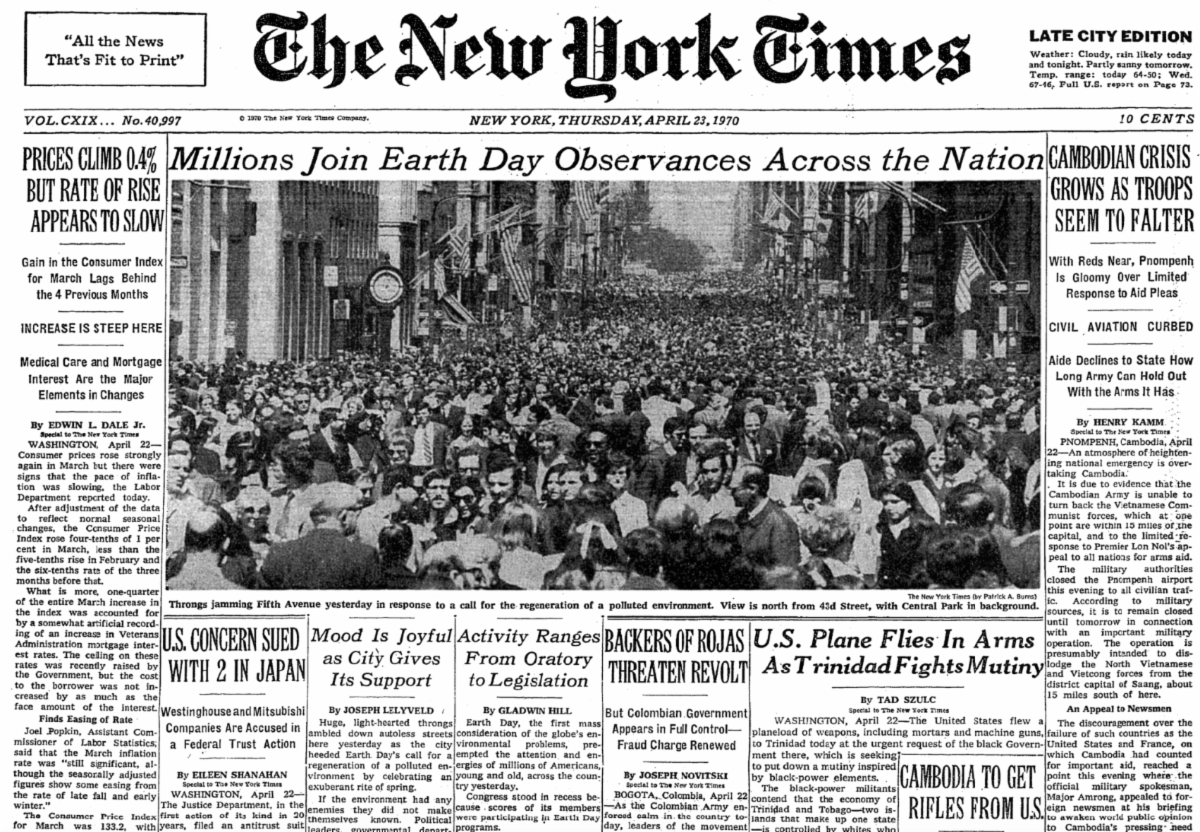

THE DAY THE EARTH MOVED - A website and film devoted to the 50th anniversary of the first Earth Day (April 22)

When the Earth Moves Film

Two contrasting views of Netflix's "Unorthodox."


You've seen the NYT's list of 52 Places to Go (Virtually) in 2020. 

So now, check out...

 TBE's 52 Places to Lead Services in 5780

I led services yesterday from the mystical Ari Synagogue in Safed...virtually.
You'll never guess where I'll be leading services from this evening!


Mourning Has Broken

You look like you could use a hug.  Everyone needs one.  Thanks to Rev Mark Lingle for sharing this video, guaranteed to put a smile on your face.

Everybody Needs A Hug 2

There is enormous sadness surrounding us right now, as we contemplate unfathomable losses. I read this morning of Margit Buchhalter Feldman, a 90-year-old Holocaust survivor from Somerset, N.J., died on Tuesday, one day before the 75th anniversary of her liberation from the camps.  What the Nazis were unable to accomplish, the coronavirus did.

But neither the Nazis nor Covid-19 could crush her spirit, nor can they crush ours. This morning I was up at 5 (Sleep schedule? What sleep schedule? I've even got a dog with insomnia).  Determined to boost my immunities, because that's what we are supposed to do these days, I took a chilly and invigorating 5:30 walk, accompanied only by a chorus of birds, and, in one part of the sky, the post-Pesach quarter moon and the dawn's early light in another. I found myself praying the morning blessings (p. 103 in Siddur Lev Shalem), with a special nod to the commentary written many years ago by Pamela Cohn Allen of blessed memory, as she walked in nature on a morning much like this one.  She was fighting cancer at the time, but I share it with you knowing that right now, each of us is fighting our own private battles...
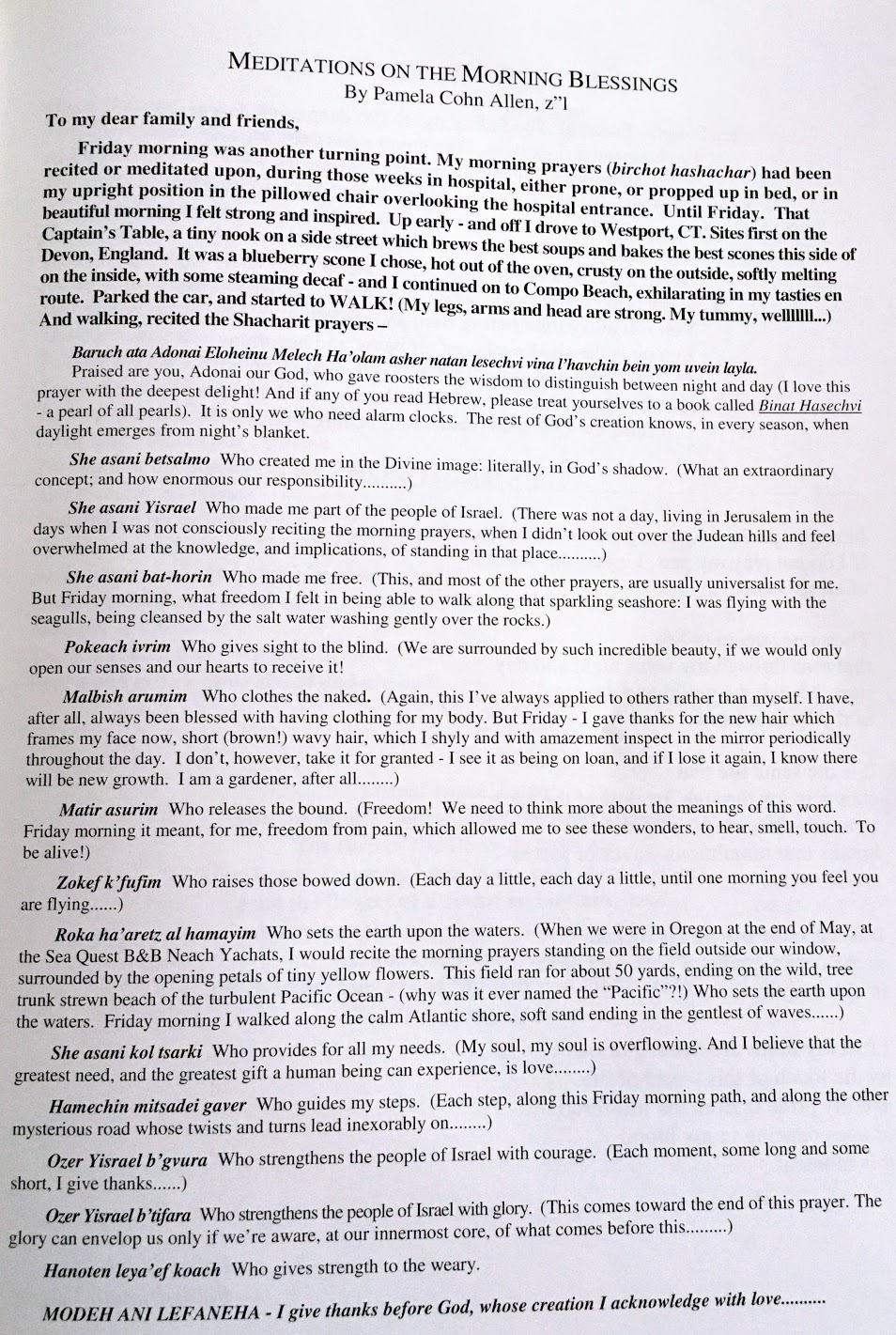

Pamela got me through half the walk, but when I got to Heartbreak Hill (Barncroft Rd - and hey, the Boston Marathon was supposed to be this week), I needed an extra boost, so I chose Cat Stevens' "Morning has Broken," which is based on a Scottish hymn and a poem by English poet Eleanor Farjeon, whose purpose was to inspire worshippers to give thanks for each day. Count me as duly inspired.

Cat Stevens - Morning has broken
Cat Stevens - Morning has Broken
But if you are looking for a faster pace, try Ahinoam Nini (Noa's) "Keren Or" (Ray of Light)

Noa (Achinoam Nini) - Keren Or
The translated lyrics:

All the stars hidden away
And the moon in a pitch black night
From the north
And south to Yemen
Not a ray of light

Morning, loyal widower
Clutch your grey sack tight
From the north
And south to Yemen
Not a ray of light

No light, not a ray of light

Light a small white candle
In this darkened tent,
This heart of mine
From the north
And south to Yemen
Then a brilliant light will shine!

The light, the light will shine


Let it shine, indeed! And for a moment at least, mourning has broken.

And as a bonus, here's another upbeat, whimsical Noa  tune - with a little English sprinkled in, entitled, appropriately, "Boker" (Morning).

Noa - Morning
Noa - Morning


God's Quarantine: 
The Divine Spark in the Human Heart

The Coronavirus pandemic has brought out the generosity of so many, including publishers.  The Koren Haggadah, by Rabbi Jonathan Sacksone of this generation's great rabbis, was made free to the public for this year's holiday.  This Haggadah commentary, like Sacks' many other writings, is filled with wisdom and theological insights.  I was struck particularly by two that related to that most vexing of questions, one that bridges the span between Passover and next week's observance of Holocaust Remembrance Day.  After Auschwitz, how can one even speak of a God who is active in history, like the God of the Exodus and Sinai, the God who saved Israel at the Red Sea?  

In back to back commentaries early in his Haggadah, Sacks shares Holocaust-related stories and in doing so, provides similar replies to that vexing question. In both cases, he demonstrates how a post Holocaust God can only be seen in human terms.  After Auschwitz, the God of Sinai has taken refuge in the human heart.  In the terminology of the day, we can call it God's Quarantine.
The first has to do with the Ha Lachma Anya passage, where Matzah, the "Bread of Affliction" first grabs the Seder spotlight.

Primo Levi's story is inspiring, but Sacks struggles to gerrymander a post-Holocaust God into the Exodus-Sinai framework.   How human beings were able to maintain their dignity in this story - one might even suggest, their God-given dignity - does little to salvage divine justice or compassion from the refuse pile of the Holocaust experience.  The fact that human beings could be so incredibly magnanimous  -despite the inhuman conditions thrust upon them - neither comes from God nor leads one inevitably back to God, at least not the God of Moses, the One capable of splitting large bodies of water and inflicting salvific plagues on nasty despots.  

In the dramatic scene recalled by Levi, the men involved are the true heroes, and indeed they restored freedom and human dignity to the world.  But did they restore God as well?  

Sacks is doing what so many theologians have done since the Holocaust: he is trying to use the canon of the Holocaust to reinforce a pre-Holocaust notion of God.  He is still addressing the God of Sinai, not the God of Auschwitz, and so the story rings hollow.

Rabbi Sacks explains God's presence similarly in his next Holocaust-connected commentary in the Koren Haggadah.  


Should God tarry, Sacks is admitting, we need the courage to take matters into our own hands and bring justice to our world. Here he hints that there is no simple answer to the question of where was God at Auschwitz, but then he returns to the heroic human spirit and the assertion that the only world more terrifying than one with an absent God is one where autocrats try to fill that void.  We need to cling to the idea of God even in God's absence, if only to leave the vacancy unfilled, leaving it to modern Pharaohs presumptuously aiming to fill it.

So what are the implications now, in the Age of Corona?  With so many people using their precious freedom to share their bread, by helping neighbors in distress and in some cases risking life and limb to do that, are those people bringing God back into the world?  And if they are - and I'm not saying that they are not - could the massive human response to this plague (the good response, not the response of those who are cynical, selfish and corrupt) be the first step toward ending the plague of divine darkness, the eclipse of God that has darkened our spiritual world for 75 years?
In his classic 1952 essay, The Eclipse of God, Martin Buber wrote, of the "still unredeemed concreteness of the human world in all its horror." Buber's paper was an effort to rummage through the still-smoldering ashes for some way of comprehending the incomprehensible while reconciling himself to a world without an operational deity.  Now, more than half a century later, has God begun to peer back at us from out of the mist?  Is the darkness receding?

These hopeful albeit farfetched approach may be irrational, but it was Ben Gurion, hardly an apologist for God, who said that in order to be a realist you must believe in miraclesAnd no less a dreamer-realist than Elie Wiesel, who had every reason to succumb to despair, quoted Albert Camus, author of "The Plague" in a 2006 interview with Time:  

"Camus said,'Where there is no hope, one must invent hope.' It is only pessimistic if you stop with the first half of the sentence and just say, There is no hope. Like Camus, even when it seems hopeless, I invent reasons to hope."
We join Sacks in inventing reasons to hope, if not for some manifestation of a traditional God, then at least for a notion of Ultimate Justice; because we desperately need the moral foundation laid out at Sinai, even as the God of Sinai has given way to the eclipsed, human centric God of Auschwitz. In that sense, we need God because no human being should ever be allowed to usurp that divine role. We need God to prevent extremists from perverting religious imagery to horrific ends.  

And the best way to do that, Sacks asserts once again, is to place that divine spark, that Eternal presence, safely quarantined inside the human heart.

Shabbat Shalom

Rabbi Joshua Hammerman

Friday, May 1, 2015

Shabbat-O-Gram for May 1

Shabbat-O-Gram 


The Shabbat Announcements are sponsored by Jill and Alejandro Knopoff in honor of their daughter, Morgana, becoming a Bat Mitzvah.


A Parent’s Blessing

As many of you know, next weekend my family will be traveling to Washington for Dan’s college graduation (there will be no Shabbat-O-Gram next week).  While everyone has been thrilled for Dan, as they should be, (and if you know anyone in the think-tank world, Dan’s specialty is international relations, with a focus on the Middle East), the instant reaction I’ve gotten from most people is a mazal tov to me on having paid the final college tuition bill.

Since, as we all know, every event of a child’s life is all about the parent, I’ve given some thought to this sacred moment in the life of a family, the graduation of the youngest child.  As of a week from Monday, for the first time since Ethan skipped off to nursery school precisely twenty years ago at the age of two, not a single Hammerman will be matriculated at any school.   Now I have heard of this animal known as graduate school, so we may not be completely out of the woods yet.  But still, this is a real watershed moment for all of us.  And since I’ve chronicled and assessed prior rites of passage for Dan, including his bris and bar mitzvah, why stop now?

So what would be an appropriate blessing with which to mark the college graduation of a youngest child?  Should we break a plate, a custom sometimes done by parents at weddings or engagement ceremonies?  Maybe burning a mortgage would be more appropriate.

Here’s a prayer I found on Beliefnet, written by a minister.  I like it a lot and it needed to make very few edits for it to be appropriate for Jewish families. It points out the anxiety all parents feel - or should feel - at a time like this, especially notorious helicopter parents like me.

“God, another rite of passage has come and gone. The child you have given has taken another step into the world. I am thankful, proud, delighted, relieved, and yet more than a little apprehensive. It’s a familiar mix of emotions, one I’ve known all the years I’ve shared this precious child with you. Today, I know you share many of these feelings, for you are a parent of great passion and joy. You share all perhaps except the apprehension. You never fear, because you are love, and perfect love drives out fear. You are a parent who knows no fear! I need that today. I need some of your parental boldness. As my child walks out now into a new season of responsibilities and challenges, in a world of struggle, I once again choose to release him/her to you. I have had to do this many times already: the first day of kindergarten, when the driver’s license came in the mail, on that first date, at high school graduation, when we drove off that first day of college, and now, when that journey is completed and they step out into the world as we know it, full of tough, dog-eat-dog battles. All we can do it pray for your hand, which reaches to protect when ours cannot. I say in faith, ‘God, bless and keep him, make your face shine upon him and be gracious to her, and look on her with favor and grant her peace.’”


Or maybe we should simply repeat the traditional blessing done by parents at a bar mitzvah:  “Praised is God, who has relieved me of guilt for whatever becomes of this child.”

Historians trace this Baruch Shep’tarani blessing back to the biblical story of Jacob and Esau, brothers whose post-adolescent lives took dramatically different tracks. Although Rebecca and Isaac were hardly exemplary parents, the blessing validates their unavoidable helplessness in opposing Esau’s wayward ways. In instituting this prayer, the rabbis were implying that there comes a point where parents simply have to let go.

My two kids’ lives have also taken very different tracks, though, since of course it’s always about us parents, they’ve pursued some of their parents’ passions in different ways.  I can see a little of me in each of them - but both of my boys are far greater than the sum of their ancestral parts.

Most of all, they have turned out to be menschen, who love and support each other and really care about others.  No parent could ask for more and Mara and I are very proud of both of them.

And since their entire childhood took place within our little village, an extreme rarity for P.K.s, especially rabbinic ones, but an advantage that this P.K. also was lucky enough to have as a child, we’ve got to share the credit with all of you.

Which means we get to share the nachas as well (for an interesting discussion of what “nachas” means for the contemporary Jew, click here).  So, Mazal Tov to everyone on Dan’s graduation - and think of us at Sisterhood Shabbat next weekend.

And while you are at it, let me know if you would like to see Dan’s resume...

Tattoo or Not Tattoo: That is the Question

On Shabbat morning, we’ll be discussing a topic that I occasionally bring up when we reach this portion of Ahare Mot-Kedoshim and there are teens in the room:  tattoos.  You can find the relevant verse in Leviticus 19:28

You shall not make cuts in your flesh for a person [who died]. You shall not etch a tattoo on yourselves. I am the Lord.

וְשֶׂרֶט לָנֶפֶשׁ לֹא תִתְּנוּ בִּבְשַׂרְכֶם וּכְתֹבֶת קַעֲקַע לֹא תִתְּנוּ בָּכֶם אֲנִי יְהוָֹה:


The topic has been trending this week with the news that the new Apple watch has trouble functioning correctly for those with tattoos (thankfully, my tefillin work just fine).

Perhaps more relevant to the topic from the Jewish perspective is this article from Ha'aretz from a few years ago.  The article details a moving account of how the adult child of a survivor wanted to keep the legacy of his father alive by walking into a Tel Aviv tattoo parlor and asking to have an exact copy of his father’s Auschwitz number branded on his own arm. Since not we are reading Kedoshim, right on the heels of Yom Hashoah, tomorrow’s discussion is a “natural.”

And it’s a discussion I often have with teens, especially in light of the growing popularity of body art.  A survey released one year ago indicated that 40% of Americans said that someone in their household has a tattoo, doubling the result of a similar survey in 1999.

 
Why are permanent, indelible tattoos considered so “unkosher?” (Yes, I know that tattoos can be reversed, but it’s a painful, difficult and imperfect process).

A good, quick response can be found on Hillel’s website. Essentially there are three reasons that have been posited through the centuries: 1) that tattooing was originally a form of pagan worship; 2) that the human body is a holy vessel, a creation “in God’s image,” and who are we to desecrate a gift from God? The mutilation of the body isn’t entirely prohibited, though. Earrings are permitted, for instance, and anything that enhances or saves life, such as autopsies, organ donation and, yes, even some plastic surgery. If the Elephant Man came into my office and said he wanted “a different look,” I don’t think I’d chase him out as a vain narcissist. While he could have technically lived without it, his self image may be so low that in fact, such surgical enhancement could in fact keep him from taking his own life.

I must add, however, that the worship of the body should have its limits - and if such physical enhancement also causes a serious risk to health (e.g. tanning salons or breast implants), we’ve got to wonder if it isn’t just another form of pagan worship. Some have made the claim that circumcision is mutilation, but the prevailing Jewish view is that it is a finishing touch to the miracle of birth, symbolizing a partnership between parents and God. And in fact, in Greek times it was the painful operation to reverse circumcision that was considered the most reprehensible form of body mutilation, since it was done in order to assimilate into Hellenistic society, which was so focused on the exposed - and exalted - human body.

So it’s a complex subject, but the third rationale, he most recent. is the most relevant here. One reason I advise teens to avoid the temptation of tattooing is precisely because the Nazis did it to us. (It’s similar to the argument that I make against cremation). The Nazis did it to dehumanize human beings, to brand them as they would brand cattle, to take away their individuality and freedom of choice. Some claim that in the current context, tattoos are freely chosen and are a means of expressing that very freedom and individuality. But the very indelibility of a tattoo demonstrates the opposite. If it cannot be reversed, we forfeit the choice to not have it! And if the only permanent choice we should be making is to devote our lives to God, rather than a lesser object of devotion (read: idolatry), then that explains why circumcision can be the only indelible bodily change that is granted blanket approval.

But what of this survivor’s son, who wishes only to preserve the memory of the evil - itself a mitzvah (“zachor”) - rather than to perpetuate that evil form of dehumanization.  Is this a fitting tribute to a generation that will soon be gone? Or is it a clumsy distortion, a visual aid that may succeed in shocking people but can’t come close to duplicating the real thing?

I tend to think the latter. There are many avenues of remembrance out there. Why choose to imitate the evil rather than stamp it out? The son’s desire is well intentioned, but if it didn’t even bring comfort to the father (who lived his whole life hoping his children would never have to live in such shame), how is this act not more than an example of the very self flagellation and mutilation that the Torah prohibits.

The Torah implores us to choose life. When we leave a cemetery, we wash our hands. Why, as we leave the smokestacks of Auschwitz behind us, should mark our hands so that the stain will never come out? Auschwitz will never fade from history. It is seared into our consciousness. The pain will never completely go away. But that doesn’t mean that we have to wear it on - or inside - our sleeves.

Shabbat Shalom X2 for this week and next!

 
Rabbi Joshua Hammerman

Thursday, May 23, 2013

Shabbat-O-Gram for May 24, 2013


Shabbat Shalom, a Meaningful Memorial Day, and Mazal Tov to all our TBE graduates, including Sophie Koester (above), who graduated from Kulanu this week.  Thank you to Aviva Maller for the photo.

Following the devastating tornados of this past week, our federation has set up an Oklahoma relief fund

See our photo album from last week's K'tanim and Hebrew School moving up ceremonies.  Please send me additional photos and video to include in that album. Also see prior albums for the  7thgrade class wedding, Temple Rock Cafe and our Passover programs and Interfaith Seder.  And don't forget Ronnie Brockman's blog, to see what kids can learn from "The Very Hungry Caterpillar" (just in time for the every-17th-year invasion of millions of very hungry cicadas).


TBE in the News

TBE’ers have been in the news this week.  See this moving interview on CNN featuring Jill (Rothkopf) Steinberg and others, describing their experiences in light of Angelina Jolie’s decision to undergo a double mastectomy in light of her genetic predisposition for breast cancer.  And Rabbinic Pastor David Daniel Klipper was the subject of a Wall Street Journal feature on midlife career changes from the world of finance to more spiritual pursuits.

Scouting and Outing

Yesterday's decision by the Boy Scouts  to lift the ban on gay youth highlights the dramatic journey American society has taken on this issue.  While the decision does not go far enough (there is still still discrimination in hiring gay adult leaders), the "evolution" in attitudes is still remarkable.  In 2001 I addressed this issue in a column entitled "On Scouting and Outing," a piece that highlights my own evolution, and the Conservative Movement's, on this issue.  But I proudly stand behind most of what I wrote then, while maintaining pride in the many positive effects scouting has had on American life, including the lives of some children here at TBE.  

I wrote then:

Admittedly, the question of sexual orientation and religious values is not a simple matter.  My congregation is at odds with many in my movement in that we do not discriminate based on sexual orientation in our hiring policies or in selecting board members. I also advocate the ordination of gay and lesbian rabbis, although I can understand the concerns of those who do not.

The issue here for me, however, is not whether the Torah is endorsing a particular sexual orientation; it is a question of simple discrimination. Yes, there are times when boundaries must be drawn -- the Pope should not be accepted to rabbinical school, for example, without first converting, nor should I be admitted to the College of Cardinals. But this is not one of those times. Jews, of all people, understand the pain of prejudice, and the combined afflictions of AIDS and violent gay-bashing are wake-up calls that all of us must hear. Further, while I do not subscribe to the notion that everything stemming from the religious right is evil, this is a case where Christian fundamentalists are trying to impose their own perception of God's will on the boy scouts and on the rest of us. Therefore, I support the resolution issued in January by the leadership of the Reform movement, calling upon local scouting chapters to publicly amend their charters to affirm non-discrimination.

I have no illusions here that even a mighty cry of Jewish protest will change this policy. It won't. Scouting, like the American flag -- and like God, for that matter -- should belong to all of us, not merely the religious right. But the B.S.A. is right now a captive of Ashcroftism, and we aren't going to change that. Nonetheless, like the lone prophet outside of Sodom, we protest not so much to change the policy as to ensure that this policy doesn't change us.

In the end, the world has come to realize that what was once thought to be a moral choice and a mere lifestyle selection is, quite simply, not that.  When the light bulb went on and people realized that, one of the most contentious issues of the day dissolved into thin air.  There are still dangers out there - hatred and narrow mindedness beyond belief (as evidenced last week in the East Village), but barriers are falling everywhere, in Rhode Island and Minnesota most recently, and even the N.B.A.

Now that the B.S.A has righted one wrong, we can go about the very hard work, all together, of teaching our boys and girls to make the right moral choices, including the choice not to bully other kids and the choice to dedicate their lives to repairing the world.

Veni, Vidi, Kvetchy

This week’s portion of Beha’alotecha chronicles the Israelites’ adventures in the Wilderness, with the running theme that carries us through the rest of the book, and indeed throughout the rest of Jewish history to this day:  “They came, the kvetched, they conquered,”  or as Julius Caesar famously put it in Latin,Veni, Vidi, Kvetchi.”  For every step forward, and there were many, there were two kvetches backward.  Most of the kvetches have to do with nostalgia, longing for those bygone days in the shackles of Egyptian slavery.

But nostalgia is not the only culprit at play here.  There is also envy.  In describing the manna, the Torah makes it seem like the tastiest thing this side of Entenmann’s crumb doughnuts -  the glazed ones.  Yet even that was not good enough for the Israelites. Rabbi Jonathan Eybeschutz, a 17th century sage from Krakow, noted that the Torah is trying to make a statement about human nature here. People will not be satisfied even with a daily dozen of Entenmann’s crumb doughnuts, if their neighbors are enjoying the same thing.  In order for people to feel fulfilled, they have to have more than their neighbors.  It’s sort of the opposite of Dayenu.  It’s never enough, unless I have more than the guy next door.

This lesson came to mind this week as I plunged into the zeitgeist by seeing the current 3-D version of “The Great Gatsby” and then heading to Broadway to see the revival of the musical “Pippin” One main character shouts "I want things! Lots of things!” while the other wants to be extra-ordinary and to find his corner of the sky.   Both productions are dazzling 21st century remakes, pumped-up-on-steroid versions of the originals.   It’s disturbing that current films and musicals need to be so over-the-top in order to hold our attention.  Subtlety is SO 20th century. 

But the main message remains for both “Gatsby” and Pippin,” and it is the same one that the Torah is teaching us.  The so-called American dream is not that different from the Jewish dream, and it’s not about having more, being better or reinventing oneself from scratch.  Those dreams are doomed to go up in flames (and Pippin’s pyrotechnic finale takes on a whole new meaning in an era of suicide bombings) or to be beaten back by relentless tides of disappointment.   The only enduring dream is one where people come together in communities that care about one another, where individuals are satisfied with what they have.  The Judaic dream discovers the extraordinary within the ordinary, so that the ordinary becomes extraordinary.  God is found in the everyday encounters that comprise community, in patching the roof and pitching the hay.  Sanctity is discovered in the everyday acts of eating and working and loving.  Salvation is attained through simplicity – and commitment.  It’s found in the act of reciting 100 blessings daily.


Ecclesiastes 5 puts materialism in it’s proper place: we should enjoy what we have earned and treat it as a gift.  There is little else that matters, as Sarah McLachlan reminds us:


I’ll be counting my blessings this weekend as I attend Ethan’s college graduation.  For those of you  who remember....

this  this
this  and

we’ve all counted our blessings together while watching our families grow together.

On this Memorial Day, what better time to reflect on the many things that endure and the many gifts we share.  Let’s do that, without complaint or envy.  

Please pass the Entenmann’s.

Rabbi Joshua Hammerman