Sunday, February 16, 2020

The Moses Primary (Times of Israel)

FEATURED POST

The Moses Primary

Which Democratic presidential hopeful would the Torah pick to run against Trump? The one with money...and the one no money
With the primary season upon us, people naturally are asking who among the Democrats running the Torah would pick to contest Trump for the presidency.  Well, in this week’s portion of Yitro, Moses makes his choice.  And it’s…. (drumroll, please)…well, everyone.
You see, Moses’ father in law Jethro (not the guy from “Beverly Hillbillies”) suggests to Moses that he delegate some of his leadership responsibilities, so that he won’t continue to be overwhelmed by the many cases being brought to him by the rank and file.  The criteria they establish for choosing these new leaders is illustrative. If you take a look at this page of commentaries from the portion, you will see that one of the qualifiers is that the nominees be “capable people,” (“Anshei Hayil,” in Hebrew).
What does that expression mean?
Well, pick a commentator and you get a current candidate.  Rashi says, “Rich men,” who are beholden to no one.  He would clearly be a Bloomberg supporter. Rashbam focuses on the quality of fearlessness, one we can certainly ascribe to Joe Biden, who has never backed down from a fight.  Ibn Ezra looks for physical endurance – think of Klobuchar in that blizzard.  Nachmanides is looking for wisdom and honesty, which frankly, means he is possibly thinking about writing in Larry David, but these qualities could define any number of candidates, including Buttigieg, whose birth chart reveals that he is “wise beyond his years.” And then there’s the next line in the Torah, the next qualification, “who spurns ill-gotten gain,” which Ibn Ezra immediately defines in one word: “money.”  So he would be the Sanders or Warren delegate.
All of which goes to show us that political eligibility is in the eye of the beholder. And Moses will probably wait until at least Super Tuesday before deciding.

Friday, February 14, 2020

Shabbat-O-Gram: Which Candidate Would Moses Pick? Love, Jewish Style

Shabbat-O-Gram 


Hebrew School graduation and old confirmation pics have been moved to the school wing, to make way for our new elevator!

 
Shabbat Shalom 

OK, so it's my birthday.  I'm only mentioning it because this morning Judy Aronin (whose birthday was yesterday) gave me an all time best birthday present.

A Red Sox Afikoman bag! The best thing to get me through what looks like will be a crummyseason!

As I sit back and relax this holiday weekend, Rabbi Gerry Ginsburg will be co-leading with Cantorial Soloist Katie Kaplan on Friday night and Cantor Debbie Katchko-Gray on Shabbat morning.  Join us (them) for this, and over the coming weeks, for our cantorial candidates' guest appearances.  It means a lot for you to take in interest in this process that is so important to our future.  Also note that morning minyan on Monday's holiday will be at 9 AM.

Some recommended holiday weekend reading...

"To bigotry no sanction..." George Washington's letter to the Jews of Newport (1780) Here's some background on that famous missive.

This story really made me proud to be a Jew - that a congregation would both 1) take care of one of their own in a time of great need, and 2) stand up for what is right at a time when taking a stand has become increasingly uncomfortable. There should be no controversy here.  Vindman did what is right, for all the right reasons. The smear campaign against him should only cause more people to stand up for him, and as we can see, at least one synagogue, his own, unequivocally has. To which I add another. Lt. Col Vindman, if you are ever in the area, you are welcome here any time as an honored guest. The only issue I have with this article is that the shul is fundraising off of this, which doesn't smell right, even if it is at the family's request.

The Jewish Nightmare of Bernie vs. Trump (Yossi Klein-Halevi, Times of Israel).  While I don't agree entirely with him, Yossi gets us thinking about this choice from the perspective of a right-of-center American immigrant in Israel.

Ganz Maintains Lead in Latest Israeli Polls (Ha'aretz)  A consequential Israeli election is just a couple of weeks away, the panel of judges has been selected for the Netanyahu corruption trial (including some notable toughies), and Israelis are, by and large, yawning.

-  Interfaith Group Renames Itself - Bluish, Jew-ish, and Jew-theran (Forward) 
We've had a longstanding relationship with InterfaithFamily, having participated recently in a pilot project called the Interfaith Inclusion Initiative (IILI). This week they re-branded
 themselves and launched a new website: "18 Doors."  See their brief video introduction below, and here's a link to their new site. 

18Doors: Unlocking Jewish
Is Bernie vs. Bloomberg Good for the Jews? (Jonathan Tilove, Austin Statesman); also, New Hampshire Just ushered in a Bernie vs. Bloomberg Title Fight (The Intelligencer: New York Magazine) and  Is 2020 Really the Year for the First Jewish President? (JTA)  Something must be in the zeitgeist this week.  As Allison Kaplan Sommer wrote Jan. 27 in Haaretz: "For some American Jews, (this match) evokes two uncles feuding across a Friday night dinner table." Bloomberg and Sanders "embody two very different classic modern Jewish archetypes: the rumpled socialist and the buttoned-down capitalist," she wrote. Or, as the trolls will translate it, Trotsky vs. Rothschild.


Could make for interesting seders this year.  Are we ready for this?


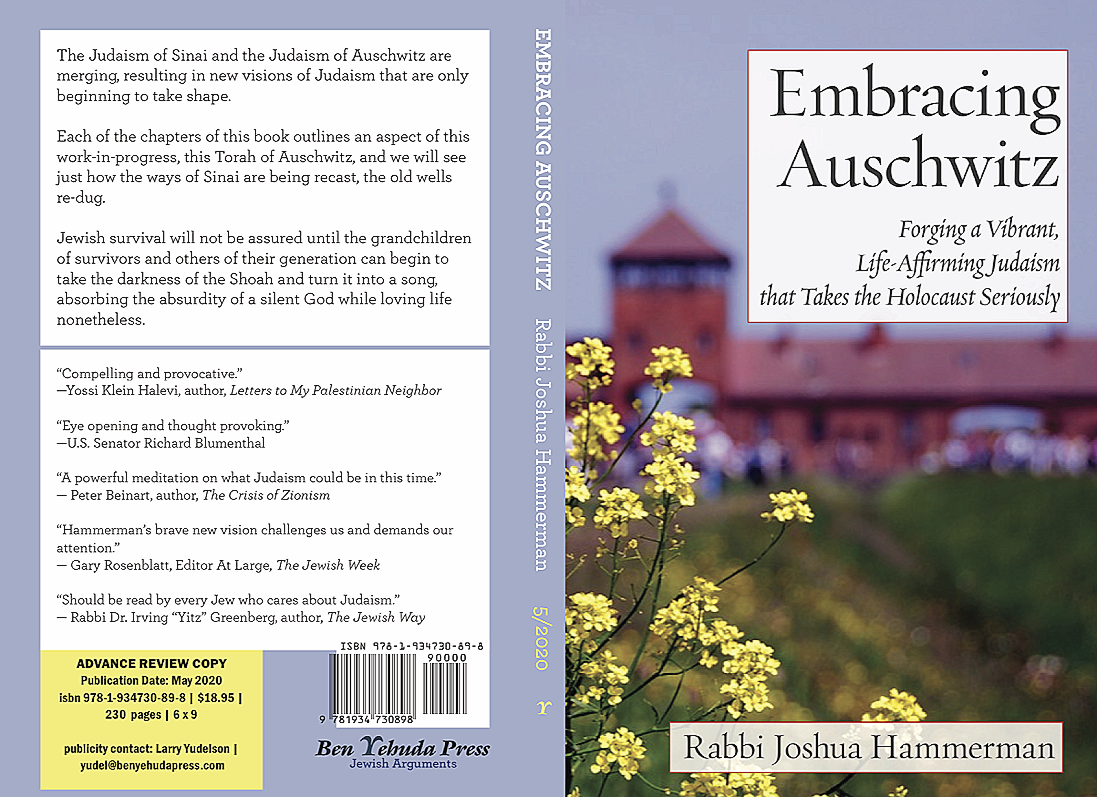
Embracing Auschwitz:
Forging a Vibrant, Life-Affirming Judaism
that Takes the Holocaust Seriously 
Now Available on Amazon!


I'm happy to announce that as of this week, my new book is now available for pre-order on Amazon. Here is the link to the Amazon page. The early response has been very positive. You can read the advance praise here, including this:


"Starting with a jarring book title, Joshua Hammerman captures our imagination and re-pivots our approach to dealing with the horrors of the Holocaust. As a gifted journalist and spiritual leader, he makes his case with a clear voice and open heart, showing us that we can fulfill the biblical mandate to 'choose life' by doing so with new forms of joy and sanctity. Hammerman's brave new vision challenges us and demands our attention."
-Gary Rosenblatt, Editor At Large, The Jewish Week

The Moses Primary

כא  וְאַתָּה תֶחֱזֶה מִכָּל-הָעָם אַנְשֵׁי-חַיִל יִרְאֵי אֱלֹהִים, אַנְשֵׁי אֱמֶת--שֹׂנְאֵי בָצַע; וְשַׂמְתָּ עֲלֵהֶם, שָׂרֵי אֲלָפִים שָׂרֵי מֵאוֹת, שָׂרֵי חֲמִשִּׁים, וְשָׂרֵי עֲשָׂרֹת.Ex.18:21 Moreover thou shalt provide out of all the people able men, such as fear God, men of truth, hating unjust gain; and place such over them, to be rulers of thousands, rulers of hundreds, rulers of fifties, and rulers of tens.
With the primary season at last upon us, people naturally are asking who among the Democrats running the Torah would pick to contest Trump for the presidency.  Well, in this week's portion Moses makes his choice.  And it's.... (drumroll, please)...well, everyone.
You see, Moses' father in law Jethro (not the guy from "Beverly Hillbillies") suggests to Moses that he delegate some of his leadership responsibilities, so that he won't continue to be overwhelmed by the many cases being brought to him by the rank and file.  The criteria they establish for choosing these new leaders is illustrative. If you take a look at this page of commentaries from the portion, you will see that one of the qualifiers is that the nominees be "capable people," ("Anshei Hayil," in Hebrew). 

What does that expression mean? 

Well, pick a commentator and you get a current candidate.  Rashi says, "Rich men," who are beholden to no one.  He would clearly be a Bloomberg supporter. Rashbam focuses on the quality of fearlessness, one we can certainly ascribe to Joe Biden, who has never backed down from a fight.  Ibn Ezra looks for physical endurance - think of Klobuchar in that blizzard.  Nachmanides is looking for wisdom and honesty, which frankly, means he is possibly thinking about writing in Larry David, but these qualities could define any number of candidates, including Buttigieg, whose birth chart reveals that he is "wise beyond his years." And then there's the next line in the Torah, the next qualification, "who spurns ill-gotten gain," which Ibn Ezra immediately defines in one word: "money."  So he would be the Sanders or Warren delegate. 

All of which goes to show us that political eligibility is in the eye of the beholder. And Moses will probably wait until at least Super Tuesday before deciding.  


Love, Jewish Style

 
Touching photo of Rabbi Vicki and Harold Axe in the
Stamford Advocate this week. Read the article

A few years ago, I wrote this about love in a High Holiday sermon - words appropriate for Valentine's Day.  Some of these thoughts came back to me this week, as in our "Beyond Dispute" class we studied the famous Ben Azzai - Akiva debate (presented below).

Reb Shlomo Carlebach said, "If we had two hearts like we have two arms and two legs, then one heart could be used for love and the other one for hate. Since I have but one heart, then I don't have the luxury of hating anyone."
For ours is a religion of Love. Ours is a God of Love.

There's an argument in the Talmud between Rabbi Akiva and Shimon Ben Azzai, over which is the most basic principle of the Torah. Akiva says, "Love your neighbor as yourself." He was a big fan of love. He LOVED love. He's the guy who put the Song of Songs into the Bible, and his late-blooming romance with his wife Rachel is maybe the greatest Jewish love story of all time.

But Ben Azzai trumped him by saying, "No, even more important than 'Love your Neighbor' is the verse from Genesis that states, "On the day that God made human beings, they were made in the likeness of God, male and female God created them."

Rabbi Arthur Green, whose book "Radical Judaism" is must reading for any post-modern Jew - and we'll be teaching it here this year - thinks Ben Azzai was on to something important. It's not enough simply to love your neighbor. Anyone can love a neighbor. Azzai says that's not enough! We have to love everyone. Not just the person who lives next door. Not just a fellow Jew. Every human being is in God's image. True, some are harder to love than others. Some are nearly impossible.

And we all know who they are!

Some days you can love them, and some days you can't. Even if you can't love them, you have to treat them with dignity. 
The Sh'ma is our most important prayer and the prayer that commands us to love - V'ahavta - "You shall love the Lord your God." So, one may ask, how can you command love?

Well, it's not really a command, as professor Reuven Kimelman has pointed out. Read properly, "V'ahavta is a response. An instinctive reaction projecting love out into the world. Projecting back what we have received."

In both the morning and evening liturgies, the Sh'ma is immediately preceded by a prayer about love. In the morning, that prayer is Ahava Rabbah - "A Great Love," a transcendent love, an UNCONDITIONAL love. The word for love, "Ahava," appears in various forms no fewer than six times in that single prayer, including the first, middle and last words. Love, love, love, love, love, love. Six times! Like a mantra.

We are loved by an unconditional love - a boundless love, as we say at night, Ahavat Olam. When you've been loved in that way, when the world has loved you in that way, the only way to respond is to give love in return.
V'ahavta - We will love. Not we MUST but we will. We will love because we've been loved. Even at times of enormous suffering, we've been touched by an Ahavah Rabbah. We will love because our God is a God of love, our Torah a Torah of love; every ounce of breath that comes from us is a breath that was given to us in love.

This is the journey we all need to take, the journey from receiving to giving, the journey to unconditional love. Let us make the passage from Ahava Rabba to Ahavat Olam, from a great love, to the greatest love of all, the love of all with whom we share this earth.

It is easy to be cynical. It is easy to be suspicious. It is easy to throw up our arms and disengage.

It is easy to hate. But IF WE HATE - THE HATERS WILL HAVE WON. They will have turned us into them.

No, they don't all hate us. And in the end, it doesn't really matter who hates us and why. All that matters is that we love. Why?
Because we have been loved.

Two Special Interfaith programs this coming week:

1) The first event in the Sharing Sacred Spaces Initiative

THURS., FEBRUARY 20, 2020 6:30-8:30 PM Guru Tegh Bahadur Foundation 633 West Avenue, Norwalk CT 06850 203.857.4460 ● www.gtbf.org  Everyone is welcome! Join us, and find out all about the Sikh faith. Our turn to host will come in June.

2) Religious Voices and the Climate Emergency


Shabbat Shalom!

Rabbi Joshua Hammerman (and reserve now for our 2020 Eastern Europe trip!)

Friday, February 7, 2020

Shabbat-O-Gram for Feb. 7 - Oscar, Elie and Albert

Shabbat-O-Gram 


"And I like large parties. They're so intimate. 
At small parties there isn't any privacy."

- F. Scott Fitzgerald, "The Great Gatsby"


"The human soul can always use a new tradition. 
Sometimes we require them."

- Pat Conroy, "The Lords of Discipline"
Shabbat Shalom (and happy 29th birthday to Ethan Hammerman!)

This past weekend was wonderful, with our B'nai Mitzvah Club on Shabbat morning (great job by everyone, especially Sophie Sigman - see Sophie's Bat Mitzvah speech), a fabulous Temple Rock on Saturday night and our World Wide Wrap family program on Sunday, along with the planning meeting for Emmet's Playground. 


The family program on Sunday included a discussion about God -- something that is important to have at any age, particularly around the time of Bar /Bat Mitzvah.  Click here for the God Questions.  And click here for the tefillin source booklet.

This Shabbat...

Join us for services on Friday night featuring Beth Styles, and Shabbat-in-the Round on Shabbat morning, featuring Katie Kaplan (it will be Katie's first time leading Shabbat-in-the Round).  We begin with breakfast at 9:30 and then at 9:45 we swing into a creative mix of prayer, poetry, conversation and meditation.  This Shabbat is very special - Shabbat Shira, the Shabbat of Song, where we reenact the crossing of the Red Sea - and this portion always coincides with the new year for trees, Tu B'Shevat, which falls on Sunday night and Monday.  So we have a combined focus on nature, miracles, women (the Song of the Sea is Miriam's big moment) and this month is also Black History Month.  At Shabbat-in-the Round, we'll be putting it all together in creative ways.  See our parsha packet, featuring poetry by Maya Angelou, Marge Piercy, Muriel Ruckheiser and Jo Harjo, plus a sneak preview page from Tablet Magazine's brand new Haggadah.


Some more suggested reading (and viewing)

Tu B'shvat Tale: Honi Comes Full Circle for the Jewish Birthday of the Trees
How to Lead a Tu B'Shevat Seder (MyJewishLearning)


Parshat Beshalach: The Story of Nachshon

Carmel Academy

The news of Carmel Academy's pending closing rippled throughout the community this week.  Read their press release along with FAQs.  After 22 years, the Greenwich campus will close and the school with be folded into the Leffell School near White Plains (formerly Solomon Schechter).  

I was one of the leaders who played a role in bringing Carmel (originally WFHA) to our area, and it's a particularly sad moment for me, along with a number of members of TBE who have been champions of the school since its inception; many of them are grieving now.  From the start, this was meant to be an experiment in educational excellence, with the inspiration of superb educators like Yitzchak Sokoloff and Marc Schulman, and the experiment, for the most part, worked.

I've always been impressed with the quality of education at Carmel, along with their true embrace of their pluralistic philosophy.  I was invited to teach guest classes many times over the years, and each time I visited, I came away in awe of the ability of Carmel kids to ask just the right questions - and lots of them!  The spirit of free inquiry has always been paramount, combined with a true love of fellow Jews (Ahavat Yisrael) - and even more to the point, fellow Judaisms. It's easy to say "we accept Jews from all backgrounds." Any school can do that.  It's so much harder to see the truths embedded in religious denominations and thought systems different from our own, and Carmel specialized at that - sharing their breathtaking campus with the Japanese School, while learning and praying in stately edifices built for the former occupant, the Rosemary Hall girls school. Whenever I would go to a Bar Mitzvah service in their stately chapel built for the Protestant elite (with the crosses subtly covered), I'd search the names of Rosemary Hall /Choate's prestigious alumni carved into the rafters - and then look out the window to see signs in Japanese. It was a global village cleverly disguised as a day school.

Our TBE Carmel students have been superbly prepared for their Bar / Bat Mitzvahs - ready to lead services with ease, with strong levels of Hebrew and a mature relationship with prayer and with Torah study.  The school's unique approach has always aimed for synthesis of the sacred and the secular, so, for example, the study of Genesis was not divorced from more scientific approaches.  The goal was to teach them together.  I never got the impression that a Carmel student ever felt she was being forced to accept enforced dogma.  I never had to ask a Torah teacher whether they also teach evolution.

This is not to say that there aren't other excellent day schools around.  There are, including BCHA and, I must add, Leffell.  It so happens that one of our 12th graders, Jordana Raich, will be heading off on long trip to Poland and Israel with Leffell this coming week - we send her off with our blessings for a safe journey! I've been in touch with leaders of Leffell and know they are planning to have parlor meetings in Stamford in the near future. 

Meanwhile, I've also been in touch with some TBE families who have been involved with Carmel over the years, to offer support.  It's a bittersweet time for them, and for our community as a whole. But through the sadness, we are all grateful for the 22 years of a school that bridged denominations, counties and cultures.

It will be missed.


Elie, Albert and Oscar

Middah Yomi  (a daily dose of Jewish values)

Warning: Spoilers aplenty ahead!

This weekend's Academy Awards present numerous Jewish subplots, including some prime Jewish acting, writing and directing nominees. (See the Forward's Complete Jewish Guide to this year's Oscars). I managed to see all but three of the nominated films for Best Picture (THE IRISHMAN, JOKER and FORD V FERRARI).  I really liked all the ones I saw, so ranking them is misleading, but here goes:

BEST PICTURE (My ranking)
1) 1917
2) JOJO RABBIT
3) LITTLE WOMEN
4) ONCE UPON A TIME...IN HOLLYWOOD
5) MARRIAGE STORY
6) PARASITE


I find that all of them resonate so much this year because they share a similar, timely theme: the search for hope in a hopeless world.

Elie Wiesel, the great prophet of the Holocaust, who had every reason to succumb to despair, quoted Albert Camus in a 2006 interview with Time: "Camus said, 'Where there is no hope, one must invent hope.' It is only pessimistic if you stop with the first half of the sentence and just say, There is no hope. Like Camus, even when it seems hopeless, I invent reasons to hope."

Judaism, I have often stated, is a glass half full religion followed by a glass half empty people.  No glass could seem emptier than one sitting in a World War One trench in eastern France; or in a Jewish stowaway's attic in a German town during the Holocaust, or in a failed marriage where every spoken word is a dagger, or in Charles Manson's Hollywood in the summer of 1969, or in a bomb shelter in a Seoul mansion with a killer loose and North Korean missiles just 30 miles away.  Yet each of these nominated films finds sunlight in the darkness, each of them leaves us smiling, or at least smirking, even if hope these days must be escorted by tragic death, some gratuitous gore and a whole lot of cynicism.  That's what hope looks like in 2020.

No, the Jews don't own Hollywood - but we are the world's leading manufacturers of hope.  That's why manufacturing hope is our Jewish value of the week.

Let's take a look at some key lines from the nominated films.

1) From "1917": "I hoped today would be a good day. Hope is a dangerous thing."
Hope is a dangerous thing, especially when fighting an endless war whose motto is, as the movie declares at the end, "Last man standing." But for Schofield, the main character, the personal war he fought, to save the life of a single person, becomes the overriding force that gave meaning to his fight. And in doing so, he brings dignity and a touch of humanity to a world that had gone crazy.  He not only saves the equivalent of Private Ryan, but 1,500 of his buddies - and one thirsty baby.  That's a good day's work on the Western Front, just one day - April 6 - in no man's land along the Aisne River.


2) From "Jojo Rabbit" (this quote from Rainer Maria Rilke appears before the final credits):
'Let everything happen to you. Beauty and terror. Just keep going. No feeling is final.'

Here is Rilke's complete poem where that line appears:

"Go to the Limits of Your Longing"

Listen
God speaks to each of us as he makes us,
then walks with us silently out of the night.
These are the words we dimly hear:
You, sent out beyond your recall,
go to the limits of your longing.
Embody me.
Flare up like a flame
and make big shadows I can move in.
Let everything happen to you: beauty and terror.
Just keep going. No feeling is final.
Don't let yourself lose me.
Nearby is the country they call life.
You will know it by its seriousness.
Give me your hand.

I loved this film because it demonstrates how the innocence of childhood, seasoned with a mother's love and a friend's wisdom, can buoy the human spirit so that it can surmount even the darkest of times. It was, like "1917," a strangely hopeful film plopped into the most hopeless of environments (the poem could easily have been uttered by Schofield in 1917 as he walked through the decimated town - always moving forward). In the end, Jojo sees that Hitler is not the playful sidekick he had imagined, and as he awakens to the monstrous truths around him, he is saved. The film left me hopeful that salvation is possible for anyone, and any society, that loses track of kindness and its own inherent goodness. Rilke, whose books were burned by the Nazis, could be born again in Germany. 


3) From "Little Women": "Life is too short to be angry at one's sisters." What a perfect tone for these unforgiving times. Even if your sister burns your manuscript - or tears your State of the Union speech in two - let the spirit of love and forgiveness fill your heart! If Jo can do it, anyone can!  Well, almost anyone.

4) From "Once Upon a Time...In Hollywood." For this film I quote from the NYT review rather than from the movie itself: 

Joan Didion, in an essay first published in 1973, described the Hollywood of that era as "the last extant stable society," and Tarantino's tableau confirms this view. Life isn't perfect, but it is coherent. People know their place. They respect the rules and hierarchies.  Rick's neighbors, Sharon Tate and her husband, Roman Polanski, live higher up in the canyon (at the end of a gated driveway) and also on the status pyramid. They are regarded not with envy or resentment, but with awe.
Tarantino's idea is that this moment in history is when everything went wrong, so he tries to reverse that history, much as he did with the Holocaust in "Inglorious Basterds."  While there's an element of foolishness in this fantasy, the ending grabs the moviegoer, crying out that while we can't change what happened then, we can change the course of history now

5) For "Marriage Story," I choose this soliloquy by Laura Dern, who plays Scarlett Johansson's divorce lawyer (and will almost certainly receive an Oscar for that performance).
"Let's face it, the idea of a good father was only invented like 30 years ago. Before that, fathers were expected to be silent and absent and unreliable and selfish, and can all say we want them to be different. But on some basic level, we accept them. We love them for their fallibilities, but people absolutely don't accept those same failings in mothers. We don't accept it structurally and we don't accept it spiritually. Because the basis of our Judeo-Christian whatever is Mary, Mother of Jesus, and she's perfect. She's a virgin who gives birth, unwaveringly supports her child and holds his dead body when he's gone. And the dad isn't there....God is in heaven. God is the father and God didn't show up. So, you have to be perfect, and Charlie can be a (screw up) and it doesn't matter. You will always be held to a different, higher standard. And it's (messed) up, but that's the way it is."
Years ago, I wrote something similar about the need for fathers to own up to their responsibilities. 

The father who is present for his child is never remote, I've discovered, and the father who is remote is never present - even when he is in the same room.

"Marriage Story" is yet another depressing movie yearning valiantly for hope and salvation, which comes when the two principles overcome the barriers thrown at their relationship (by society and especially their lawyers). At the end, Scarlett no longer needs to feel suffocated and Adam Driver is able to accept responsibility. That allows both of them to be friends and better parents, and - just as she does with her son in "Jojo Rabbit" - Scarlett expresses her love and protectiveness by tying his shoes. These days, even the smallest gesture - tying a shoelace - can be redemptive.  Good thing he didn't wear loafers.


6) And from "Parasite," this bit of dialogue: 

Dong-ik: Is that tent going to leak? Yeon-gyo: We ordered it from the U.S., it'll be fine.

Yes, the U.S., that bastion of dysfunction, whose leader is "in love" with South Korea's mortal enemy.  The U.S, once the last great hope for humanity, is now disentangling itself from strategic post war alliances - that U.S. That tent is absolutely going to leak - and it does. But it doesn't really matter, because the climate induced deluge that follows renders the tent useless anyway. And what of the iron dome to protect Seoul from raining missiles? Without a stable U.S. to depend on, one that will not suggest that the best defense for Seoul would be for the entire city of nearly 10 million souls to be moved away from the border, an ally that will stage regular war games to put the northern dictator on notice - without that, tents are going to leak.  Underlying the satire of "Parasite" is the film's true horror - that freedom itself is on life support, and that the class differences between the flooded out lower class and those living high and dry in their hilltop mansions are ultimately insignificant.   For the poor, the roof is leaking.  For the rich, that danged American-made tent has been recalled.  For the rich and poor of L.A., too, hope's foundation is as flimsy as Tarantino's imagination allows it to be, no matter whether you live in the Valley (like Brad Pitt's character) or up in the hills with DiCaprio and Sharon Tate.  That's not a lot to bank on.

We can only hope.  And in the meantime, like Tarantino blowing a kiss to his expecting Israeli wife who was watching the Golden Globes from their home in Tel Aviv, we can only turn to our loved ones and say, "Todah, gveret.  I love you."  

If anyone can manufacture hope from that, we can.

SHARING SACRED SPACES

 
TBE is proud to be part of the Sharing Sacred Spaces initiative.  We've been chosen for this internationally-known project as the Jewish representative, along with houses of worship of different faith groups.  Read all about the initiative in this brochure.

This year, religious and spiritual communities are coming together in partnership to visit one another's sacred spaces, learn about other religions, extend hospitality, equip themselves with some of the tools of interfaith dialogue, and build an interfaith community. The Sharing Sacred Spaces (SSS) program is designed to engage religious diversity within a safe and tested format, and to widen participation in interreligious activity across Stamford and Fairfield County. 

Beginning on February 20, 2020, the first of the participating seven congregations will open its doors to extend hospitality to participating congregations and visitors. Each SSS congregation will open its doors in turn, with the last site visit scheduled for January 2021. Through these visits to spaces where people pray, worship, engage in religious practices and celebrate life's events, participants will be invited to listen, learn, and connect with one another. Each visit will contain specific elements: an architectural /religious tour of the space; an introduction to the religion; sharing from members; a dialogue or a shared activity; and refreshments. Each visit is thus more than a 'tour' or 'open house'; it is an experience. 

Sharing sacred spaces is designed to deepen understanding of one another to ultimately build trust, generate goodwill, and foster a greater sense of community together. SSS' third iteration in Stamford is proudly offered in collaboration with the Interfaith Council of Southwestern Connecticut (interfaithcouncil.org).

First visit: THURS., FEBRUARY 20, 2020 6:30-8:30 PM Guru Tegh Bahadur Foundation 633 West Avenue, Norwalk CT 06850 203.857.4460 ● www.gtbf.org  Everyone is welcome!

Join us, and find out all about the Sikh faith. Our turn to host will come in June.

Shabbat Shalom!

Rabbi Joshua Hammerman