In This Moment: A Rabbi's Notebook
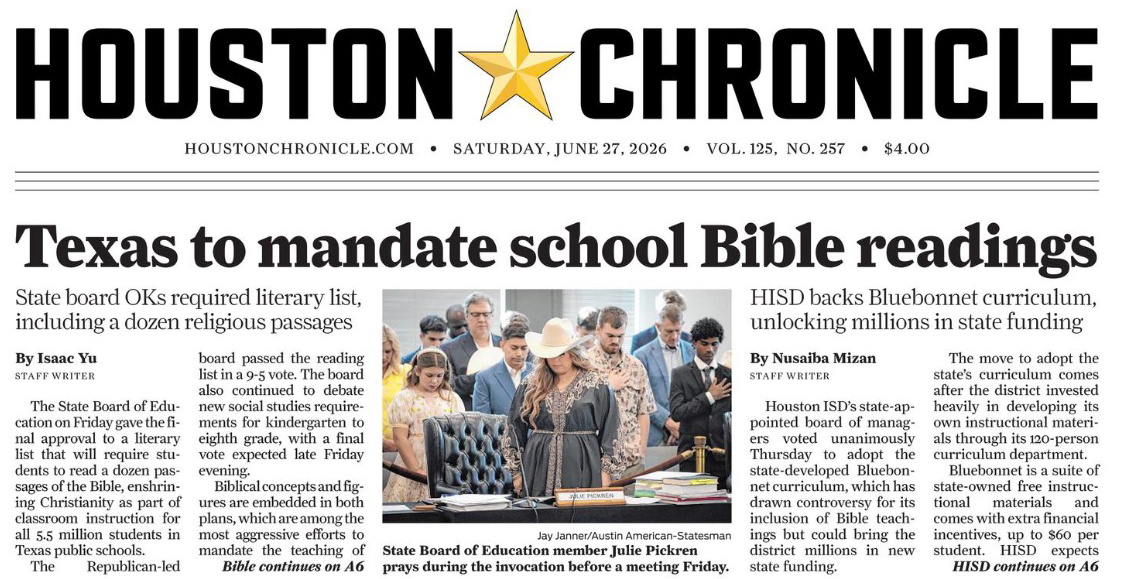
Breaking News: The Texas State Board of Education voted on Friday to include biblical passages in its K-12 public school curriculum, in a move that will affect 5.5 million students of many faith backgrounds.
The board heard from more than 400 experts, teachers and concerned citizens on two proposals — one that would overhaul the state’s social studies curriculum, and another that would create a required reading list for K-12 public schoolchildren. Both proposals include biblical references, passages and stories. According to the Texas Tribune, The Republican-led Board decided Thursday evening to allow final votes on a rewrite of Texas’ K-8 social studies lessons and a mandatory reading list for all public schools that includes Christian stories.
During the meetings, the board heard from a number of Jewish leaders, who bemoaned the misleading use of the term “Judeo-Christian” in describing the religious additions to the curriculum, as if Judaism was an equal partner in this endeavor.
The R.N.S quotes Blake Ziegler, a Texas field organizer for the Religious Action Center of Reform Judaism, saying, “One would think that this phrase is meant to evoke friendship between the two faiths, but I do not find that here — or in the language surrounding support for this list.”
And Cameron Samuels, executive director of Students Engaged in Advancing Texas, a group that aims to incorporate young people in state policy decisions, objected to using “Judeo-Christian” to characterize Texas values, saying, “Not in my Jewish faith shall you mandate entire chapters of the Bible for over five-and-a-half million students in Texas and proclaim that this speaks for Jewish people.”
Apparently. even in the rare cases where a Jewish translation of a biblical source is employed - for a passage from chapter 3 of Lamentations - a long outdated 1917 Jewish Publication Society edition is used, with archaic descriptions that are especially gruesome. Further, that passage, which points to Jewish culpability for the destruction of Solomon’s temple in Jerusalem by the Babylonians, is juxtaposed with readings about the Holocaust, such as Elie Wiesel’s Night, implying a theological linkage in interpreting those two events.
That is an abomination. The Holocaust and Lamentations are kept far apart in Jewish educational circles. The biblical book is chanted on the fast day in which Jews recall many disasters of Jewish history. But that fast day, known as Tisha b’Av (the ninth of the Hebrew month of Av) specifically does not commemorate the Holocaust, which has its own observances in the Jewish calendar. It does mark many other dark moments in Jewish history, like the destruction of the second Temple in 70 and the expulsion from Spain in 1492, both of which are said to have occurred on that same fateful Hebrew date.
As tragic as these other events are, the Holocaust stands alone regarding the nature of the evil, the scale of its destruction and our proximity to it.
The focus of Tisha b’Av traditionally has been to blame the victim, the assumption being that the ancient Jews sealed their catastrophic destiny through some fault of their own, ranging from idolatry in the case of the first Temple’s downfall to causeless hatred in the case of the second. It would be unthinkable to assign blame in such a manner to the victims of the Holocaust, what with the guilty parties so clearly known and the memory of their crimes still so fresh.
Additionally, while the ancient prophets and sages were most concerned with reconciling the relationship between a sinning Israel and her God, many moderns have a greater problem with God’s role in the Holocaust.
So Tisha b’Av and the Holocaust would appear to be mutually incompatible. Another reason to remove the word “Judeo” from what this curriculum really is: 100 percent Christian.

To sum it up, calling the Texas Christian Nationalist curriculum “Judeo-Christian” is like calling a ham sandwich kosher.
Messing with Texas Texts…
But if the Texas Board of Ed insists on including “Judaic” content in this curriculum, I’ll happily make some suggestions as to what biblical and post-biblical passages might be included.
So allow me to take this opportunity to mess with texts in Texas.
First of all, do not include passages from the New Testament. Jews don’t call the Hebrew Bible the Old Testament, so no need for a new one. But if you insist on including the New Testament (which should imply the automatic removal of the “Judeo,” Jews do have text that is similar in nature to the New Testament in that it follows up on the Hebrew Bible. It’s called the Talmud. For us, those centuries of rabbinic commentary “completed” the Bible, reinterpreting it from top to bottom. So if you can match every Gospel citation in your curriculum with a Talmudic reference, that’s a start.
Oh, and when you are quoting from the Bible, don’t forget to include the Book of Esther, with its strong feminist message and description of diaspora Jews who stand up for their identity and fight back against their oppressors.
And how about the Song of Songs, the soft-porn love poem whose graphic imagery might make a few Texas teachers blush. I can recommend some videos.
Or Ecclesiastes and Job, whose sharp cynicism toward religion might make even Bernie Sanders blush.
Let’s not forget that much of the New Testament is intended as an anti-Jewish polemic; hence the vilification of “Scribes and Pharisees,” as well as so many details in the passion narrative that have promoted antisemitism over the centuries. So let’s make sure to leave the passion narrative out.
But if you insist on being nasty toward the Jewish heroes known as Pharisees, just to give equal time, Rabbi Eliezer Diamond of the Jewish Theological Seminary researched a number of anti-Christian polemics found in the Talmud and later Jewish sources. They are pretty blunt, crude and - I must confess - insulting to my Christian neighbors. But for the sake of equal time for the “Judeo” part, well, it makes sense to include them, no?
Here’s something from the great medieval philosopher Maimonides, who had the luxury of living mostly in the Muslim world, so he could tell us what he really thought about Christianity:
Jesus of Nazareth who aspired to be the Messiah and was executed by the court was also alluded to in Daniel’s prophecies, as ibid. 11:14 states: “The vulgar among your people shall exalt themselves in an attempt to fulfill the vision, but they shall stumble.”
Can there be a greater stumbling block than Christianity? All the prophets spoke of Messiah as the redeemer of Israel and their savior who would gather their dispersed and strengthen their observance of the mitzvot. In contrast, Christianity caused the Jews to be slain by the sword, their remnants to be scattered and humbled, the Torah to be altered, and the majority of the world to err and serve a god other than the Lord.
Maimonides, Mishneh Torah, Laws of Kings and their Wars, 11.6-9
Shall we include that in the Texas curriculum? I didn’t think so.
So, Texas Board of Education, how does it feel to have your faith insulted?
Want more? Here are some passages that I’ve suggested in various contexts that speak to our current national emergency:
Psalms 109:8-9
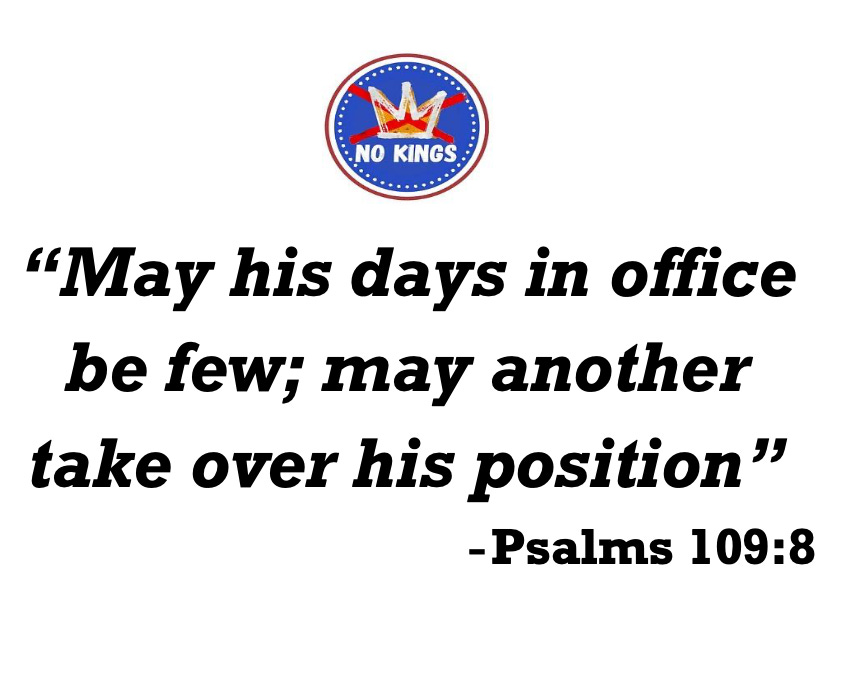
That one will go well in a political science class.
I’ve been a big fan of Proverbs 28, the same chapter that ICE marketers have used to attract new recruits (comparing Christian soldiers to lions). Well check out these verses:
Like 28:6:
Better is a poor man who lives blamelessly
Than a rich man whose ways are crooked.
Or verse 11:
A rich man is clever in his own eyes,
But a perceptive poor man can see through him.
Then there’s verse 13:
He who covers up his faults will not succeed;
He who confesses will find mercy.
And can’t leave out verse 18:
He who lives blamelessly will be delivered,
But he who is crooked in his ways will fall all at once.
Those verses from Proverbs could well headline a post-mortem morality tale following Trump’s next impeachment.
Ken Paxton will love these next passages from the Talmud and Midrash, describing the six genders of rabbinic thought: Click on the link to see them all.
Below is one of them, a commentary from Midrash Bereshit Rabbah 8:1:
R. Yirmiyah ben Elazar said, when God created the first human, they were created [as an] androgenous [אנדרוגינוס]; thus is it written, “male and female did He create them.” R. Shmuel bar Nachman said, when God created the first human, God created them with two faces, one on each side, and [when God made Eve,] God split Adam along the middle, forming two backs.
And this from the Mishnah (Bikkurim 4:1):
An androgenous (a hermaphrodite, who has both male and female reproductive organs) is similar to men in some ways and to women in other ways, in some ways to both and in some ways to neither.
I guess ancient Babylonia is where Jewish woke was born. And this is all part of the “Judeo” sacred writ. Can we put that in the Bluebonnet Curriculum, Texas?
You want to know what is decidedly not “Judeo”? Putting the Ten Commandments on the classroom wall, which Texas already approved. For Jews, the Big Ten are only the beginning. We count 613 commandments in the Torah alone. And some of the 613 might not be suitable for Mrs. Smith’s third grade classroom wall.
“Mrs. Smith, what’s cir-cum-cision?”
I would love to see religious / moral values taught in the schools in a manner that is neither insulting nor coercive. I’d love to see all religions included, comparatively but not competitively. Jefferson and the founders understood that it would be nearly impossible to pull that off; hence the need for an Establishment Clause.
My argument isn’t against religion. I’ve spent my life studying and teaching it. And we have places where it can be taught beautifully. They are called churches, synagogues, temples and mosques. The Hartford Institute estimates there are roughly 350,000 religious congregations in the United States.
I’ll bet there are a whole lot of them in Texas.
Let’s teach biblical values there, beginning with all the commandments Ken Paxton has broken.
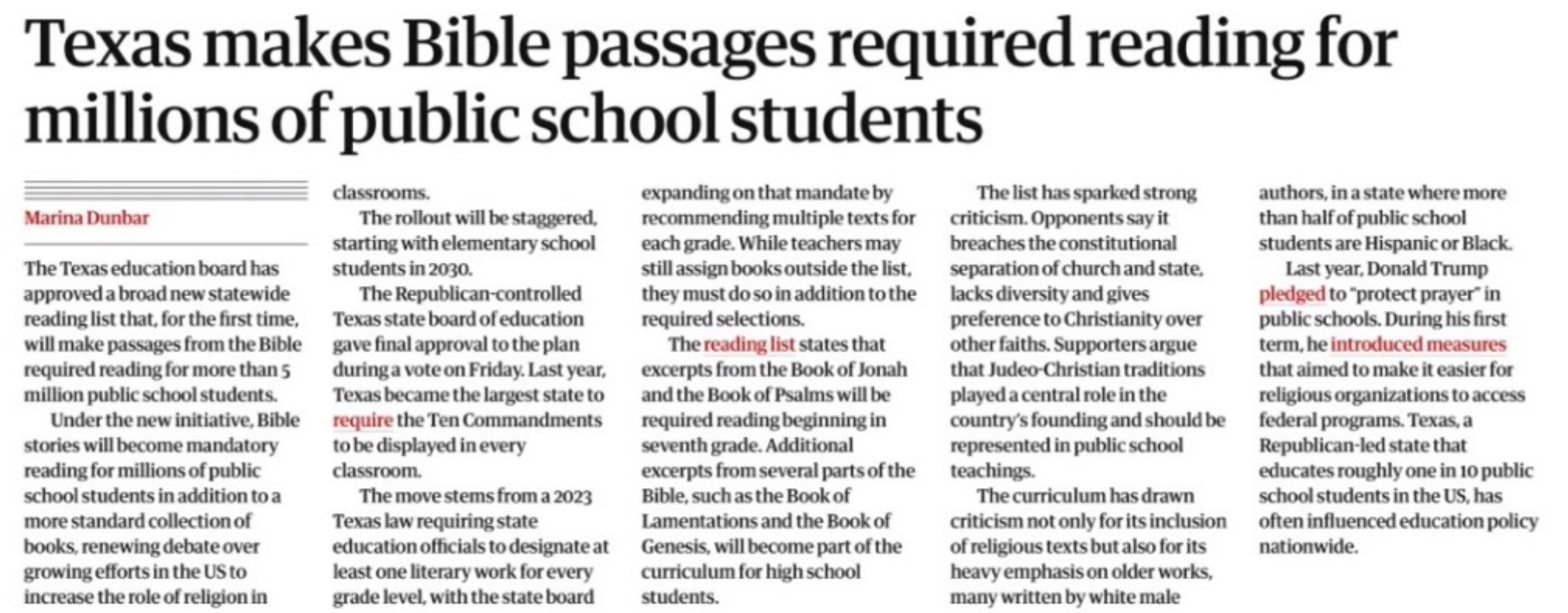
From The Guardian

You are exactly right, Rabbi, there is nothing “Judeo” about Texas’ bullshit white “christian” supremacy laws. This country and this regime are trying their hardest to force their twisted version of “Christianity” on everyone in this country. We have to fight them.
Texas has never obeyed the Constitution!
Right you are!
This MUST be removed.. the bible DOES NOT belong in PUBLIC schools. Only Texas would even think about doing this. How un-American how agains church and state. My blood boils from the things Texas does and thinks they can. They are the most selfish politicians and uncaring about its people. We must rise against them and get rid of everyone of them
Absolutely wonderful, enlightening, and politically powerful! It is disappointing to know that people like Ken Paxton, or Donald Trump, could not (or will not) read and understand what you have spoken here.
I think this might backfire on teaching their “quotes” from the bible, select parts that only highlight their messages about their form of Christian worship. Number one - kids in public schools will definitely question and challenge parts of their message and unlike actual religious teachers - public school teachers are under no obligation to endorse these messages. Might be a golden opportunity to teach an independent teacher’s message of freedom in our country to practice whatever faith, or no faith you choose.
Interesting idea, to develop strategies for educators to work around these mandates. But I’ve no doubt that teachers who get excessively bold will be fired. We could face some interesting court cases upcoming. It’s been a century since the Scopes trial (1925). We might be due for a sequel.
Here in Germany school children have the (compulsory) choice between catholic, protestant religious class OR "Ethics" which teaches about ALL religions, favoring none. I´ve always been glad that my children and grandchildren have all had this alternative. Texas people making these decisions are nutcases. What else can one expect 🤷? Thank you, Rabbi Hammerman, for another enlightening and educational Notebook page.