Here is audio and text of the sermon I gave this past Shabbat in Stamford, as I spoke to the congregation and the week’s Bat Mitzvah, Vivian Kaplan, daughter of my close friend and colleague Cantor Katie Kaplan. Now Vivian loves horses, so I took the liberty of skipping a few portions ahead to talk about why Pharaoh’s horses did not really drown at the Red Sea.
In the sermon, I didn’t bring up what might be the most salient connection between the Bible and Our Current Presi-dicament, the fact that a horse named American Pharoah (yes, they did misspell it) won the Triple Crown in 2012. That horse, the good American Pharaoh, should not be mistaken with the current bad one, who also has a fondness for the alternative barnyard name “Piggy.”

When I turned my attention to this week’s Torah portion in the sermon, I had a lot to say about the narcissistic, megalomaniacal Egyptian Pharaoh described in Exodus chapter 1, and by implication, our current American version, the one who just said that he is all-powerful, restrained in exercising the power of the state only by his own morality - that what’s in his head is all that matters. They share much in common, the two pharaohs, in their psychopathic brutality, in how they try to cover the tracks of that brutality, how they upend truth and even try to fool God, and how they try to bring their entire nation into complicity in their crimes against humanity. That’s what I discuss in the sermon, based on a single verse, without having to sully the evening, and the Torah, by bringing up our current pharaoh’s name.
It will be an important story to tell and retell, long after the outrage induced by the inexcusable White House response to their murder of Renee Nicole Good has receded and the worst perpetrators are reduced to an eternity of shame.
Right now, many of us are feeling like this quote from BoJack Horseman.
But someday, the defeat of Trump and Trumpism will be the focus of joyous annual seder-like retellings, perhaps on the evening of January 6, with a seder plate filled with horseradish to remind us of the bitterness that we felt and the tears we shed with every needless death caused by this brutal regime.
Which reminds me to remind you of my summons to all Americans with an ounce of “horse sense” and respect for innocent life: We can only fight one pharaoh at a time. There are many evils in this world, some of which, like Iran (which according to Reuters, has killed over 500 protesters in the current round), Hamas and Russia, must be fended off as needed, but we must keep our eyes on the most important prize. The key enabler and cause of injustice in our world today resides not on college campuses nor in Gracie Mansion (though there are concerns), but in the golden White House of the American Tutankhamun.
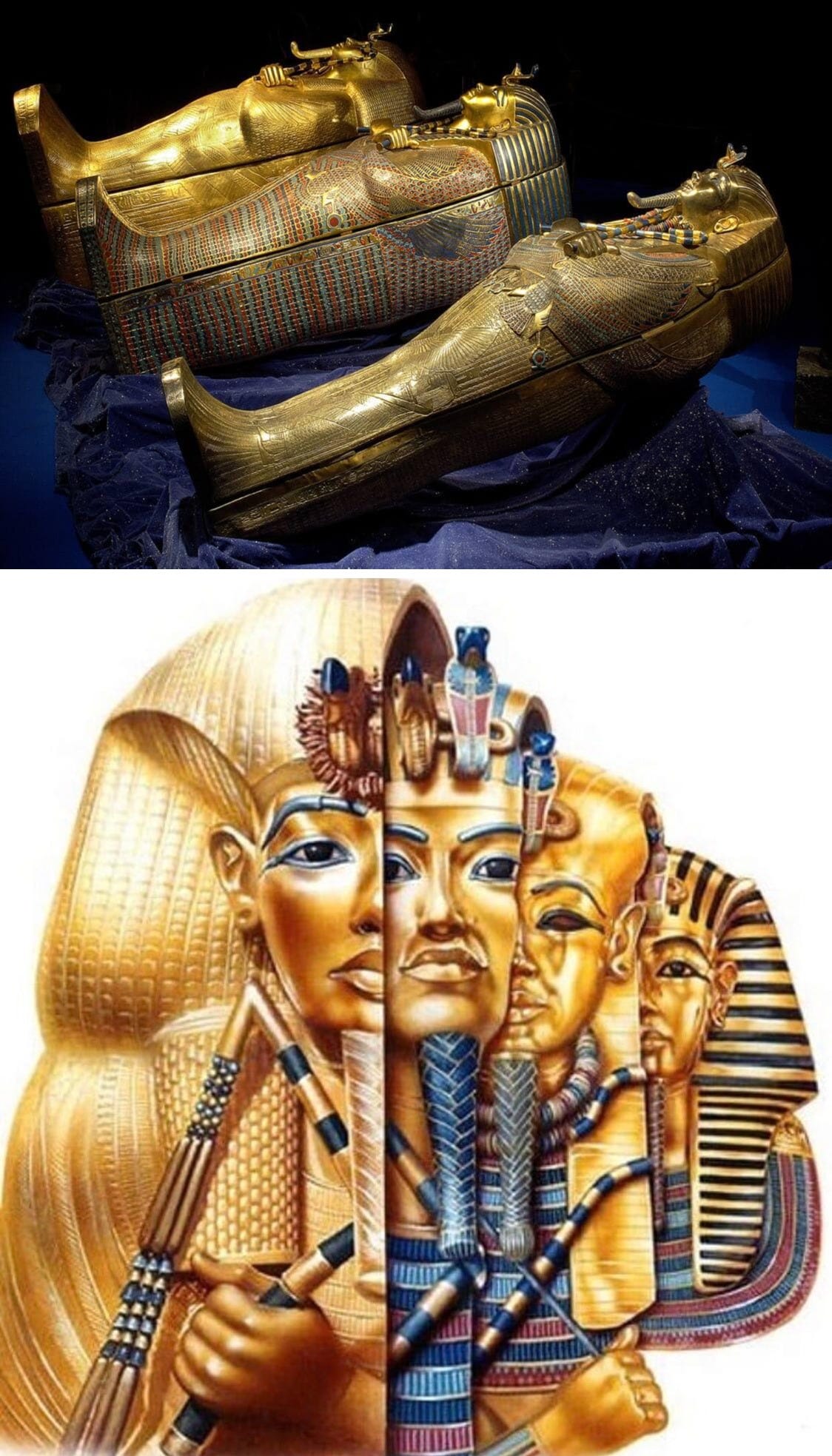
King Tut, incidentally, is having a moment. An exhibit of this gold-obsessed monarch is touring America this year, stopping off in Boston next month. I haven’t seen so much gold since….every time I see a photo from the White House bathroom.
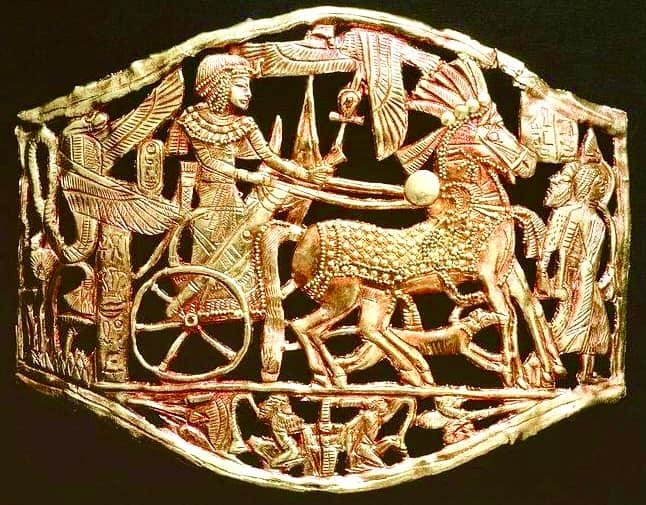
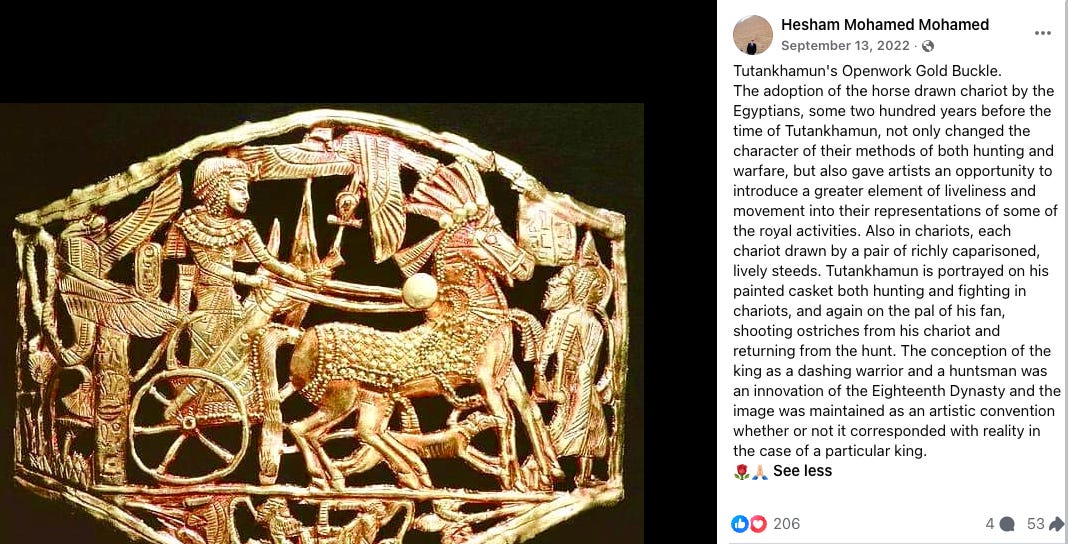
And on top of this posting, I share a photo of some of the Tut tomb loot that includes depictions of his horse and chariot1. A perfect lead in to this retelling of our battles against pharaohs old and new.
And so, the text of the sermon (but I really recommend the audio!):
Vivian. A year and a half ago, you spoke at my final service as senior rabbi – you were really good (in other words, you heaped praise on me. You said I was funny!). And after the service you came up to me and you made me promise to be at your bat mitzvah. So I promised and here I am, with Mara, to celebrate with you. We wouldn’t have missed it!
So this is my chance to wish you mazal tov. And the pressure’s on, because to live up to your billing, I have to be funny. So I came up with a joke. It’s at the end. Let’s see if you can pick up on it. And when you hear it - you’re supposed to laugh.
OK - As you might recall, I always try to connect the Torah to something the student is passionate about. And it so happens that the Exodus story that begins with week’s parsha comes to a great climax in a few weeks, with center stage belonging to – you guessed it – horses.
Now you can’t have the Exodus story without horses. Just think about the seder plater. Right smack in the middle is what? Horseradish!
And by the way, I’ve seen videos of you riding and I can say unequivocally that you canter batter than your mom!
Now I think horses get short shrift in this story. For one thing, they all die. In the Red Sea.
Now it’s one thing for Pharaoh’s army to be wiped out – they all chose to ride into what they thought was dry land. But no one ever gives it up for the horses. All those innocent horses! Thay had no choice. They all died too.
Or did they?
The text reads
אָשִׁ֤ירָה לַֽיהֹוָה֙ כִּֽי־גָאֹ֣ה גָּאָ֔ה ס֥וּס וְרֹכְב֖וֹ רָמָ֥ה בַיָּֽם׃
Sing unto Adonai for God is great; horse and driver were hurled into the sea.
Now here’s where it gets interesting. The word for “hurled” is RAMAH – which also means lifted up. It’s also a camp that Mara and I went to. And Rabbi Knopf too.
So the verse seems to be saying that God lifted up the horses.
I guess you can say they were riding the waves – surfing.
OK, and now get this…
In chapter 14, when we read the narrative of what happened at the Red Sea, the Torah says, “Adonai said to Moshe, “Stretch forth your hand over the sea that the waters turn back over the Egyptians, over their chariots, and over their horsemen.”(27)
And then, we read two verses later:
The waters turned back and covered the chariots and the horsemen of all of Pharaoh’s army who were coming after them in the sea; not even one of them remained.”
They all died. The horsemen all died. But who isn’t mentioned here? What’s missing?
THE HORSES. It doesn’t say that the horses died at the Red Sea!
Maybe the horses didn’t die!
We never hear that the horses died.
So what happened? Maybe they suddenly learned how to swim! Or surf.
Now don’t get me wrong. Horses aren’t usually the good guys in the Bible. Not a great rep. Usually they are owned by kings – and usually those kings are up to no good.
But they are animals. And they are innocent. And they are considered majestic and strong. In the Book of Job, Job asks of God…
Do you give the horse his might? Do you clothe his neck with a mane? Do you make him leap like the locust? (Job 39:19-20).
Maybe even leap out of the raging waters of the Red Sea.
And we get this verse from Isaiah – where the prophet remembers the Mighty Hand that led Israel from Egypt through the Sea. He says, “Who led them through the depths? Like a horse in the desert, they did not stumble (Isaiah 63:13).
Isaiah is comparing God at the Red Sea - TO a HORSE (perhaps with no name).
I think even Isaiah thinks the horses made it across. What is it about the horse that makes Isaiah compare it to God?
I was told once by another bat mitzvah student who loved horses, that when riding a horse, what you say to the animal matters, much less than your position in the saddle and the movements of your legs.
We are dependent on each other. There is an interdependence between the horse and the rider. Maybe that’s why the verse at the Red Sea says, “Horse and Rider God threw into the sea.” To teach us about that interdependence. The horse and rider share the same fate. You go where your horse goes.
So this bat mitzvah told me, “There is so much trust that I can usually get them on the bit, which basically means that they have put all their power in my hands.”
When you are riding a horse, your life is literally in their hands – and hooves. And their fate is in yours. You can literally steer the horse into the Red Sea and it will obey. Unless it’s one of those horses who refuses to go over that last gate in an equestrian event. Those are really annoying. And dangerous.
The trust you have with a horse is the trust we also have in God. And in our parents. And in the Jewish people. And in history. We trust that things will work out well. Those horses at the Red Sea had that trust too. And, if my reading is right, they were saved. – and the Torah is teaching us that we need to be worthy of their trust in us by taking care of animals – they are innocent. They didn’t deserve to drown in the Red Sea.
But trust requires action, Vivi. Not just waiting. But doing. Taking risks sometimes. You can’t wait for God to save us.
Yesterday was the yahrzeit of Abraham Joshua Heschel, the great mid-century moral beacon of the Jewish world. He once said that in a free society, some are guilty, but all are responsible. Not just to save the horses – but to save ourselves and one another.
So in your portion, the one we read tomorrow, that starts off the Exodus cycle, we see what Heschel is getting at.
Pharoah is suspicious of the Hebrews, whom he considers foreigners even though they’ve lived in Egypt for centuries. So he gathers his wise counselors for a cabinet meeting and says, Hava Nitchakma Lo,” “Come let us outsmart them – actually it literally says, “Let us outsmart him.”
So they come up with a plan to murder of all Israelite newborn boys. Doesn’t sound too smart to me. But the outsmarting here is not the brutality, but how Pharaoh tries to cover his tracks.
But why does it say “outsmart him?” In the singular? And who is the “him” we are talking about?
The most logical answer is that the “him” here is the Israelites. And why in the singular? Because as we know, with haters, they always lump the other, as all being alike. You know, these Jews. These immigrants. They’re all alike. Yes, they’ve lived in Egypt for 400 years. But they’re still different from us. And they’re all the same. An important lesson.
Let me give you two more possibilities.
Rashi says the reason Pharaoh says “Let’s outsmart HIM” rather than “them” is because the one they are outsmarting is God. Of course God is not necessarily masculine, but that’s how biblical Hebrew works. But it’s Rashi’s answer to why the singular.
Well, this is why. God promised never to bring a catastrophic flood after Noah’s Ark. But here they were going to be throwing all those Hebrew boys into the Nile, which always floods, to die in the water – and that could be seen as breaking God’s promise. That turn of events would throw everything into mass confusion in heaven and on earth – so that no one, including God, would be able to point a finger at the true culprit – Pharaoh.
In other words, Pharaoh would use that distraction to get away with his crimes against humanity. To get away without consequences. He would literally flood the zone, as they say, with watery murder. He thought he could outsmart God. In fact, he thought he WAS God.
What a jerk!
Thank you, Rashi. Now, here’s a third option, based on the commentary of Nachmanides – Ramban. 2
Let’s outsmart “him” is not referring to the Israelites or to God. But to the Egyptians. Pharaoh wanted to cover up his crimes by pinning them on his countrymen, his subjects. And not just some of them. ALL OF THEM.
Pharaoh understood that the papyrus trail for crimes against the Israelites would come back to him UNLESS he could succeed in engaging the entire population of Egypt – the entire nation – in his crimes.
So he involved his people in the enslavement and oppression of the Israelites charged all of them to throw the baby boys into the river.
And no one protested. Not a one, unless the heroic midwives were Egyptians, though most consider them to be Israelites.
No one else. The nation of Egypt, in their greed and fear, followed their leader without questioning. Without even a whimper. Without (so much as we can tell), threat or intimidation. They just remained silent.
In matters of morality, the Torah is teaching us, we do not have the right to remain silent. But not a single Egyptian raised a pinky to help the Israelites. Save for pharaoh’s daughter, the one who rescued Moses, who may have had Israelite ties.
Let’s compare: There were over 27,000 righteous among the nations honored in Yad Vashem. 27,000 Poles and Hungarians and Czechs and Dutch and French and even Germans - helped Jews during the Holocaust. But not one Egyptian in the Exodus story lifted a finger to do anything to stop this crime against humanity.
People are in general cowards. That’s why Pharaoh says, “We shall outsmart HIM.” The singular entity here is Egypt, not Israel, and not God. The Egyptians acted as one. And Pharaoh outsmarted them by making them complicit.
Let me repeat. People are by nature inclined to not act – and to rationalize their inaction.
But your portion teaches us that we can’t beat around the burning bush. As Heschel said, we are all responsible for the crimes done on the name of our nation.
And starting tomorrow, Vivi, when you come up and have your Aliyah and state unequivocally that you are taking your place among the Jewish people, having implanted within yourself the seed of Torah wisdom. You will take upon yourself the right and obligation to speak out against injustice.
Remember, freedom never comes for free. It must be earned – through action.
But this is also true – The slavery in Egypt begins tomorrow, but the Torah already tells us that there will be a happy ending. Right near the beginning of the story.
God makes a promise:
וְלָקַחְתִּ֨י אֶתְכֶ֥ם לִי֙ לְעָ֔ם וְהָיִ֥יתִי לָכֶ֖ם לֵֽאלֹהִ֑ים וִֽידַעְתֶּ֗ם כִּ֣י אֲנִ֤י יְהֹוָה֙ אֱלֹ֣הֵיכֶ֔ם הַמּוֹצִ֣יא אֶתְכֶ֔ם מִתַּ֖חַת סִבְל֥וֹת מִצְרָֽיִם׃
“And I will take you to be My people, and I will be your God. And you shall know that I, יהוה, am your God who freed you from the labors of the Egyptians.”
And that verse, that promise, which just might be the most important verse in the whole Torah is… Exodus 6:7. 3
OK – so that was the joke.
But this isn’t. You, Vivi, with your love of animals, might even be the one to save Pharaoh’s horses from drowning in the sea. And in doing so, maybe you’ll help save us all.
Tut’s horse and gold buckle:
Ramban on Exodus 1:4
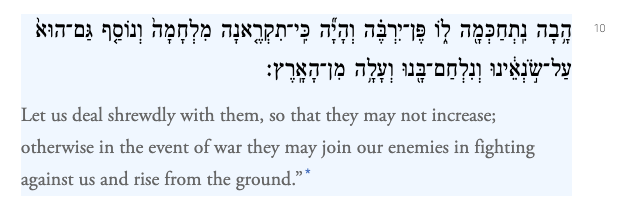
COME, LET US DEAL WISELY WITH HIM. Pharaoh and his wise counsellors did not see fit to slay them by the sword, for it would have been a gross treachery to smite without reason a people that had come into the land by command of a former king. The people of the country also would not give the king consent to commit such perfidy since he took counsel with them, and all the more so since the children of Israel were a numerous and mighty people and would wage a great war against them. Rather, Pharaoh said he would do it wisely so that the Israelites would not feel that it was done in enmity against them.
It is for this reason that he placed a levy upon them, as it was customary that strangers in a country contribute a levy to the king, as it is mentioned in the case of King Solomon. Afterwards he secretly commanded the midwives to kill the male children upon the birthstool so that even the mothers should not know it. Following that, he charged all his people, Every son that is born, ye — yourselves — shall cast into the river. Essentially, Pharaoh did not want to charge his executioners to slay them by the decree of the king or to cast them into the river. Rather, he said to the people that whoever would find a Jewish child should throw him into the river. Should the child’s father complain to the king or to the master of the city, they would tell him to bring witnesses and then they will exact vengeance [for the crime].
Now once the king’s restriction was removed, the Egyptians would search the houses, entering them at night, and indifferent [to the cries of the parents], would remove the children therefrom. It is therefore said, And when she could no longer hide him. It appears that this [decree to drown the Israelite children] lasted but a short time, for when Aaron was born [three years before Moses], the decree was not yet in existence, and when [shortly after] Moses was born, it appears that the decree was revoked. Perhaps it was through Pharaoh’s daughter, who, in her compassion for the child Moses, said to her father that he should not act in that way. It may be that when it became known that this decree was enacted by the king, he revoked it, or again it may be that it was revoked on account of the astrologers, as is the opinion of the Rabbis, since it was all done dexterously by them in order that the crime not be known. This is the meaning of the complaint made to Moses our teacher [by the officers of the children of Israel], Ye have made our savor to be abhorred in the eyes of Pharaoh, and in the eyes of his servants, to put a sword in their hand to slay us, meaning, “Now they will increase their hatred of us and find justification for saying that we rebel against the government, and they will then openly slay us by the sword without the necessity of doing it slyly.”

No comments:
Post a Comment