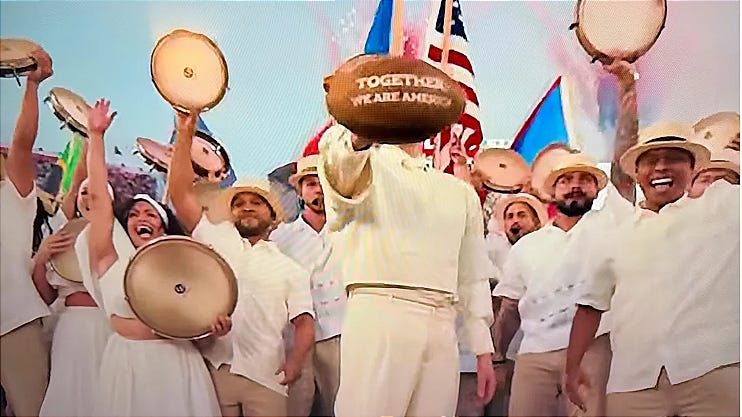
Four words. Four words redefining who we are and the neighborhood we live in. Four words redefining the very word “America.”
When Bad Bunny said “God bless America,” he made it clear that he was not just referring to the place Kate Smith used sing about, the one having oceans white with foam.1 Yes, his vision of America includes the USA, along with the other countries represented by the flags that poured onto the stage along with Old Glory.
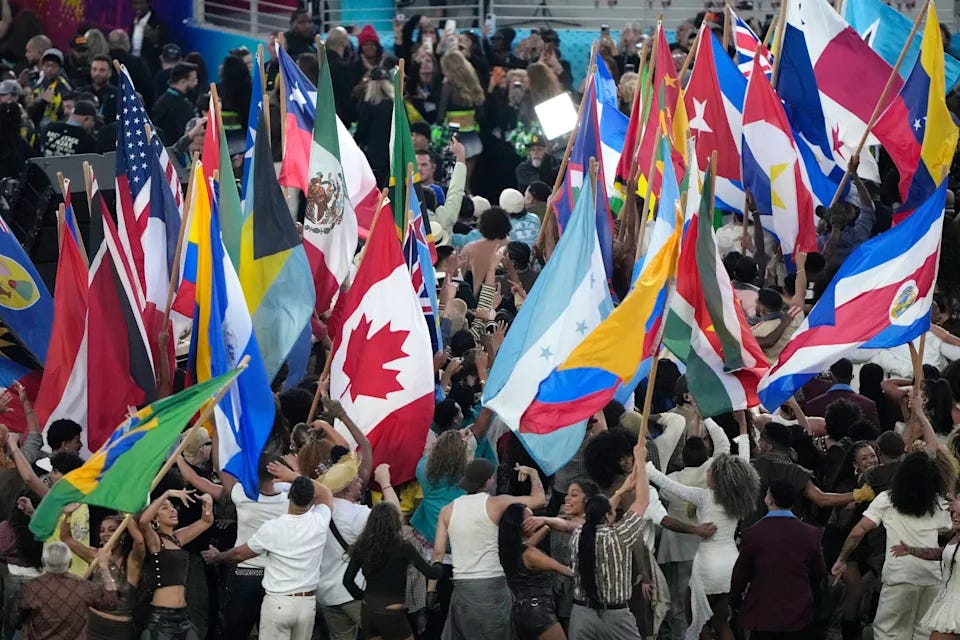
But “America,” he made clear, meant South and Central America, too, along with Canada. His was an expansive, inclusive vision of America, and of a U.S. much more comfortable in its own skin and able to reach out to her neighbors in love.
The four words on the football that he held up briefly said it all: “Together: We Are America.”
And Americans cheered, by the tens of millions.
How uplifting it was to see how, in just a few moments, everything could be changed. A disoriented nation recalibrated itself with a sentence, with just four words. Without having to understand the meaning of every word sung, our understanding of America’s role in the world was made clear beyond doubt. We are part of a neighborhood, and our role is share, not to dominate, to love, not to hate.
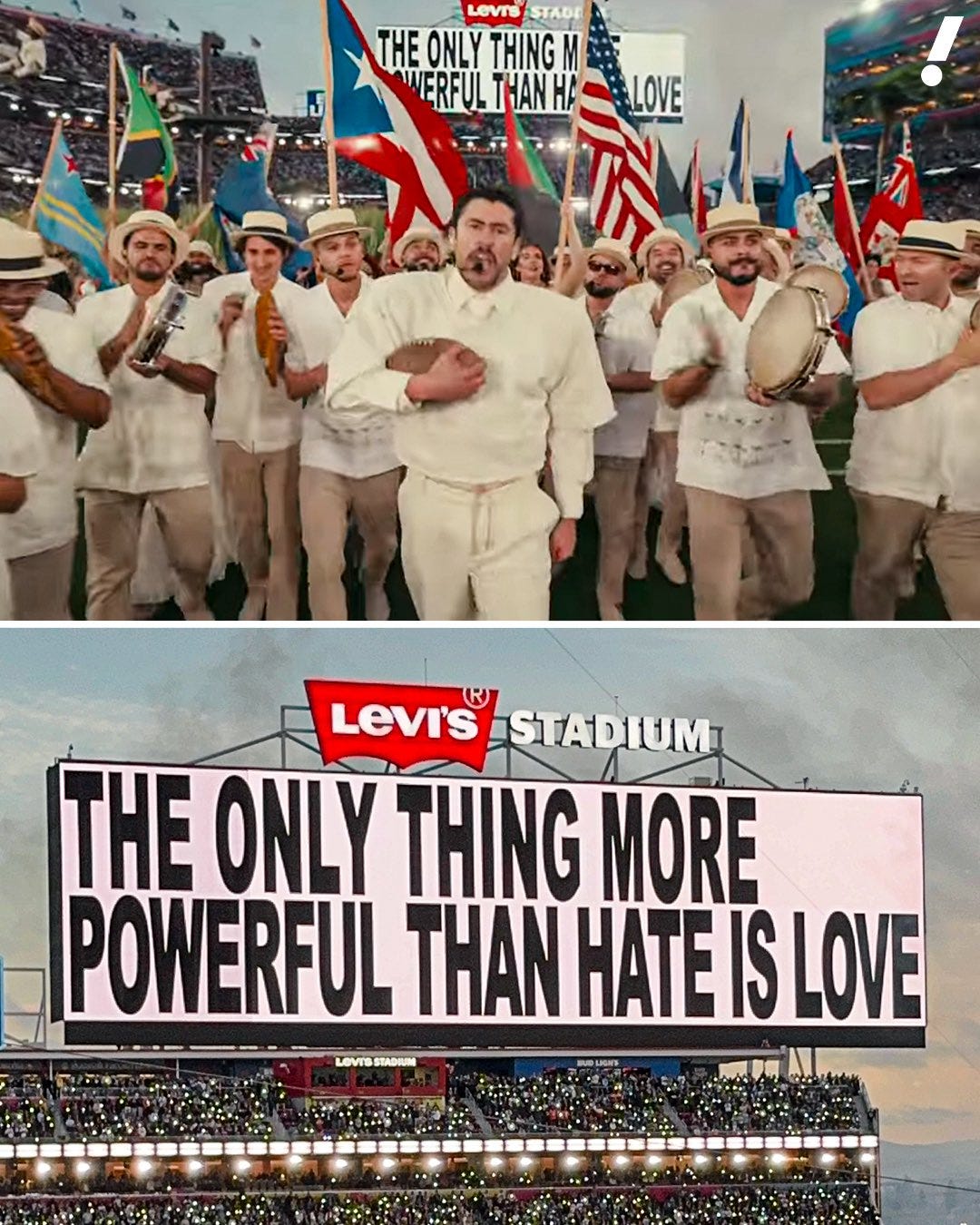
Super Bowl Sunday just might be what we look back at as the day America became America again. Maybe it’s time for New Yorkers to go back to calling 6th Ave “Avenue of the Americas,” an idea that’s never quite taken off. We are citizens of the Americas.
It just took four words.
I’ve seen four words change everything before, with a Hebrew prayer.
It’s called the Kaddish2, and many people know it as a prayer for the dead, though strangely, death is not mentioned even once. It is instead about life and love and peace. It speaks of worlds shattered, which is certainly what happens to us when a loved one dies, but in this prayer it is the entire cosmos that is in need of repair. The opening words ask that God’s name be restored to wholeness, so that a deep cosmic rupture can be repaired and the universe brought back into balance.
Similarly, when we say the Kaddish, over and over again, we seek to rebalance our shaken lives. And sure enough, when we repeat it day after day, like a mantra, it does help to restore a semblance of stability to our lives. It is a most powerful ritual. It reorients Jews outward, taking us from the depth of sadness and loneliness to reconnect with the community around us (you need to be surrounded by at least nine other adults to say the prayer) and with Jews around the world, past and present.
But there’s more (and I’ll get to the four words shortly).
The last line of the prayer traditionally implores God, the one who brings peace on High, to bring peace to us and to all Israel, and we say Amen.”
Here is the source, Job 25:2.
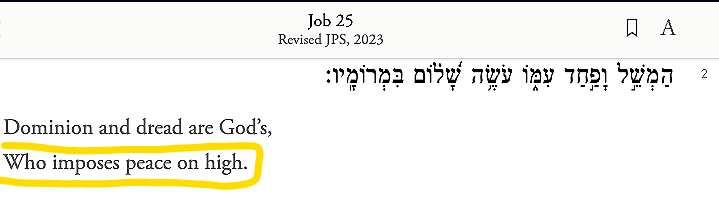
Why do we ask for God to impose “peace on high?” The commentator Ramban suggests that in the heavenly heights, there is only peace. The source of peace is to be found in those heights.
When I watched Bad Bunny’s halftime show unfold, the tune that kept running through my head was the opening number of Lin-Manuel Miranda’s great love poem to the barrios of New York, “In the Heights.”
In the Heights’ nostalgic glances are directed toward the Dominican Republic, whereas the halftime show focused on Puerto Rico, Bad Bunny’s home, but the peace and love bursting from the heavens in the biblical verse, are not unique to those places. Wherever home is, whether found on utility poles and fields of sugar cane, or the neighborhood bodega, or, in Miranda’s movie, the hairdresser and the fire hydrants and the pool club and the dance hall - and in Santa Clara, a (real!) wedding and a living room where child watches his hero win a Grammy. By the end of In the Heights, and by the end of halftime, those blessings from the heights, the heavenly heights, permeate the entire hemisphere. Everywhere becomes home. The sugar cane fields are corn fields in Iowa. The bodegas in Harlem are Wegmans in White Plains. Every grandmother is an abuela. Every flag is my flag.
Oseh Shalom Bimromav. The purest peace. That’s the peace that they feel in heaven, says Ramban, who lived in Girona and Barcelona. Is this heaven? Is this Iowa? Is this San Juan? No, it’s Santa Clara. And it’s America.
The last line of Lin-Manuel Miranda’s show says it all:
Where it's a hundred in the shade
But with patience and faith
We remain unafraid
I'm home!
The last line of the Kaddish, also found at the end of the central prayer known as the Amidah,3 is based on Job 25:2.

God makes peace in the Heights - and for all of Israel.
But the term Israel can, like “America” be interpreted both narrowly and expansively. The word is both a place and a people; Israel was also a person, Jacob, whose children came to include the followers of three great monotheistic religions.
Those great faith traditions fought for centuries over who could lay claim to the title and legacy of “Israel.”
And the Kaddish prayer, which could easily be seen as leaning toward the narrowest definition, comes to express the most expansive simply by adding four words to it.
So here are the four words that change everything in this prayer:
V’al Kol Yoshvei Tevel - “And all who dwell on earth.”
This line was appended to the phrase “all of Israel” by progressive Jews at the end of the 20th century. It gained prominence when recited during the funeral of Shimon Peres, which made so much sense, given how expansive his vision was and how much he dreamed of peace. It has really caught on since.
You can see the additional four words in brackets here -

along with a commentary in the Conservative movement’s prayerbook, Lev Shalem, which states:
The 20th-century philosopher Emmanuel Levinas asserts that the designation “Israel” includes most broadly all human beings who are committed to the ethical care of the stranger. In our prayers, we may move among various understandings of “Israel”: Israel as Jewish community, Israel as national home, and Israel as emblematic of all those who uphold an ethical universe.
So we can pick and choose how expansively to pray for peace, in Israel and beyond, and for God to bless the narrow confines of the United States of America - and beyond.
When rabbis began appending the four words in the Kaddish, some of the translations expressed the need to bring that peace from the Heights down to earth.
From Art Waskow a beloved 60’s Jewish visionary who recently passed away:
You who make harmony
in the ultimate reaches of the universe,
teach us to make harmony
within ourselves, among ourselves —
and peace for all the children of Abraham,
through Hagar and through Sarah —
the children of Israel;
the children of Ishmael;
and for all who dwell upon this planet.
(Cong: Amen)
From a leading light of Jewish renewal, Rabbi Zalman Schachter-Shalomi z’l:
You, who harmonize it all
on the highest planes –
bring harmony and peace to us,
to all Israel and all sentient beings
As we express our agreement and hope
by saying: *AMEN*
And from Everett Fox, a literary translator of the Bible, “in the spirit of Franz Rosenzweig,”
Maker of peace in the abode-on-high,
may God make peace
for us and for all Israel,
and for all who dwell on earth,
and say, Amen!
With four short words, the Kaddish is transformed from a prayer for peace ostensibly for one nation to a prayer for peace for all people and other living things, and for the earth itself.4
And the beauty of it is that these four words don’t take away from the original prayer, as Jewish tradition frowns on taking things away from prayers. But to add to a prayer is something else entirely. And the expansion is biblically sourced, using a verse from Isaiah 18:
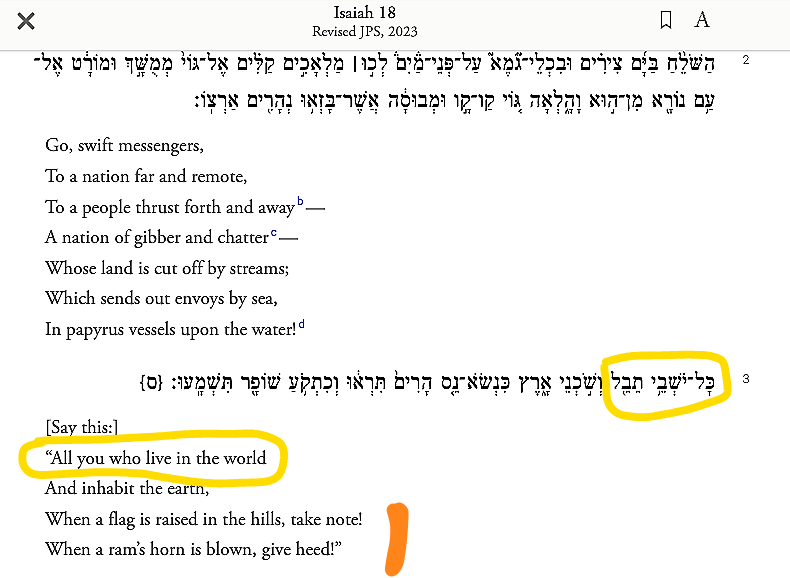
Four short words... in Isaiah’s verse it’s actually just three. Kol Yoshvei Tevel.
All who live in the world…
When a flag is raised in the hills, take note!
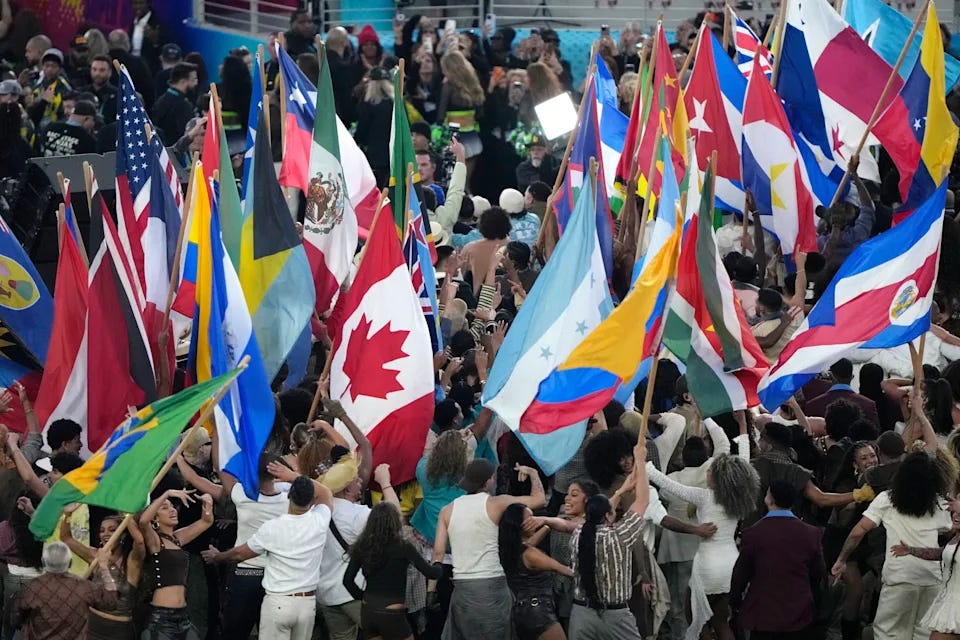
When a horn is sounded, give heed!
I want to be the first to suggest that at Rosh Hashanah services this year, we sound whistles along with ram’s horns.
See the rest of Isaiah 18 below5 to better understand the prophet’s vision of peace from the heavens.
The America that danced at halftime on Sunday was a different America from the one that watched the first half. A bigger one. One that was able to look up into the Heights and see from where our salvation might come.
The backstory to God Bless America is relevant here. Written by Irving Berlin, an American Jew, during World War One and revised in the late ‘30s as a response to the rise of Hitler and fascism in Europe, it has been embraced by both the right and the left over the decades. Berlin made some minor changes when he revised it. "To the right" might have been considered a call to the political right, so he substituted "through the night" instead.


See also this from Rabbi David Teutsch in the prayer book, Kol Haneshamah: Shabbat ve-Chagim, (p. 114): “Adding the rabbinic phrase v’al kawl yoshvei tevel (and for all who dwell on earth) logically completes the concentric circles of our aspirations – our care starts with our minyan, extends to the entire Jewish people, and radiates outward from there to all who share our planet.”
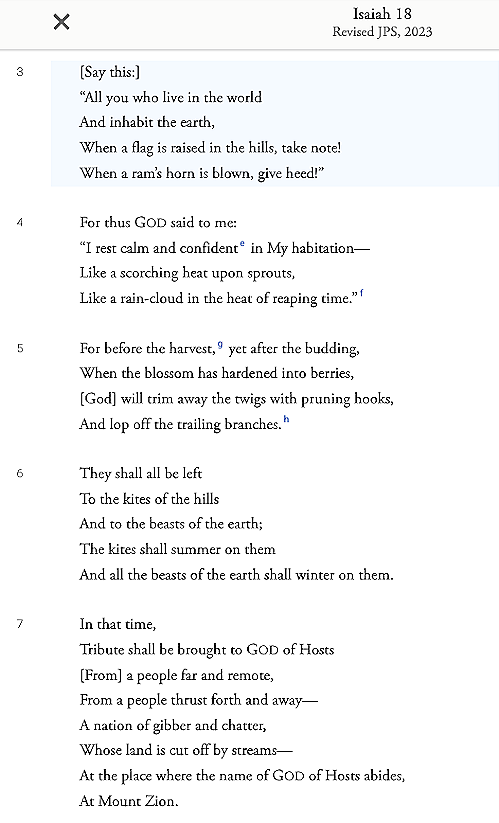

Perfect message for our times.
Thank you very much for this insightful exploration of Bad Bunny’s performance, through this Jewish lens.
From the Bodega to Wegmans in White Plains! Gotta love it. I do hope that you are right and that could perhaps be a turning point. But I’m not so sure. I do remember asking you about Kol Yoshvei Tevel. Thanks for reminding me us all.
Good evening Rabbi,
Words to " In the Heights" https://www.allmusicals.com/lyrics/intheheights/intheheights.htm
I watched the video; but, due to poor hearing didn't know what was being said most of the time. I never the less enjoyed it. I rewatched it, after reading the verses, and enjoyed it even more. It has the spirit of the half-time with Bad Bunny so I can see why you thought of it. TY
Here's to flags, horns and whistles. :-)
You failed to mention that your prediction that the New England Patriots would win, was wrong. Whomp, whomp!!!
Too painful to mention!
As a not Stupid Bowl fan, I do always pick a side. And 2026 was the Seahawks! I love Seattle. Or did years ago. But as a Rabbi fan, I waded through 5,000 words on your prediction. And, it turned out, it was wrong. Go make yourself a nice cup of Seattle’s Best coffee. There’s always, to quote a baseball term, next year! 😊🏈💥
So true. I like Seattle too, the city and the team.
ישר כוחך! An inspiringly beautiful piece!
Thanks, Amy!
With all the evil it was beautiful the sanctity of family and marriage was portrayed.
What a beautiful entry, Rabbi Hammerman! Thank you many-fold! I didn´t tune-in at all concerning the SuperBowl, I couldn´t watch it here in Germany. There is a sports´ channel, but not my thing - do instead of watch ;) . I love how you bring in such basics in Judaism as this time with the Kaddish, Oseh Shalom (my all-time favorite song), examining the relevance of happenings in the world in light of Jewish teachings. Having spent a good part of my youth in Seattle/Bainbridge Island/San Juans/ Mercer Island, of course I would have been rooting for the Seahawks! YAY! 🥳
(Sorry, didn´t mean to rub it in 💫)
It’s quite OK. I have some close friends in Seattle and I’m happy for them. Oseh Shalom is everyone’s favorite.
I understand why Oseh Shalom is one of your favorite songs. It is so soothing to listen to. Also I found one with captions in English. https://www.youtube.com/watch?v=TFwqF2qVU38
I didn't watch the SuperBowl, not my favorite sport. One channel on the internet showed different segments of Bad Bunny's performance. I didn't understand any of that, not only because of my hearing, but I only know a few words of Spanish. They showed the dancers, the wedding, him giving the trophy to the little boy and the flags.
I especially liked his final message: “The only thing more powerful than hate is love”
Here is my favorite Oseh Shalom: https://www.youtube.com/watch?v=-ODQuc6PzVk&list=RD-ODQuc6PzVk&start_radio=1