The most earthshaking, existential event for Israel came last weekend, and it had nothing to do with their bunker busting bombs in Tehran. It was this headline from a Gallup survey released before the war began, and it is a grave threat to the Jewish state.


The shifts away from Israel - both partisan and demographic - are dramatic.1
That’s particularly true among Democrats, Independents and young people, but not exclusively. There’s a ten point drop in Republican support since 2024. But as a lifelong Democrat, and one who is 100 percent convinced that the current MAGA-Republican regime - one that has hitched its wagon to Israel’s current government - is a mortal threat to democracy and the world order, Israel’s steep and dramatic decline in American public opinion is a five-alarm fire.
And now, with the Gaza War having metastasized into a global conflict, with Israel’s and America’s strongman leaders in apparent lockstep, and with both facing crucial elections just months away and a slew of legal problems, I feel that it is more urgent than ever for those who love both countries to speak out fearlessly.
Here is where things stand, one week into the second Iran war:
I am heartsick over the suffering of so many this past week, including the parents of dead Iranian schoolchildren, Israelis who died in a Bet Shemesh synagogue bomb shelter, and so many others. I’ve downloaded Israel’s “red alert” app so I am awakened hourly through the night by Iranian missile firings - though I still can’t imagine what it is like to run for shelters again and again, day after day. I am fearful for Jews and others who face an onslaught of hate fueled in part by this war, including shooting attacks on two Toronto synagogues this weekend.
While I understand the need for Israelis to fall in line at a time of national crisis, especially when there is a chance to eliminate, once and for all, a perceived existential threat, I’ve got to believe that there is an undercurrent of skepticism that more closely approaches what Americans are feeling. I want to grasp the fears and hopes that guide Israelis, but they also need to understand the prevailing skepticism over here that will likely help to derail their hopes unsatisfactorally.
The current war is historically unpopular2 here in America3, and its American architect is even more despised than his war.
While there are indications of an initial support for the war among a plurality of American Jews,4 although with significant concerns about its impact on Israel’s standing in America, I believe that support is shallow and, as has almost always been the case historically, over time it will likely wane.
That’s in part because American Jews have turned from Israel in devastating numbers. In a Washington Post poll of American Jews conducted in early September, about half disapproved of the military action Israel had taken in Gaza and 61%, think Israel has committed war crimes against Palestinians in Gaza. So the baseline of support before the current Iranian war was disturbingly low.
Unlike the Gaza War immediately following October 7, this is clearly a war of choice. Even if there were top-notch, trusted communicators making the case for its necessity now (and there are not), it’s hard to garner support for a war of choice. But with this war’s shifting and unclear goals, politically-motivated timing and an American president demonstrating deep mental and psychological decline, there is little confidence among Americans, including Jews, that the ship of state is in good hands. No one trusts this cast of miscreants.
Also, this war is increasingly being prosecuted - on both sides - by glazed-eyed religious fanatics who believe they are bringing about the Rapture5 or otherwise conjuring a Messianic age, led, on our side, by the most profane man on earth who truly believes he is God’s chosen. Newsweek reports that “some U.S. military leaders are telling troops that the Iran war is part of "God's divine plan" featuring President Donald Trump and Jesus, according to a religious freedom advocacy group.” That goes over really well with mainstream Jewish audiences, who would sooner not see the world come to an end over biblical references to the “Battle of Gog and Magog.”
While Israel has long faced mortal threats from Iran and it would be a desirable outcome for Iran’s fundamentalist government to go away or be severely weakened, Israel has historically been much better at starting wars than ending them. It has never succeeded in accomplishing regime change, though it has tried (notably in Lebanon). Its military and intelligence services are top-notch and its people are resilient and fearless, but they too find themselves at the mercy of America’s rudderless leadership.
The longer this war enflames the region without clear and definitive goals or outcome, the more Israel will devolve into a pariah state - not merely around the world - but in particular right here in America.
In other words, Israel could possibly win the battle of Tehran - it already has - but lose the war for the hearts and support of America. And while destroying Iranian desalination plants and frying its oil infrastructure are of questionable long-term benefit, the strategic consequences of losing American support are almost impossible to understate.
Forget about bipartisan support. AIPAC and Bibi willingly sacrificed that a decade ago. Now, as of last month’s Gallup poll, they’ve lost all of America, not just Democrats. We are heading toward bipartisan condemnation. Since it has failed so acutely in its one essential mission (it’s even helped turn “Zionism” into an epithet), if AIPAC were an employee of any one of the companies owned by its major donors, it would have been fired by now.
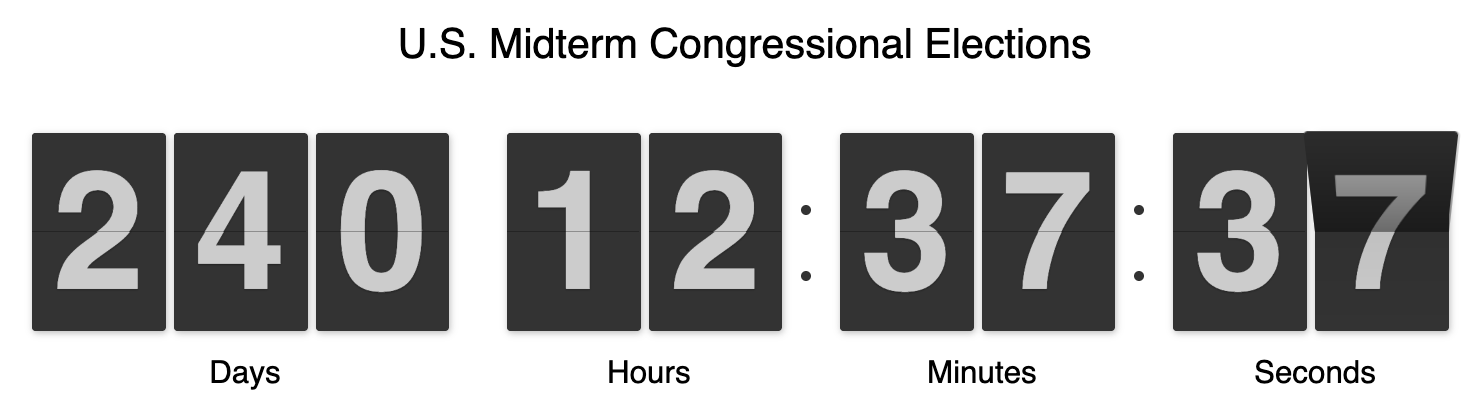
The Day of Reckoning is close at hand (240 days to the midterms, minus the hour we lost when we turned the clocks ahead last night). Unless Trump succeeds in putting a halt to a free and fair American election, Israel will have to answer to a Democratic House - and possibly Senate - that will punish Israel not only for it’s actual transgressions, but for its alliance with Trump. Ignoring that likelihood has been an act of political malpractice on the part of the Israeli government. Do they not see this coming?
After the midterms, Israel will need its real allies in America to stand up for it as never before. That’s me and those like me - the battered and broken moderate and progressive American Jews.6 Israeli politicians have long cared very little about what American Jews think of them, particularly progressive and moderate American Jews, who comprise the vast majority. (Naftali Bennett and Yair Lapid are notable exceptions to this). We’ve been considered a sideshow, cheering spectators in the Zionist drama. Well, now they need us more than ever before. And it may be too late.
For that support to be there, and for Israel to have a chance to rebuild its image, one thing is absolutely essential: a new government in Jerusalem. That has helped before, in 2021, when a “change” government was briefly in place. Israel’s image improved dramatically. The sample size is small during the Netanyahu era, but lots of the damage can be undone. 7 Healing can happen.
For healing to happen, the defeat of Benjamin Netanyahu in the next election, to be held, God willing, no later than October, is fast becoming Israel’s most urgent, existential, prerequisite.
There’s not a minute to lose. Gavin Newsom’s nuanced but jarring criticism (where he did not actually call Israel an “apartheid state,” as Steve Shaffey has pointed out8) is a sign that the Democratic establishment has been completely alienated by Netanyahu’s government, though not by Israel as a whole.
As Emily Tankin wrote in The Forward:
Given that Newsom is broadly a centrist, his words made a clear statement: Politicians understand that uncritical support for Israel is no longer compatible with the Democratic mainstream. Democratic voters are pushing politicians to, if not abandon Israel entirely, then at least condition their support for it.
And the future of American Jews and the Democratic Party is now not only up to Democratic politicians who decide how much to give Israel and under what conditions. It is also up to American Jews, who have to decide whether those politicians, in doing so, are moving away from their values or bringing them back into alignment.
I implore my Israeli friends to understand: This is not just American Jews we are talking about whose support is waning, and not just Democrats. Gallup tells a sobering tale. Americans are falling into line with their suspicion that Israeli Prime Minister is manipulating the US President and American foreign policy toward his personal ends. Every minute that this toxic bromance continues places the US-Israel relationship in more acute danger.
So end the war ASAP. Take the win and negotiate a ceasefire that eliminates the short and immediate term dangers emanating from Iran and its proxies. Protect the Iranian people from their own leaders mowing them down on the streets and foreign bombers turning their cities into chemical infernos. Do both. And then, move on to elections. And then with a clean slate of leaders on all sides, start building a new Middle East.
And let the good people of Israel and America spend the rest of 2026 trying to rebuild their tattered democracies. Now, unless there is a definitive victory in Iran very soon, Israel will be judged even less kindly by all Americans, including Jews themselves. The next Gallup poll might make this one look sanguine by comparison.
Gallup breakdown:


For those who think there is broad support for the war here, see this Saturday posting from the Strength in Numbers Substack:
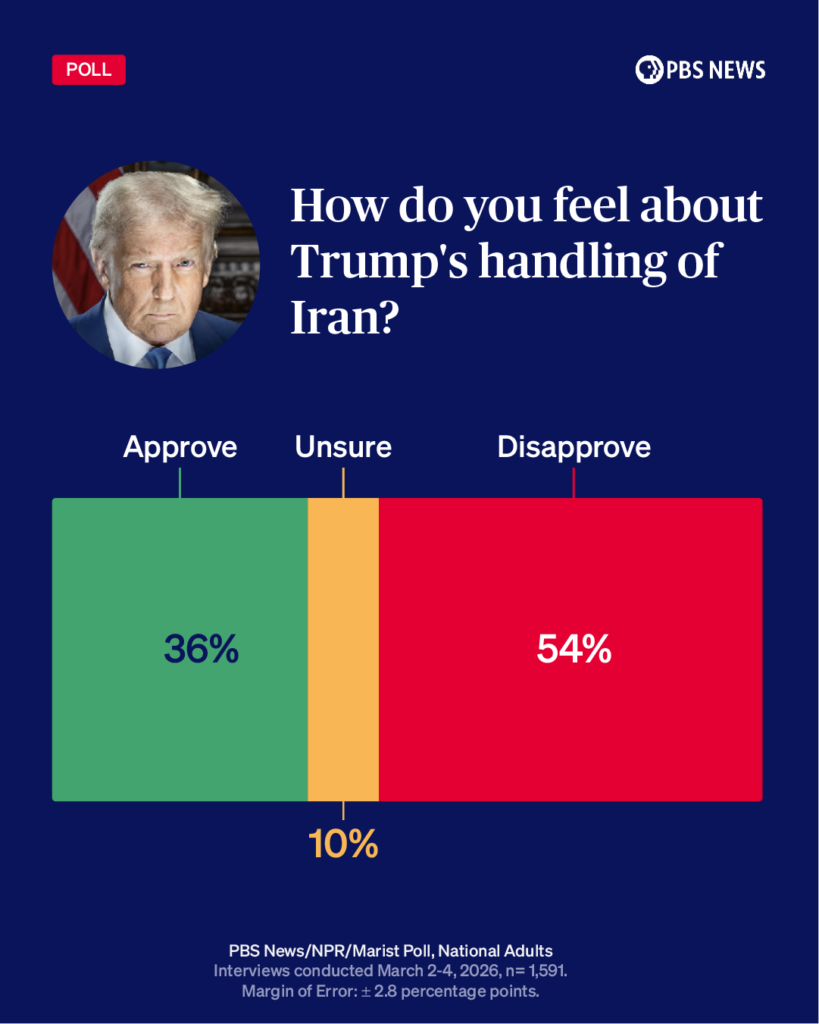
The Iran war is historically unpopular — and it’s only going to get worse. Across five high-quality polls, an average of about 38% of Americans support the military strikes in Iran and 50% oppose them. That makes this the most unpopular war at launch in the history of modern polling. For comparison, 92% of Americans backed the war in Afghanistan, and 72% supported the Iraq invasion when those conflicts began. If history is any guide, war polling only moves in one direction from here: down.
PBS/NPR/Marist, on Friday:
Wars Often Lose Public Support Over Time. Trump Started This One Without Much (NYT):
President Trump likes to assert that he has accomplished things no other president has. With the opening of his military assault against Iran, he has achieved another distinction: He is the first president in the era of modern polling to take the United States to war without the support of the public.
Traditionally, Americans stand behind their president when he first orders troops into battle, generally sticking with him unless it drags on, casualties mount and victory seems increasingly elusive. With Mr. Trump’s war against Iran, the public has skipped the rally-around-the-president phase this time.
Support for his ferocious bombardment of Iran has ranged from 27 percent in a Reuters/Ipsos poll to 41 percent in a CNN survey, far below the level of public backing that Mr. Trump’s predecessors initially enjoyed when they used force overseas. Given that wars tend to grow less popular over time, the initial negative response portends political challenges for Mr. Trump and his fellow Republicans the longer the fighting continues.
And from New York Magazine:
It’s now been a week since Donald Trump and Bibi Netanyahu began their war of destruction and regime change in Iran, a conflict that has gone regional as Iran retaliated. Polls taken before the bombs started dropping showed there was far from any national consensus favoring an attack on Iran or any other foreign military adventure. While it takes some time to conduct public-opinion surveys, it seemed Americans really would prefer their leaders focus on the economy and the cost of living.
Now there’s enough postattack polling to make it clear this is a war that is very unpopular, much like its commander-in-chief in the White House. G. Elliott Morris collected eight polls taken since last weekend and found just one (from Fox News) showing net approval of the war at zero. The rest were negative, ranging from YouGov at minus-10 percent to CNN-SSRS at minus-18 percent. The polling is roughly at the same levels of Trump’s net job-approval ratings (currently at minus-11.2 percent at RealClearPolitics, minus-12.8 percent at Silver Bulletin, and minus-13 percent at Decision Desk HQ). As Morris points out, this is really a historical anomaly:
This [is] the most unpopular war at launch in the history of modern polling. For comparison, 92% of Americans backed the war in Afghanistan, and 72% supported the Iraq invasion when those conflicts began. If history is any guide, war polling only moves in one direction from here: down.
See JPPI poll from last Thursday: Connected US Jews back Iran strikes, wider US public stays skeptical. And See Jerusalem Post coverage:
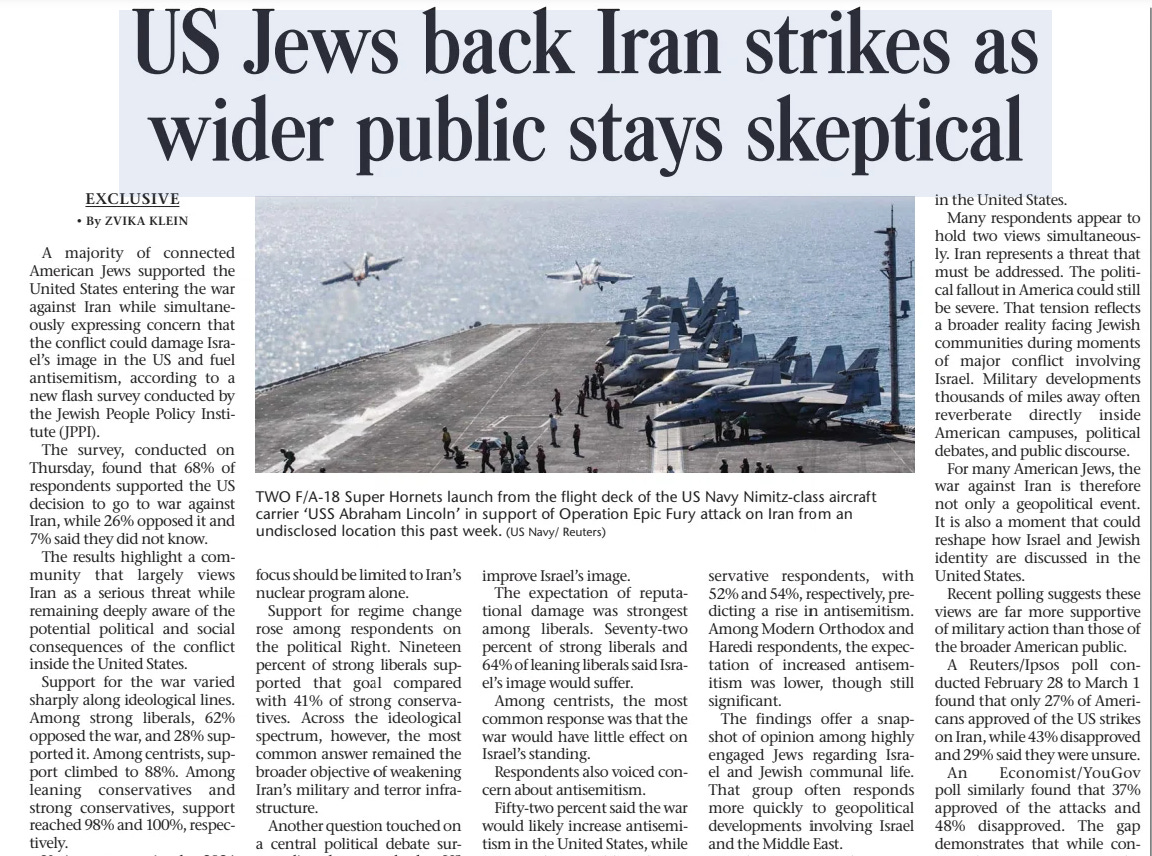
A survey conducted by the JPPI found that many US respondents hold two views: Iran’s threat must be addressed, but what will the fallout in America be?
A majority of connected American Jews supported the United States entering the war against Iran while simultaneously expressing concern that the conflict could damage Israel’s image in the US and fuel antisemitism, according to a new flash survey conducted by the Jewish People Policy Institute (JPPI). The survey, conducted on Thursday (March 5), found that 68% of respondents supported the US decision to go to war against Iran, while 26% opposed it and 7% said they did not know.
The results highlight a community that largely views Iran as a serious threat while remaining deeply aware of the potential political and social consequences of the conflict inside the United States. Support for the war varied sharply along ideological lines. Among strong liberals, 62% opposed the war, and 28% supported it. Among centrists, support climbed to 88%. Among leaning conservatives and strong conservatives, support reached 98% and 100%, respectively.
Voting patterns in the 2024 US presidential election also played a major role. Trump voters overwhelmingly supported the war, with 99% backing the US decision. Harris voters were far more divided, with 47% supporting the war and 42% opposing it. JPPI uses “connected American Jews” to mean respondents who are more engaged in Jewish communal life and more attentive to Israel and Jewish issues than the broader public. The group does not represent all US Jews.
The survey also asked respondents what the war’s main objective should be. A clear majority, 58%, said the goal should be a broad dismantling of Iran’s nuclear program, ballistic missile capabilities, and support for terrorism. Another 27% supported regime change in Tehran as the primary objective. Only 3% said the focus should be limited to Iran’s nuclear program alone. Support for regime change rose among respondents on the political Right. Nineteen percent of strong liberals supported that goal compared with 41% of strong conservatives. Across the ideological spectrum, however, the most common answer remained the broader objective of weakening Iran’s military and terror infrastructure.
Another question touched on a central political debate surrounding the war: whether US President Donald Trump had been persuaded by Israel to take military action. A large majority, 72%, said Trump had intended to go to war with Iran from the outset and required little persuasion. Fourteen percent said Prime Minister Benjamin Netanyahu convinced him, while another 14% said they did not know. Even among strong liberals, more than half believed Trump already intended to go to war. Among strong conservatives, that view reached 85%.
War’s potential impact on Israel’s image
Despite broad support for the war itself, respondents expressed significant concern about its potential impact on Israel’s standing in American society.
Forty-five percent said the war would harm Israel’s image in the United States, while 32% said it would make no difference, and 10% said it would improve Israel’s image. The expectation of reputational damage was strongest among liberals. Seventy-two percent of strong liberals and 64% of leaning liberals said Israel’s image would suffer. Among centrists, the most common response was that the war would have little effect on Israel’s standing.
Respondents also voiced concern about antisemitism.
Fifty-two percent said the war would likely increase antisemitism in the United States, while 33% said it would make no difference, and only 4% said antisemitism would decline. Concern was particularly strong among Reform and Conservative respondents, with 52% and 54% respectively predicting a rise in antisemitism. Among Modern Orthodox and Haredi respondents, the expectation of increased antisemitism was lower, though still significant.
The findings offer a snapshot of opinion among highly engaged Jews regarding Israel and Jewish communal life. That group often responds more quickly to geopolitical developments involving Israel and the Middle East. At the same time, the survey suggests that support for confronting Iran militarily does not eliminate anxiety about the domestic environment for Jews in the United States. Many respondents appear to hold two views simultaneously. Iran represents a threat that must be addressed. The political fallout in America could still be severe.
And an American Jewry facing renewed antisemitism:
For some Jews, no matter what they feel about the war, the unease is palpable: The historic pattern of blaming Jews or Israel for American military action is resurfacing, this time against the backdrop of a real war involving Israel at its very center, and a social media landscape where hate spreads faster than facts. (JTA)
See The Nexus Project’s explanation of exactly what constitutes antisemitism in this conversation and what does not.
See Naftali Bennett’s commentary from last summer about Israel’s pariah status: “Israel needs to tell a new, different story,” he urged. “Of strength and positive action. It has no chance in the current government that is concerned with its own power, honor, and politics, but not with the good of Israel.”
California Governor Gavin Newsom did not call Israel an apartheid state, nor did he call for cutting military aid to Israel. This manufactured controversy is amazing because the short video exchange is there for anyone to see.
This is exactly what Newsom said: Netanyahu “is trying to stay out of jail. He’s got an election coming up. He’s potentially on the ropes. He’s got folks, the hard line, that want to annex the West Bank. [Journalist Tom] Friedman and others are talking about it appropriately as sort of an apartheid state.”
The word “it” refers to Israel after annexation. This is clearer when you watch the video. How can anyone deny that Israel will become an apartheid state if it annexes the West Bank without giving Palestinians in the West Bank the same right to vote in Knesset elections that Jews in the West Bank have?
When asked about military aid to Israel, Newsom said, “It breaks my heart, because the current leadership is walking us down that path where I don’t think you have a choice about that consideration.”
Is that not obvious? If Israel becomes an apartheid state, which is where some in the current government want to take it and where those of us who love Israel don’t want it to go, how can the U.S. not at least reconsider military aid?
The problem is Israel’s government and its policies, not Newsom’s legitimate concerns about where that government is going.
Those of us who care about Israel’s safety and security and the strength of the U.S.-Israel relationship should consume our news responsibly. What Newsom actually said represents genuine care for Israel, not genuflection to AIPAC. We cannot effectively advocate for Israel if we deny reality or condemn messengers who deliver truths we need to hear.

By conducting a war that offers little chance of liberation to Iranians and by seeking ways to avoid political accountability from verdicts by courts and voters, there is indeed a “toxic bromance” between Trump and Netanyahu. In this regard, I am struck by a transition in a passage in Deuteronomy 25 recited on a recent Shabbat that provides a thoughtful rebuff to contemporary efforts that would justify a war against Iran’s cruel leaders by linking those leaders to Haman, the vicious descendant in ancient Persia of the Amalekites, the classic ruthless antisemites in the Bible:
15 You must have completely honest weights and completely honest measures if you are to endure long on the soil the Lord your God is giving you.
16 For everyone who does those things, everyone who deals dishonestly, is abhorrent to the Lord your God.
17-18 Remember what Amalek did to you on your journey after you left Egypt … cut[ting] down all the stragglers in your rear.
19 Therefore … you shall blot out the memory of Amalek…
One comment in the 5th-9th Century CE clarifies this juxtaposition of honesty and vengeance as a statement that a lack of honesty toward neighbors and other customers empowers vicious enemies:
The text mentions the predations of Amalek right after discussing just weights and measures, to warn us that when people cheat each other, the national bounds of unity, loyalty, and mutual trust are strained and the nation becomes vulnerable to Amalek.
[Midrash Tanhuma, cited in Etz Hayim, pp. 1135-36, fn. 17]
Minimizing gerrymandering and protecting Congressional elections from Presidential interference based on dishonest claims of fraud in America and hearing corruption claims in court in Israel are the political equivalent of observing the duty to use fair weights and measures in the marketplace and a necessary moral basis for national unity, loyalty and mutual trust.
Do motives/intentions matter? trump only ever acts out of self-interest. Greed, lust for power (and other types of lust too), retribution, glory. What is smart policy, or good for Americans and Israelis, is not part of the calculation.
It comes under the category of “even a broken clock gets the time right twice a day.” Things may work out from time to time but solely by accident and he should never get credit for it.
I just said these exact words to my husband last night!!
I am curious about your take on the recent podcast out of Shalom Hartman Institute, which has a rather different take: https://www.youtube.com/watch?v=F5JTfhNqhZQ
I was particularly struck by the 93% number. That is remarkable.
From October 7 onward, I have also been struck by Jews outside Israel (of whom I am one) asking Israel to change its behavior to (as I would now phrase it) appease the rest of the world. I tried then and still try to have nuanced conversations with people on these issues.
But, over the past two years, I have come to believe it's not a Jewish problem. It's not an Israeli problem. It's the world's problem. Irrespective of how awful either Trump or Netanyahu is (and they both are). Fact is, the anti-Jewish tropes of power, blood, etc. that underlie much of the growth in anti-Jewish hate on both the right and left were dormant. October 8 and following--irrespective of Israel's actions in Gaza or elsewhere--showed them sprouting.
Should there be a war with Iran? I don't know. But I do know that world opinion of Jews should not be a factor in that decision.
I will listen to it - I respect Yossi and Donniel greatly and often listen to that podcast. My presupposition here is not that the war is morally wrong - though the timing is questionable at best - or that Iran's leaders deserved their fate, it's that I have zero faith that Trump is capable of leadingthe US and Israel to a positive outcome. The IDF could mitigate against that. But with every day that passes with more Trumpian bluster and no endgame in sight, the odds of a serious miscalculation increase.
There seems to have already been a serious miscalculation. And as to be expected, Trump blames the mishap (loss of over 160 schoolchildrens´lives) on somebody else. Typical. All these fires, all the scarce water for 93 million being wasted in putting them out. Destruction of disalination plants. OMG what a mess for millions of innocent people. All these three men can do (I´m including Putin in the mix) is destroy, destroy, destroy. And promising to rebuild with luxury hotels and golf course resorts for the wealthy ... this will probably never come to be anyway. I guess they won´t stop until they have destroyed our whole mother earth and all its inhabitants. Sorry to be so negative. I´m steering away from your primary topic because I simply don´t know what to think anymore.
Fair points. And I was editing as you were responding, so...hope it all still makes sense.
And the fact that this is religiously motivated - our president thinks he’s God’s chosen - does not inspire confidence
I don't see any good options. And yes, the idea that (some) Christians think they are bringing Armageddon and that's a good thing? Oy.
Agree.
I agree with much of this, but I do hope you are aware that the name of the Israeli PM has nothing to do with anything. Its just an excuse becuase Bibi sucks. But put Bennett or Lapid in office and there will be ZERO drop in antisemitism.
Good morning Rabbi, it is 4:45 a.m. here in CA. In the past few days I spoke to a 50 year old Christian lady who says she voted for trump; but, at 6months of his presidency saw evil in his eyes. She believes, based on the bible, that he is the antichrist. I spoke to a 70 year old Asian man who says he holds no grudge against the president; but, that thinks this is the Lord's way of changing the world.
What do I think? I think this war is manmade by two maniacal, authoritarian dictators. I don't think that Netanyahu had to do very much to incite trump to start this war. trump has made it very clear that he hates Muslims. This was just his chance to put his words into action by reigning terror on Iran. He and his sickophants can cite as many different reasons for this war that they want; what it amounts to, IMO, is simply hatred.
My mantra is "WAR, what is it good for, ABSOLUTELY NOTHING."
As I see it, Trump is a traitor--owned by Putin, and Netanyahu is a self-serving traitor to Israel. The faster God's judgement hits T, the better. Both need to go.
I hope you don't hate me for what I think. Why has this part of the world been at war for 4000 or more years? It is very simple. Because the country's leaders use religion to convince the people that their religion is superior to all others, and they have the right to control or eliminate all others inside their country's borders, and guard against or invade all other countries with different religions. And not just in the Middle East!
I just finished “Ghosts of A Holy War”. Incredibly informative, highly recommend. It clarifies very well which religion and peoples believe they are superior to all others, and in particular, which ones they believe to be inferior.