
For a group that melted into history 2,000 years ago, the Pharisees are having a moment. CNN just chose Pharisee as their Word of the Week and Pete Hegseth has evoked it multiple times to disparage critics of the Iran War, especially journalists, citing a sermon he had heard on the topic. The problem is that the virulent anti-Pharisee language of the New Testament has, over the centuries, evolved into outright antisemitism. “Pharisee” has become a convenient euphemism for “Jew,” with a focus on the worst stereotypes of Judaism, much like other euphemisms such as “globalist,” “cosmopolitan,” “communist,” “colonizer” and “Zionist.” Or, as one historian argues, “devil.” 1
“Pharisee” works if you want to focus on Judaism’s (incorrectly) supposed cold, calculating legalistic side, even though the original Pharisaic Jews promoted precisely the opposite, as I’ll explain. But hey, anything that makes it easier to hate a Jew and promote a Christian Supremacist military to fight Trump’s Holy Wars. Pete Hegseth doesn’t care how we get to this Christian Nationalist Nirvana, as long as we get there.
Here’s the most salient thing Hegseth said:
You see, the Pharisees, the so-called and self-appointed elites of their time, they were there to witness, to write everything down, to report, but their hearts were hardened, even though they witnessed a literal miracle. It didn’t matter. They were only there to explain away the goodness in pursuit of their agenda.
Oh yes, you can add “elites” to that list of euphemisms, slithery Pharaohs whose hearts were hardened.
Last week at the Capitol, Senator Jackie Rosen chastised Hegseth for using the term, pointing out its well-known antisemitic associations.
Hegseth sat there with the kind of sickening grin, like that high school kid in the principal’s office, caught red handed peeping into the girls’ locker room. Rosen scolded him, calling Pharisees “a problematic and historically weaponized term that casts Jewish communities as hypocritical and morally corrupt.”
“And then you doubled down again,” she said. “Words matter.”
Hegseth did not retract. That’s because he agrees with the text claiming that these Jews refused to appreciate the miracles wrought by his Lord. And most Jews refused to believe in Jesus then, resulting in an eternity of scorn, just as so many refuse to believe in the salvation being wrought by God’s Chosen One now, according to the polls. That makes all us non-believers into….oh I don’t know…Pharisees!
You just know that Hegseth just ached to call Rosen a woke weenie or something along those lines. He was just itching to pull an AOC-style “Wah! Wah! Wah!” (which, incidentally, hasn’t aged well). Except that he couldn’t - because isn’t this the administration that has tried to shut down major universities, stymie free speech and upend democratic institutions because of antisemitism? Isn’t their entire ruse based on helping Jews, or at least pretending to, as they pave the way for Christian White Supremacism to reign supreme?
Sure it is. And that usage of antisemitism as a means of achieving an even more antisemitic goal, not criticism of the war, is what’s most hypocritical and morally corrupt about this whole episode. The Trump administration could care less about the Jews, and Hegseth’s anti-Pharisee crusade proves it.
I implore my fellow Jews to take notice: This man is NOT your friend.
Pharisees: more democratic than Democrats.
And here’s the juiciest irony of all: the Pharisees, a Jewish sect that existed in Roman-era Judea, who had many adherents critical of Jesus; well, they were skeptical about this charismatic rabbi because they prided themselves in thinking skeptically about everything. The Pharisees turned out to be one of the most intellectually rigorous, morally demanding and socially inclusive movements of the ancient world. You didn’t need to belong to the country club to be a Pharisee. Most likely you couldn’t. But you could live a fully-observant, God-fearing life, even without the mediation of the priests.
Yes, the Pharisees were more democratic than the Democrats. They were the Jewish version of DEI. They weren’t just skeptics, they were pacifist rebels. They were an illiberal’s nightmare. They were “No Kings…AND No Priests Too!”
Those of us who want to fight the forces of autocracy and see democracy prevail could learn a few things from the Pharisees. And you might learn a few things too, Pete.
Why the “P” word is a slur
The first thing to learn is why it antisemitic to use the word. It’s comparable to using the “n” word for Blacks. Really. It’s that bad. While in Jesus’ time some Jews were Pharisees and some not, and some Pharisees followed Jesus and some not, as the decades and then centuries passed, Jesus’ followers came to conflate all Jews with Pharisees, and that did not bode well for Jews. It became shorthand not just for Jew but for Evil Jew.
My colleague Rabbi Sandra Lawson wrote about this recently:

What Jewish people experienced, over centuries of living as a minority inside Christian Europe, was a specific portrayal of the Pharisees being used against us. The Pharisees were cast as hypocrites, rigid legalists, enemies of truth and goodness. That portrayal became part of a broader theology called supersession which in plain English is the belief that Christianity replaced Judaism, that God’s covenant with the Jewish people had been cancelled and replaced by something new. In that framework, Jewish practice was obsolete and left behind.
The Pharisees became the symbol of everything that refused to be replaced. The villain of the story.
And over centuries, as that portrayal spread and hardened, the cartoon version of the Pharisees, the scheming, hypocritical, morally corrupt, enemies of truth, became the cartoon version of Jews. Full stop.
It was preached from pulpits. Taught to children. It built the cultural foundation for laws that stripped Jews of rights, expulsions from entire countries, and violence that never really stopped.
It fed pogroms.
It fed worse.
The word Pharisee carried all of that history into the modern era. When you call someone a Pharisee you are reaching into a well that has been poisoning Jewish life for two thousand years.
If a straight line can be drawn from early Christianity to the Holocaust, it begins with that word. Jews are legalistic, miracle-denying troublemakers. Like reporters.
For Hegseth not to know that, at the very least, the simpleton math of Pharisee = Jew = Bad strains credulity. The Christ-killing-Jew-hating theology that his brand of Christian White Supremacism espouses has largely been disavowed, especially by Catholics since Vatican 2.
For Hegseth to bring back that word, at this moment, as Secretary of Defense (or Minister of Mutilation, or whatever) just shows how his intoxicated consciousness exists totally within a militaristic-apocalyptic theological framework of 1096. He’s a Crusader lobbing javelins in some video game, charging up the hill to liberate Golgotha. He is not living in the real world.
No wonder Pope Leo sees him and his boss as being so dangerous. They are setting interfaith dialogue back decades, if not centuries, with their unabashed, militant supersessionism that mocks other religions even as it pretends to save them like damsels in distress in Harvard yard.
They’ll “save” me from Gaza protesters, even as the ADL is telling us that college protests have subsided considerably, falling 66 percent over the past year. But at the same time that they pretend to be protecting me, threatening the heck out of over 60 institutions of higher learning ostensibly because of antisemitism, they’re also telling me, “Just sayin’, your religion sucks, and when we’re done, you’ll be second class.”
Funny thing is, even as Jesus blamed the Pharisees for their criticism of him, excoriating their supposed legalistic rigidity and dishonesty, the Pharisees were not the Jews in power in Jesus’ time (though that changed by the time the New Testament was completed). They were the underdogs, often the outcasts, and they were very diverse group that shared much with Jesus’ followers. They opposed the temple aristocracy, that group known as the Sadducees. They popularized grass-roots religion in synagogues, like the ones in the Galilee frequented by Jesus and has followers. Literally, some of Jesus’ best friends were Pharisees.
Paul was a Pharisee.
Pete H, was Paul a bad journalist too? He certainly had a good publicist.
Pharisees were not accused of conspiring in Jesus’ death, but it is so easy to conflate this group that Jesus despised so much with those who contributed to his demise.
Je suis a Pharisee
But that’s not at all how Jews look at Pharisees. In fact, I - along with every rabbi - am a spiritual heir to the Pharisees. They were the founders of rabbinic Judaism, and many were among the greatest scholars of that era, and all of Jewish history. You just insulted every rabbi, Pete.
Insulting the Pharisees isn’t merely an antisemitic trope, it’s like insulting your grandmother. These are my peeps, Pete Hegseth. Quit insulting my peeps! They were intellectual and moral giants. People like…
Hillel, the first century sage who proclaimed the essence of Torah (which could be recited while standing on one foot) to be “What is hateful to you do not do to your neighbor. The rest is commentary - now go and study!” Does he sound like a hypocritical legalist? No, he sounds, in fact, like Jesus himself, who recited his version of the Golden Rule, most famously in the Sermon on the Mount, in Matt. 7:12. Basically the same thing.
Yochanan Ben Zakkai, who escaped besieged Jerusalem in a coffin to set up an academy. Is this what you would consider the act of one of the “children of hell,” as Jesus called the Pharisees in Matthew 23:15? Or “blind,” in Matt. 23:26?
Simon Ben Shetach, who lived in the century before Jesus, a sage of modest means. One day his students bought him a donkey from an Arab in the market. When they presented the donkey to their teacher, suddenly a precious jewel fell from its fur. The students were overjoyed. Their teacher would be financially secure for the rest of his life. But the sage insisted on bringing the jewel back to its rightful owner, the Arab in the shuk. Upon receiving the gem, the Arab said, “Praised be the God of Shimon ben Shetach.” This the type of guy who Jesus detested - who would coveted status and demand the prime seats in the synagogue (Luke 11:43)? In fact, the contemporary historian Josephus portrayed the Pharisees as extremely virtuous and opposed to luxuries.
And Rabbi Yehuda haNasi (Judah the Prince), arguably the greatest of the first cohort of the bridging generation that birthed the rabbinic era, the Tana’im.
We’re so alike
Maybe Jesus despised the Pharisees because they were so alike. Same learning style, same language, same DNA (including on dad’s side), and same zest for kindness and love. But they were Macy’s to Jesus’ Gimbels. In Luke 11, Jesus says “Now then, you Pharisees clean the outside of the cup and dish, but inside you are full of greed and wickedness.” But in Pirke Avot, the Pharisees’ training manual, it specifically states, “Don’t look at the container but at that which is in it (Avot 4:20).” Both Jesus and the Pharisees are saying that what’s inside matters more than what’s on the surface.
Perhaps if Pete Hegseth stopped parroting these notorious insults, which led to catastrophic consequences for the past twenty centuries, people would begin to recognize that there is much common ground among our religious traditions, and some of our despised leaders weren’t so evil after all.
Bringing religion and leadership to ordinary people
But Hegseth may not have liked one thing the Pharisees stood for: inclusivity.
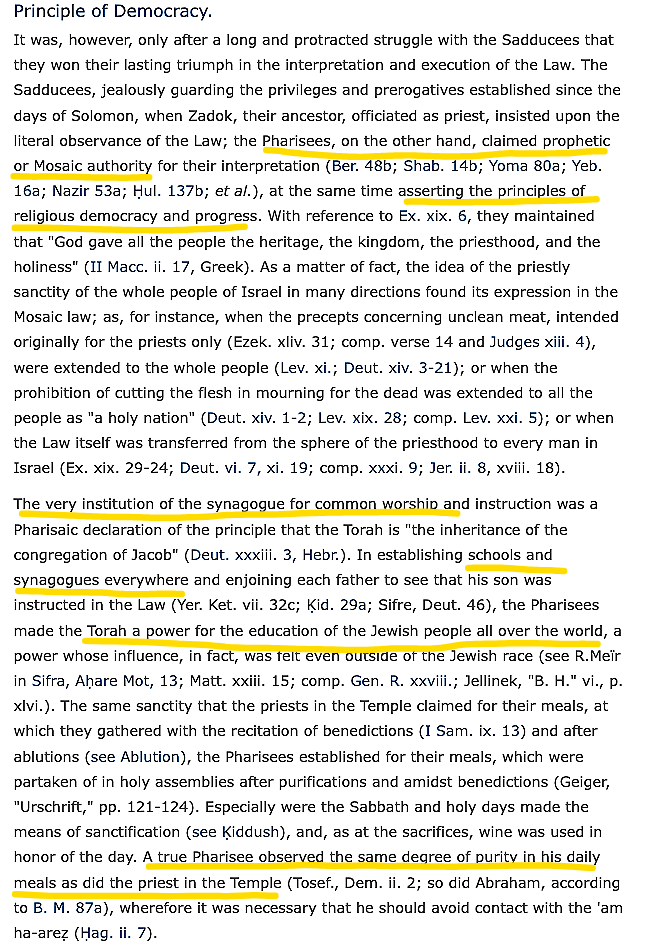
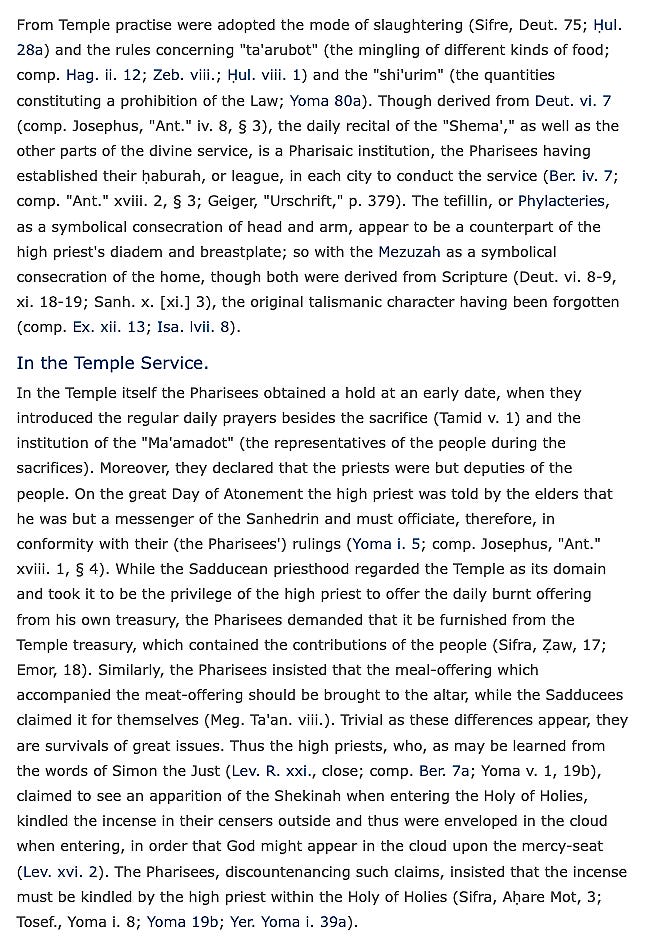
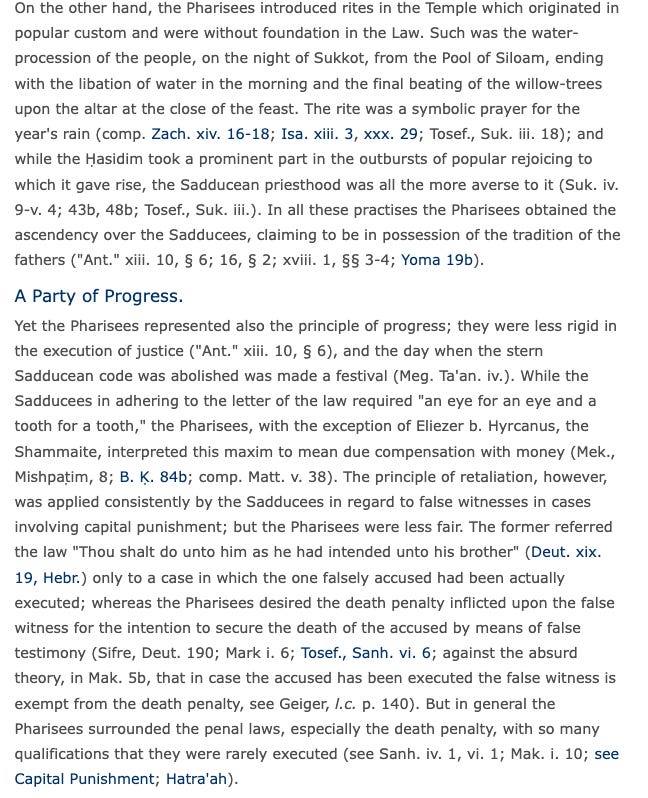
In his classic essay about Pharisees from the Jewish Encyclopedia, Kaufmann Kohler lays out why the Pharisees were considered to be purveyors of democracy to the world of ancient Judaism. You’ll find more details in the footnotes.2
They did that by breaking through the Temple priest’s ownership of ritual and authority and bringing basic practices down to the people. So now Passover and Sabbath celebrations could take place not just in the temple itself, but at dining tables in every home. That’s how the Passover Seder came to be, and just in time to introduce Jewish practice to a much more diverse and mobile population, one that would soon be on the move in earnest when the Temple was destroyed.
Now schools were established and synagogues proliferated all over the land and beyond. Jewish communities already were thriving in places as distant as Alexandria and Rome itself. The Pharisees helped to decentralize the faith so Torah would replace Temple as Judaism’s prime symbol.
Not only was Judaism suddenly for everyone, not just the Jerusalem aristocracy, but through the Pharisees, anyone could become a leader. The merit-based system of leadership elevated scholars and teachers to leadership roles rather than kings and priests. (Conservatives used to like merit-based leadership, right Pete?)
It wasn’t pure, Athenian democracy, but these rabbis were popular and accepted by the people, because they lived among them. When the Temple was destroyed in 70 C.E., the Pharisaic leaders were suddenly thrust into the forefront while the Sadducees and priests faded into insignificance.
And finally, Pharisees love questioning. The style of learning that they revolutionized and led later to the Talmud, relies on intense, collaborative inquiry and critical thought. An inquisitive mind is the enemy of Trumpism. I don’t mean to be insulting. It was Trump, not me, who said, “I love the poorly educated!”
And Hegseth seems hellbent on making the Pentagon into a mecca of anti-intellectualism. According to Eliot A Cohen in the Atlantic, “his military-education reforms seem designed to ensure fighting men can’t think and thinking men can’t fight.”
For whatever reason—perhaps Hegseth had a rough time in freshman calculus or was embarrassed while parsing a difficult passage of Plato—he seems determined to bar academics or anyone who faintly resembles one from contact with the armed forces. He has prohibited officers from attending the Aspen Security Forum, presided over by well-known radicals such as my former boss Condoleezza Rice. He has extended this ban to participation in think-tank events where officers might meet and even get into arguments with retired generals and admirals, not to mention former ambassadors, undersecretaries of defense, retired spies, and, worst of all, people with Ph.D.s who know foreign languages or operations research.
So maybe that’s why Pete Hegseth insults Pharisees so much. They stood for democratic values and prized critical thought. They, like Jews forever and journalists today, dare to stand up and speak truth to power. He and his boss can’t stand that.
And we must stand up to him now and his violent messianic, hateful rhetoric.
It’s time to disavow your Pharisee comments, Pete, and to put them to bed. Yes, Jesus insulted Jews, as was his right.3 Freedom of speech existed even before there was a First Amendment. "When a person refrains from speech, the ideas die, the soul stops, and the senses deteriorate," said Moses ibn Ezra (Shirat Yisrael 12c).
But that doesn’t mean everyone has to echo those insulting remarks.
Of course Hegseth will never disavow the Pharisee remarks because they are just the tip of his theological iceberg, as best articulated by his mentor, pastor Douglas Wilson, who not only wants to turn this into a Christian nation but is aiming for a fully Christian world, and an oppressive, patriarchal society that most Christians and Jews would not choose.
As chronicled by The Bulwark, Wilson and his followers “would deny not only women but also non-Christians the franchise and the right to pursue public office. They would limit the ability of believers of other faiths—including non-Protestant Christians—to publicly practice their faith; Wilson recently said on a podcast that the theocratic society he envisions would ban mosques from broadcasting calls to prayer and prohibit Catholic parades honoring the Virgin Mary.”
So Hegseth’s views on Pharisees presage a vision that has no place for Jews or women or Muslims or even Catholics.
See also: What Christian nationalism has in store for Jews and other religious minorities (JTA) - “These folks say that pluralism is heresy, and they argue that in a biblical society, people who weren’t Christians could still be there, but they would clearly be second-class citizens.”4
And this is the man who has been selected to lead us into battle?
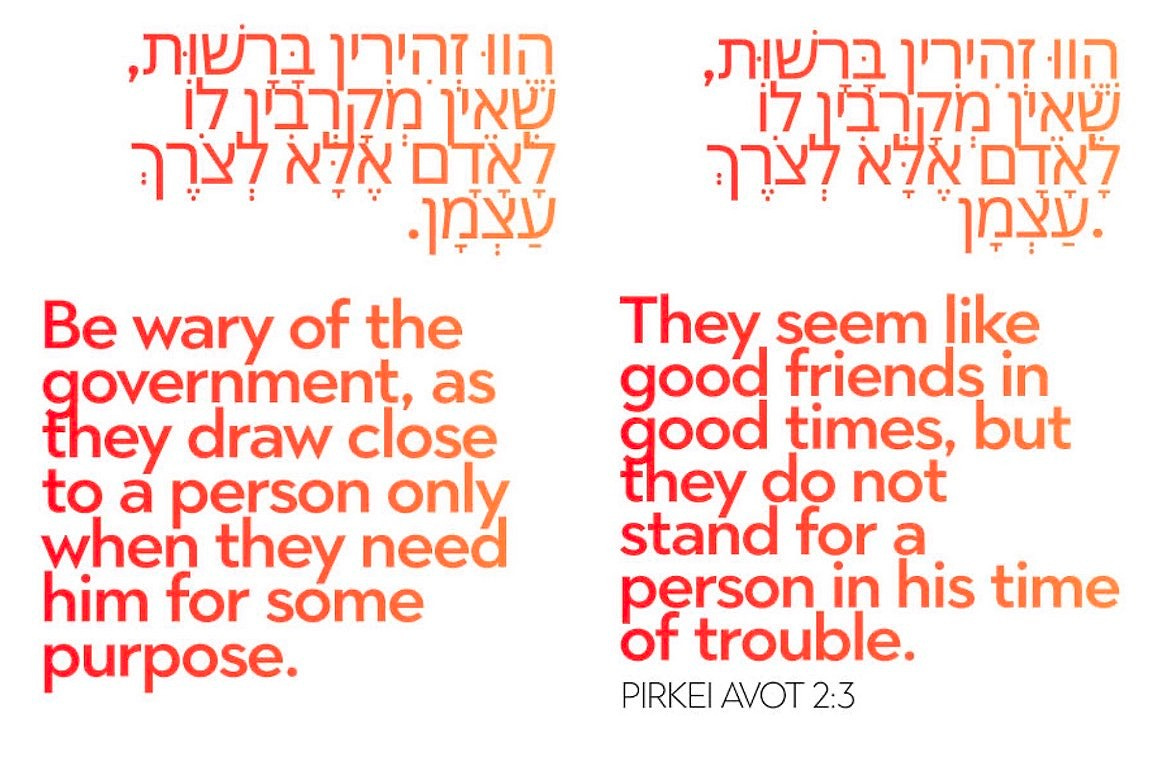
We could do with some wisdom from Pharisaic sources just about now. Here’s a good one, from the tractate Pirke Avot 2:3:
Jews as children of the devil? (The Protestant Theological University).
In 1943, Joshua Trachtenberg published the book The Devil and the Jews. The Medieval Conception of the Jew and its Relation to Modern Antisemitism. In his book, Trachtenberg argues that all negative medieval ideas about Jews go back to one basic idea: that Jews are children of the devil.
…In John, Jesus' criticism seems to be directed specifically at the Pharisees (8:13), or at Jews who do not believe in him (8:30-31). This involves an internal Jewish debate in which harsh language is used. The context also regularly refers to "the Jews" without further nuance (8:22,48). According to 8:39-42, Jews are said not to be children of Abraham or even children of God. Such a reading goes beyond discrediting Jews because of their unbelief in Jesus: it argues that (these) Jews, from the beginning, even before the New Testament, were not the real children of God; and not even the actual children of Abraham. This makes the promises of the Tanakh conditional on belief in Jesus. We find a similar rhetoric in Revelation 2:9 and 3:9. There, the gathering of Jews who do not believe in Jesus is called "synagogue of Satan," and they themselves "not Jews,” i.e., Jews who call themselves Jews but are not true children of Abraham and not true children of God.
Entry on Pharisees from the Encyclopedia Judaica (pdf below).

Entry from the Jewish Encyclopedia article on Pharisees):
For an energetic subset of supporters, the promise of Donald Trump’s MAGA movement centers on increasing the influence of Christianity in American life and returning the country to what they see as its founding Christian ideals.
Scholars say that through their devotion to Trump, these Christian nationalists have claimed a prominent, mainstream place in Republican politics — a phenomenon that has alarmed Jews and other religious minorities.
And regardless of the result of the presidential election, they aren’t going away, said Julie Ingersoll, a professor of religious studies at the University of North Florida.
“One of the reasons they’ve been successful is they focus on the long-term. To give just a couple of examples: It took them 49 years to overturn Roe v. Wade and they’ve been working on dismantling public education for the same length of time. We can see the impact of that effort all over the country,” she said.
Christian nationalists left their fingerprints all over Project 2025, the controversial proposed 900-page blueprint for a second Trump administration published by the Heritage Foundation and other conservative groups. They also run for office at every level of government, turn out in large numbers for campaign events, and are proving to be a powerful voting bloc in many places. A little more than half of Republicans are “adherents or sympathizers” of Christian nationalism, according to a survey of 22,000 Americans in all 50 states that was carried out last year by the Public Religion Research Institute.
Opposition to the separation of church and state, abortion and LGBTQ rights are among the principles that unify the Christian nationalist movement, but it has no central leadership or theology.
As the movement grows more confident about the prospect of a Christianized America, leaders representing different streams have made some specific proposals. Some want to shutter the Department of Education, seeing it as an obstacle to religious schooling, while others target the Centers for Disease Control and Prevention because they see vaccines as a danger. To crack down on abortion, some suggest using the death penalty as a deterrent. At least one pastor suggested repealing the 19th Amendment, which gave women the right to vote.
In contrast to these concrete plans, Christian nationalists have spoken more vaguely about what would happen to Jews and other religious minorities if they were given the chance to enact their vision for the United States, according to interviews with scholars who track the movement.
“I’m scratching my head to identify any specific policies or even comments that have been proposed from these groups that speak to the status of Jews in a realigned Christian nationalist America,” Matthew Taylor, a scholar at the Institute for Islamic, Christian, & Jewish Studies, said in an interview.
Taylor said the lack of specificity is not an oversight.
“They know that it won’t be popular to describe such an end state as being exclusive and dominated by Christians, so they tend to pitch it in more vague terms about Christianity triumphing or Jesus being glorified and lord over the United States, leaving the rest implied at best,” he said.
The most specific articulation found by Chelsea Ebin, a Drew University professor who studies the Christian right, is one she recently extracted from an influential pastor in an interview. She documented the exchange in a draft of a forthcoming academic paper, which she shared with the Jewish Telegraphic Agency.
Ebin asked Ken Peters, the pastor of Patriot Church ministry, for his position on repealing the 14th Amendment, which was enacted to guarantee citizenship and equal protection under the law to formerly enslaved Americans following the Civil War, and was at the heart of the federal abortion protections guaranteed by Roe v. Wade, the 1973 Supreme Court decision overturned in 2022. Peters said that ending slavery was the right thing to do but that the amendment had otherwise moved the country away from God. He opposes birthright citizenship and protections for immigrants and LGBTQ people.
Ebin asked him how felt about ending protection from religious discrimination under the 14th Amendment. “I’m cool with that,” Peters said.
For less forthcoming Christian nationalists, parsing their public statements requires an understanding of how they differ in their theological frameworks. The spectrum of possibilities can result in a wide variety of attitudes toward Jews: Some are traditional antisemites, but many proclaim a love for Jews while actively trying to convert them as part of an eschatological prophecy that also undergirds their support for Israel.
Calvinist theology and the Baptist church are the origin point for a strand of Christian nationalism known as reconstructionism. This movement sounds obscure — and it is, said Ingersoll, a scholar of reconstructionism. But the admittedly small number of reconstructionists has been extraordinarily impactful, she said.
“They’ve had a lot of influence shaping our broad evangelicalism because of the fact that they got Christian schools — and then Christian home schools — going, and they shaped what those schools look like,” Ingersoll told JTA.
Reconstructionists envision a society based on biblical law and would support whatever form of government is able to enact it. “If a monarch does that, fine. If a democracy or republic does it, that’s fine, too. Or a dictator — they don’t care about the structure,” Ingersoll said.
Regardless of the structure, Jews and other religious minorities must be marginalized in this vision of America.
“These folks say that pluralism is heresy, and they argue that in a biblical society, people who weren’t Christians could still be there, but they would clearly be second-class citizens,” Ingersoll said.
One of the most prominent pastors in this camp is Joel Webbon, the head of Right Response Ministries and the senior pastor of Covenant Bible Church in Austin, Texas. He promotes hatred as virtuous when aimed at the enemies of God, including other religions.
“I hate Judaism, but I love Jews and wish them a very pleasant conversion to Christianity,” he said in a social media post on X on Saturday.
Webbon’s directness and his explicit attack on Judaism are characteristic of his type of reconstructionist Christian nationalism. There’s another major strand of the movement where such talk is not typical. Scholars refer to it as “charismatic,” meaning that adherents believe in the power of spiritual gifts such as divine healing, miracles, and speaking in tongues.
With their focus on the End Times, these nondenominational Christians are usually not very specific about what the country would be like if they held sway. They tend to talk about politics through biblical analogies, such as the prophecy that Trump will defeat Kamala Harris like the warrior king Jehu vanquished wicked Jezebel in the book of II Kings, and then proceeded to reverse the moral decay in the Kingdom of Israel.
Charismatics are Taylor’s primary subject of scholarship and he says that it’s clear enough they too would prioritize Christianity in the public square and in policy-making, especially around questions of abortion and gender and sexuality. As for their treatment of minorities, he said, it’s a little complicated.
“I would separate out the question of what happens to Jews from what would happen to other religious minorities,” Taylor said. “The way that these folks talk about Muslims is different from the way they talk about Jews. The way they talk about Hindus is different from the way they talk about Jews.”
They are sentimental about Christianity’s origins in Judaism; the fact that Jesus and his apostles were Jews is front of mind for them. There’s even a fondness for Jewish ritual, which is why rallies organized by charismatic groups such as the New Apostolic Reformation tend to feature the blowing of shofars and Christian men wrapped in Jewish prayer shawls. In and near this camp are many people who identify as Messianic Jews, meaning they believe that practicing Judaism and worshiping Jesus are compatible, a belief rejected by all major Jewish denominations.
Jews by the ordinary definition of the term, however, would likely be relegated to a protected second-class citizenship akin to the dhimmi status of Jews under Islamic law, Taylor said.
“There’s a sense of recognition that they are, that Jews are, contiguous with Christian belonging in some way, but that definitely would not give them an equal voice in terms of policy-making or setting the political agenda or having civil rights,” he said.
Muslims, meanwhile, would be treated far worse.
“The charismatic world views Islam as a demonic religion,” he said, referring to the fringe belief that the Muslim faith was inspired by evil demons. “And so I think they would seek to curb, if not eradicate, some Islamic prayer and practices, at least in the public square, if not also destroying it in private.”
There’s a third major category: Christian nationalists who are Catholic. Their handiwork can be found in the work of Project 2025, according to Ingersoll.
“The basic tenor of it and the underlying assumptions, especially the pro-family politics, are drawn from Catholic natural law theology,” she said. Project 2025 is considered perhaps the most mainstream articulation of Christian nationalism. It’s controversial enough that Trump distanced himself even while dozens of his former staffers were involved in drafting its proposals.
There’s less attention paid to Jews and Israel by the Catholics than by the other two groups, which are Protestant, because their theological framework is different and they have different beliefs about the end of the world.
Historically, divisions among the different strands of Christian nationalism have been bitter, but they have made common cause in their support for Trump. Taylor predicted the fissures would reemerge if Trump takes office and the different visions compete for influence.
“They are drawn to Trump for different reasons, but they are all unified in supporting him, which has given at least a veneer of unity to the movement,” Taylor said.
But even if Christian nationalists don’t ultimately agree on exactly what a Christian America would look like, they are working to pull the country in the same direction — one that scholars agree isn’t very hospitable for Jews.
In one vision for the country that has allowed Jews to thrive, what it means to be fully American is ever-expanding. But pluralism isn’t this country’s only political tradition.
“There’s a growing movement that thinks what being American means should be held tightly,” Ingersoll said. “Held tightly by Christians.”

No comments:
Post a Comment