In a recent Substack posting, the former Labor Secretary Robert Reich wrote of disturbing events that he’s witnessed, on the highway, in line at a bakery and at a neighborhood Safeway, and he asked, “Is our civic life becoming more brutish, or am I becoming angrier about it?”
He wrote:
I’ve been seeing more people dump their trash on the street and telling them to stop. I’m watching parents scream at their kids with a ferocity I’ve rarely witnessed before, and occasionally I suggest they treat their kids better. My neighbor has started using a loud power tool in the evening, and I’ve asked him to keep it down.
I’m aware of more shoving and pushing — in a department store, at a local restaurant, at an airport — which pisses me off. I hear more people using racial, ethnic, and sexist insults, which I just won’t tolerate. Yesterday’s errands included a stop at the neighborhood Safeway, where someone called the cashier a “bitch.” I told him he shouldn’t say that.
Are such small acts of bullying on the rise, or am I becoming less tolerant of them?
The answer to his question about the deterioration of civic life is yes - and emphatically no.
You see, Martin Luther King Jr. proclaimed famously that “the arc of the moral universe is long, but it bends toward justice.” But in Jewish tradition, justice is only half the battle. For Judaism, the arc of the moral universe must bend, at least as much, toward love. And despite all the hate and anger we witness, despite the ginned-up algorithms online and Trump’s hateful tweets, despite the antisemitic violence in London and our Jim Crow Supreme Court, despite it all, as we enter May of 2026, I believe that the arc is bending – slowly but surely – toward love.


Yes, I’ve seen what Reich has seen: people cutting in line, yelling at cashiers and raising holy hell on social media, and cars routinely going 90+ on the turnpike.
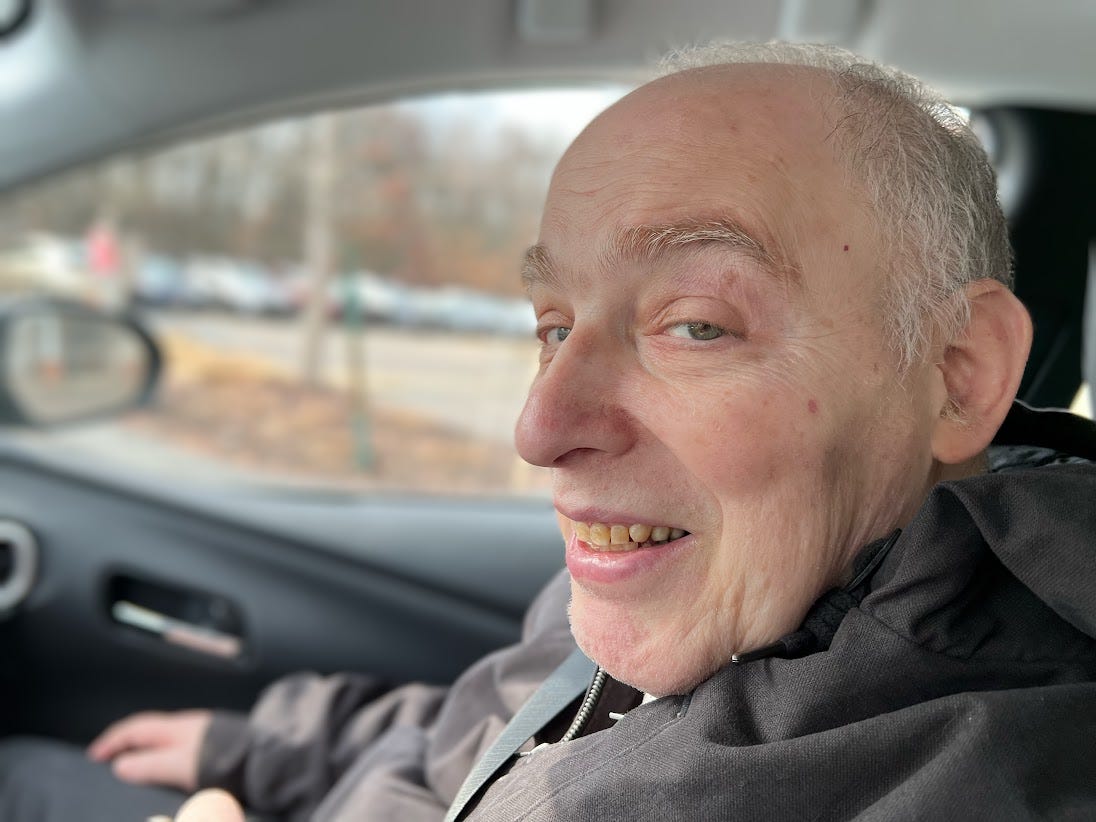
But I’ve also seen the other side, and I see it all the time, thanks to my intellectually disabled brother, Mark. You see, Mark, who like me is in his late 60s, has to deal with obesity and very limited mobility, to go along with his other challenges. He still is able to get around without need of a walker - barely.
For more on Mark, see my prior article, “My Brother’s Keeper” And listen to the chapter “My Brother’s Keeper: On Disability and Destiny,” in my audiobook, Mensch-Marks.
A few times a month, I make the trip from my home in southern Connecticut up to Boston to take Mark out for lunch, usually at a Panera a few blocks away from his day program. I try to park as close to the restaurant’s entrance as possible, but at lunchtime that usually means a short walk through the lot, on uneven, sloping pavement, with traffic. It’s daunting for him, but also needed exercise, and the grilled cheese awaiting him on the other end is the best incentive imaginable.
While I make that agonizingly slow walk with Mark from the car to Panera’s entrance, with him holding both my hands and me usually walking backward, people line up to open the Panera door for us. I’ve been taking Mark to that place for years, and never once - not a single time - have had I had to open the door myself.
And not once - not a single time - has a person in vague proximity to the door when we arrive not stopped, or backtracked or shifted several steps sideways to open it. I’m not talking about two thirds or three quarters. The number is 100 percent.
You see, Martin Luther King Jr. proclaimed famously that “the arc of the moral universe is long, but it bends toward justice.” But in Jewish tradition, justice is only half the battle. For Judaism, the arc of the moral universe must bend, at least as much, toward love.
Over the course of time, literally hundreds of people have had the opportunity to help us during these excursions, whether at the door, behind the counter, the men’s room, anywhere in the restaurant, and literally no one has turned down the chance. And when I thank them, and I always do, they always downplay it.
And no wonder - here’s the secret: They are the ones who are grateful, to my brother, for reminding them of their humanity and for giving the chance to perform a random act of kindness.
Mark is the conduit to hundreds of such acts. He is the enabler of all that is good about people, all the things that can never be replicated by A.I. Now I’ll admit that Mark can be pretty selfish and annoying at times, but he also recognizes his vulnerability and is willing to let others help him, even total strangers - especially if at the end of the rainbow is a grilled cheese and a Diet Coke.
For Mark, Diet Coke is absolutely his favorite (Panera has only Pepsi, which is OK too) and that love is the only thing he shares with the eugenics-obsessed occupant of the White House, who would dismiss my brother with disgust and an “R” word and probably claim, as he has in other contexts, that people like Mark should “just die.”
He and his sidekick RFK - who has dismissed many on the autism spectrum as useless “kids who will never pay taxes, they’ll never hold a job, they’ll never play baseball, they’ll never write a poem, they’ll never go out on a date. Many of them will never use a toilet unassisted” - would not recognize the positive impact Mark has made on so many lives.
Mark wasn’t toilet trained until late adolescence. Until then my parents, sister and I took turns wiping him; not a pleasant task, but one that older siblings of toddlers face every day, I figured. A minor inconvenience. For my parents, Mark’s condition was a tragedy; for me, a given. As a teenager, while most of my friends spent their Friday nights hanging out in someone’s basement or at the movies, I often gave Mark a bath.
I used to justify Mark’s existence by noting that he had provided me with cheap sensitivity training. And while it’s no doubt true that I am a better person for having cared for him while we were both children, I now have a keener understanding of the impact Mark and others with similar challenges have on other people. Mark’s life’s purpose, so much as I can determine, is to bring out the best in other human beings. Trump’s is to bring out the worst, by constantly displaying the worst in himself. Those who lack the capacity for empathy can’t possibly understand how much it replenishes the soul to be able to hold a door for someone in need.
And yet, since 100 percent of people in my unofficial Panera experiment acted kindly, that’s got to include at least a few sociopaths, one would think. Law of averages. Yet even they helped Mark. My brother is a kindness magnet. You don’t need to be a genius to be a kindness magnet. In fact, you don’t even need to be human - my cancer-surviving (thus far) miracle dog Casey is one too.
While so many have had their lives enriched by their passing encounters with my brother, I’ve had the privilege of seeing the glow in their eyes and the smile on their faces. This spiritual connection, between Mark, a total stranger, and me, lasts just a moment or two and then it’s gone forever. Until the next one. Now, as I we begin our slow walk in the parking lot, I scan the scene, wondering whose life Mark is going to change today. Will it be someone dealing with a harsh breakup? Some bad news from the doctor? Or just someone perpetually lonely?
And then this week, something happened.
When Mark and I were coming back to my car at Panera’s, as he was trying to duck his head through the door and slide in to sit down, he came up short and landed awkwardly on the edge of the seat for a few moments. He lingered there but was unable to move his feet to steady himself, and so he and eventually went to the ground.
I was unable to lift him up - he weighs at least 250 pounds. For several moments we were both overwhelmed with confusion, but I sensed that help was on the way. Before I could even turn to look for help, a woman came along and then another, and then a man, and then another woman. Four good Samaritans who happened to be walking by all came over to help. One took on the role of directing the operation, asking Mark questions - his name, whether he was hurt, could he move his leg - while calming him down. His leg which had been bent awkwardly, was straightened and stabilized. Then, each of the volunteers took a side, and they carefully lifted him into the car on the count of three, as if they were transferring an accident victim onto an emergency room gurney on The Pitt.
And then, just as fast as they had lifted him, they disbursed. I was too discombobulated to get their names or ask if I could make a donation or do something to thank them. I was shaking, fighting back tears, and standing in complete amazement and awe at the potential for good that resides in all people, 100 percent of them, and the ability of my brother to bring it out.
I pulled myself together just long enough to ask one question of the self-appointed group leader, that first woman who came up to me, as she was turning to leave.
“Did you all know each other?”
“No,” she replied, and disappeared.
Mark was OK, and so I turned to buckle him in - but someone already had. I got in and we drove off.
Mark’s life’s purpose, so much as I can determine, is to bring out the best in other human beings.
Jews recite Psalm 145 several times each day, and verse 14 is alluded to constantly in the liturgy:
GOD supports all who stumble (literally: “lifts the fallen”),
and makes all who are bent stand straight.
Lifting the fallen and straightening those bent over are seen as Godlike acts, expressions employed to describe God in blessings recited each morning and in the liturgy’s central prayer, the Amida, recited three times each day. God is that which lifts the fallen – Somech noflim – and heals the sick – rofeh cholim – and releases the bound - matir asurim.1
I’ve called it the “God Particle,” a takeoff on the Higgs boson particle in physics. Just as Higgs boson’s version of the God Particle does for the physical universe, my version of the God Particle propels human beings and history forward and it is activated through acts of kindness and love. As Judaic scholar Eitan Fishbane describes it, “God is the space within the inextricable threads of life. God is the mystery that pulsates at the core of our living and our dying.”
Just as my brother was lifted from the ground by a group of total strangers, who had never met and came together for just this one moment of doing God’s work, so does Mark lift spirits - and open doors - for all who literally open doors for him. He makes us all better people and thereby fills the world with good people. He is activating the God Particle on earth. So are programs like The Pitt2, I should add, and Ted Lasso3, which is returning - and none too soon. Lasso made kindness great again4. He made it chic.
Which would make Mark not just a kindness magnet, but a “Chic Magnet.”
Mark single-handedly has done what lawyers and economists around the world have failed to do: he’s proven Robert Reich wrong. And, if RFK is listening, his toilet etiquette is excellent.
I can only dream of having such an impact on the world, and so divine a purpose in my life.
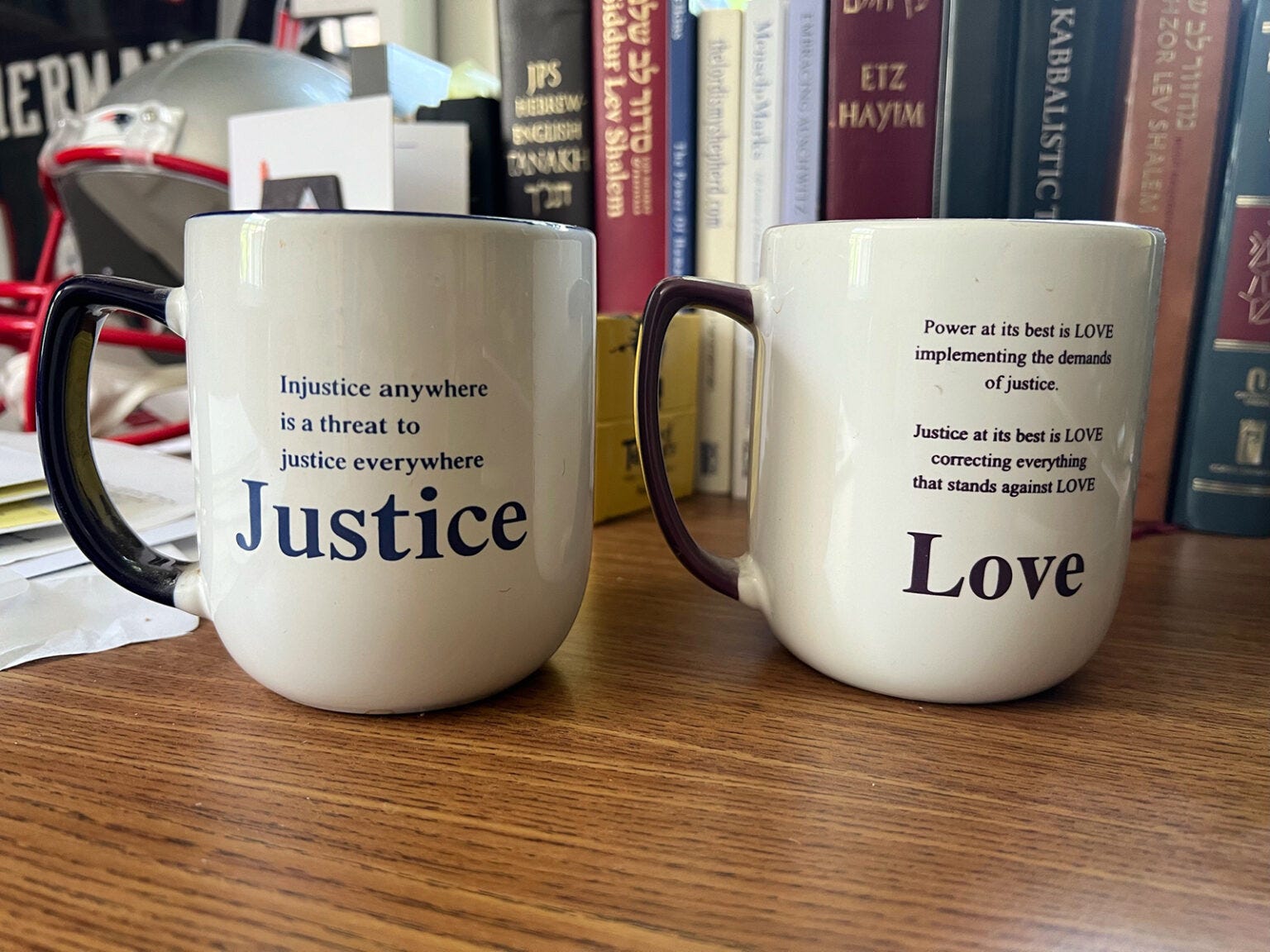
Justice and Love mugs, from the MLK Center in Atlanta. (Rabbi Joshua Hammerman)5
Notes:
Imitating God’s acts of kindness is frequently seen in Jewish sources as a means of actualizing the Sacred in our lives. Here are common examples:


From my essay about The Pitt and White Lotus, “Maybe Jesus will Save Her From those Buddhists”
“In a moment of extremis, the main character, Dr. Michael Robinavitch, played by Noah Wyle, muttered a central Jewish prayer, the Sh’ma.
Hear O Israel, the Lord our God, The Lord is One4
When the most extreme moment of the entire series demanded an ancient and powerful response, Dr. Robby (who could pass for a rabbi in name and appearance, probably not an accident) knew the Sh’ma by heart.
But when he realized his “lapse” was being watched, he told another character, apologetically - with an acute embarrassment that he carried with him through the end of the final episode - that he was reciting it only because he had spent lots of time in his childhood with a religious grandparent.
What he may not have realized is that his gut reaction it was the right response. The Sh’ma plays many roles in Jewish tradition, but one of them is that it serves as a “last rites,” a deathbed confession and declaration of faith, recited either by those dying or on behalf of those recently deceased. This prayer has been on the lips of martyrs for two thousand years, following the example of Rabbi Akiva.5 Robby was, in effect, reciting last rights for the shooting victims alongside him in that makeshift morgue. It was a cleansing, healing moment - but treated by other characters, and Robby himself, as a mental breakdown.
I can’t emphasize enough how incredible that moment was. The most cathartic scene of the most powerful medical series ever, centered around a prayer and a ritual that I’ve performed with the dead and dying hundreds of times. And yet, in The Pitt, where first responders routinely display raw emotion and are provided unlimited transfusion bags filled with grace - somehow this moment of totally appropriate religiosity was treated as a panic attack, “a complete meltdown” in Dr. Langdon’s accusatory words.”
Writing in Slate about the hit TV series, Ted Lasso, a rare show about a genuinely nice guy, Anna Nordberg states, “Too often, compassion is associated with weakness, when in fact it’s the opposite. It takes nothing to put someone down in order to salve whatever emptiness is inside you. It takes nothing to go for the kill instead of trying to help others. But it does take courage—true, radical courage—to make the choice to be a good person every day.” In that show, the title character is betrayed by people he trusts – it turns out he was set up to fail. But he turns to the perpetrator of the ruse and says simply, “I forgive you.”
Lasso fights back with kindness
Note that justice is on the left, love on the right. From AISH:
In Jewish mystical thought, the right side represents kindness, while the left represents strength, or a level of strictness or severity.
When choosing between right and left, and obviously, when the outcome is the equal as opposed to, say, giving someone directions, the Jewish way is always to favor kindness.
Practically speaking, that helps explain why so many things in daily Jewish life lean to the right. For example:
- A Mezuzah is always placed on the right side of the doorway.
- A Shofar: the ram’s horn that’s blown on the high holidays, is blown from the right side of the mouth.
- A Kiddush Cup: the cup of wine you make a blessing over the Sabbath and holidays, is always held in your right hand.
Even when doing something mundane, like putting on your shoes or washing your hands, it’s best to start with the right.
When you favor the right, on a deep, spiritual level, even if you’re not always thinking about it, you’re getting yourself used to favoring kindness.
Thanks for this positive and personal article. I understand being a father of an autistic child. He is mildly autistic, a one in three level classification, but has had and still has differences and challenges. The most important and difficult was becoming toilet-trained. We had to change his adult diapers until he was finally able to use the bathroom at nine years old. He did not attend school until he was seven, not because he didn't want to, but because schools did not want to change his diaper. At seven, we thought we had finally got him to a public school that would accept him, and on the third day, they tried to force him to sit on the toilet. He was terrorized and refused to return to school, even though he wanted to go to school. The school system refused to transfer him to another school for the rest of the school year. Our family's lawyer was contacted for help, and he mentioned that his grandson was autistic and attended a private school that totally accepted him. The next school year, he started attending this school and still does. One year after attending, he started using the toilet. He is now 15 and brilliant in math and loves languages. He became friends with our lawyer's grandson and many other kids. His classmates all accept that he is a bit different but still love him. He is also very kind, and when his class went on a field trip to a museum, without being asked, he helped a classmate who is also autistic and does not do well in new surroundings, holding his hand throughout the tour of the museum. He taught his classmates and his teachers what it means to be kind to others!

Thanks so much!