Thursday, February 19, 2015

Shabbat-O-Gram for Feb. 20


Shabbat Shalom!

Tonight our 7th grade class (see four of them above) will be helping to lead our main service.  They'll show us how popular TV programs and movies teach us Jewish values.  With the Oscars coming up this Sunday, I'll assess which Best Picture nominee best exemplifies positive Jewish values (I've seen all but one).  Meanwhile, send me your nominations.  Also, read the Jewish Journal's special "Jews and Oscars" section here, look here to read about the Jew behind the Grand Budapest Hotel, also click here to read about Holocaust themed  foreign film nominee "Ida."  


On Tuesday at 7:30, as part of my "Hot Topics for Cold Months" series, I'll be joined by the JCC's Israeli Emissary Or Berger to discuss the upcoming Israeli elections and, more generally, the state of democracy in Israel.  Here's some homework: read the most recent Israel Democracy Index and follow closely what's going on with the Israeli elections.  It has been wild.  Undoubtedly, we'll come around to what's become a very hot topic on both sides of the ocean, Prime Minister Netanyahu's upcoming speech before Congress.

And finally, please spread the word about next Saturday evening's inaugural event of our LGBT group, a gathering at Harbor Point.

The group's goal is to create a welcoming environment in which the Jewish LGBT community can socialize, celebrate Jewish life, learn together and share experiences. Membership in Temple Beth El is not required, and people of all ages are welcome to the group.  Inclusivity has always been a hallmark of Temple Beth El and we want to remove the sense of alienation that Jews in the LGBT community have experienced in many synagogues when seeking acceptance and a spiritual home.

Meanwhile, as we welcome our most joyous month of Adar today, our joy is tempered by the events of this past week in Copenhagen...


The Copenhagen shooting: Driving a Hole through the Holy


One of our TBE young adults, Lauren Pollack, is spending the semester in Copenhagen and is living very close to the synagogue that was attacked.  She was kind enough to send along reflections for me to share with you.  Look for them below. 

When I visited that very synagogue last summer, I noticed the sign above the entrance (see photo above), which states, "Blessed be the one who comes in God's name."  I could not help but reflect this week on the irony of that invitation, in light of the desecration committed by perpetrators of terror who claimed to speak in God's name, and who violated that sacred space without invitation.

We get hung up on the semantics as to whether those who pervert God's name should be seen as representing their faith.  Like just about everything else in our polarized political landscape, this debate has been used to demonize and paint entire faith groups with very broad brushes.

Judaism teaches that we are all representatives of our faith group - which is why we even have a name for those who give us a bad name by perverting the divine name, or more accurately, we have a name for those despicable deeds themselves: we call such actions a "Hillul Ha-shem," a "Desecration of the Name."  It comes from a verse in Leviticus, "And you shall not profane My holy name; but I will be hallowed among the children of Israel: I am the Lord who hallows you."  Examples of such "hilluls" in Jewish sources include stealing, desecrating the Shabbat and gossip.

The Hebrew root for "hillul" implies more than a moral desecration of that sacred Name; the imagery is quite concrete and physical.  It connotes a piercing or hollowing out.   Taking this imagery to its logical conclusion, these destructive actions create a cavity, an abscess that infects everything else around it.  The "Hillul Hashem," rather than being a sacred act, is in fact a hollow caricature of the sacred.  The perpetrator dresses the part of piety, but it turns out to be a grotesque disguise.  In other words, it's a cartoon, this caricature, one that renders profane the sacred surroundings and drives a spike of nihilism into the heart of divinity.  They drive a hole in the midst of the holy. 

 
These purveyors of death, not the journalists and satirists, create the most objectionable cartoons of God.  The unfathomable, unknowable God is rendered two-dimensional by their outrageous breach, and through their nihilism, God's name becomes the greatest victim.

So those who perpetrate terror in the name of God are actually desecrating that name and defaming their faith.  But they remain, to the outside world, representatives of that faith simply by the fact of their identifying with it.  Bernie Madoff identified as a Jew.  His views were as far from mainstream Jewish values as you can get - his life was Exhibit A in the museum of "Hillul Ha-shem."  Exhibit B might well be Rabbi Barry Freundel, who on Thursday pleaded guilty to 52 counts of voyeurism from secretly videotaping nude victims at his congregation's ritual bath.  

It is up to Jews everywhere to demonstrate that we, not Freundel, Madoff or Baruc Goldstein, are the representatives of the true Judaism; we need to overwhelm their i evil with our good.  Muslims have no less a burden right now. I work closely with several Muslims on our local Interfaith Council and have great deal of sympathy for their ongoing plight.  I do not regard the terrorists as the true face of Islam, but much of the world does.  Who really is the face of Islam is now an open question, just as it is an open question whether Meir Kahane's disciples are the true face of Judaism.

But this I believe: Those who do God's work here on earth, those who care for others and treasure each precious human life, whether they be Jewish, Christian, Muslim, or anything else, they are the true face of God.  They are the ones who are filling the breach in the divine Name.  

And they are the ones being welcomed by the sign over the door at the Copenhagen synagogue: "Blessed be the one who enters in God's name."  


The Copenhagen Shooting-A Reflection  
By Lauren Pollack

 I had just gotten home from a short study tour in western Denmark when I heard the news of the first shooting. It's sad to say but as soon I heard that the shooter had fled the scene and the police had begun a manhunt in and around my neighborhood my thoughts instantly jumped to the Copenhagen Synagogue, situated in the heart of Copenhagen, which also happens to be less than a 2-minute walk from my apartment.

 
I fell asleep before the shooting at the synagogue happened, but at around 2 AM one of the SRA's in my building (Social Residence Advisor-similar to an RA in a college dorm except they're more like mentor and friend) came running downstairs to check if we were all home and safe. I saw how nervous and shaken he was, my housemates started chattering about a shooting that had just happened at the Synagogue. I grabbed my phone and I checked the news.  I saw what I had so unfortunately expected; someone who had been guarding the Synagogue during a Bat Mitzvah had been shot and killed.

The day after the attack I kept finding myself leaving my apartment to walk over to the Synagogue; I went three times in one day. With each hour the piles of flowers, candles, and notes grew larger and larger. The sidewalk is still covered in flowers and candles, and more fresh bouquets are laid down each day. Each time I visit I weave in and out of the people in the crowd and the police who have been stationed there to protect the visitors and the city as a whole.

The outpouring of love and support from the community here in central Copenhagen has been truly profound. Jews and non-Jews alike have been paying their respects at the site of the second attack, but it has also been very eerie and confusing time for many, including myself. A friend of mine has been attending Shabbat services at the Chabad house here in Copenhagen and this upcoming weekend she invited me for Shabbat. But the questions I keep asking myself are, "Do we go now?" "Is it even more important that we go this Shabbat, or would we be making a mistake or taking too big of a risk?"  I keep finding myself considering sacrificing my freedoms of expression, religion, and speech so that I can ensure my safety and avoid calling attention to myself as an American, and as a Jew. Where is that line between being cautious and sacrificing my beliefs in the wake of such a devastating attack?  
           
I think that I have also experienced the attacks differently because I am Jewish. I have noticed that even though just a few days have past since the attacks, everyone is still somewhat in shock, scared, and upset. I think those same feelings will linger with me a bit longer than many of the students here. Many of my American friends did not contextualize this event and consider it as something that fits into a larger more systemic issue currently facing Jews in Europe and around the world. It's unsettling to me that one of my most immediate thoughts after the first shooting was that Synagogues need protection, that Jews in Denmark, myself included, were very vulnerable.

My reaction to the attacks remains in stark contrast to the reactions of most Danes. Denmark's society is a very trusting one. For instance, during the winter months, the sun is very rarely seen-the skies are consistently gray. So when the sun is shining bright, daycares here will bundle up the babies in their care and place them in their carriages out in the sun, usually on the sidewalk-for the most part unattended. That's just how this society works, and before the attacks I thought it was so beautiful and interesting-if someone left a bike unlocked in front of a store in Washington D.C. within hours it would be gone for good. Reflecting upon this aspect of society following the attacks, it's hard for me to say whether or not I'm confortable submitting to this Danish way of life. Trust is such a fundamental aspect of society here and is engrained in much of their routine, it would be hard for me to adjust back to my new "Danish life" if you will-if I abandoned all trust because of one tragic event; I do have a lot of faith and trust in this country and the people that I have met here so far.
           
I trust that the Danish police, whose presence was very scarce in Copenhagen before the attacks (part of the trusting nature of the Danes), are working hard to protect this city and me. I trust that my abroad program is working hard to make this situation as manageable as possible and provide resources should any student feel overwhelmed and distracted. I trust that the uneasiness I feel walking around will slowly dissipate, as I know I cannot feel this way forever.
           
Life moves on. That isn't to say that there is nothing the world can learn from what happened; we have seen attacks like this one before, in Paris at Charlie Hebdo and the Kosher supermarket for instance, where many more people lost their lives because they were targeted for exercising their right to free speech and for being Jewish (and in the wrong place at the wrong time). I think personally however, it's important for me to focus on not letting this event dictate how I feel about Denmark, how I feel about being a Jew (especially during such tumultuous times for Jews in Europe and around the world), or influence my time in Copenhagen and my travels.
           
The Danes have welcomed me so warmly during my first month here and I'm looking forward to the next 3 months I have in Scandinavia and Europe (and for the sun to be a more frequent visitor). Copenhagen is such a beautiful city. Hatred does not belong here; it doesn't belong anywhere.

Below are some photos that I took the day (afternoon and night) of the shooting of the flowers, candles, and letters that have been placed on the sidewalk in front of the Synagogue: 


Wednesday, February 11, 2015

TBE Bar/Bat Mitzvah Commentary: Emily Marrinan on Mishpatim

People who know me know that I love to read.  One of my favorite series is the “Divergent” series, the first of which has come out as movie.  It turns out that “Divergent” really ties into my portion of Mishpatim.  In fact, it also has a “bat mitzvah” ceremony.

It’s really called the “Choosing Ceremony” and is very similar to today, minus a few details.  Don’t worry, no blood will be drawn! But when you get beyond those details what’s happening?  Teenagers are deciding their future, and starting to make choices for themselves.  It’s the first time they are really responsible for those choices.  Also, the Choosing Ceremony, like the Bat Mitzvah is the moment when they start to become independent of their family.

Today, I am making my choices, although thankfully I won’t be becoming fully independent and I have a lot more freedom to decide than most people did in the book.

Another similarity is how Mishpatim and the dystopian of Chicago in Divergent are both based on a strict set of rules that people have to follow – and both societies expect full obedience to those rules.

The Torah expects 24/7 obedience.  When the Israelites are at Sinai, they say “Na’aseh  v’nishma”  which means that they will “do and listen” – in other words, that they will obey even before they have totally understood the reasons behind the laws.   It so happens that this is said in chapter 24, verse 7.  So they really were pledging to be loyal 24/7.  But the Torah also has a built-in flexibility where laws can be changed if they no longer make sense.

Here’s a great example.  The Torah says, “Eye for an eye.”  But the rabbis of the Talmud later made it clear that the law is not talking about literally taking out someone’s eye, but paying them money and compensation for their injury.

Another example found in my portion is slavery.  We don’t have it any more. But these laws still are important, because the Torah is teaching us how to treat employees and also to love the person who is different from us.

In the world of swimming, another one of my favorite activities, I’ve learned that rules or standards are important – and there are a LOT of them.  They’ve changed a lot too, just like the laws of the Torah.

For example, in the breast stroke, there are rules regarding the pullout, the kick, the actual stroke, breathing patterns and more.  These standards were changed very recently, just four or five months ago.  I’ve had to learn a new pullout and really practice it to get it right. 

In swimming, when you don’t get a stroke right during a race, you get disqualified, so there is no margin for error.  This has given me good practice at being able to develop self discipline and limit my mistakes.  Fortunately, in life, there’s a greater margin for error.  You can even make some mistakes when leading services or reading Torah, and the rabbi has promised that we won’t get disqualified. 

Not only are rules meant to change in order to adjust with the times, but sometimes we might need to protest against a rule that we think is unjust.  We shouldn’t just follow orders blindly.  When the Israelites said “Na’aseh V’nishma,” while the doing came first, the word “Nishma” teaches us that the laws eventually need to make sense, even if they don’t right away.  That’s an important message of Divergent, and also of becoming a Bat Mitzvah.  Because when things don’t make sense, or when the law or society is unjust, we can choose to protest against them or try to change them.

Maybe the most important lesson my Torah portion teaches is that we should love the stranger.  With that in mind, my Mitzvah project is called “Goggles for Guppies.”  I’ve been collecting new or gently used goggles, swim caps and bathing suits which are being donated to underprivileged children who can’t afford them.  So far, I’ve collected over 200 caps, over 75 goggles and about 50 suits.


Friday, February 6, 2015

Shabbat-O-Gram


Mazal tov to Emily Marrinan and her family, as Emily becomes Bat Mitzvah this Shabbat afternoon and our thanks for sponsoring this weekend’s Shabbat announcements and Shabbat-O-Gram.


While we find ourselves in the midst of a ridiculous string of snowstorms, we can be grateful at least that major events have not been affected.  Last weekend we came together for events both joyous and sad.  On a bone-chilling Friday night we joined together for services downtown.  Saturday night’s Temple Rock was incredible fun

Saturday night’s Temple Rock was incredible fun -see our online album here.  You can also see our Tu B’Shevat album here, featuring last week’s seder for the younger grades and our Thursday “Top Chef” competition for our older grades (see photos above and below).  Oh yes, and there was that football game on Sunday night.  My prediction, alas, was incorrect.  I had the Patriots winning by 3, and as we all know, they won by 4.


This week’s Torah portion is Yitro, which includes the Ten Commandments.  See this source material comparing our “Big Ten” to similar colelctions from other world religions.  You’ll find many similarities, a needed reminder that no moral code - and no religious group - exists in isolation.


Judaism: Shaken and Stirred

In the midst of all the joy and fun of last weekend, on Sunday we had two funerals in our sanctuary and an additional one in our cemetery.  Many, many turned out to honor Penny Horowitz, a woman loved and admired by our whole community.  Among Penny’s pet causes here at TBE were two events that ironically are occurring this weekend.  One is our Scholar in Residence program, which she and Michael created here many years ago as an ongoing, annual event.  This year’s guest is Rabbi Jeffrey Salkin, a noted author and speaker, who promises to shake and stir us with his brand of “Martini Judaism.”  Read this interview with Salkin in this week’s Jewish Ledger. 

His Friday night topic (service begins at 7) is “Israel without Apology.”  Given the great concern so many of us have about Israel, along with the ambivalence many feel, I am hoping that this lecture will lead to some honest, constructive conversation.  Here’s what Salkin says in the Ledger interview:


There are three steps to effective Israel advocacy, according to Salkin. “First of all, people have to know the facts - the history of the Arab-Israel dispute, the origins of the Palestinian issue, and what Zionism means and has always meant,” he says. “Second, we need a communication strategy. It doesn’t work to simply fire back our perceptions and our truths; we need to engage others who might not agree with us on everything, but who might, nevertheless, be partners in dialogue. Finally, we need to defend Israel unequivocally.”

On Shabbat morning, Rabbi Salkin will speak on, “What They Never Taught Us in Religious School.” What are Judaism’s most controversial teachings and why don’t we talk about them more?  And after our sit-down Kiddush lunch, he’ll speak on “The Gods Are Broken” - The legend of Abraham breaking his father’s idols is Judaism’s most famous (non-biblical) story. Do Jews still have the courage to break contemporary idols?

I mentioned that this weekend there would be two programs near and dear to Penny.  For many years, she handled bar mitzvah related matters at our gift shop, including invitations and the sale of tallises.  Every year, our seventh graders learn all the ins and outs of tallit and tefillin - and they get to try them on.  We call it the “World Wide Wrap.”  Bar Mitzvah class Parents and students will wrapping this Sunday morning (we're inviting 5th and 6th grades too) and then Rabbi Salkin will speak on “Putting God on the Guest List: How to Reclaim the Spiritual Meaning of Your Child’s Bar or Bat Mitzvah.”  Our men’s club is providing breakfast.

So it promises to be a great weekend for everyone, and one where we will be able to honor the memory of Penny Horowitz by promoting the living, vibrant Judaism she was so instrumental in perpetuating here at TBE.  See the full scholar in residence schedule here.

Jews and Marijuana

Next Tuesday night at 7:30 I’ll be exploring what Judaism has to say about the ongoing debate on the legalization of marijuana.  Just to give you a little sampling, check out this article on the biblical roots of this topic.  Our “Hot Topics for Cold Months” series will continue with a conversation about Israel and Democracy on the eve of their elections, on Feb. 25.

 
I hope you'll be able to dodge the snowflakes and spend some time with us over the weekend.

Shabbat Shalom!

Rabbi Joshua Hammerman


Friday, January 30, 2015

Shabbat-O-Gram Super Bowl Ask the Rabbi Edition

Dear Rabbi,

I understand TBE is holding its first Shabbat service in downtown Stamford in over 40 years.  Is that true?  And if so, will you be checking out the watering holes on Bedford St after the service?

                                                                                                 Tevye Butterfield Tigin

Dear Tigin… I mean Tevye,

It’s true that we’ll be holding our first Shabbat service in 41 years downtown on Friday – at the Unitarian Universalist building just across Bedford St. from the Avon.  We’ve been wanting to return to our roots for a long time.  Our membership committee has been pounding the pavement down there to let everyone know that Beth El’s back!  I envision this grand “Hello Dolly” scene at the Harmonia Gardens…. or something equally dramatic.  So get there at 7 on Friday.  The service will end early enough for adults who choose to frequent the many restaurants and other gathering places down there to do so, sort of like Jews do in Manhattan after Friday night services on the Upper West Side. All the ingredients are in place: snow on the ground, the coldest night imaginable, and walking out of that and into a very warm, inviting, musical environment to celebrate with a welcoming community. They even have a Jewish star hanging in the front of the room!

Of course there is also this thing called Shabbat…which will preclude me from joining you afterwards…

Dear Rabbi,

Where should we park?
                                                                                                Remo Lucky 16 Handler

Dear Remo,

Wherever you can!  That’s the one thing that makes this a little less convenient than services up here. But give yourself a little extra time.  There are parking lots and spaces on the street.  I’ve been informed that parking at the bank right there is not a good idea.  You can also park up here at TBE, but you’ll be lonely. There is no service here this Friday night. 

Dear Rabbi,

I heard your temple will be playing my music this Saturday night.  Can I come?
                                                                                               
                                                                                                P. McCartney

Dear P

Absolutely.  But be prepared to bid on these items.  And please don’t sing the one about Maxwell’s Silver Hammer.  It has a dark side, mentions my name and I take it personally.


Dear Rabbi,


Dear P,

That’s OK.  I never went along with the supposed secret messages embedded in that song.  But if you are interested in discussing the Jewish view on the legalization of Marijuana, the snowed out session from last Tuesday has been rescheduled for Tues., Feb. 10.

Dear Rabbi,

What else is happening this weekend?
                                                                                                                Miriam Timbrel

Dear Miriam,

Lots.  It’s Shabbat Shira, the Sabbath of Song, where we read of the crossing of the Red Sea and the great Biblical song that followed.  The Haftarah is the Song of Deborah

Next week is Tu B’shevat, the new year of trees.  I’ll be honored to lead a seder for our younger grades on Sunday and on Thursday our older grades will be having another fantastic “Top Chef” contest to celebrate.  You can find some Tu b’Shevat materials here and here.  Also, this Sunday is UJF Super Sunday.  Go down to the JCC and led a hand – and don’t miss the halftime show. And as for later,  here’s some “Halacha for Halftime” for those who prefer Talmud to Katy Perry.


Dear Rabbi,

Speaking of halftime, what’s this year’s Super Bowl prediction, based on Jewish sources?  I need to know, because you are always right!

                                                                                                                Shimmy the Greek

Dear Shimmy,

I’m recusing myself this year.  No not that I feel “deflated” by anything that’s happened over the past few weeks.  I already stated my case last week that I would take my lead from a man and family I’ve known my whole life; and on Monday night, Robert Kraft spoke.  Unless proven otherwise, his word matters to me more than all the hot air that has inflated the airwaves these past two weeks (though I liked today’s scientific revelation in the NY Times) .  But we’ll see.

As for the game, well, this week’s portion’s Song of the Sea states clearly, “Horse and Rider will be thrown to the Sea(hawks).”  The horse would have been either the Broncos or the Colts.  Is the rider Paul Revere, the original riding Patriot?  Not a good sign for the Pats. BUT… the portion’s name is Beshallach, which sounds a lot like the name of a certain Patriots coach. 

Looking at Jews in Super Bowl history, it is noteworthy that the Patriots’ Julian Edelman has Jewish ancestry on his father’s side.  And the NY Times chips in with the revelation that Tom Brady has a menorah in his Boston area home, which BTW, is located down the street from the Krafts, in my home town of Brookline.

In the Talmud (Berachot 9a) a protector is called a “Patranos.”  This clearly refers to the New England offensive line.  Also, in Hebrew, “Pitriot” are mushrooms. Go here to see some gorgeous looking Israeli mushrooms, likely from the Hefer Valley (a fertile strip of land between the Mediterannean sea and Green Line in Central Israel).  This is one area of the country that was redeemed by the Jewish National Fund in the early Zionist days, and the great symbol of that redemption, at least here, are Pitriot.  And since there are three whole pitriot in this photo, so, Patrots by three?

OK.  Here’s more proof:

Sexist implications aside, there are clear connections between what Jews call the Patriarchs and what Americans consider "the fathers of our country," the Patriots. Abraham planted trees, George Washington cut one down. Samuel Adams had a biblical name. So did Isaac. Bob Kraft's brother, incidentally, is named Avram.

The words Patriot and Patriarch both appear in modern Hebrew, each beginning with the three-letter root peh-tet-resh. That root yields some interesting words, like "Pehter Rechem," the first born of the womb," for livestock and humans, based on the Passover story and the 10th Plague. I'm not sure about that plague, but I can see the Pats' pass rush reminding Seattle of a few of the others. Then there's the word "Patur," which means "exempt" or "free." It's a rabbinic concept often employed in halachic discussions, especially in deciding who might be exempt from certain ritual obligations. Interestingly, in modern Hebrew a "pehter" is also a "trigger action," indicating that the Pats will be especially effective in the shotgun, and the verb derivative "hiftir" means "to sack." Clearly, their pass rush will be ferocious. Finally, "niftar," the passive form of the root, means to die. I'm not sure what to make of that.

But whichever team wins, the other will be saying what parents have said to their B'nai Mitzvah children for centuries, "Baruch shep'tarani," which means, "thank God I'm not longer going to have to deal with your shenanigans, essentially, and in modern Hebrew, "Good Riddance." All from the root peh-tet-resh.  Is that enough for you, Shimmy?

Dear Rabbi,

Yes.  But what’s on TBE’s schedule for next week?

Dear Shimmy,

Glad you asked.  We’ll be hearing from Scholar in Residence, rabbi and noted author Jeffrey Salkin.  See the schedule below.

And have a Super Shabbat!


Rabbi Joshua Hammerman

Friday, January 23, 2015

The Bread of Deflation - Shabbat-O-Gram

Shabbat Shalom

With wintry weather in the forecast for Shabbat morning, a reminder of our policies.  Shabbat (adult) services are never officially cancelled.  Obviously, we want people to stay safe and use discretion in deciding whether to come.

On the other hand, when we have children’s programming, such as tomorrow, when our Hebrew School is scheduled to meet on Shabbat, that could be cancelled.  In that case, parents will be informed and an announcement will be sent out.  Because we do not send out email announcements on the Shabbat, we will make that call by mid afternoon on Friday.  Because of having to decide the day before, we will typically lean on the side of safety.

Regardless, Tot Shabbat (5:30) and Friday evening services (7 PM) are definitely ON for tonight.  Last week we had over 100 people for our service and the Oneg at my home.  It was wonderful.  Tonight our special musical guest will be David Bravo, long time accompanist for the immortal songstress Debbie Friedman.  Let’s keep things rolling!  And let’s pray for good weather next weekend, with our service downtown on Friday night, followed the next night by Temple Rock.

Mitzvah Opportunity: Used Car Needed

Jewish Family Service seeks a car donation for a client, one who happens to be part of the TBE family. Cars in any condition will be accepted and donations are tax-deductible.   If you have a car to donate, or know someone who does, please contact Rebekah at JFS: (203)921-4161 or rkanefsky@ctjfs.org 

The Bread of Deflation

As a lifelong New England Patriots fan, this has been a painful week.  I won’t go into all the details of the so called “Deflate-gate,” some of which are widely known and many of which are as yet unknown.    The public has not yet heard from the NFL or Patriot’s owner Bob Kraft.  I’ll be listening especially for Kraft, because the guiding light of his life is his late father Harry, a man who was a tremendous role model for me as well.  He was a true “mensch,” a man of the utmost integrity and moral stature.  And humility.  All the kids at Kehillath Israel looked up to him.  My father, whom Harry helped to hire as cantor, loved and respected him.  Harry Kraft used to work with Bar Mitzvah students and he wrote my Bar Mitzvah speech with me… actually for me – in those days, that’s what they did. 

So I know one thing, that when Bob Kraft weighs in on this, Harry will be looking over his shoulder.   If anyone is responsible for compromising the integrity of the game and the reputation of his team – his family – he won’t let that slide.  But he also knows his quarterback and coach better than just about anyone.  If he is defending them, that will mean a lot too.  In the meantime, my inclination is always “innocent until proven guilty,” but we’ll see how it plays out.

This week’s portion of Bo includes the Torah’s most detailed description of the night of Passover, introducing us to that most deflated of foods, matza.  I’ve written much about matza’s symbolism, but the most important aspect of matza is that it is not allowed to inflate – to ferment – beyond a certain amount.  The stipulations for making matza are even more precise and strict than those for inflating a football.

So why that precision and strictness?  The Chatam Sofer explains that hametz (leaven) is symbolic of the inflation of the ego, and also a metaphor for negativity.  Perhaps this whole “Deflate-gate” controversy also revolves around inflated egos and cynicism, whether on the part of the Patriots, their legion of haters, the league, the media – whose feeding frenzy on this reminds me of some old family seders when the matza balls come out (and I must say, I prefer my matza balls inflated and fluffy rather than dense and pebbly).  All around, this is a story about ego.

One modern commentator delinates Hametz from Matza in this manner:  Chametz is nothing but puffed up matza. But what chametz is actually made out of is nothing less than matza itself! So too there is an idea that the ego is nothing but a corrupt twisted desire that actually has its basis in a drive coming from the soul. For example:

·         The soul wants only to give, to help humanity and fix the world. The ego's perverted version of this noble drive is the desire for power and control, the urge to conquer the world.

·         The soul wants to connect with the Divine. The ego wants to use spirituality to serve its needs (this is the basis for idol worship).

·         The soul wants to connect with other people meaningfully. The ego corrupts this desire into a drive to manipulate and take from people.

By seeing that the ego is often nothing but a corruption of a noble desire we can easily move past it and bring even the ego to serve God.

Some interesting lessons about the need to deflate our egos, to be “Matza Mensches” in all we do. 

Which brings me right back to Harry Kraft.


Shabbat Shalom

Friday, January 16, 2015

Shabbat-O-Gram for January 16

Shabbat Shalom.  A special birthday will be celebrated over the coming days:  Jack Steinberg, a long time TBE member who currently resides at Atria, will be turning 100.  Mazal tov, Jack! 


Building a Bonfire

I hope you can join us at 7 PM (note that time!) for services this evening, featuring guest guitarist Avram Pengas.  And then you are cordially invited to join Mara and myself at my home for the Oneg.

Unless we suddenly are inundated with unexpected numbers on a holiday weekend, tonight’s service will take place in the lobby.  At times people have asked why we prefer the lobby to the sanctuary at times when we are not expecting throngs of worshippers.  Why do we lobby for the lobby?  Let’s be clear, I would love to have 250 here every week – and with Cantor Fishman and the fantastic array of musical and prayer experiences we are planning, we are quite likely headed in that direction.  But in the meantime, a prime goal of our services is a sense of intimacy and connection that cannot easily be achieved in a large, half-empty room.  The difference is profound.

Contemporary Jewish musician Joey Weisenberg put his finger on the attitudes of contemporary American Jews, and in particular millennials, in his work “Building Singing Communities: “If you want to build a bonfire, bring the logs close together.”

As Hannah Ashar adds in her essay, “Ideas for Nurturing Jewish Peoplehood with Warmth, Intimacy and Self Expression” (p.24), “The suburban arrangement of many American shuls (and much of American Jewish life) allows people to sit, sing, and pray at a distance. Choose intimate prayer spaces and ask that people come close during tefilot.” She offers other suggestions in that brief essay that we might want to follow.  But for our purposes, the key is that people are praying in close proximity to one another.  When we talk about “participation” in services, which can be achieved with lots of communal singing, or it can be achieved in silent meditation.  We can be full participants even when simply listening to the cantor or rabbi.  But that can happen only when we feel connected to our community  and in relationship with the people around us. Right now, in our facility, that is best achieved in the round - and in the lobby.

This conversation is not a new one.  You can get some valuable historical insight in this 1994 essay, “Why temples look the way they do.” -  “Stage Three (1970s and on): Synagogues reflect new worship styles. Sanctuaries are built with Shabbat worship in mind, setting out seats based on expected attendance. To encourage congregational participation and make the worship leaders more accessible, the bimah is built low and open, and seats are often arranged in a “U” or semicircle so worshipers can see one another. Sound systems are rarely necessary, as discussion and Torah dialogues have often replaced formal sermons. Organs and choir spaces rarely exist; members prefer a cappella singing or the use of electronic keyboards or guitar as accompaniment.”

And now, a generation after that, if anything, the trend is to go even smaller.  Yet intimacy can also be felt when there are lots of people.  In some ways, even our High Holidays can, at times, feel intimate.  But that’s because most of the seats are filled.  At TBE, no one should ever feel alone.

So now that you’ve seen why rabbis and cantors usually lobby for smaller, more intimate prayer spaces, you can feel free to challenge those assertions.  I would love to hear new ideas and a vigorous conversation about how to have a more meaningful prayer experiences here.  We should never stop growing!

But if you want to lobby against the lobby, please be prepared to answer one simple question: How do you propose that we build that bonfire?


All Hatred is Local

When the late Tip O’Neill coined the phrase, “All politics is local,” he had no idea just how small the world was about to become.  Yet now, despite the growing hegemony of social media and instantaneous global reaction, we can take comfort in the stubborn fact that local communities still think for themselves.  So global trends, while increasingly disturbing and impactful, do not instantly transform determine local attitudes.  That’s very comforting, given the intensifying global phenomena of Islamic extremism and anti-Semitism.

Anti-Semitism in Europe is hardly new and it’s not going away.  We need to be concerned about it.  Were I living in France right now, moving to Israel (or America) would be an increasingly attractive option.  But that doesn’t mean it is rising everywhere.  Here in Stamford, our interfaith community is engaged in ongoing dialogue designed to keep lines of communication open.  Last night at the Ferguson Library, over 100 people from a wide variety of racial, religious and generational backgrounds got together for a conversation about race.  It was a moment we can be very proud of. 

I am not so naïve as to suggest that the evils of the outside world can’t affect us.  Do we need to be vigilant about security?  Of course.  Especially now.  But the local leaders that I speak with, Christians, Muslims, Jews and none-of-the-above, are all on the same page, the page of moderation, dialogue and love.  We are fortunate to live in a community where Jews can always live freely and proudly, a place where our congregation has always been respected and cherished.  No doubt racism and hatred still reside behind closed doors of many local homes, and no doubt latent prejudice persists even in the public realm.  We need to have ongoing conversations about how we all too often prejudge people by what they are rather than loving them for who they are.  A generation after Dr. King, the racial playing field is still far from level.   

But the conversation persists.  Extremism may indeed be global, and the globe is shrinking fast.  But hatred, like politics, is still local.  And so is love.

Dr. King asked of God in 1964:
... grant that we will always reach out
for that which is high,
realizing that we are made for the stars,
created for the everlasting,
born for eternity.
May we learn again to reach out for those stars

And Let US be the fulfillment of his dream.

An App for Empathy

By the way, did you know that there is an app for empathy? According to “The Wisdom Daily,” “‘20 Day Stranger’ is an iPhone app developed to create an intimate and anonymous connection between you and another person. For 20 days, as you and a stranger get up, and go to work (or school or travel or wherever else the world takes you), while the app tracks your path, pulling related photos from Foursquare or Google Maps along the way.”

Dr. King would have loved that.


An Israeli Election WE Can Vote In

I highly recommend JTS Chancellor Arnold Eisen’s posting, “Speaking to and About Israel.”  Here’s a salient quote:

After the carnage in Paris, the Jewish State seems more necessary to Jewish survival than ever before. It also seems to stand front and center in the global battle against terrorism. Israel’s importance in that war is out of all proportion to the country’s small size and population. When Israel occupies such a prominent place on the agenda of world leaders, and on the world Jewish agenda, when Jews have once again been singled out by history, North American Jews dare not be silent where Israel is concerned. Our voices more than ever must be as strong, loving, judicious, faithful—and honest—as we can make them. What shall we say, as Jews, here and now, to Israel? And—no less important—how should we say it?

Yes, we have so much at stake in Israel’s future.  With that in mind, voting has begun in the World Zionist Elections. (See https://www.myvoteourisrael.com/ to register).  MERCAZ represents Masorti / Conservative Judaism.  We have the chance to help shape the World Zionist Congress and, thereby, have an impact on creating an inclusive Israel by voting for Mercaz (slate #2).

The Mercaz platform is based on three values:
·         Religious Pluralism in Israel Did you know that Conservative rabbis cannot legally perform marriages or conversions in Israel?  This is wrong and must be changed.
·         Affirmative Action for the Masorti (Conservative) Movement Why should the Israeli government give millions of dollars to Orthodox and Ultra-Orthodox synagogues and institutions and the 50 congregations of the Masorti Movement have to fend for themselves?
·         Ecology We believe that we are responsible for safeguarding the fragile ecosystem that exists in the land of Israel. 

Anyone who identifies as a Jew and is over 18 years of age can vote.  Registration can be done in 5 minutes, online at http://votemercaz.org/ . The cost is $10 for adults and $5 for students and young adults (ages 18-30). Once you have registered, you will be able to go and vote immediately.

Shabbat Shalom (and Go, Pats!)

Rabbi Joshua Hammerman


Thursday, January 8, 2015

Shabbat-O-Gram for Jan 9


Shabbat Shalom

A reminder that Friday night services now begin at 7 PM.  With Cantor Fishman on vacation this week, I’ll be going solo - with a special focus on silence and mindfulness (see below).  In addition,  we’ll be having a special family service led by our 5th and 6thgraders at 6, with a Disney theme, including prayers sung to Disney themes (I’m tempted to dust off my Lyin’ King Purim parody that I wrote years ago).   I’ve seen some of the material and it’s really creative!  Great for the whole family.

Next Friday night Cantor Fishman will be bringing musical guest Avram Pengas, a world renowned musician specializing in guitar and oud.  Plus, join Mara and for a special Oneg Shabbat at our home after services.  Looking ahead, circle January 30 on the calendar for our Shabbat service downtown.

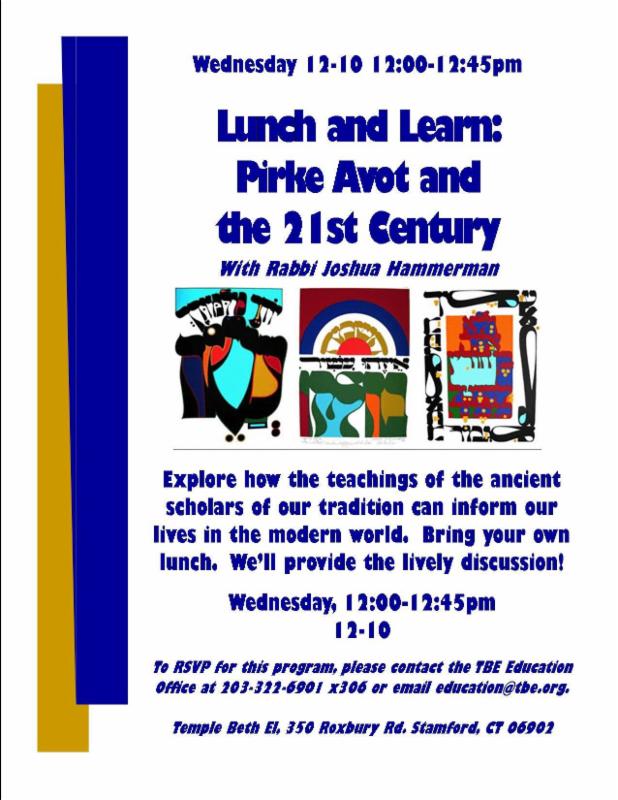
Other than Shabbat, I hope you can join me at three big events next week.  I’m really looking forward to the first session of my “Hot Topics for Cold Months” series on Tuesday night, this time focusing on  Judaism and Gun Violence.  On Wed. at noon, ourLunch and Learn series on Pirke Avot continues.  And on Thursday evening, our interfaith “Learning and Latte” will step aside for this month for an interfaith community conversation, Moving Beyond Racism, featuring Mayor David Martin.

Also, our new LGBT group had a preliminary meeting this week.  The next meeting will take place on Thursday evening, Jan. 22 at 7:30.  A Havdalah / social event is also on the calendar, set for March 7 at a Harbor Point location.  Save those dates!  More info to come.

And don’t forget our Israel trip - see the itinerary and other info here.  We would love to have you join us this July.


Holy Silence, January Cold, Jerusalem Snow, Heschel and “Wild”


Jerusalem in snow

“It had nothing to do with gear or footwear or the backpacking fads or philosophies of any particular era or even with getting from point A to point B. It had to do with how it felt to be in the wild. With what it was like to walk for miles with no reason other than to witness the accumulation of trees and meadows, mountains and deserts, streams and rocks, rivers and grasses, sunrises and sunsets. The experience was powerful and fundamental. It seemed to me that it had always felt like this to be a human in the wild, and as long as the wild existed it would always feel this way....It offers a silence. It offers a solace. It offers a perspective.”  
      Cheryl Strayed, Wild: From Lost to Found on the Pacific Crest Trail

“The deepest language of the soul is silence.” 
Rabbi Rami Shapiro, quoted in the current issue of the digital journal Sh’ma, which features some stirring essays on silence. 

Over the holidays, I went to see the excellent film “Wild.”  In this week’s portion of “Shmot,” the book of Exodus begins with Moses embarking on a similar journey - remarkable similar, in fact, as he retreats to the silence of the wilderness to escape family trauma (his estrangement from the Egyptian court) and personal calamity (his murder of a taskmaster) in a tortured and tortuous journey of self discovery.

The great conservationist Aldo Leopold spoke of January as an ideal month to explore the outdoors, despite the cold, because, with so much of nature in hibernation, there are few diversions.  As I walked across the frozen tundra of my lawn this morning and heard little but the crunch of ice beneath my feet, I could understand what he was getting at.

He writes, in his classic, “A Sand County Almanac,” “The months of the year, from January up to June, are a geometric progression in the abundance of distractions. In January one may follow a skunk track, or search for bands on the chickadees, or see what young pines the deer have browsed, or what muskrat houses the mink have dug, with only an occasional and mild digression into other doings. January observation can be almost as simple and peaceful as snow, and almost as continuous as cold. There is time not only to see who has done what, but to speculate why.”

January, then, is a time when we can pause, meander and reflect.  The cold forces us to go a little more slowly (unless you are in Green Bay or Foxboro, that is), and the snow blankets the world with a coat of mystery.  It coated Jerusalem with a few inches just this week, and for a fleeting moment, the tumult of the region was replaced by silent stirring, with the only noise being children at play.

Friday marks the yahrzeit of Abraham Joshua Heschel, whose contributions to the Civil Rights battles of the 1960s was apparently airbrushed out of the film “Selma,” which opens nationally this weekend.  Heschel spoke out against silence, both human and God’s, in the face of injustice.   But Heschel also understood the power of silence in prayer.  Long before mindfulness became a fad, he practically invented the concept of wonder for the 20th century Jew, living in an increasingly urban, complex and noisyworld.

Here’s what he wrote about prayer, nature and silence:

“To pray is to take notice of the wonder, to regain a sense of the mystery that animates all beings, the divine margin in all attainments. Prayer is our humble answer to the inconceivable surprise of living. It is all we can offer in return for the mystery by which we live. Who is worthy to be present at the constant unfolding of time? Amidst the meditation of mountains, the humility of flowers - wiser than all alphabets - clouds that die con­stantly for the sake of His glory, we are hating, hunting, hurting. Suddenly we feel ashamed of our clashes and complaints in the face of the tacit glory in nature. It is so embarrassing to live! How strange we are in the world, and how presumptuous our doings! Only one response can maintain us: gratefulness for wit­nessing the wonder, for the gift of our unearned right to serve, to adore, and to fulfill. It is gratefulness which makes the soul great.”

...In a sense, our liturgy is a higher form of silence. It is per­vaded by an awed sense of the grandeur of God which resists description and surpasses all expression. The individual is silent. He does not bring forth his own words. His saying the con­secrated words is in essence an act of listening to what they convey. The spirit of Israel speaks, the self is silent.

...Twofold is the meaning of silence. One, the abstinence from speech, the absence of sound. Two, inner silence, the absence of self-concern, stillness. One may articulate words in his voice and yet be inwardly silent. One may abstain from uttering any sound and yet be overbearing. Both are inadequate: our speech as well as our silence. Yet there is a level that goes beyond both: the level of song. “There are three ways in which a man expresses his deep sorrow: the man on the lowest level cries; the man on the second level is silent; the man on the highest level knows how to turn his sorrow into song.” True prayer is a song.

That’s our unofficial mission statement here - to cultivate silence, and to transform it into song.

On Friday night at 7 PM, we, like Robert Frost, Moses and Meryl Streep will also travel “Into the Woods” - I mean the wilderness (got my movies mixed up), with quotes by Cheryl Strayed and others.  Let’s see if we can’t experience some meaningful moments amidst the holy silence.

And on Shabbat morning, we’ll deepen mindfulness with a discussion of the portion through the eyes Rabbi Levi Yitzhak of Berdichev, as described in the new book, “A Partner in Holiness.”

"It is only when we silent the blaring sounds of our daily existence that we can finally hear the whispers of truth that life reveals to us, as it stands knocking on the doorsteps of our hearts."   K.T. Jong

Have a peaceful - and quiet - Shabbat.


Rabbi Joshua Hammerman

Friday, January 2, 2015

Shabbat-O-Gram Jan 2

Since my main O Gram  message was  already sent out before the New Year, just a few quick reminders:

- A reminder that services now begin at 7 PM on Friday evenings.  Join us tonight! I’ll be talking about “The Times Square Ball Drop and Other Jewish Rituals.”

- This week's portion is Vayechi, as we conclude the book of Genesis.  Family dynamics, Jewish continuity and assimilation are major themes of the portion.  It also features an often overlooked ritual that has become part of the Shabbat dinner experience: the blessing of children. With that in mind, on Shabbat morning we'll be discussing an advertising campaign that is proving to be very controversial in Israel, and how it relates to the blessing of Jacob’s grandsons.  See the controversial TV ad here and preview the entire Parsha packet here, including articles about the “Israeli Friday Night” ad campaign.

-  There is no Religious School this Sunday morning, but we DO have morning minyan, as usual, at 9 AM.

- We've added some new photos of our volunteers at Inspirica's Family Shelter on Christmas Eve. You can see them, and our entire Hanukkah photo album, here.  And catching up on some recent events, see Sydney Eben’s bat mitzvah speech here and Jessica Olin’s here.


Shabbat Shalom, safe travels, and happy 2015!