Thursday, May 28, 2015

PRESENTATION OF FRED WEISMAN MEMORIAL TIKKUN OLAM AWARD - by Joan Weisman

See below the remarks given by Joan Weisman last night as the first Fred Weisman Tikkun Olam was given out to Ken and Amy Temple.  Fred passed away just a few months ago.  Such a fitting tribute to a great man. Below is a photo of myself with Joan and Fred at the 1996 Purim Comedy Night - one of the many programs inspired by this wonderful couple.


PRESENTATION OF FRED WEISMAN MEMORIAL TIKKUN OLAM AWARD
May 27, 2015

I am  overwhelmingly honored that an annual award recognizing outstanding volunteerism has been established in Memory of my beloved Fred.  He would be so happy to know that others will pick up the ball and run with it now that he can no longer do it himself.  He would also want you to know that he  totally enjoyed the game, the good people he worked with and the goals he attained.
Needless to say, the past couple of months since Fred passed away have been a sad and reflective time for me.  Learning that others recognize  the mark he left in the world is helping me in the healing process and I thank you for giving me this opportunity to speak about him . 
Shortly after Fred's passing there was an article in the NY Times that called out to me.  It was entitled:  The Moral Bucket List.   David Brooks wrote about  two sets of virtues, the résumé virtues and the eulogy virtues. The résumé virtues are the skills you bring to the marketplace. The eulogy virtues are the ones that are talked about at your funeral — whether you were kind, brave, honest, and really cared  about making the world a better place?
At about that time, a dear friend referred to Fred as having possessed “a moral compass”.  It got me to thinking about how much one  man, my Fred, tried to make a difference in this crazy world without an iota of cynicism.  He truly believed the Star Fish Story…you may not be able to save the world but you can save one person at a time.  Similar words I believe that Hillel spoke:  If you save one person, it is as if you saved the world.  His moral compass drove him in so many different directions:  Humanitarian services, health care, the arts, community service, philanthropy, youth activities, education and of course family love and responsibility were never sacrificed.   I was asked to share Fred's most notable accomplishments with you to enable you to understand the spirit of the award and the man for which it is named.  So here goes.
He served  on the AmeriCares Board for 13 years  to relieve suffering throughout the world, served on Temple Boards, presided over the Science Education Center and The Pacific House Mens Homeless Shelter, made  homes safe warm and dry with HomeFront,  Helped feed and house the poor, read to young children every week for years in the Reading Partners’ Program, mentored kids on science and ecology,  lead Odyssey of the Mind youngsters to winning State Championships,  lead a Scout Troop for 13 years, coached Little League and Junior Achievement, traveled with Healing the Children and AmeriCares on  missions throughout the world, spent a week with AmeriCares in Freshkill after 9/11, bought a mobile medical clinic for AmeriCares’ Free Clinic and provided funds for the Weisman Free Clinic in Bridgeport. He established a college scholarship for minority students studying to be teachers of science, technology, engineering or math.  sponsored annual symphony concerts and built sets in a local theater,   In addition, he served as an elected official on the land use commission in Brookfield for many years. 
About now, you must be wondering whether he had 48 hours in each day, required no sleep or had super human powers.  We won't ever know, but maybe wearing his Superman or Mickey Mouse shirts really did work.  In spite of being a cancer survivor for 20 years and told he had only six months to live on at least two occasions, he was always happy.   He would often exclaim that the reason he did for others was because he was the luckiest man alive and because of his good fortune wanted to share with others.  He truly felt that he was given extra years because he hadn't yet done enough to save the world. 
I recently found the words Fred spoke just last year as he was honored by the Pacific House Homeless Shelter in Stamford with the Rays of Hope Award.  “It has been extremely gratifying to return to Stamford after a 20 year absence to find Beth El continuing what Joan and I had started at Beth El Cares.  We thank you all for giving meaning to the old adage “that those who can, must do”  There are many needy throughout the world but we must not forget the needs of those in our own backyard. "
I think the  most important question that we can ask ourselves as we think about The Fred Weisman Memorial Tikon Olam Award is what each of us can do to repair the world, how we can pay it forward in even a very small way.  How each of us can find and follow our own moral compass as Fred followed his.  How we can pass on the value of tzeduka to our children and grandchildren.   I hope that all I have shared with you about my dear Fred will not be perceived as bragging but an opportunity to see how possible it is for anyone to make the world a better place. 
We will all miss Fred's energy, his love of life and his good deeds but hopefully, his spirit will inspire all of us to perform deeds of kindness and there will always be worthy recipients of this award.  Fred would say about now, It's time for less talking and more doing....
So It is my pleasure  to invite Amy and Ken Temple to come up so that I may  present them with the first Annual Fred Weisman Tikkun Olam Memorial Award. 
Amy and Ken, you have lead Beth El Cares far beyond what we could have hoped for when we founded it over 30 years ago.   For the past four years, you have been the stewards behind the Homeless Shelter Dinners, High Holiday and Passover Food Drives and many other caring activities.  Ken, you also serve on the Board of Directors of the Temple and Amy you have chaired the Temple Annual Purim Carnivals.  You are a couple that embodies the spirit of Tikkun Olam and Fred would be proud to know that you are being honored.   I wish you many more years of joy in serving the community and carrying out the values that this award conveys.

Friday, May 22, 2015

Airbrushing Ruth

There are lots of heroes in Jewish traditional sources and most of them are men.  But have you ever noticed that our holidays do a good job of maximizing the acclaim given women?  Purim would not be Purim without Esther.  Hanukkah has Judith and Passover has Miriam.  And even long before Betty Friedan changed history into her-story, Shavuot had Ruth.  Without Ruth's classic kindness, there would never have been King David - literally, as he was her great grandson. How sad it would have been for all of us if Ruth's voice had been stilled.

Jewish tradition has no inherent problem with women. The problem isn't Judaism - it's Jews.  The problem is the slippery slope that comes from the incremental discrimination against women, a discrimination that originated in patriarchal and misogynistic societies and gained momentum over time - and especially recently.  

As a committed pluralist, I need to accept that for some Jews - and some iterations of Judaism - halachic justifications for the differentiation between male and female sex roles are internally consistent with an accepted worldview that existed in previous eras, long before feminism.  They were right, perhaps, for their time.  Those practices, which minimized women's roles in public religious life, also reflected a general reverence for ancient practices.

But I also know that discrimination against women, like all discrimination, is a slippery slope, one that leads to objectification and has, in many cultures, led to a culture that condones violence. So, while refusing to succumb to the temptation to condemn past practices, we need to go out of our way to reverse the disturbing trends.  But in some parts of the Jewish world, the exact opposite is happening.

Over the centuries, in Judaism, the silencing of women's voices has taken a strikingly literal turn. Click here for a halalchic study, from an Orthodox journal, of the evolution of the controversial concept of Kol Isha, a concept designed to limit where women's voices can be heard.  Then click here for a comprehensive study of the topic by a Conservative scholar.  That responsum concludes:

...There is no general prohibition against women singing in classic Jewish law based on the Talmud and subsequent codes and commentaries until the early nineteenth century. The current blanket prohibition accepted by Haredi and some modern Orthodox rabbis was first suggested and rejected by Rabbi Joshua Falk (d. 1614) and was only given as a halachic ruling by Rabbi Moshe Sofer, the Hatam Sofer, in the early nineteenth century.... There is therefore no halachic justification for anyone walking out when women sing. But even if one accepts the very strict ruling of the Hatam Sofer, it is forbidden to walk out in order not to insult the female performers.

So we can see the slippery slope in action and how the notion of Kol Isha took on a life of its own relatively recently.  The 19th century is only yesterday by Jewish historic standards.  

Well, this week, the slope got even slipperier.  Now, not only are women no longer to be heard in public Jewish life, evidently they also cannot be seen.  Not just covered up - but airbrushed out completely.


See below a photo of Israel's new government, sworn in this week.  The lack of women in senior positions is just one of the many major concerns that one could have about this government.  But at least there are some women.


Or are there? See this front page from a Haredi newspaper.  The women have been airbrushed out!


Israelis are a creative lot, so that affront gave rise to some rather hilarious memes.


But the humor masks a real problem.  For if a society tolerates the silencing of an entire segment of the population - and now the rendering of them as invisible - where does that slippery slope lead?  What outrageous behaviors will happen next, and against whom, and how will they be justified? 

We need to return Judaism to its roots, literally, to Root, which is the Hebrew for Ruth. Ruth could easily have disappeared into the dustbin of Moabite history.  But she insisted on being heard, being seen and remaining aside her mother in law Naomi, to whom she said, famously "Whither thou goest, I will go; and where thou lodgest, I will lodge; thy people shall be my people, and thy God my God."

Soon, if this slippery slope is not reversed, who knows, maybe someone will try to airbrush Ruth right out of the Bible.


Airbrushing Ruth, Shavuot and Memorial Day, 7th Grade Aliyah - Shabbat-O-Gram

Shabbat Shalom!

Candle lighting: 7:53 PM
Services at 7 tonight, 9:30 on Shabbat, Sunday and Monday; 8 PM at Temple Sinai on Sat. night. (where we'll discuss whether the Ten Commandments are still relevant)
Shabbat Torah portion: B'Midbar.


Aliyah Ceremony for 7th graders
Mazal tov to our 7th graders, who celebrated their Aliyah Ceremony last night, officially moving onward and upward to our teen program.  Click here to see a complete slide show of the event.

Jewish Heritage Month
I just watched President Obama's speech to American Jews at Adas Israel in Washington, honoring Jewish Heritage Month.  You can watch it here - and it's well worth watching.

Memorial Day and Shavuot
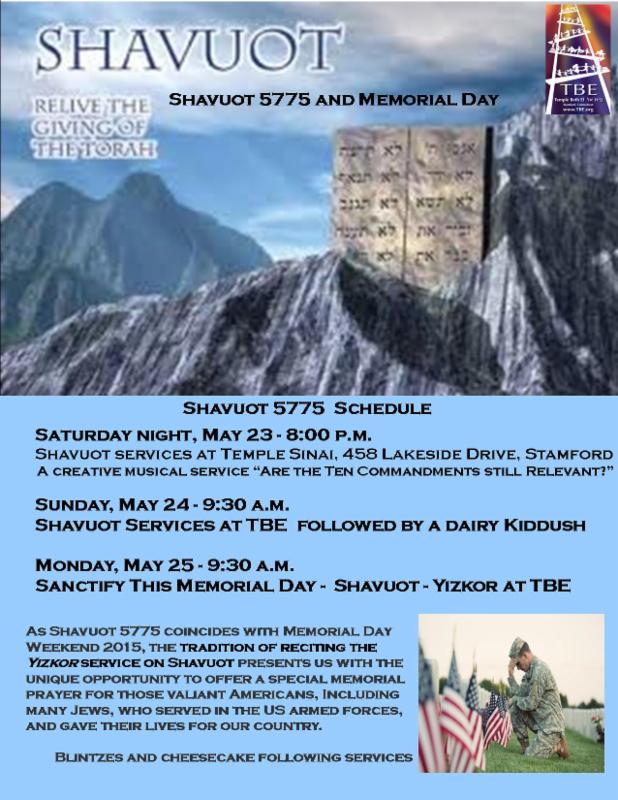
On Monday, we will combine observances of Memorial Day with our Yizkor service for the second day of Shavuot. Preview our special supplement here.

More on Jewels Harrison
Last week I wrote about Jewels Harrison's upcoming Bar Mitzvah.  A comprehensive web page has just been unveiled, giving more details of Jewels' amazing story, including several videos of his music.  See it here

The Disappearing Women - Getting Back to our Ruths

There are lots of heroes in Jewish traditional sources and most of them are men.  But have you ever noticed that our holidays do a good job of maximizing the acclaim given women?  Purim would not be Purim without Esther.  Hanukkah has Judith and Passover has Miriam.  And even long before Betty Friedan changed history into her-story, Shavuot had Ruth.  Without Ruth's classic kindness, there would never have been King David - literally, as he was her great grandson. How sad it would have been for all of us if Ruth's voice had been stilled.

Jewish tradition has no inherent problem with women. The problem isn't Judaism - it's Jews.  The problem is the slippery slope that comes from the incremental discrimination against women, a discrimination that originated in patriarchal and misogynistic societies and gained momentum over time - and especially recently.  

As a committed pluralist, I need to accept that for some Jews - and some iterations of Judaism - halachic justifications for the differentiation between male and female sex roles are internally consistent with an accepted worldview that existed in previous eras, long before feminism.  They were right, perhaps, for their time.  Those practices, which minimized women's roles in public religious life, also reflected a general reverence for ancient practices.

But I also know that discrimination against women, like all discrimination, is a slippery slope, one that leads to objectification and has, in many cultures, led to a culture that condones violence. So, while refusing to succumb to the temptation to condemn past practices, we need to go out of our way to reverse the disturbing trends.  But in some parts of the Jewish world, the exact opposite is happening.

Over the centuries, in Judaism, the silencing of women's voices has taken a strikingly literal turn. Click here for a halalchic study, from an Orthodox journal, of the evolution of the controversial concept of Kol Isha, a concept designed to limit where women's voices can be heard.  Then click here for a comprehensive study of the topic by a Conservative scholar.  That responsum concludes:

...There is no general prohibition against women singing in classic Jewish law based on the Talmud and subsequent codes and commentaries until the early nineteenth century. The current blanket prohibition accepted by Haredi and some modern Orthodox rabbis was first suggested and rejected by Rabbi Joshua Falk (d. 1614) and was only given as a halachic ruling by Rabbi Moshe Sofer, the Hatam Sofer, in the early nineteenth century.... There is therefore no halachic justification for anyone walking out when women sing. But even if one accepts the very strict ruling of the Hatam Sofer, it is forbidden to walk out in order not to insult the female performers.

So we can see the slippery slope in action and how the notion of Kol Isha took on a life of its own relatively recently.  The 19th century is only yesterday by Jewish historic standards.  

 
Well, this week, the slope got even slipperier.  Now, not only are women no longer to be heard in public Jewish life, evidently they also cannot be seen.  Not just covered up - but airbrushed out completely.

See below a photo of Israel's new government, sworn in this week.  The lack of women in senior positions is just one of the many major concerns that one could have about this government.  But at least there are some women.


Or are there? See this front page from a Haredi newspaper.  The women have been airbrushed out!


Israelis are a creative lot, so that affront gave rise to some rather hilarious memes.


But the humor masks a real problem.  For if a society tolerates the silencing of an entire segment of the population - and now the rendering of them as invisible - where does that slippery slope lead?  What outrageous behaviors will happen next, and against whom, and how will they be justified? 

We need to return Judaism to its roots, literally, to Root, which is the Hebrew for Ruth. Ruth could easily have disappeared into the dustbin of Moabite history.  But she insisted on being heard, being seen and remaining aside her mother in law Naomi, to whom she said, famously "Whither thou goest, I will go; and where thou lodgest, I will lodge; thy people shall be my people, and thy God my God."

Soon, if this slippery slope is not reversed, who knows, maybe someone will try to airbrush Ruth right out of the Bible.

Rabbi Joshua Hammerman


Sunday, May 17, 2015

ABC News coverage of Six Day War, June 8, 1967

News coverage of the Six Day War by ABC news harks back to the last time Israel was David in the eyes of the world, and the moment she became Goliath.


ABC News Videos | ABC Entertainment News

Friday, May 15, 2015

Shabbat-O-Gram for May 15


Mazal tov to the Kaplan family as Justin becomes Bar Mitzvah this Shabbat, and we thank them for sponsoring this week’s Shabbat announcements and Shabbat-O-Gram.

Candle lighting: 7:46 PM
Services at 7 tonight - Katie Kaplan will be joining the cantor, myself and David Bravo
Torah portion: Behar-Behukotai – click here for a Parsha Packet on the “Tochecha” (rebuke) section, which we’ll be discussing tomorrow.


Mazal tov to my son Dan, who became a college graduate last week (see above the first family photo we’ve ever taken that includes four college graduates) and to the many students from our congregation who have recently or about to graduate.  Next Thursday that will include our Hebrew School’s 7th grade, in what I hear will be a very moving ceremony that they are preparing. This Sunday marks the last day of Hebrew School ).  We are thankful to Lisa Udi, Board of Ed members, parents and teachers for what has been a wonderful year.  Special thanks to Sue Shapiro, who will be leaving our faculty after many years of dedication and excellence.  We will miss her on the faculty, but fortunately she and Carl will still be very much here as congregants.  The dedication of our teachers is so often overlooked – they cannot be thanked enough.

Not only has it been a great school year, but a great year for our teens too – a real year of growth for our teen program, again, with great thanks to Lisa.  This Sunday, we begin an exciting new partnership with Temple Sinai, joining our teen programs together for social activities and community service. This week’s project will involve baking, and I’ll be bringing the finished products over to the Jewish Home in Fairfield.

Lots happening as we rush toward an upcoming quadruple holiday week.  Quadruple?  Yes.  Here’s the lineup.

-          Sunday: Jerusalem Day - Click here for a map of the battle of Jerusalem and here to see the historic moment when the Israeli troops liberated the Western Wall in 1967.
-          Tuesday: Rosh Hodesh Sivan
-          Next weekend: Memorial Day AND Shavuot.  Read more about this linkage here.

The linkage of Memorial Day and Shavuot makes perfect sense: both are seen as the unofficial beginning of summer and both are woefully ignored.  But it’s rare for them to coincide in this configuration, where the holiday ends with Yizkor, the memorial prayer, taking place on Memorial Day itself. It will bring added meaning to both holidays, at a time when Memorial Day has come to be synonymous with swim clubs and shopping. On Sat. night we will begin the holiday jointly with Temple Sinai, a custom that we began last year – this year at Sinai (appropriate for the holiday), and a creative service/”Tikkun” conversation on issues related to the journey to Sinai and the contemporary relevance of the ten commandments.  For more Shavuot service information, click here


Now, back to this weekend:


Piercing the Heavens: A Very Special Bar Mitzvah

We learn in Pirke Avot, “There is no person who does not have his hour.”  On a Shabbat morning in early June, a remarkable young man will ascend to the Torah to become Bar Mitzvah in my synagogue, on the very same pulpit where his bris took place thirteen years ago.  His name is Jewels Harrison. 
Because of his degree of autism, Jewels’ capacity for speech is very limited, but he has found new ways to sing God’s praises.  In only a short amount of time, Jewels has become an accomplished pianist.  He doesn’t read music, but is able to hear and reproduce it in detail. Innovative rows of pictures and symbols helped him identify and associate songs to play. 

For his mitzvah project, Jewels has been performing at small parlor recitals, raising money for programs which will benefit other kids with special needs.  His playing is extraordinary for any child his age, but especially for one who has spent so much of his life with very limited ability to communicate.  See for yourself - an excerpt from a recent performance has been uploaded to http://ellentube.com/videos/0-8z2xziy2/.

To hear Jewels play is to hear the shepherd boy’s flute in the iconic Hasidic tale of the Baal Shem Tov.  Moved by his first exposure to the powerful Yom Kippur service though unable to read or understand the liturgy, that boy prayed in the manner that he knew best.  The congregation was aghast and looked to evict the boy, until the rabbi indicated from the pulpit that those shrill sounds of the whistle were able to pierce the heavens so that the prayers of the entire congregation might ascend.

Jewels is also preparing to lead many of the prayers of the service with his voice.  Through hard work and much patience, he is going to do just fine, but for the hundreds who will be attending, perfection will not be pertinent.  What will matter was that we bear witness to Jewels’ resounding statement that every human being has his hour, every life has infinite value, and everyone is equal in the eyes of God.

You may have heard of the recent cancellation of a bar mitzvah for special needs children in Rehovot, Israel, because it was to be held in a Masorti (Conservative) facility.  The mayor insisted that the service be held at an Orthodox synagogue.  The irony here is that some traditional synagogues do not allow such children to come up to the Torah and say the blessings.   There is a notion in Jewish law that those with severe disabilities are not “of sound mind” and therefore are not eligible to take on public responsibilities like being a witness, or, more to the point, representing the congregation in leading services.   Despite these restrictions, even very traditional rabbis are increasingly recognizing the dangers of labeling special needs or physically disabled children with a broad brush. 

In their book, “Practical Medical Halacha,” Fred Rosner and Moses Tendler state that Jewish law urges those with special needs “to achieve their fullest potential as Jews, while exhorting society to assist them in making their religious observance possible.”  In the Talmud, after all, (Eruvin 54b) Rabbi Preida had a student with a severe learning disability, to the point where needed to repeat each lesson four hundred times before the student understood it.  Such patience needs to be applied across the board, and to a degree, that is happening. 

There is no lack of compassion for special needs children in the Orthodox world, a general position of inclusiveness that is mandated in the Talmud; which is why the Rehovot incident is even more alarming.  The mayor was willing to turn these kids into pawns to further his own political agenda.

Masorti has been running this special needs bar mitzvah program in Israel for many years. Just as Conservative Judaism has incorporated relevant contemporary data to reassess longstanding views regarding feminism and homosexuality, so did it long ago find ways to incorporate into ritual practice contemporary understandings of mental impairment and genetic disorders.  As with women and gays, the purpose of implementing changes to long-held practices is to affirm the dignity of these individuals.   As our sources repeat time after time, the dignity of the individual should always be paramount. 

I've led many memorable bar/bat mitzvahs of special needs children.  One of my first was for a young man with Down syndrome, who used that bar mitzvah process as a springboard to living an exemplary life in leadership and advocacy.  Today, three decades later, he is often in Washington articulating his cause and lobbying for better legislation.  He’s co-written a book (which became a TV movie) detailing his experiences.  Had he grown up in Rehovot, God only knows if he would have had such opportunities or gained such confidence.  It would have been the world’s loss.

Children with such challenges have so much to offer and often can’t stand up for themselves when mistreated.  Many can’t speak at all.  Oftentimes they are too trusting of those take advantage of them.  The Rehovot story is simply a disgrace, a stain on Israel and a shame for all of us. If this behavior is representative of Judaism, it almost makes me want to go back to Sinai and start all over again.

Fortunately it is not.

When I was 12, I got into the only fistfight of my life, and it was when a kid started mocking my brother, who is significantly impaired, laughingly calling him a "retard." Nowadays there are only a few things that bring out the moral outrage in me as much as the abuse of innocent young children with disabilities.


And few things validate my decision to become a rabbi and represent the eternal message of Sinai more than seeing children like Jewels ascend to the Torah, piercing the heavens with a prayer so intense and pure that it just might save us all.

Piercing the Heavens

We learn in Pirke Avot, “There is no person who does not have his hour.”  On a Shabbat morning in early June, a remarkable young man will ascend to the Torah to become Bar Mitzvah in my synagogue, on the very same pulpit where his bris took place thirteen years ago.  His name is Jewels Harrison. 

Because of his degree of autism, Jewels’ capacity for speech is very limited, but he has found new ways to sing God’s praises.  In only a short amount of time, Jewels has become an accomplished pianist.  He doesn’t read music, but is able to hear and reproduce it in detail. Innovative rows of pictures and symbols helped him identify and associate songs to play. 

For his mitzvah project, Jewels has been performing at small parlor recitals, raising money for programs that will benefit other kids with special needs.  His playing is extraordinary for any child his age, but especially for one who has spent so much of his life with very limited ability to communicate.  See for yourself - an excerpt from a recent performance has been uploaded to http://ellentube.com/videos/0-8z2xziy2/.

To hear Jewels play is to hear the shepherd boy’s flute in the iconic Hasidic tale of the Baal Shem Tov.  Moved by his first exposure to the powerful Yom Kippur service though unable to read or understand the liturgy, that boy prayed in the manner that he knew best.  The congregation was aghast and looked to evict the boy, until the rabbi indicated from the pulpit that those shrill sounds of the whistle were able to pierce the heavens so that the prayers of the entire congregation might ascend.

Jewels is also preparing to lead many of the prayers of the service with his voice.  Through hard work and much patience, he is going to do just fine, but for the hundreds who will be attending, perfection will not be pertinent.  What will matter was that we bear witness to Jewels’ resounding statement that every human being has his hour, every life has infinite value, and everyone is equal in the eyes of God.

You may have heard of the recent cancellation of a bar mitzvah for special needs children in Rehovot, Israel, because it was to be held in a Masorti (Conservative) facility. The mayor insisted that the service be held at an Orthodox synagogue. You can read the latest update on this sad situation here) The irony here is that some traditional synagogues do not allow such children to come up to the Torah and say the blessings.   There is a notion in Jewish law that those with severe disabilities are not “of sound mind” and therefore are not eligible to take on public responsibilities like being a witness, or, more to the point, representing the congregation in leading services.   Despite these restrictions, even very traditional rabbis are increasingly recognizing the dangers of labeling special needs or physically disabled children with a broad brush. 

In their book, “Practical Medical Halacha,” Fred Rosner and Moses Tendler state that Jewish law urges those with special needs “to achieve their fullest potential as Jews, while exhorting society to assist them in making their religious observance possible.”  In the Talmud, after all, (Eruvin 54b) Rabbi Preida had a student with a severe learning disability, to the point where needed to repeat each lesson four hundred times before the student understood it.  Such patience needs to be applied across the board, and to a degree, that is happening. 

There is no lack of compassion for special needs children in the Orthodox world, a general position of inclusiveness that is mandated in the Talmud; which is why the Rehovot incident is even more alarming.  The mayor was willing to turn these kids into pawns to further his own political agenda.

Masorti has been running this special needs bar mitzvah program in Israel for many years. Just as Conservative Judaism has incorporated relevant contemporary data to reassess longstanding views regarding feminism and homosexuality, so did it long ago find ways to incorporate into ritual practice contemporary understandings of mental impairment and genetic disorders.  As with women and gays, the purpose of implementing changes to long-held practices is to affirm the dignity of these individuals.   As our sources repeat time after time, the dignity of the individual should always be paramount. 

I've led many memorable bar/bat mitzvahs of special needs children.  One of my first was for a young man with Down syndrome, who used that bar mitzvah process as a springboard to living an exemplary life in leadership and advocacy.  Today, three decades later, he is often in Washington articulating his cause and lobbying for better legislation.  He’s co-written a book (which became a TV movie) detailing his experiences.  Had he grown up in Rehovot, God only knows if he would have had such opportunities or gained such confidence.  It would have been the world’s loss.

Children with such challenges have so much to offer and often can’t stand up for themselves when mistreated.  Many can’t speak at all.  Oftentimes they are too trusting of those take advantage of them.  The Rehovot story is simply a disgrace, a stain on Israel and a shame for all of us. If this behavior is representative of Judaism, it almost makes me want to go back to Sinai and start all over again.

Fortunately it is not.

When I was 12, I got into the only fistfight of my life, and it was when a kid started mocking my brother, who is significantly impaired, laughingly calling him a "retard." Nowadays there are only a few things that bring out the moral outrage in me as much as the abuse of innocent young children with disabilities.

And few things validate my decision to become a rabbi and represent the eternal message of Sinai more than seeing children like Jewels ascend to the Torah, piercing the heavens with a prayer so intense and pure that it just might save us all.

Tuesday, May 12, 2015

TBE Bar/Bat Mitzvah Commentary: Justin Kaplan on Behar - Behukotai

Last October, my family decided to get a dog from a rescue center.  I’ve always dreamed of having one.  My mom went on the website and they posted photos of a few dogs and as soon as I saw her, I knew she was the one.  We have no idea what breed she is, but we know she has hound in her because of her speed.  Maya is lightning-quick and her nose sticks out like a hound. 
                On the website she was known by her original name – Charity. 
                Within a week we brought her home and we haven’t regretted it for a moment, because of how loving and fun she is.  She’s made a huge difference in our lives.  True, she’s not totally housebroken yet – but that just gives us a goal to work toward.
                Maya was the inspiration for my mitzvah project.  I am raising money to donate to Second Chance Rescue, the organization that gave us Maya.  Second Chance was formed in 2009 on the firm belief that all animals deserve to be loved and cared for, and no animal should ever be abused, neglected or homeless. Their mission is to facilitate the adoption/rehoming of animals that have been abandoned, or given up by their former owners, and to place them in new loving homes.
                My portion describes an ideal society, one where people help one another and take care of other people, even strangers and slaves.  They also care for the land, even allowing the land to rest.  And also the give special care to their animals.  Everyone is included in the household.  The idea that even animals deserve a special chance would fit in well with my portion.  It’s clear from the portion and what I’ve learned from Maya, that animals are important contributors to that ideal community.
                These days, the closest we can come to creating that ideal community is at camp.  As many of you know, each summer I go to sleep away camp in Pennsylvania.  I’ve been going there for 9 years and have made tons of great friends . . . some of whom are here today.  Camp has helped me to become much more independent.  Last year, I only saw my mom twice every day!  Yes, she is the camp nurse for younger grades.  But this year, I won’t see her nearly as much because I’m moving to the other side of camp (the part for teenagers).
In many ways, camp creates an ideal community, something that can’t so easily be created back home in Stamford.
Nothing can beat the friendship that comes from living close together with about a dozen other kids – without driving one another crazy.
The key to that closeness comes from setting basic rules (like no stealing) but going above and beyond to not hurt one another.
The Torah recognizes that things can’t always be so ideal, so it says, try to make things better at least once every seven days (Shabbat), and once every seven years.  And camp allows us to create an ideal society for seven weeks every year.
And within those seven weeks, there are seven days when team spirit wins out over everything else.  We call those days “Color War.”  We get to play lots of different sports, which I love and in each one of them, we must work as a team in order to win.
I suppose that for me, the ideal community would be one that has the fun of camp, with lots of dogs and plenty of sports – and, oh, yes, where my mother is the nurse. J 

        Now that I’ve become a bar mitzvah, I hope to make the world a more ideal place for everyone to live. 

Friday, May 1, 2015

Shabbat-O-Gram for May 1

Shabbat-O-Gram 


The Shabbat Announcements are sponsored by Jill and Alejandro Knopoff in honor of their daughter, Morgana, becoming a Bat Mitzvah.


A Parent’s Blessing

As many of you know, next weekend my family will be traveling to Washington for Dan’s college graduation (there will be no Shabbat-O-Gram next week).  While everyone has been thrilled for Dan, as they should be, (and if you know anyone in the think-tank world, Dan’s specialty is international relations, with a focus on the Middle East), the instant reaction I’ve gotten from most people is a mazal tov to me on having paid the final college tuition bill.

Since, as we all know, every event of a child’s life is all about the parent, I’ve given some thought to this sacred moment in the life of a family, the graduation of the youngest child.  As of a week from Monday, for the first time since Ethan skipped off to nursery school precisely twenty years ago at the age of two, not a single Hammerman will be matriculated at any school.   Now I have heard of this animal known as graduate school, so we may not be completely out of the woods yet.  But still, this is a real watershed moment for all of us.  And since I’ve chronicled and assessed prior rites of passage for Dan, including his bris and bar mitzvah, why stop now?

So what would be an appropriate blessing with which to mark the college graduation of a youngest child?  Should we break a plate, a custom sometimes done by parents at weddings or engagement ceremonies?  Maybe burning a mortgage would be more appropriate.

Here’s a prayer I found on Beliefnet, written by a minister.  I like it a lot and it needed to make very few edits for it to be appropriate for Jewish families. It points out the anxiety all parents feel - or should feel - at a time like this, especially notorious helicopter parents like me.

“God, another rite of passage has come and gone. The child you have given has taken another step into the world. I am thankful, proud, delighted, relieved, and yet more than a little apprehensive. It’s a familiar mix of emotions, one I’ve known all the years I’ve shared this precious child with you. Today, I know you share many of these feelings, for you are a parent of great passion and joy. You share all perhaps except the apprehension. You never fear, because you are love, and perfect love drives out fear. You are a parent who knows no fear! I need that today. I need some of your parental boldness. As my child walks out now into a new season of responsibilities and challenges, in a world of struggle, I once again choose to release him/her to you. I have had to do this many times already: the first day of kindergarten, when the driver’s license came in the mail, on that first date, at high school graduation, when we drove off that first day of college, and now, when that journey is completed and they step out into the world as we know it, full of tough, dog-eat-dog battles. All we can do it pray for your hand, which reaches to protect when ours cannot. I say in faith, ‘God, bless and keep him, make your face shine upon him and be gracious to her, and look on her with favor and grant her peace.’”


Or maybe we should simply repeat the traditional blessing done by parents at a bar mitzvah:  “Praised is God, who has relieved me of guilt for whatever becomes of this child.”

Historians trace this Baruch Shep’tarani blessing back to the biblical story of Jacob and Esau, brothers whose post-adolescent lives took dramatically different tracks. Although Rebecca and Isaac were hardly exemplary parents, the blessing validates their unavoidable helplessness in opposing Esau’s wayward ways. In instituting this prayer, the rabbis were implying that there comes a point where parents simply have to let go.

My two kids’ lives have also taken very different tracks, though, since of course it’s always about us parents, they’ve pursued some of their parents’ passions in different ways.  I can see a little of me in each of them - but both of my boys are far greater than the sum of their ancestral parts.

Most of all, they have turned out to be menschen, who love and support each other and really care about others.  No parent could ask for more and Mara and I are very proud of both of them.

And since their entire childhood took place within our little village, an extreme rarity for P.K.s, especially rabbinic ones, but an advantage that this P.K. also was lucky enough to have as a child, we’ve got to share the credit with all of you.

Which means we get to share the nachas as well (for an interesting discussion of what “nachas” means for the contemporary Jew, click here).  So, Mazal Tov to everyone on Dan’s graduation - and think of us at Sisterhood Shabbat next weekend.

And while you are at it, let me know if you would like to see Dan’s resume...

Tattoo or Not Tattoo: That is the Question

On Shabbat morning, we’ll be discussing a topic that I occasionally bring up when we reach this portion of Ahare Mot-Kedoshim and there are teens in the room:  tattoos.  You can find the relevant verse in Leviticus 19:28

You shall not make cuts in your flesh for a person [who died]. You shall not etch a tattoo on yourselves. I am the Lord.

וְשֶׂרֶט לָנֶפֶשׁ לֹא תִתְּנוּ בִּבְשַׂרְכֶם וּכְתֹבֶת קַעֲקַע לֹא תִתְּנוּ בָּכֶם אֲנִי יְהוָֹה:


The topic has been trending this week with the news that the new Apple watch has trouble functioning correctly for those with tattoos (thankfully, my tefillin work just fine).

Perhaps more relevant to the topic from the Jewish perspective is this article from Ha'aretz from a few years ago.  The article details a moving account of how the adult child of a survivor wanted to keep the legacy of his father alive by walking into a Tel Aviv tattoo parlor and asking to have an exact copy of his father’s Auschwitz number branded on his own arm. Since not we are reading Kedoshim, right on the heels of Yom Hashoah, tomorrow’s discussion is a “natural.”

And it’s a discussion I often have with teens, especially in light of the growing popularity of body art.  A survey released one year ago indicated that 40% of Americans said that someone in their household has a tattoo, doubling the result of a similar survey in 1999.

 
Why are permanent, indelible tattoos considered so “unkosher?” (Yes, I know that tattoos can be reversed, but it’s a painful, difficult and imperfect process).

A good, quick response can be found on Hillel’s website. Essentially there are three reasons that have been posited through the centuries: 1) that tattooing was originally a form of pagan worship; 2) that the human body is a holy vessel, a creation “in God’s image,” and who are we to desecrate a gift from God? The mutilation of the body isn’t entirely prohibited, though. Earrings are permitted, for instance, and anything that enhances or saves life, such as autopsies, organ donation and, yes, even some plastic surgery. If the Elephant Man came into my office and said he wanted “a different look,” I don’t think I’d chase him out as a vain narcissist. While he could have technically lived without it, his self image may be so low that in fact, such surgical enhancement could in fact keep him from taking his own life.

I must add, however, that the worship of the body should have its limits - and if such physical enhancement also causes a serious risk to health (e.g. tanning salons or breast implants), we’ve got to wonder if it isn’t just another form of pagan worship. Some have made the claim that circumcision is mutilation, but the prevailing Jewish view is that it is a finishing touch to the miracle of birth, symbolizing a partnership between parents and God. And in fact, in Greek times it was the painful operation to reverse circumcision that was considered the most reprehensible form of body mutilation, since it was done in order to assimilate into Hellenistic society, which was so focused on the exposed - and exalted - human body.

So it’s a complex subject, but the third rationale, he most recent. is the most relevant here. One reason I advise teens to avoid the temptation of tattooing is precisely because the Nazis did it to us. (It’s similar to the argument that I make against cremation). The Nazis did it to dehumanize human beings, to brand them as they would brand cattle, to take away their individuality and freedom of choice. Some claim that in the current context, tattoos are freely chosen and are a means of expressing that very freedom and individuality. But the very indelibility of a tattoo demonstrates the opposite. If it cannot be reversed, we forfeit the choice to not have it! And if the only permanent choice we should be making is to devote our lives to God, rather than a lesser object of devotion (read: idolatry), then that explains why circumcision can be the only indelible bodily change that is granted blanket approval.

But what of this survivor’s son, who wishes only to preserve the memory of the evil - itself a mitzvah (“zachor”) - rather than to perpetuate that evil form of dehumanization.  Is this a fitting tribute to a generation that will soon be gone? Or is it a clumsy distortion, a visual aid that may succeed in shocking people but can’t come close to duplicating the real thing?

I tend to think the latter. There are many avenues of remembrance out there. Why choose to imitate the evil rather than stamp it out? The son’s desire is well intentioned, but if it didn’t even bring comfort to the father (who lived his whole life hoping his children would never have to live in such shame), how is this act not more than an example of the very self flagellation and mutilation that the Torah prohibits.

The Torah implores us to choose life. When we leave a cemetery, we wash our hands. Why, as we leave the smokestacks of Auschwitz behind us, should mark our hands so that the stain will never come out? Auschwitz will never fade from history. It is seared into our consciousness. The pain will never completely go away. But that doesn’t mean that we have to wear it on - or inside - our sleeves.

Shabbat Shalom X2 for this week and next!

 
Rabbi Joshua Hammerman