Author of "Embracing Auschwitz" and "Mensch•Marks: Life Lessons of a Human Rabbi - Wisdom for Untethered Times." Winner of the Rockower Award, the highest honor in Jewish journalism and 2019 Religion News Association Award for Excellence in Commentary. Musings of a rabbi, journalist, father, husband, poodle-owner, Red Sox fan and self-proclaimed mensch, taken from essays, columns, sermons and thin air. Writes regularly in the New York Jewish Week and Times of Israel.
Here's a screen grab from one of history's most famous Zoom Seders
Tweet courtesy of MythAddict
If you missed last night's star-studded "Saturday Night Seder," here it is.
It was terrific from beginning to end, but if you have only time to hear one part, head right to 45:06, where Stephen Schwartz plays his hit, "When You Believe," sung by Cynthia Erivo (who played the female Moses, Harriet Tubman) and Shoshana Bean of "Wicked" -- and they doubled up on Elphabas, with Idina Menzel pitching in with the Four Questions.
----------------
Below are some screen shots of our first TBE Zoom Seder.
Moses and The Israelites at the Red Sea: What REALLY Happened
And finally, some humor of a more local flavor
Jacob the Bar Mitzvah Boy Explains Passover With His Dad
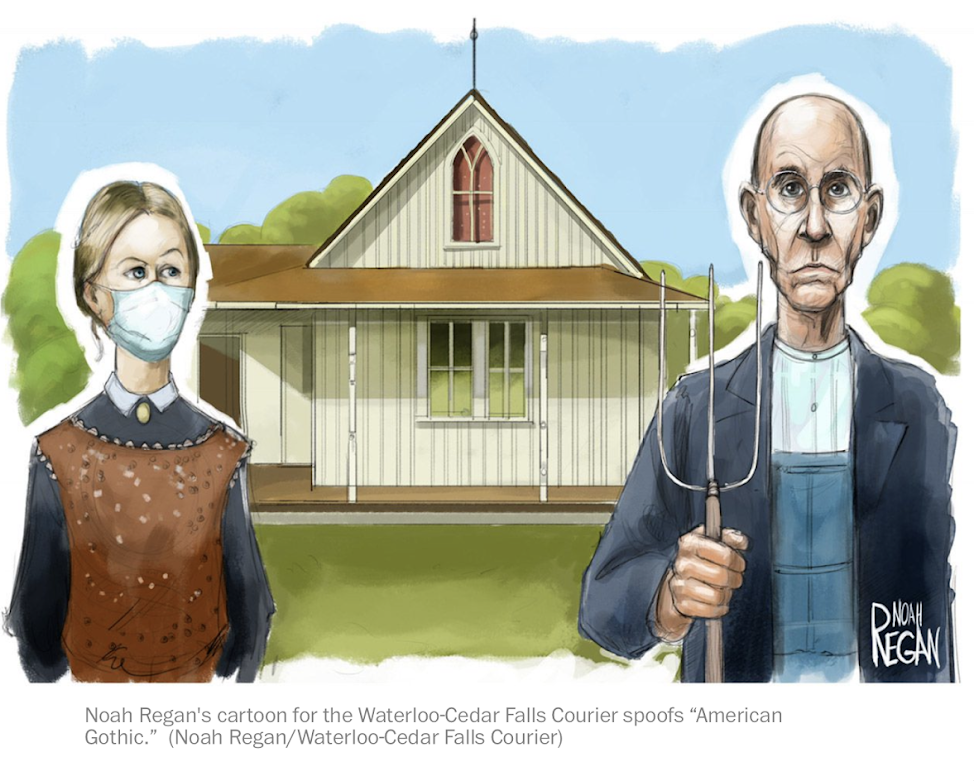
And two more immortal works of art, adjusted for social distancing....
The First Draft of History
I hope your Passover has been thus far safe and, to the greatest degree possible, uneventful. Our TBE Zoom Seder was among the most satisfying events I can recall here. The virtual room was filled with people from here to Hawaii, from Florida to San Francisco, some of them multiple generations of the same families. Zoom technology enabled me to "invite" to our Seder vintage eye-witnesses to Passovers past. We added readings relevant to this Passover and used the chat box liberally to solicit responses to questions we never had thought of asking before; like, how the ritual of washing hands has changed us, how can we find signs of God's presence in the face of illness and suffering, and what activities (or ceasing of your normal activities) have you found to be reviving during these days of quarantine?
Please send me screen shots from this Seder and your family Zoom Seders so we can put together a montage of our extended congregational family. Some of you already have - and I'd love to collect lots more. Try to collect your thoughts in writing too, and send me reflections on your Seders and Passover 5780. We are living witnesses to a challenging time that some day we will recall with both sadness and pride. As part of TBE's 100th anniversary, help us to write the first draft of history.
Instead of the 10 plagues, we did the 10 blessings. We normally diminish our cups because we feel the pain of the Egyptians who suffered, but this year we aren't diminished by sharing the pain of others, so with each blessing - which I asked each person to repeat after me in English, just like in the 10 plagues - we added some wine to our cups. The blessings were: We are healthy. We are volunteering. We are reaching out. We are learning new technologies. We are innovating. We are slowing down. We are staying home. We are supporting local restaurants. We are appreciating the arts in new ways. We are paying attention. Then we made a l'chayim and drank! Will do again!
Please send your Zoom Seder reflections to rabbi@tbe.org
Also, the Jerusalem Post is inviting readers to submit Covid-19 memorials from the Jewish world in conjunction with Yizkor commemorations taking place this week. See https://yizcor.carmel6000.com/#/.
And don't forget Sunday's weekly healing and hangout at 1 PM
Locusts? Really? Do yourself a favor and don't enlarge the photo. It's not pretty. And so, OK, it's true that locusts are used as apocalyptic imagery in the Bible (specifically by the prophet Joel). However, they are also kosher (though some debate just how kosher they are), and for Jews from some parts of the world, a delicacy. So think of them less as an apocalyptic omen than as a sign that we'll never go hungry.
Does that help?
An Important Message from our Beloved Elders
An important message from residents of a seniors facility, from the Washington Post.
Opening Doors and Unlocking the Yearning Heart:
A Look at Nachman of Bratzlav's Haggadah
The pandemic has brought out the generosity of so many, including artists and publishers. Over the past week, I've been able to download two classic Haggadahs that are invaluable to the Haggadah collector.
I've taken some brief excerpts from the Bratzlav Haggadah which, while two centuries old (he died in 1810), is an exceedingly contemporary commentary. In the view of his biographer Rodger Kamanetz,Nachman's storytelling was clearly designed to reach out to people who otherwise would not be interested in Jewish mysticism or in serious religious Judaism.
"I think what's most modern about Rabbi Nachman is his consideration of the problem of extreme doubt and extreme nothingness - of descending into states of mind where he felt that he knew nothing, which he frequently proclaimed to his followers.... To dramatize and live out the reality of doubt is an extraordinary feat for a figure like Rabbi Nachman, who clearly was deeply devout and deeply religious."
So he was a very traditional figure, though he lived in the infancy of a very radical movement, Hasidism, and he was addressing an audience with increasingly modern sensibilities. No wonder his Haggadah commentary feels like it was written just for us, as we grapple with living in Coronaville, 2020.
Commenting on the verse from the Haggadah, "God will bring us out of Egypt with a strong hand and outstretched arm," a section of word-by-word analysis that rabbis go gaga over and everyone else at the table typically wants to skip, the Bratzlaver shares thoughts that echo in our current experience, of the need to bear our suffering, see beyond it and never lose hope. While we ruminate over our current predicament, Nachman's point would be that we always need to be aiming for self improvement and lessons learned, even when so much is out of control. There are things we can control: how we read danger signs, to what degree we socially distance ourselves and influence others to do the same, and how and when we raise voices in protest.
The next commentary that I've excerpted ends with words that have never been more prophetic. As the Israelites shed themselves of the crust accumulated from centuries of superstition, cynicism and lethargy, God "opens doors" for them, releasing them from their Egyptian quarantine. They are now keenly aware of the miracles they've witnessed, enabling them to overcome their despair. We too have been awakened to the miracles of our families, our community, the goodness in people and the gift of life.
And we too yearn for the opening of doors. The journey from Passover to Shavuot this year, from Egypt to Sinai, the traditional And we too yearn for the opening of doors. The journey from Passover to Shavuot this year, from Egypt to Sinai, the traditional counting of the Omer, will be a time of counting and growing such as we've not seen since the Exodus itself.
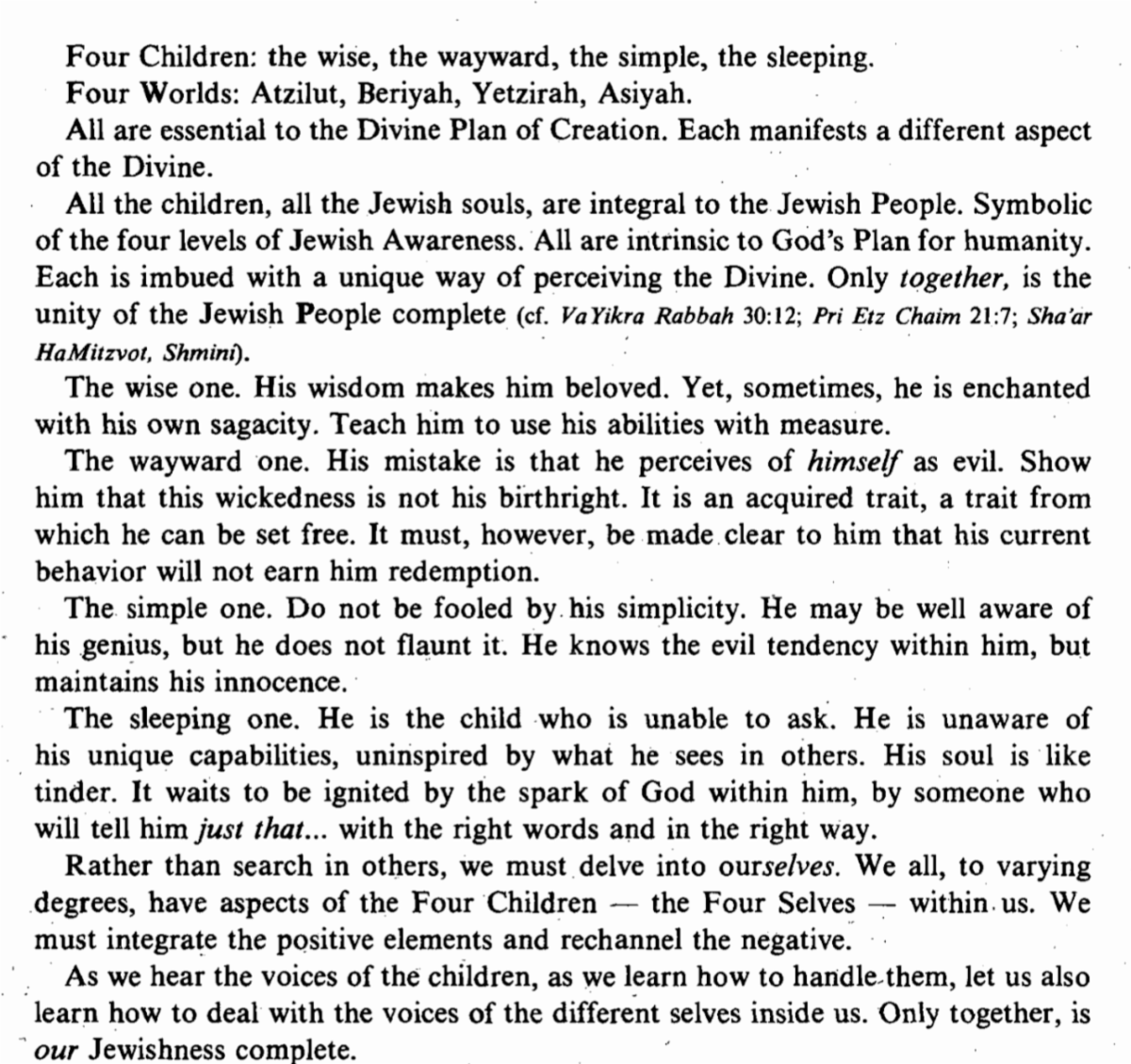
Here's Reb Nachman's take on the Four Children - a fascinating psychological study in which all four of them in fact reside within each of us.
In the commentary below, we read Nachman's take on the Matzah as the "Bread of Experience" and how the Seder itself, as embodied in the matzah, is sort of a Rorschach test of one's openness to Jewish experiences. In light of this past week's once-in-a-lifetime Seder experiences, it is hard to imagine that anyone was bored! If this was, for you, just another Seder, please take two Nachmans and see me in the morning. I'd love to hear your Seder stories from this week, especially if you happen to be among those that Nachman was talking about, the person who usually is heard saying countless times, "Are we there yet?" before we've even broken the middle matzah. What moved you this year? How was this Seder experience different from all others?
And finally, here's a small snippet of the book's extensive introduction, where Nachman tells the story of the Exodus, from the very beginning of Genesis. We read in this excerpt a fascinating psychological study of Pharaoh, the defeated despot - that first paragraph is a keen analysis of autocrats, then and now - and how the Israelites endured the night of terror with joyous expectation of their pending liberation, so joyous that even Pharaoh's own daughter was enticed to join them. For a guy who lived decades before Freud, he was speaking in the language of Freud and Kafka...and us.
As a way of recalling the first (and hopefully last) TBE Zoom Seder, here are my leader's process notes for what was a memorable evening that covered the gamut of emotions.
Judy Aronin started is off with a stirring rendition of "There's No Seder Like Our Seder."
I asked those who were among the most senior elders present to join me in the first line of Kiddush.
After the Kiddush, participants held their kiddush cups up to the screen. What a sight! The we showed other heirlooms and sacred family objects; several of us had hand-made Matzah covers created by our kids when they were at Bi Cultural Day School that looked almost identical. Hmm....
URECHATZ
We cleanse our hands from the the impurity of the virus and the paralysis of fear.
*** CHAT BOX MOMENT: How has the ritual of washing hands changed for you these past few weeks?
Karpas – p 10
Karpas—We hold the symbols of spring that remind us that the life of the universe continues its cycle of death and of rebirth. The new green sprouts break through the kittel, the lingering shroud of the snow of winter. Still, we dip the hopes of spring into the salt water of current loss.
PEOPLE CAN EAT!! PASS AROUND NUTS OR CHIPS…. Blessing
RA Haggadah supplement p.2
Susan Schneiderman
THE SYMBOLISM OF KARPAS
Why was it necessary to tell us that one must make a blessing on the karpas boray peri ha’adamah, since we are obligated to make a blessing on any food which we consume? The reason is based on a principle of Halakha: for anything which would normally be improved through cooking, we say the sh’hakol blessing when it is uncooked and the appropriate blessing In this case ha’adamah when it is cooked.
Based on this, the Maharil wonders why, if one uses parsley for the karpas, one would say boray peri ha’adamah? There is a great lesson to be learned from the fact that we say this blessing even though we eat it raw. This is an allusion to a Midrash (BT, Sotah 11b): when the Israelite women gave birth in the fields and the Egyptian soldiers would come to kill the children, the ground would swallow up the infants. The Egyptians would then bring oxen to plow up the ground in order to find them. After they left, they broke through the ground and sprouted up like weeds, as it says “I caused thee to multiply as the plants of the field.” (Ez. 16:7) In order to remember this great miracle, we eat greens and recite the blessing boray peri ha’adamah even though it is not necessary to recite this blessing under these circumstances.
*** CHAT BOX MOMENT
1)How do we traditionally explain karpas at the Seder? How does Rabbi Ginzburg tie this symbol into the story of Passover?
2)The Midrash borrowed from the Talmud is fanciful at best. Why offer such a strange explanation for this common symbol? What does it add to the story of the Exodus?
3)In these trying times, how can we find signs of God’s presence in the face of illness and suffering?
4)4. In what way is karpas a symbol of hope?
YACHATZ – larger piece for afikomen
Get rid of that hametz!!
Amanda Geffner and Sophia
CHAT BOX MOMENT: HOW IS COVID 19 LIKE HAMETZ? OR NOT?
Maggid
In a time of isolation, we must remember that humans are defined by our ability to speak. We cry across the electronic void hurling words of connection to those near and far. It is truelo tov heyot adam livado—it is not good for people to be alone.
We speak of the four expressions of redemption:
Freedom from fear
Freedom to hope
Freedom from inequality
Freedom to care
Ha Lachma p. 12 – we are in the darkness phase
Uncover matza
ENGLISH of Ha lachma – Mike and Rita Butterman
*** CHAT BOX MOMENT:
1)What do you consider your promised land?
2)What three objects would you bring out of Egypt?
“Everybody needs an Egypt…
And one long journey
that they’ll remember forever
on the soles of their feet” (Amnon Ribeck)
Four Questions
Araceli and Brendan Aronin
RA Supplement p. 3 bottom
a.What does it mean to “ask questions” when one is celebrating the Seder alone or with a small gathering? What questions might we ask this year to start off the Seder?
b.How is a does a virtual Seder feel different from a personal Seder?
c.Do you think that a virtual Seder will discourage or encourage conversation and questions? Why?
It's the Israelites' last night in Egypt, the night of the final plague, the slaying of the Egyptian first born. (Note: Sources are divided as to whether this plague targeted only males or included females as well.) When the Egyptians learned about this fearful plague, some Egyptian mothers decided to seek refuge for their firstborn in the houses of Israelites. Imagine the Israelites, sitting safely in their homes, and suddenly there's a knock at the door and an Egyptian mother is pleading for the life of her firstborn. Should the Israelites take in the Egyptian firstborn?
Discuss what people present would have done on that fateful night.
Read the following tenth century midrash (Exodus Rabbah 18:2): When Moses said: “I will smite all the firstborn” (Ex. 12:12), some of the Egyptians were afraid and some not; those who were afraid brought their firstborn to an Israelite and said: “Do please allow him to pass with you this night.” When midnight struck, God smote all the firstborn; as for those who took asylum in the houses of the Israelites, God passed between the Israelites and the Egyptians, depriving the latter of life while leaving the Israelites alive.
Message for us…. Not what God did – but what the Israelites did. The Israelites stood up to the divine will to save other human lives!!!!
Rather hesitantly, with small steps, terrified by darkness
Softly
Dedicated
Purposefully
with accuracy
And love
Carrying little signs like the wrinkles of passing time,
The transition of seasons, my changing body, the pearls of my longings.
*** Chat Box Moment:
Are the "signs and wonders" picket signs and perseverance? Or are they simply thoughts and prayers? Who do WE stand up for?
Play “If I Had a Hammer" – that’s our response - we welcome Peter, Paul and Mary to our Seder!
Ten Plagues p. 46
Dayenu - p48
RA – p 10
“Two walls of water are on my right and my left
Behind me are Pharaoh’s troops
and in front of me the desert
And perhaps the promised land.
That sums up my life.” (Yehuda Amichai)
P. 52 – Pesach, Matza and Maror – Beverly Stein
P. 54 B’chol dor vador – 55. Read all together and Victor Frankl reading on p 55 bottom
In every generation every one of us is obligated to regard ourselves as though we had gone through Mitzrayim. As it is said, "And you shall tell your child in that day, saying these words, "Because of what the Eternal did for me in bringing me out of Mitzrayim. " Thus, it was not our ancestors alone whom the Holy One, blessed be He, redeemed, but He also redeemed us with them. As it is said, "He brought us forth from there in order to bring us in, that He might give us the land which He swore unto our ancestors."
WINE CUPS ARE RAISED AND WE READ TOGETHER:
Therefore we are obligated, to thank, sing the Hallel, praise, glorify, exalt, honor, bless, elevate and raise our voices for joy to the Holy One, Blessed be He, Who performed all these miracles for our ancestors and for us! He brought us from human bondage to freedom, from sorrow to joy, from a time of mourning to a festive day, from deep darkness to great light and from slavery to redemption! In Your presence we renew our singing as in ancient days: Hallel-lu-yah Sing Hallel to G-d!
Show N’Tell 1 – Passover before during and after the Shoah. Show matzah baking 1943 Warsaw ghetto testimony to 3:59
Show N tell 2 – show family heirloom or other special Pesach object…..
p.58. Miriam’s Cup – Joan Rosenthal reads 2nd cup - blessing
Rahtzah--We wash again. This second washing is different for we have added a letter “heh” to the end of the word. We feel more connected to the holiness of the universe, to each other and to the Holy One, the “heh.” We can now bless our hands by reaching out to help those in need as it says with a strong hand and an outstretched arm you will help lift others out of their Egypt.
RA p. 1) – “I will sprinkle clean water upon you, and you shall be clean: I will cleanse you from all your uncleanness and from all of your idolatry.” (Ezekiel 36:25)
*** Chat box question: What activities (or ceasing of your normal activities) have you found to be reviving during these days of quarantine?
In this time of pause from “normal” activities, what societal or personal behavior have you been able to reflect upon as needing to change? What current shifts do you hope will be maintained when we resume life “after” Covid-19? .
p. 59 Motzi Matzah--We need to find (motzi) the matzah. All the blows of the taskmasters can be seen on its pockmarked surface. Yet it has become the symbol of freedom. It reminds us that once upon a time we left Egypt. The only thing we carried with us into freedom was matzah. It was enough-dayenu.
p. 60 Maror --We taste the bitterness of this very moment. For the reality is we never completely leave Egypt nor make it to the Promised Land. We are always on the way. It is in the seeking not the finding that life is lived. Yet, tasting matzah, we are better equipped to confront the bitterness that is our lot.
P.16 RA bitter and sweet
Korekh--The deeper truth is that there is no slavery and no freedom distinct from each other. They are not separate realms. Thus, we take matzah and maror and eat them together, no longer imagining that we can separate them. Korekh means to embrace---to embrace all of life.
Shulhan Orekh
Tzafun - Afikoman hidden beneath rolls of toilet paper
Afikoman – an amulet that protected from disease.
p. 68 – should we invite Elijah in???? 14 day quarantine?
4th cup – p.73
Had Gadya with sound effects. Cause effect…cascading events – all our destinies are interconnected and even the slightest act done by the least significant person can make a huge difference.
p. 85 Nirtza – “The seder ends in an outburst of longing.” (longing for the meal!!!)
Nirtzah--The Psalmist says: “open your hand and satisfy every living thingbe-ratzonwith will”. It is a mistake to understand that verse as meaning God gives every living being what they desire. That is not our experience. What wearegiven isratzon—a will to live, to love, and to give. Now we are ready for the journey to freedom that lies ahead.


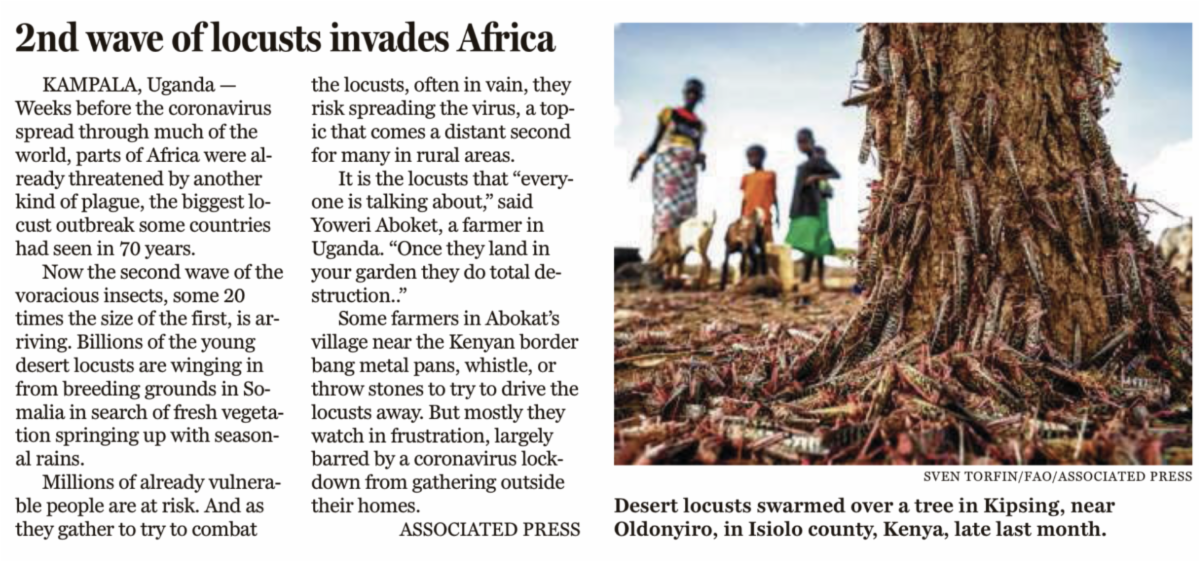 Locusts? Really? Do yourself a favor and don't enlarge the photo. It's not pretty. And so, OK, it's true that locusts