
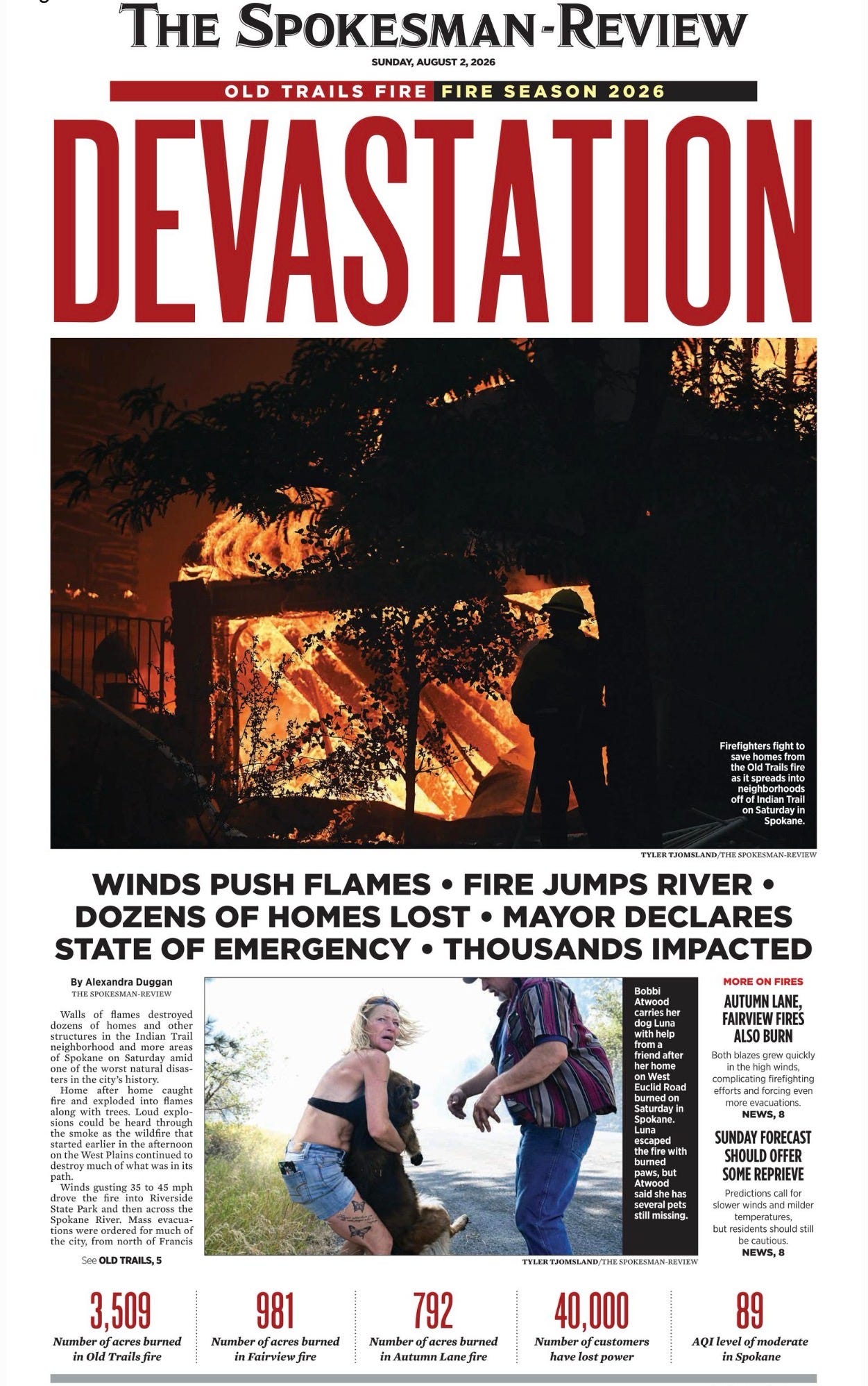
Sunday’s screaming headline from Spokane tells it all. The fires in the Pacific Northwest and the raging fires in France and Spain - and now Greece - which concurred with the three hottest days France and Spain have ever endured. The unthinkable is becoming the unavoidable - and although the Trump administration has itself become a five-alarm fire, with all the corruption and injustice, we can’t neglect perhaps its most destructive and indelible legacy, the gutting of our planet.
The current crisis calls for a drastic reimagining of our relationship with the world around us. We need to see the earth not as our garden to tend, or even as a precious gift on loan, but rather as part of the essence of who we are. The world is not around us, it is within us. It is part of us, as we are an inseparable part of it. One out of every five breaths we inhale is courtesy of the Amazon rainforest, which is itself being destroyed by the devastating combination of climate change and greed. The simple yet profound acts of eating and breathing literally make us one with God’s creation, and, as I claim here, with the Creator as well.

The following sermon was delivered on Friday evening, July 31 at Temple Beth Tikva in Madison, CT. The focus here is on a verse calling on us to gain deep satisfaction from the fruits of the Sacred Land, and then to convert those gifts into blessings. Then, on Shabbat morning, I led a discussion on a passage from that portion, the famous and controversial verses from Deuteronomy enshrined in Jewish liturgy which correlate moral behavior with consequences to the environment. The source packet for that session can be found below in the notes.1 The message is one of foreboding, with a glimmer of hope and a deep sense of responsibility to appreciate the bounty God has given us and to repair the damage to our environment.
Audio is above. To watch the sermon, click below:
TRANSCRIPT:
What can I say at the end of a month where Paris is burning2 and France has had the three hottest days ever recorded - in the same week! When there’s no rain in Spain – even on the plain - where from space the US Pacific Northwest looks like a smokestack and where all of us woke up recently to an orange, smoky sky?


The Jewish answer to this is found in our portion of Ekev, and it begins with the simple formula popularized by Elizabeth Gilbert and Julia Roberts as Eat, Pray, Love. Actually, for Jews it’s Eat, Love, Pray. And that’s the beginning of a solution to our problem.
Let me explain.
Several years ago, I led a trip to Central Europe for a group of about 30 of my congregants…. We stood in the gas chambers of Maidanek and the ruins of the crematoria at Auschwitz. We saw the miracle of Jewish resilience in Budapest and of a Jewish cultural renaissance in Krakow and Berlin. We came back primed to make a difference in our world.
It was a trip that changed all our lives, but it wasn’t easy, even on the most practical levels. Some of the restaurants we ate at over the course of our time there were well, not quite as Kosher as I would like. It’s just the nature of traveling to places where there are very few Jews. At one restaurant on the road from Maidanek to Krakow – a place that we called ahead and told them to offer fish and vegetarian options and no pork, and they said “no problem,” they had whipped up something special for us.
We arrive and they proudly bring it out: Chicken stuffed with Mozzarella. I had them take the mozzarella out. (“No meat.” “Lamb.”)
So it wasn’t exactly up to my standard of observance, but it kind of made me feel good that my congregants had not a wisp of concern about ordering things in front of me that their great grandparents living in those same shtetls probably would not have ordered in front of their rabbi. It meant that we could get past details of ritual correctness of what we were eating and focus on the enormity of what we were experiencing, the overwhelming sense of purpose just from being there. We had just been standing in a gas chamber a couple of hours before. Because of where we were and where we were going, this was the holiest unkosher chicken dinner I ever saw.
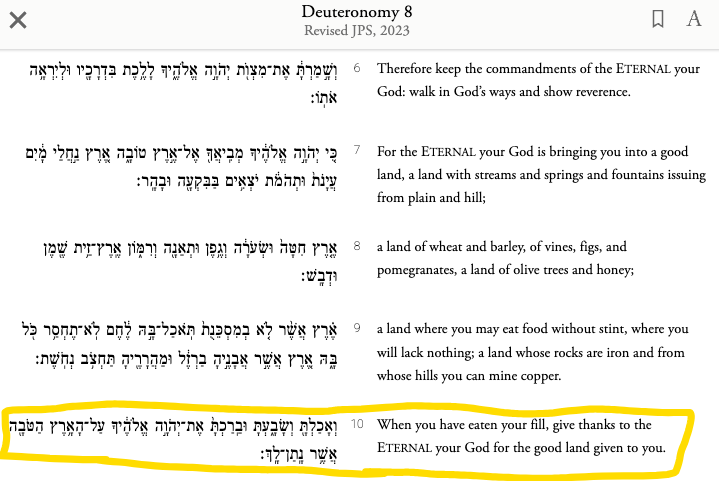
Our portion of is the second foodiest of the entire Torah (aside from Emor, which lists the kosher animals). You’ll find in Ekev the basic formula from which rabbis later constructed the Grace after Meals (Birkat Hamazon)3 – The key line is from Deuteronomy 8:10:
וְאָכַלְתָּ֖ וְשָׂבָ֑עְתָּ וּבֵֽרַכְתָּ֙ אֶת־יְהֹוָ֣ה אֱלֹהֶ֔יךָ עַל־הָאָ֥רֶץ הַטֹּבָ֖ה אֲשֶׁ֥ר נָֽתַן־לָֽךְ׃
When you have eaten and you are satisfied, give thanks to the ETERNAL your God for the good land given to you.4
“V’achalta V’savata Uvayrachta.” You’ll eat – you’ll be satisfied – and you’ll bless. Eat – Love - Pray
Why that order? And NOT the Wolfganger Rebbe’s version: Live, Love, Eat.
Why did Wolfgang Puck get it wrong? Why eat first– and then we bless? I know what you are saying. But John Boy Walton and his family always said Grace before the meal. Why do Jews do it after? I used to joke that first we want to make sure the food is good. There are blessings for before, like HaMotzi, but they are not as important.
A Hasidic master explained this ritual in this way. In the act of eating, we are sating ourselves with the waters of salvation, receiving divine flow directly from God. When we do that, we are given the most intimate of blessings. It’s as if God is nursing us - an incredible, non-patriarchal image. The shining face of God is present in the food we eat, a greater delight than any delicacy, this master said. And with that simple but profound sense of joy, we then transform that sacred act of eating into one of blessing.
It’s like a GI tract for the soul. Or a Jewish form of communion, a chance to absorb divinity – to make God a part of us. Now don’t misunderstand. We’re not literally eating God…we’re becoming one with God’s universe and with God’s message, with the divine flow – or shefa, as Kabbalists call it. We are, in a real sense, what we eat. Now for me the laws of Kashrut have a lot to do with that. But this verse doesn’t mention Kashrut at all. It’s something even bigger. Bigger even than food. It’s an expansive concept, one that could include, in the right situation, on the road from Maidanek to Krakow, chicken with mozzarella.
This source of this flow of abundance is not just food but all of nature, God’s good earth – and it’s described in great detail in this portion, right before that Grace after Meals verse that I mentioned – and it’s all about the land of Israel…
כִּ֚י יְהֹוָ֣ה אֱלֹהֶ֔יךָ מְבִֽיאֲךָ֖ אֶל־אֶ֣רֶץ טוֹבָ֑ה אֶ֚רֶץ נַ֣חֲלֵי מָ֔יִם עֲיָנֹת֙ וּתְהֹמֹ֔ת יֹצְאִ֥ים בַּבִּקְעָ֖ה וּבָהָֽר׃
For the ETERNAL your God is bringing you into a good land, a land with streams and springs and fountains issuing from plain and hill;
אֶ֤רֶץ חִטָּה֙ וּשְׂעֹרָ֔ה וְגֶ֥פֶן וּתְאֵנָ֖ה וְרִמּ֑וֹן אֶֽרֶץ־זֵ֥ית שֶׁ֖מֶן וּדְבָֽשׁ׃
a land of wheat and barley, of vines, figs, and pomegranates, a land of olive trees and honey; And fantastic hummus! And those breakfast buffets are to die for.
אֶ֗רֶץ אֲשֶׁ֨ר לֹ֤א בְמִסְכֵּנֻת֙ תֹּֽאכַל־בָּ֣הּ לֶ֔חֶם לֹֽא־תֶחְסַ֥ר כֹּ֖ל בָּ֑הּ אֶ֚רֶץ אֲשֶׁ֣ר אֲבָנֶ֣יהָ בַרְזֶ֔ל וּמֵהֲרָרֶ֖יהָ תַּחְצֹ֥ב נְחֹֽשֶׁת׃
a land where you may eat food without danger, where you will lack nothing; a land whose rocks are iron and from whose hills you can mine copper.
So it’s not just food – as it also says in this portion (famously), that man does not live by bread alone. It’s the totality, the whole package of abundance that fills us to the brim. This passage is describing one land in particular, of course; the Land of Israel, and there is a real Zionist message here. That land is so dear to us, so precious, and so fragile. It has no great river to feed it, unlike Egypt or Babylon or ancient Rome. The Land of Israel is totally dependent on God’s rain falling in its season and in proper amounts. Do you know how attuned our ancestors were to rain? Biblical Hebrew has at least seven different words to describe liquid precipitation, denoting different times and intensities of rainfall. And that doesn’t even include snow. One commentator says that God even times the rain so that it falls at night, so it won’t upset our schedules during the day.
This Land, our home, is where we take in all that is godly – V’Achalta – and everything comes from God.
The current crisis calls for a drastic reimagining of our relationship with the world around us. We need to see it not as our garden to tend, or even as a precious gift or loan, but rather as part of the essence of who we are. The world is not around us, it is within us. It is part of us, as we are an inseparable part of it.
And this land is where we are satisfied – V’Savata - and where we learn what it means to be satisfied. To be just so incredibly grateful for these gifts. Ayzehu Ashir – Pirke Avot asks. Hasamayach b’chelko. Who is rich? The one who is SATISFIED with their portion. This incredible land is ours on loan. We don’t own it. And we need to share our bounty.
And then, and only then, we bless. – U’Vayrachta.
To bless is not merely to utter words of thanks, but to recognize the enormity of that abundance, that gift of life, and then convert what we take in, into action – the bounty that we are given is transformed into a cornucopia of blessings that we send out into the world. Through our deeds of world repair. Through feeding the hungry or welcoming refugees to our table, through seeking peace and ending war, through promoting justice and kindness - and through preserving the planet.
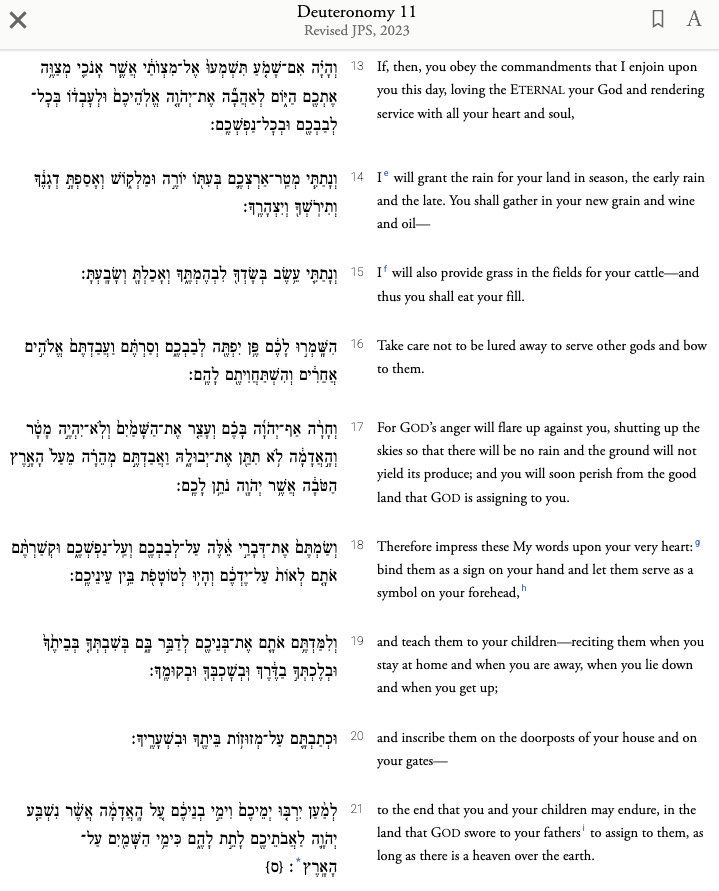
Because, Deuteronomy adds, all that abundance can be lost in a second if we prove to be unworthy of it. The portion demonstrates that in a paragraph that I’ll be discussing tomorrow, one that has found its way into the traditional liturgy as part of the Sh’ma.5
For while this might be the foodiest and most Zionist of portions, it’s also the most environmental. If we abuse this gift, we are told, if are not sufficiently grateful, if we fail to convert that divine flow into blessing, the flow will be interrupted. I had prostate surgery last year. Interrupted flow is not fun. And in the holy land, and by extension throughout the entire earth, the interruption will cause the plentiful rains to cease, the sky to dry up, the crops to shrivel, France and Spain to have their worst wildfire seasons ever, and half of North America to wake up in the morning with an orange sky.
Once a few years ago I saw Yellowstone burning. I stood at the side of Yellowstone Lake and not only could I see the wildfires, I could feel the rumble of the flames. It felt like a beating heart. I felt so vulnerable. And last year in a trip to Los Angeles I drove past entire neighborhoods gutted by the scorched earth of the Eaton fire in Altadena.
America is burning. So far this year, 42,651 fires have burned more than 4.5 million acres across the United States, according to the National Interagency Fire Center (which is a government agency so it’s probably an underestimate, unless they haven’t gotten to that website yet).
What else has been burning? Well how about the Amazon rainforest, often described as the Earth’s “lungs?” One out of every five breaths we take is courtesy of oxygen provided by the Amazon rain forest? A documentary broadcast this week by Deutsche Wella6 blames global greed, arson and illegal deforestation for the destruction of the rainforest in Brazil. “The main driver behind these fires is money,” it says. “Even protected areas are burning.”
These high cathedrals of terrestrial biodiversity, burning to the ground; all those layers of century-old chestnut trees, vines, rubber trees, palm trees, banana plants, orchids, passion fruit flowers; the macaws, toucans, sloths, jaguars, anacondas and ants that called them home. All the thirsty armadillos. A monumental universe….gone.
Holy places burning, everywhere we turn. God is there too. God is in the abundance and God is in the flaming devastation. The earth is burning.
We must care for it. It is part of us.
John Muir wrote: “One touch of nature makes the whole world kin…This grand show is eternal. It is always sunrise somewhere; the dew is never dried all at once; a shower is forever falling; vapor is ever rising. Eternal sunrise, eternal dawn and gloaming, on sea and continents and islands, each in its turn, as the round earth rolls.”
“The earth is the Lord’s,” says the Psalm. It is all holy. And it is all aflame! But God willing, if we can convert the abundance that we have been given, the divinity that flows through us at every meal, the oxygen from the Amazon, we can convert those spiritual calories into blessings, we can unseal the divine flow that has been reduced to a trickle and replenish our parched earth.
And so, I return to my initial question: What do you do in a week where Paris is burning, there’s no rain in Spain – even on the plain, when from space the Pacific Northwest looks like a smokestack and where we have looked up at an orange, smoky sky.
And my reply?
Three words. No, not “chicken with Mozzarella.”
V’Achalta, V’Savata U’Vayrachta.
Menachem Mendl of Kotzk called these three words the most fundamental mitzvah of all, because they are recited almost instinctually. It’s not about ritual practice, which has its place. It’s not about intricate Kosher laws. It’s a gut response to the pure miracle of being alive. We just need to tap into that divine flow and show thankfulness for our blessings by being a blessing.
Eat-Love-Pray.
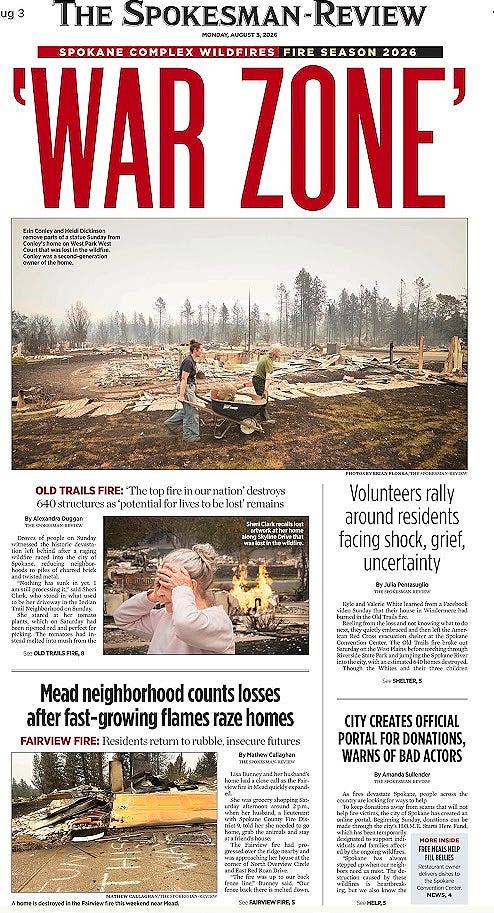
Jewish sources on food….
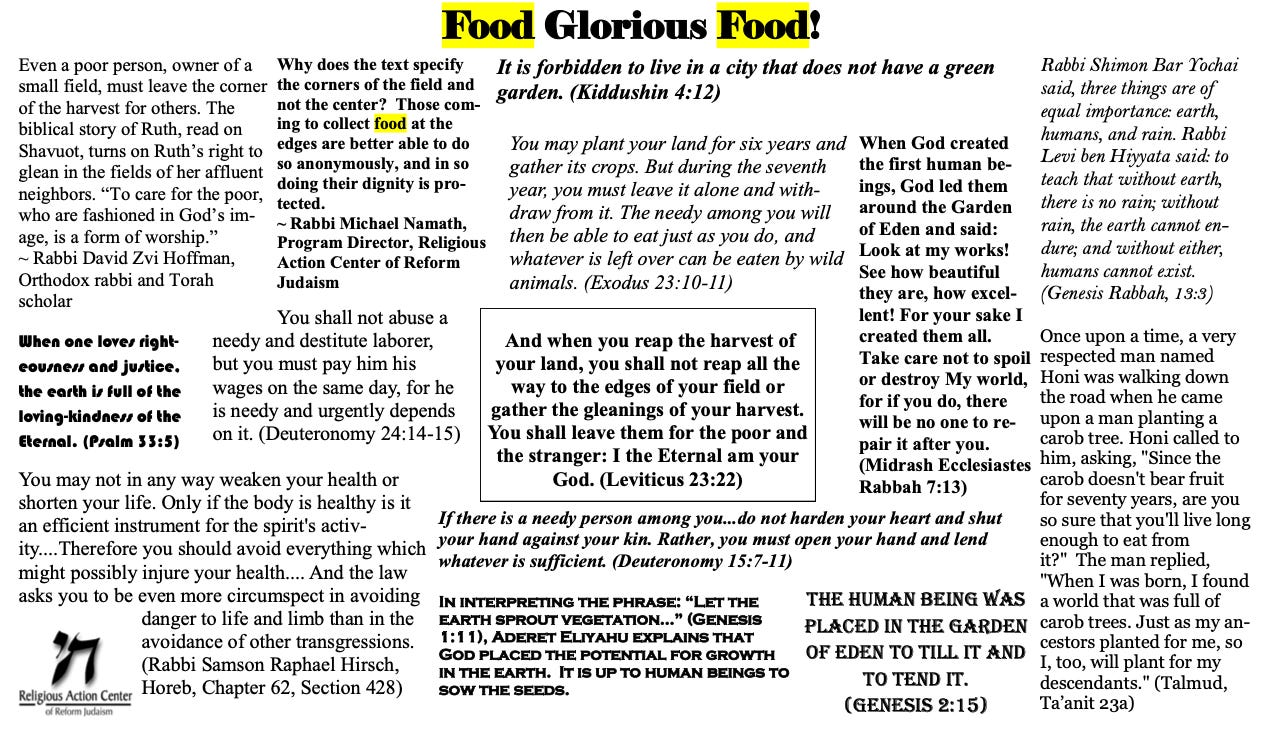
NOTES:

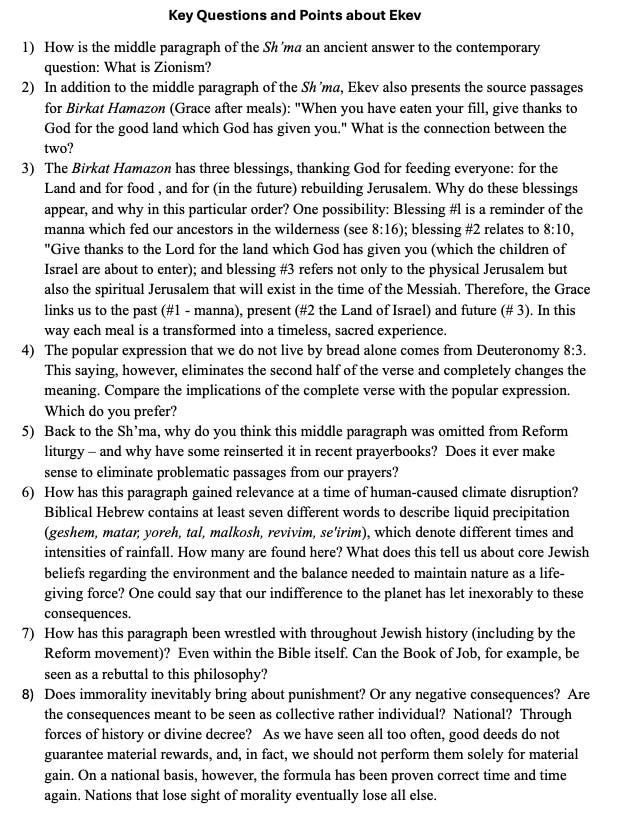
As Madeleine Schwartz, editor in chief of The Dial, wrote in the New York Times:
This summer has unleashed a special kind of hell on France: not just several heat waves with temperatures reaching as high as 112 degrees Fahrenheit, but drought and forest fires, some right next to Paris. On my street, the leaves have already turned brown; a once lush lawn now looks like burned straw. Across the country, farmers are reporting that crops have withered in the blistering conditions.
The extreme weather has forced the country in and out of a state of paralysis. Near Bordeaux, a wildfire has burned some 160 square miles; more than 220,000 people have been evacuated. Several nuclear power plants were temporarily shut down; trains were canceled because their route brought them too close to a fire. Paris landmarks like the Louvre and the Eiffel Tower have had to close early because of the heat, leaving tourists and the businesses that cater to them grumbling. As one crisis follows the next, the government has offered only an incoherent response.
ON JUDAISM AND FOOD:
See the complete Birkat Hamazon (Grace after Meals) here. See it explained in Wikipedia and in the Virtual Jewish Library. See and download also this excellent collection of source materials on food in Jewish tradition:

For a more complete version of that packet, download the two sourcebooks below:
See also A Prayer for Millions Facing the Disgrace of a SNAP Hunger Crisis
Complete section of Deut. 8:6-10
Second paragraph of the Sh’ma
DW documentary:
