
When she was running for president, Elizabeth Warren had a plan for everything. Apple famously has “an app for that.” And we have psalms - one for every mood and life situation imaginable.
Psalms are under-utilized tools for restoring a sense of balance to our tumultuous lives, for Jews, Christians, atheists, polytheists, anyone who sees our most ancient poetry as a key to accessing the most universal - and most human - themes.
And there’s a psalm for everything.
For those seeking to be calmed from panic or soothed from pain, there are psalms for that. Below you’ll find psalms for…
…accountability, justice, vindication, celebration, letting go, affirmation, exuberance, renewal, gratitude, wonder, amazement, healing, perspective, hope, desperate faith, breaking destructive habits and harmony…
…plus a playlist for Psalm 133, the Psalm of Unity.
And that’s just scratching the surface of these 150 masterpieces of ancient poetry (plus some bonus psalms for Dead Sea Scrolls fans).
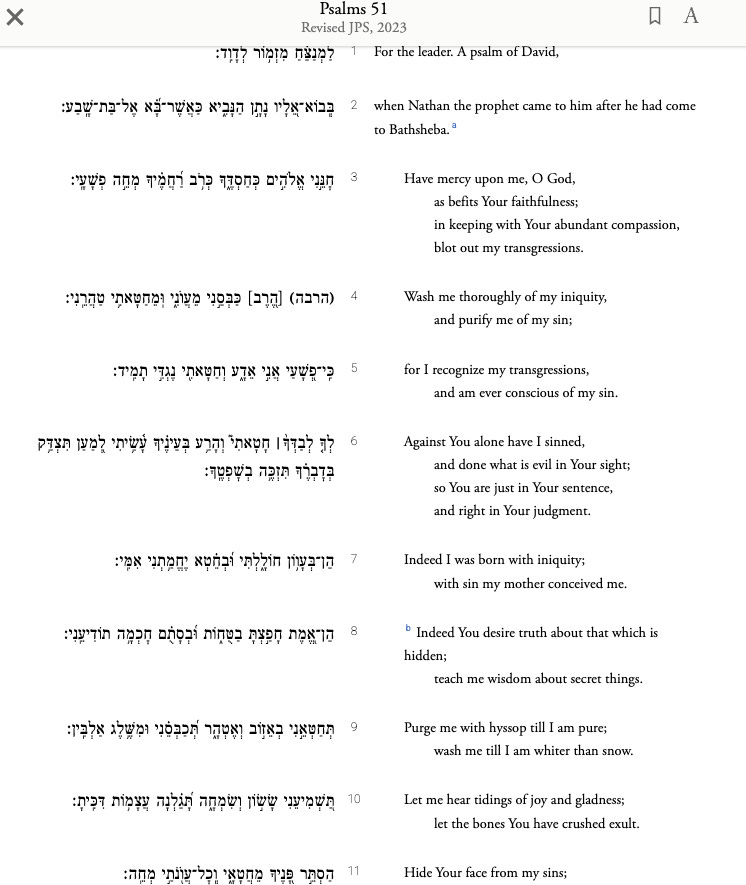
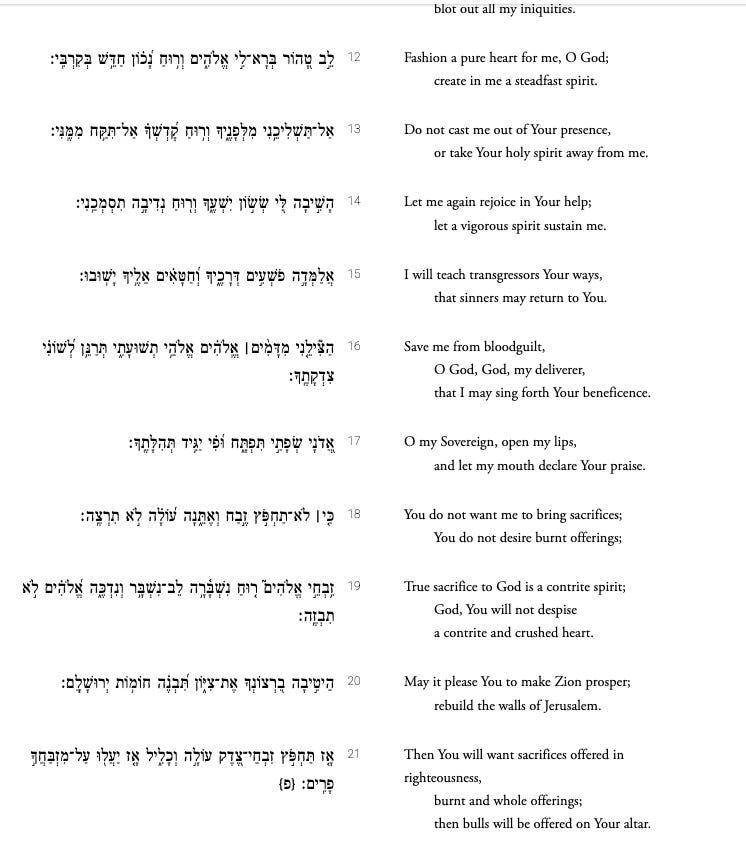
In the video above, I discuss Psalm 511, whose theme is ACCOUNTABILITY (You can generate a transcript if you would rather read than listen). Clearly it’s one that is relevant right now, given that our president and his collaborators refuse to take responsibility for any misdeed. Apologizing is their deadliest sin, right up there next to honesty. They put a lie to their own projected accusations of “Trump Derangement” with unmoored demonstrations like Pam Bondi’s all-timer this week in Congress. In any event, I’d much prefer being accused of derangement to being complicit in the great moral unraveling of the Trump-Epstein era.
The Psalms keep us morally moored, and at a time of increasing artificiality and sociopathology, they simply keep us human. As we lurch forward at a time of an increasingly uncontrollable AI, staying grounded in our humanity is becoming increasingly essential, which speaks to the need for the Humanities in general, and immersion in great literary works like these poems, which have been marinated in centuries of interpretation, experience and pure human passion.
Here are some of my faves, listed by theme. Whatever your mood, there is a psalm for that.
JUSTICE: For those wanting to stay vigilant in the face of unceasing assaults on bedrock principles of justice and equality, I highly recommend Psalm 82, which in the Jewish liturgy is the Psalm of the Day for Tuesday. When I used to lead my synagogue’s service every Tuesday, I often read a couple of verses of this poem in English, simply to remind myself of the task at hand:
In your judging,
Consider the modest, the orphan.
Find justice for the destitute
And the oppressed.
Assist the poor, the down and out.
Save them from the bullies’ hands.
When I read those words, I’m not asking God to remember the victims for me, but rather that I remember them for God, that I become God’s hands. I seek the strength and fortitude to act on God’s behalf.
VINDICATION: If you are looking for a sign from heaven that corruption might soon be removed from our land, there’s a psalm for that too. Psalm 109 is God’s way of assuring that the swamp will soon be drained, particularly verses 7-8.
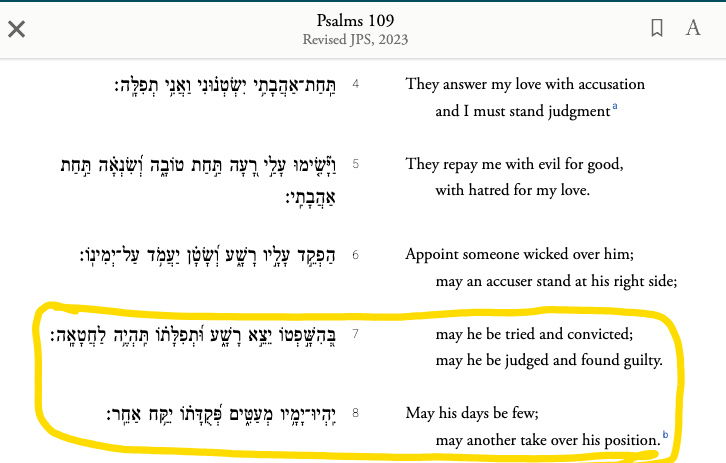
If you ever feel an itch to sit behind home plate or the end zone and hold up a biblical sign, you can trade in that ever-popular “John 3:16“ for something a little more fitting for these times. Hold up “Psalm 109:8,” and you’ll get lots of clicks - and maybe a few dirty looks!
Rabbi Shefa Gold, a leader in Jewish renewal offers this companion guide to the daily psalms. With that aforementioned Psalm 82, she focuses on the final verse in fostering mindfulness:
Kumah Elohim Shaftah Ha-Aretz - Arise God and judge the land. (Psalm 82:8)
She adds:
As we explore the inner landscape, we find places of shadow - corners of the heart that are unhealed or hidden in shame. We call on the God-force within us to rise up, to reveal the Divine perspective so that the entirety of our inner landscape can be bathed in Awareness.
CELEBRATION: There’s a psalm for Thursday too: Psalm 81:
Sound a shofar at the New Moon....
at the moment of concealment/potential for our Celebration Day.
It is a statute for Israel; it is a rule for Jacob. (Psalm 81:4-5)
Gold comments:
We live our lives in the holy cycles of exile and return, forgetting and remembering, going out from ourselves and returning again to center. We cycle between being Jacob, the ego struggling to manipulate the world, to being Israel, the one who encounters God directly. Through our calendar and festivals we attune to the cycles of the moon whose waxing and waning reflects our own spiritual cycles. As awareness of those cycles deepens, the circles of our lives become spirals, connecting the mysteries of the universe with our own Center.
LETTING GO: For Psalm 93, the Friday psalm, Gold focuses on verse 2:
Your throne was long ago secured; beyond eternity are You! (Psalm 93:2)
And then she adds:
As we prepare for Shabbat, we gradually release our grip on personally mastering this world. No matter how we have struggled, succeeded or failed during this past week, today we prepare ourselves now to let go of the illusion of control and surrender our cleverness to the vast Intelligence that has been in charge all along.
AFFIRMATION: if you are in need of a moment of sweet surrender and humility, Psalm 93 is the one for you. This psalm can also provide a moment of hope for the ultimate triumph of good over evil, of sacred aspirations over profane realities. Which is why a perfect musical setting for this psalm is Shlomo Carlebach’s Krakower Niggun, in which Carlebach (who admittedly has his own complicated legacy) envisions the souls of the martyrs of a destroyed Krakow synagogue returning home, dancing. The ultimate triumph of life. When we worked together in Stamford, Cantor (now Rabbi) George Mordecai, one of the most spiritual and creative musicians I’ve ever met, set Psalm 93 to that melody.

You see, the word aydotecha - decrees - circled in yellow above, contains the word ayd, which means witness, and ayda, which means testimonies. When I returned from my first trip to Poland in 2010, having borne witness to the destruction of Jewish communities and having become the embodiments of their legacy, their very lives, I prevailed upon George (and a very reluctant choir) to descend from the bima on Kol Nidre night that year, which happened to be a Friday, when that psalm is recited, and to dance. Dancing on Kol Nidre night was not something my congregation (or, frankly, most congregations) had remotely considered before then. And while at times I felt like Kevin Bacon in “Footloose” avoiding John Lithgow’s icy stares, the message was powerful and enduring - and dare I say, liberating - celebrating the triumph of life in the face of death, which is, in itself, a prime message of Yom Kippur.

Here is a recording of that historic marriage of liturgy and melody, led by Rabbi Mordecai and myself.
And here is the original video of my March of the Living group of Jewish teens dancing to that melody within the synagogue in Krakow where the souls of the martyrs danced in Carlebach’s dream, and perhaps still do in ours.
Each of the Psalms of the Day can become anchors for moments of mindfulness to direct us and ground us before we head out on our ventures of world conquest - or simple survival.
At the onset of Shabbat there are seven psalms chanted, known as Kabbalat Shabbat. See a literary commentary on the Kabbalat Shabbat psalms by Benjamin Segal, from his book, “A New Psalm,“ along with my own poetic interpretations of the Kabbalat Shabbat psalms.
For EXUBERANCE, there’s Psalm 95.

RENEWAL: Psalm 96, to sing a new song unto God.

GRATITUDE: If you are feeling supremely grateful, Psalm 92, the Shabbat Psalm, is the one to sing.

WONDER: If you wish to express sheer awe in the face of nature’s wonders, try Psalm 148.

AMAZEMENT: To express more joy and wonder at the world around us, head right to Psalm 8
When I behold Your heavens, the work of Your fingers,
the moon and the stars that You set in place
what is man that you have been mindful of him,
mortal man that you have taken note of him?
Let’s look at some psalms recommended by a great Jewish spiritualist of the 19th century, Reb Nachman of Bratzlav. There are stories of how, as a boy, Reb Nachman of Bratzlav would escape to a small loft in his father’s house that was set aside as a storehouse for hay and feed. All day, he would hide himself and chant psalms. Nachman said that the key is to be able to find yourself in every psalm. Many of the psalms are about enemies and war. Nachman would see these as being equivalent to the war we are fighting within our own souls.
HEALING: Take Psalm 105, which is part of the collection of ten healing Psalms prescribed by Reb Nachman called the “Tikkun Ha-klali.”
Here the psalmist fires off ten staccato charges in five sentences, saying essentially:
Stop feeling sorry for yourself and treating yourself like a victim. Here’s what you need to do to get out off the mat: Be thankful, call to God, sing, give praise, seek, remember, speak of the Sacred and search for the divine presence.
Where illness or depression makes us passive, this Psalm activates us.
PERSPECTIVE: Or take a look at Psalm 90, verse 12:
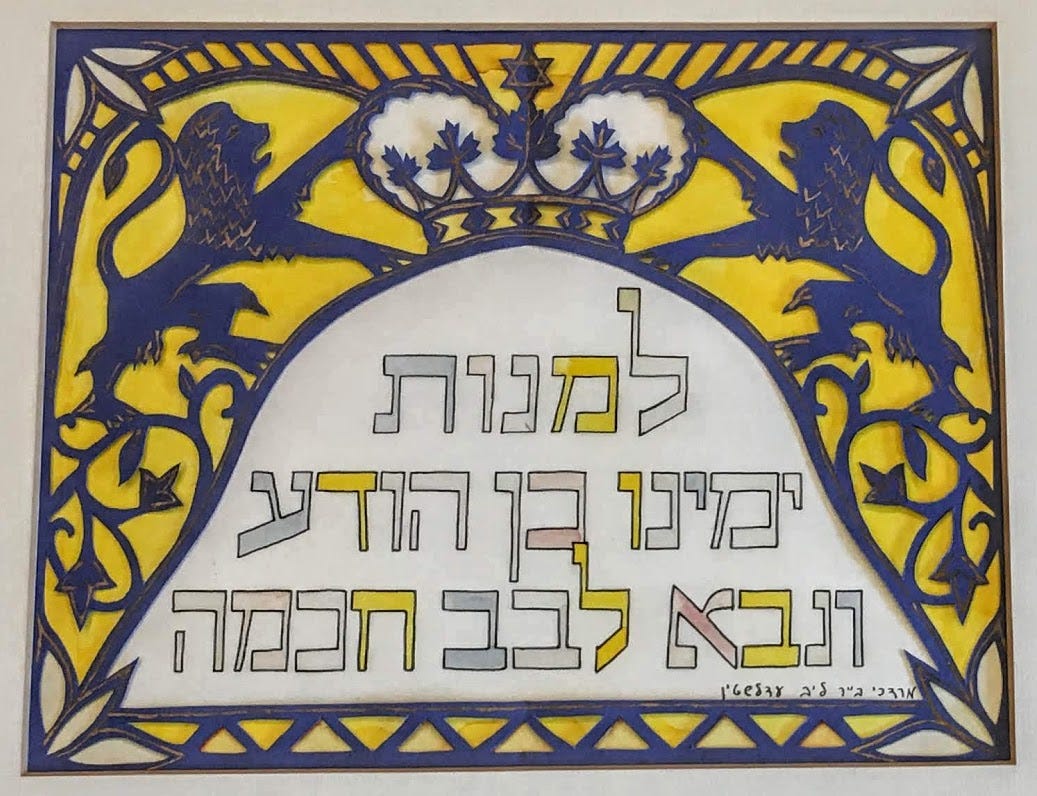
“So teach us to number our days so that we may gain a heart of wisdom.”
I think about that psalm every day and it has become the guiding credo of my life. On the wall of my home office is a paper cut with those very words on it, given to me by Marty Edelstein of blessed memory when I left my first congregation in Peekskill, NY.
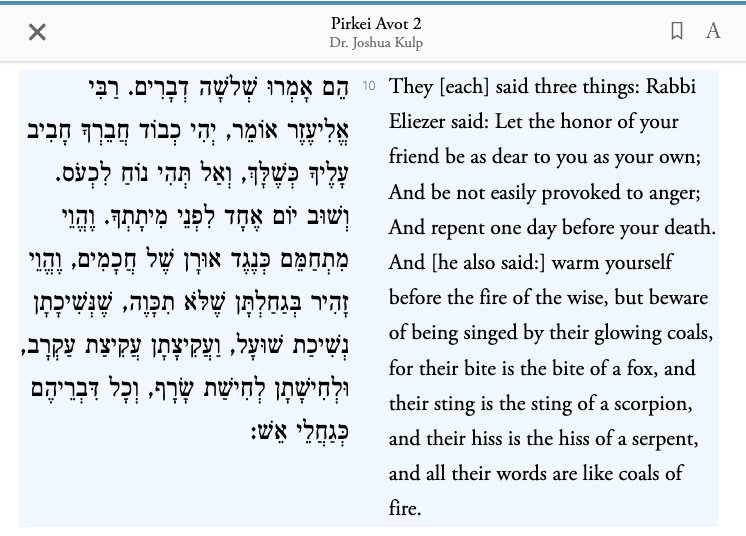
Our Sages said (Avot 2:10), “Repent one day before you die.”2 The medieval commentator Meiri writes, “A person should really examine his deeds every day.” For we can never know when that last day will be.
We need to ask ourselves, as role models to children, what will matter more to them thirty years from now, that trip to Hawaii or that march to protest injustice? Plastic or paper? Native Americans, when they make a key decision, ponder what the impact will be on the 7th generation. We need to take the long view as well, to make each day count.
HOPE: Psalm 126 is perhaps the most familiar of the “Psalms of the Steps,” those psalms chanted originally as pilgrims ascended the fifteen steps up to the temple. This one is also found in the grace after meals on Shabbat and festivals:
When the Lord restores the fortunes of Zion-we see it as in a dream-our mouths shall be filled with laughter, our tongues, with songs of joy.
Laughter leads to joy and joy to acceptance.
DESPERATE FAITH: Another of those Psalms of Ascents is Psalm 130, which cries out to God “from out of the depths.” We wait, and wait, and wait, for an answer to our pleas. The great Israeli musician Idan Raichel’s midrash on that psalm has become an international hit.

BREAKING DESTRUCTIVE HABITS? There’s a psalm for that too. Psalm 118 states, “Min ha-Metzar Karati Yah.” “From out of the straits I called upon the Lord.” The plural for metzar, metzarim, found often in the Bible, is equated to Mitzrayim, Egypt. So when we call to the Lord from out of the straits, we are calling from slavery -- the slavery of habit and addiction. See this article for more.
We are pleading for a very personal liberation.
HARMONY AND UNITY: For community to work, everyone must be willing to make difficult sacrifices. Psalm 133 is a poem many people of different faiths know, because of its musical variations and because of its profoundly hopeful message: “Behold, how good and how pleasant it is for brethren to dwell together in unity.”
“Heenay mah tov u’mah nayim, shevet achim gam yachad.”
Here are a number of versions of this verse, spanning across time and around the world. Most of them are Jewish, but I’ve also included some Christian versions. And if that’s not enough, here are some more, from the Zmirot database, and you’ll also find below a classical version, Leonard Bernstein’s Chichester Psalms.
Spend some time today listening to Psalm 133, presented here in so many diverse styles, Hasidic, Progressive, Ugandan, classical Israeli, choral, upbeat, reflective, Mizrahi (Benny Elbaz, a Sephardic star) and, oh yes, Harry Belafonte. Find a way to allow its universal message, expressed in so many diverse and particular ways, to seep into your heart and produce a harmony unique to you, forging new connections to our common humanity.
That is the magic of the Psalms and their extraordinary power to speak to us in this moment.
Have a peaceful and rejuvenating Shabbat, Valentines Day and Presidents Weekend. Remember on the Hebrew calendar, the month of unmitigated joy, Adar, also begins this coming week. Add to that my birthday (shhh) - and we can discover lots of ways to find love, connection and humanity in our lives.
Shabbat Shalom.
HERE’S MY PSALM 133 PLAYLIST:
From the nearly lost Jewish community of Uganda.
One of my favorites, from the Hasidic Song Festival. Hinay Mah Tov begins at about 37:10 in. Notice that back then, Hasidic music was sung by women and not all the men wore kippot. It was religious music that was embraced by all the people.
Psalm 51
Avot 2:10

No comments:
Post a Comment