If ever Americans needed to celebrate July 4, this is the year. And if ever American Jews needed to observe July 41, this is absolutely the year. We are all being distracted and often enraged by attacks - or presumed attacks - on our patriotism, our integrity, and even our safety. Some of that is intentional, as a means of dividing us, frustrating us and making us feel powerless.
July 4 reminds us that we have the power to make miracles happen and that, as Americans, we have so much to be grateful for - and so much work left to do.
As Rabbi Michael Barkley wrote,
July Fourth is a time for us to be happy and grateful. We celebrate our ability to live securely and worship freely as Jews in this country — opportunities that did not exist for many of our ancestors and still do not exist for some Jews around the world today. And we rejoice in the manifold blessings of a country whose values are so consonant with our own.
This commemoration is so rich in symbolism and ritual that it almost feels - dare I say - like a Jewish holiday. I once imagined how, were it in fact a festival ordained by the Torah and plotted out by the rabbis, Jewish legal sources would ordain its observance, especially when it coincides with Shabbat, as it does this year. Here is an updated version.
The following deliberations on America’s liberation are to be taken with the tongue well ensconced in-cheek:
So, with Independence Day coinciding with our day of Interdependence, Shabbat, I am sharing here, as a public service, some key halachic opinions from the archives. This is obviously a parody, but it authentically shows how the rabbis, ancient and modern, develop Jewish religious practices. This is how - if you’ll pardon the expression - the sausage is made.
I’ve done some research to see what Jewish practices are in order and came across a little-known rabbinic source related to “Ethics of the Fathers,” called “Ethics of the Uncles.” There I found the following, attributed to “Dod Sh’muel,” or “Sam, the Uncle.”
The relevant section is embedded in a chapter entitled, “DOD SH’MUEL’S TOP TEN LISTS.” WHEN JULY 4 COINCIDES WITH SHABBAT, THE FOLLOWING ARE ADDED TO REGULAR SABBATH PRACTICE:
If July 4 Coincides with Shabbat...
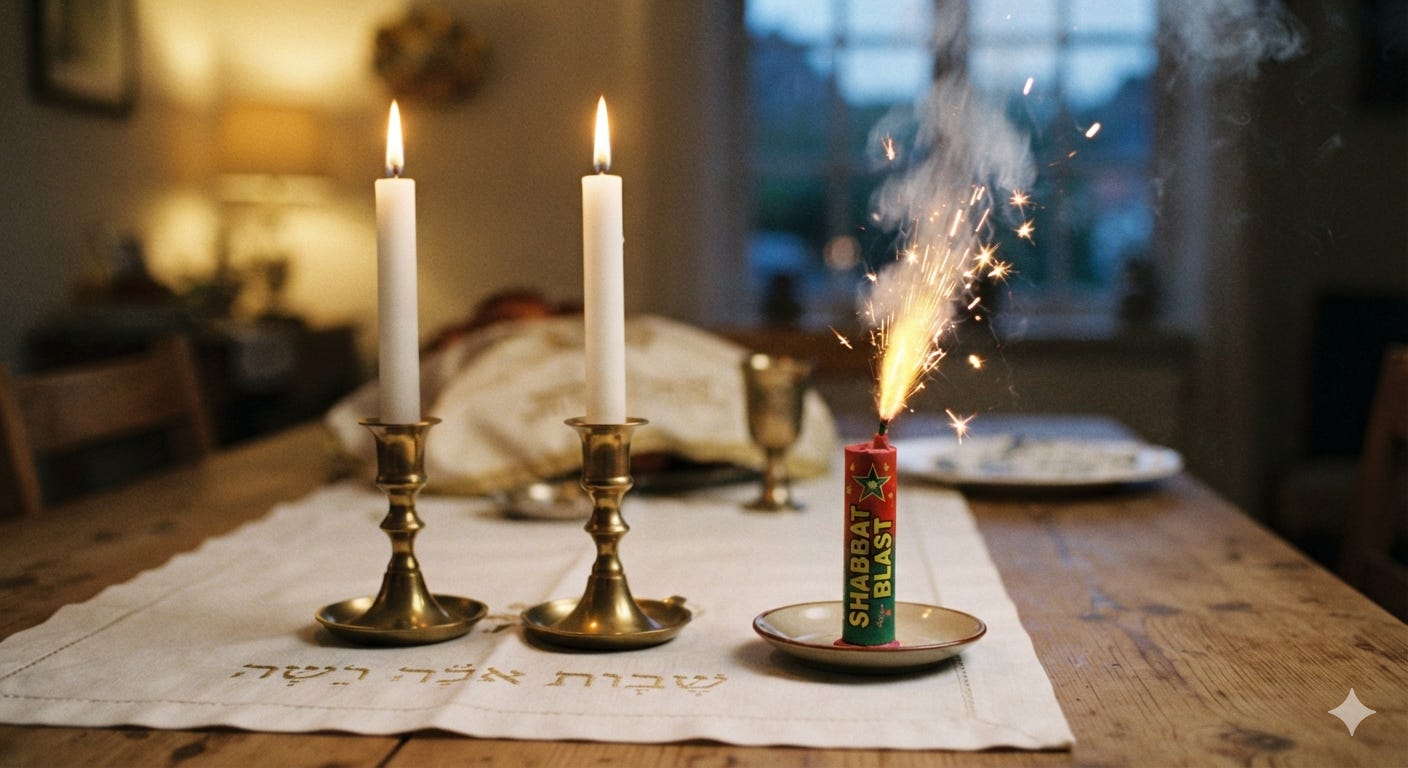
1) We begin the Shabbat with not 2, but 3 candles. The third is to be lit by remote control from a safe vantage point at least 100 feet away. (See the photo at the top of this Substack. Do not try this at home.)
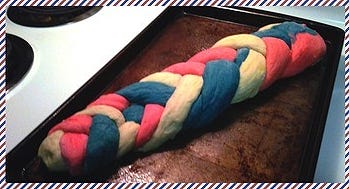
2) At the Sabbath meal, 2 hallahs are served, each must have apple pie filling. Some say peach. Others argue for strawberry. The Starbucker and Dunkiner Rebbes ordain “one may be apple, but the other must be pumpkin spice.” To which Rabbi Yossi said, “Pumpkin spice? Not in July, idiot!”
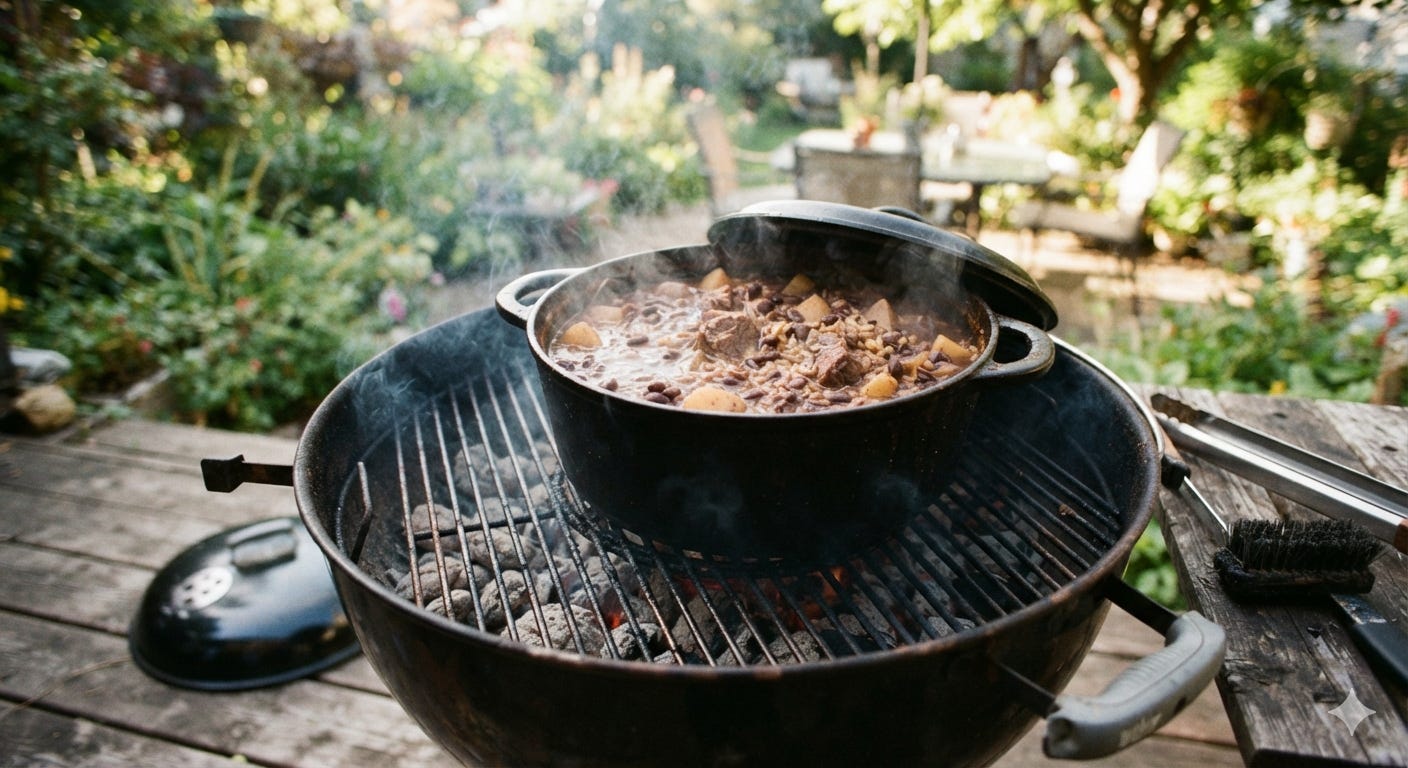
3) Cookouts are allowed, as long as the charcoals are lit before sunset and the food is prepared beforehand. In other words, cookouts are not allowed. (See the AI-generated photo above featuring a crock pot with cholent on a grill. Not recommended!)
4) It is customary to sing Adon Olam to the tune of “Yankee Doodle Dandy.” This one is not only allowed, my congregation’s custom has been to utilize multiple American classic melodies to this prayer, which typically ends the service and has no specified liturgical melody. There are hundreds of known melodies for Adon Olam (Here are 34 of them). Below is one sung to a tune from Hamilton.
5) When reciting the central prayer known as the Amida, instead of facing Jerusalem, which is the prevailing practice (and has been for centuries when Jews pray), we face Washington D.C. Or not… depending on your political inclination. Or, to keep Washington close to your heart, fill a large bowl of water with green food coloring, place it before the ark and then you can symbolically face the Reflecting Pool. (See also my recent Substack comparing the desecrated facade of the Kennedy Center to the Western Wall).
6) When walking around with the Torah, it is customary for the cantor and rabbi to do a do-si-do with the president, singing “Turkey in the Straw,” (click here to see actual turkeys dancing) all the while contemplating the great mystery as to whether the Jewish circle dance (hora) and American square dance can ever be compatible. Can we square that circle?
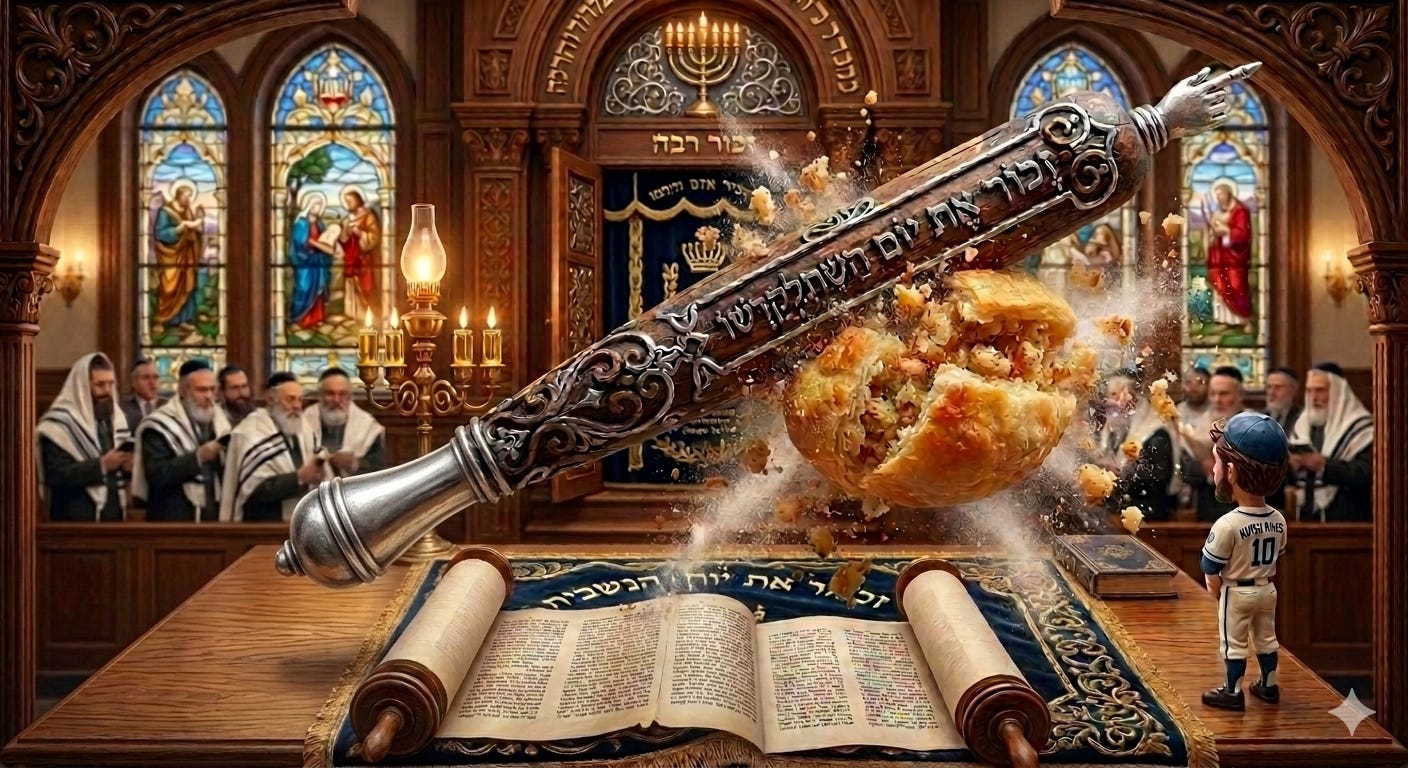
7) At the beginning of the Torah reading, the Gabbai (sexton) shouts, “Play Ball” and the reader takes the yad (pointer) and tries to knock a knish out of the park. (The AI-generated prompt above has some doozy errors - and no women, which indicates an Orthodox bias).
8) The popular Shabbat afternoon dish known as cholent, featuring simmering vegetables, beans and often chunks of meat, is pureed so that all the items blend together and then simmered in a melting pot, the very American term derived from Israel Zangwill's very Jewish 1908 play The Melting-Pot.2 The simmering stew is traditionally eaten with a hundred hot dogs - on Coney Island in less than five minutes, or in Brighton Beach with a side of borscht - after which a nap is in order, in a room far away from everyone else.
9) NASCAR runs the “Shabbat 500.” Precisely at sundown, all the drivers get out of their cars and run for the finish line.
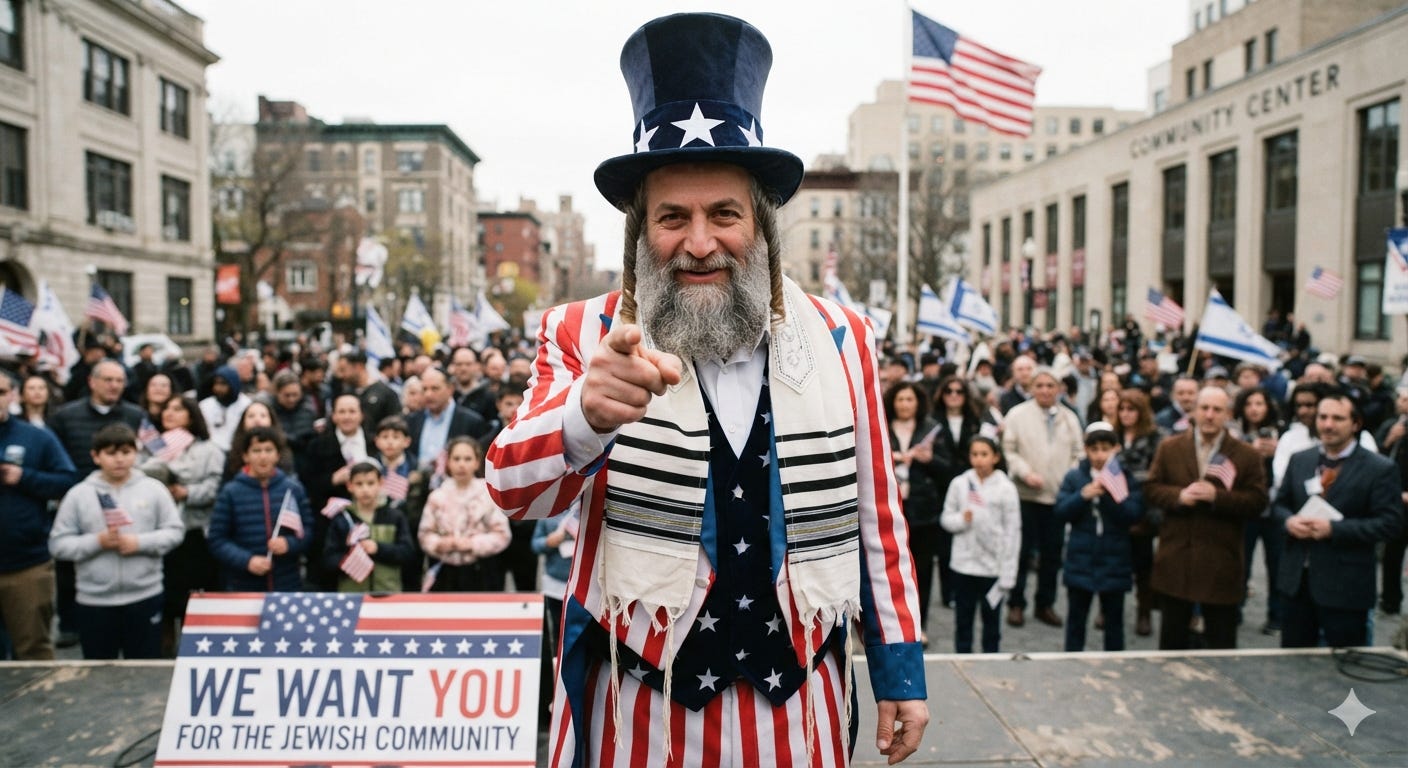
10) Finally, for one day of the year, Lubavitch Hasidim replace their furry streumels with patriotic top hats, and then go around to Jews imploring, “We want YOU.”
Recalling Lenny Bruce’s classic routine, Jewish and Goyish:
Celebrate is goyish word. Observe is a Jewish word. Mr. and Mrs. Walsh are celebrating Christmas with Major Thomas Moreland, USAF (ret.), while Mr. and Mrs. Bromberg observed Hanukkah with Goldie and Arthur Schindler from Kiamesha, New York.
The Melting Pot (source: PBS)
1908 - Israel Zangwill’s play about immigrants in America becomes one of the most successful productions in the history of Broadway. Zangwill updates the story of Romeo and Juliet. This time, instead of feuding families in a medieval Italian city, the lovers were from Russian Jewish and Russian Cossack families. Zangwill’s play emphatically claimed that America was a new country where the old hatreds had no place. For the new immigrants in America to try to keep alive their old hatreds and prejudices was pointless, evil, and probably impossible.
God, Zangwill claimed, was using America as “a crucible” to melt the “fifty” barbarian tribes of Europe into a metal from which He can cast Americans.
Today, the melting pot metaphor is often taken to refer to soup, or perhaps fondue, into which cheese is melted. This robs Zangwill’s message of much of its power. Zangwill’s “crucible” was a much more violent idea. A crucible is used in metallurgy to reduce ores and metals to their liquid form so they can be purified, mixed, and poured in castings. Zangwill was telling his audience that they were being molded in the fires of the Almighty into a new thing: the American. And they loved it.
Zangwill’s religious interpretation of America was not new. The Pilgrims thought that the New World was divinely provided 250 years before “The Melting Pot.” Americans had referred to their country as the New Jerusalem for many years. Lincoln’s Second Inaugural Address explained the terrible price of the Civil War as the punishment of a just God for the sin of slavery. But Zangwill had found exactly the right metaphor to translate the urban immigrant experience into American Exceptionalism. If they would but suffer to be melted in the pot, then they would become just as American as anyone else

No comments:
Post a Comment