Friday, December 23, 2016

Shabbat-O-Gram for December 23

Shabbat-O-Gram

Tis the Season for Mitzvot!

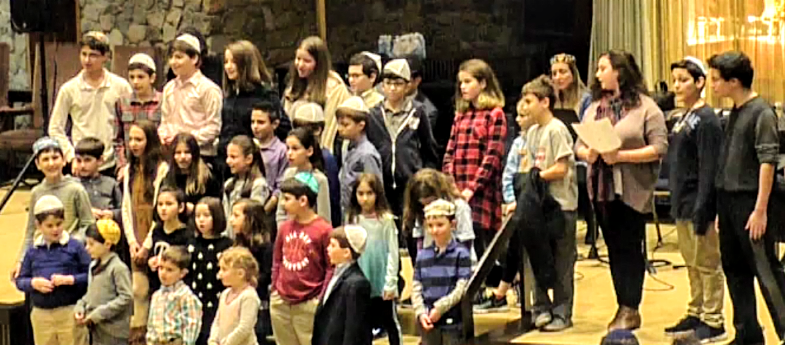
TBE students cast their Mitzvah net in all directions this week, visiting residents at Brighton Gardens, singing at last Friday night's Kabbalat Shabbat service, and preparing gift packages for the JFS Adopt-a-family program and for the Jewish Home (where my mom was a happy recipient).  See more photos in our TBE winter album.  


Thank you to the Temples!

And speaking of special Mitzvot, a special thank you to Ken and Amy Temple for organizing our annual Christmas Eve visits to local agencies.  This year, we will be visiting three places, New Covenant House, Pacific House and Inspirica.  More than 100 people from 44 TBE families will be assisting in this effort on site as singers and servers (if you total up all the Hanukkah candles lit during the 8 day festival, that's one family per Hanukkah candle), and another 35 families who won't be on site made donations of food and supplies.  Truly a massive effort on behalf of Ken and Amy, as well as all who are giving of themselves this weekend.  I will be bringing electric Hanukkah menorahs to each location, so that we we may celebrate not one but two holidays this year along with our neighbors.


Shining the Light in Berlin


Given the horrible terror attack in Berlin this week, it makes us appreciate all the more our innate ability as human beings to pierce the darkness with ever-increasing light.  We grieve with the people of that city.  The Hanukkiah that will glow once again this year overlooking the central symbol of that city, a place that has known so much darkness, demonstrates that explicitly.  So will our visit to some of the darkest places of human history this summer.  Our Jewish Heritage Tour will also pierce that darkness.  Our group is growing and the registration deadline is fast approaching.  Check out the itinerary by clicking here.


Hanukkah Nights (and Shabbat)

The cantor and I will both be here for services over the holiday week. Join us!  Also, 
we are delighted to be partnering with "Members of the Tribe" family Facebook group for the best young family Hanukkah party in town! If you are around on Tuesday and have young kids, this is the place to be! You can sign up here. See the flyer at the bottom of this email for more information.

With Hanukkah just a week away, don't forget to send me your candle lighting photos for our Hanukkah album.  See some of last year's here.

If you are looking for a one page printout of the Hanukkah blessings and a morsel of learning for each night, JTS has provided just what you are looking for.  You can print out the pdf here.


And if you were stymied by last week's snow, you can read Evan Goldblum's Bar Mitzvah commentary on Vayishlach here.  

Mazal tov to him and a special mazal tov also to TBE's Rick Redniss, deservedly chosen as Stamford's Citizen of the year.

Aphrodite and the Rabbis - and the December Dilemma

 
A zodiac mosaic at the ancient synagogue in Sephoris (Tzipori) in the Galilee.  
That's Zeus-Helios, the sun god, in the center! And incidentally, it's the exact same image that is depicted on top of Brandenburg Gate (photo above)

A new book by one of my professors at JTS, Rabbi Burton Visotzky (who has spoken here), highlights one of the perplexing questions about Hanukkah, and for that matter, the December Dilemma:  To what degree does the Hanukkah story reflect the Jewish rejection of the prevailing culture?  Or are our celebrations, and rabbinic Judaism as a whole, immersed in Greco-Roman symbolism and themes.

The book is called "Aphrodite and the Rabbis," and I'll be discussing it here this Shabbat.
Visotzky gives ample evidence of significant Hellenistic influence on the versions of Judaism practiced during the centuries before and especially after the destruction of the Second Temple:

- The Passover Seder is a Greco-Roman symposium banquet
- The Talmud rabbis presented themselves as Stoic philosophers
- Synagogue buildings were Roman basilicas
- Hellenistic rhetoric professors educated sons of well-to-do Jews
- Zeus-Helios is depicted in synagogue mosaics across ancient Israel
- The Jewish courts were named after the Roman political institution, the Sanhedrin
- In Israel there were synagogues where the prayers were recited in Greek.

In that case, the Maccabees were not so much freedom fighters seeking to purify Jewish faith in the face of an alien culture, as they were rabble rousers from the countryside seeking to, um, drain the swamp of Jerusalem from a corrupt aristocracy that was both Greek and Jewish.  Ironically, once they gained power (long after Judah died), the descendants of the Maccabees themselves became corrupt, so that later on the rabbinic class, known as the Pharisees, opposed them. But the story here is not so much political as it is cultural.  If Jewish culture was so connected to Greco-Roman themes even at its origins, what are we to make of cultural syncretism today?  Is there such a thing as a "pure Judaism?"  Have "December dilemmas" been built into Judaism from the start - and what does that mean for our own times?

This is a great topic for those rare years when Hanukkah and Christmas Eve coincide. In fact, listen to an excellent podcast called "Judaism Unbound" and go to episode 42, where Burt Visotzky appears,  about midway through you'll hear him get very uncomfortable when asked to compare the widespread practices of having images of Zeus on ancient synagogue mosaics with Jews today bringing Christmas into their homes.  It's a fascinating conversation, and one we should not avoid.

And while you are at it, this article from the Forward sees Hanukkah bushes as a subversive means of both claiming and satirizing the Christmas tree.  Interesting.

But in the meantime, I recommend Visotzky's book - and also, BTW, the Judaism Unbound Hanukkah web page, which has lots of creative ideas, including Eight Ways to Light Your Menorah.


Reinventing Religion

This TED Talk by Rabbi Sharon Brous is a must-see.  She lays out how we can reinvent religion to meet the needs of modern life.  It is worth watching, especially on this weekend where so many are focused on the place of religion in our lives.  It also reflects so much of what we are trying to accomplish here at TBE.

Notes from the Frying Pan:
An Existential Commentary on Latkes 


Debbie Friedman singing
Debbie Friedman singing "I am a Latke"
What is a latke?  

All my preconceptions of latkes have been proven wrong -  it turns out that the first latke was actually made of cheese.  I ponder this question while listening to Debbie Friedman's (1951-2011) musical children's classic, "I am a Latke," which takes us from the vat of batter  to allusions to the crackly fulfillment of a potato's oil splattering fate, helping us to envision how its  death by a thousand sizzles can lead to a miraculous rebirth on the plate.   A lonely potato, united with onions, flour, oil and, if it is lucky, a pinch of cinnamon (my mother's recipe) is transformed into a golden brown swan, delightfully crunchy and delicious.

Is the latke hopeful and triumphant, or is it the loneliest spud on earth?

Fyodor Dostoyevsky begins his classic novella, "Notes from the Underground," with the protagonist's plea, "I am a sick man . . . I am a wicked man."  This cry of despair introduces us to one of the most alienated, indecisive and lonely figures in all of literature.

My suspicion is that Debbie Friedman's latke really wants to be this Dostoyevsky antihero.  It strains through the strainer to emerge cynical, watery and dank, to see the world as a haven of brutishness, darkness and unmitigated evil.
How does this slab of batter, battered by life since its origins in the potato fields of Mother Russia, suddenly jump from the pan, tanned and tasty in full Hollywood splendor, as a Debbie Friedman ditty?  

Debbie's songs lifted the spirit.  As she put it:

My music has become the vehicle by which I am able to create a sense of a safe and loving space. It is a space in which hands and arms and souls touch in gentle song.

That's where her latke ends up. Actually, the latke ends up in my stomach, but metaphysically, it ends up in a nirvana-state on a plate, with children smiling and clapping at its entry into the room. There is no space more safe and warm than a dining room with the smell of fresh-cooked latkes.

But that moment is actually not Debbie's focus in the song. The song takes place in the blender, at the moment of the unformed latke's greatest pain and uncertainty, an existential crucible that slices and dices - and all for $19.95 if you order now - and grates and grates and grates. Or at the hands of grandma, who grates by hand, so that parts of grandma's knuckle end up in the mix, giving rise to diabolical anti-Semitic canard that Jews consume their grandmothers for Hanukkah.

The song takes place where Dostoevsky - not Debbie - lives, where there is no tenderness, no interaction, no ability to mix with the onions and the flour - and not even the possibility that the flour might be something more blessed, like matzo meal.

Friedman's lyrics begin with our protagonist in an existential stupor, acutely aware of his lot:

I am so mixed up that I cannot tell you,
I'm sitting in this blender turning brown.

But all too quickly, the spud-mix is much too amenable to forging friendships:

I've made friends with the onions & the flour,
& the cook is scouting oil in the town.

The batter desires to be cooked but is dependent on an accomplice, which is perhaps its greatest weakness. No one will help him. He is always alone, unattractive and despised. 

All hope seems to be lost.

I sit here wondering what will come of me,
I can't be eaten looking as I do. I need someone to take me out & cook me,
Or I'll really end up in a royal stew.

And finally, this despair leads to messianic anticipation - something that the Underground Latke would never have entertained.

I am a latke, I am a latke
& I am waiting for Hanukkah to come

That salvation does come for most latkes in that post-fry rebirth, crispy on the plate, with the kids licking their fingers. But that happy ending is not found in the Friedman song. Instead, the uncooked latke muses on the foods of other Jewish holidays and the need to perform acts of kindness for others.

Acts of kindness? What planet does this starch-o-phile live on? Dostoyevsky's 
Underground Man asks plaintively, "Which is better-cheap happiness, or exalted sufferings?"

Well, which is better?" In the frying pan, there is no cheap happiness - nor is there in life. He argues that even a toothache is enjoyable, anything that makes us more aware of pain; for pain promotes consciousness. He adds that it is especially enjoyable to make others suffer with us. Where in such a world is there room for acts of kindness? In the cafeteria of Goldman Sachs there are paninis, sushi, grilled options, and a hot buffet with rotating themes...but there are no latkes.

We must remember those who have so little,
We must help them, we must be the ones to feed

The true Underground Latke fries alone, but that sizzling sound that we hear is actually his giggling at the prospect of others that will fry after him, or even alongside.

The Underground Latke is the perfect latke for 2016.

But Debbie Friedman never lived to see 2016. Her optimism and cheerfulness gives us a smidgen of hope that maybe, just maybe, this latke swimming in my stomach will have the audacity to give me indigestion for eight full nights!

That little oil-soaked spud can last a long, long time, just long enough for the days to get longer, the evenings warmer and the morning sun to peer over the horizon, and for Debbie Friedman's "safe and loving space in which hands and arms and souls touch in gentle song" to become the space that we all inhabit.

What a miracle that will be!


-----------------------

Also, see these Hanukkah goodies from the Rabbinical Assembly:

  Prayers & Kavannot (meditations before lighting candles)

And see below a Hanukkah video for kids:

Maccabees and Miracles: The Hanukkah Story for Kids


Shabbat Shalom and Happy Hanukkah!

Rabbi Joshua Hammerman

Wednesday, December 21, 2016

TBE Bar/Bat Mitzvah Commentary: Evan Goldblum on Vayishlach

Shabbat shalom!

Many of you know that I am a big fan of superheroes; so Vayishlach is a perfect Torah portion for me.  It is action-packed with battles, revenge, an exciting wrestling match and a hero who is transformed and takes on a new identity. Everything you need for a great superhero episode.

The main character is Yaakov, and the villain is Esav.  Yaakov has many adventures that I could talk about today, but I am going to focus on his famous wrestling match, and how it transformed him and his relationship with his brother Esav.  

Like with any superhero, you first need to understand the superhero’s backstory. So for those of you who weren't here a couple weeks ago, Yakkov and Esav are twins and Esav was born first, but Yakkov had thought he should have been first-- so he came out holding Esav's heel. The name Yakkov actually means heel.

The brothers were very different. Esav was a fierce hunter and Yakkov was a more spiritual person. The brothers had a major rivalry and Yakkov convinced Esav to trade away his birthright for a bowl of soup. Yakkov then pretended to be Esav, and tricked his father Isaac into blessing him as the first born.  Esav got angry and Yakkov's mother told Yakkov to run away, which he did. He stayed away for over 14 years, got married twice and had lots of kids and lots of animals (see Dad? He loved pets) 

So that leads us to today's Parsha – – G-d tells Yakkov to go back to his land and while Yakkov is traveling he learns that Esav is coming his way with 400 armed men. So Yakkov tries to get his family ready for what he thinks is going to be an attack by Esav, and then he goes off on his own to get himself mentally prepared.

The Parsha tells us that during the night, “Yakov was left alone and a man wrestled with him until the break of dawn.”  “Va-ye-va-tear Yakov livado, va-yay-ah-vake eesh emo ad alot ha-shachar.” 

The first question I had is how can a person be alone and also wrestling with someone?  This made me wonder: Who or what is Yakkov wrestling with? I read that there may be several answers, including a robber, a demon, Esav's guardian angel or Yakkov's own conscience. I think Yakkov was wrestling with both Esav's guardian angel and with himself. This was a very scary time for Yakkov – – even more scary than standing up and giving a speech in front of over 100 people at your bar mitzvah. Yakkov had to wrestle with his own fear so he wouldn't let his fear prevail. This is a good lesson for all superheroes, as well as for the rest of you out there – – You can't let fear defeat you or keep you from moving forward.

Another part of growing up is understanding the different sides that make up who you are and figuring out which parts of your personality reflect the real you deep inside.

Evan: Sshh—not now Tommy. I’m giving my D’var Torah.

Tommy: So is this your Bar Mitzvah? I thought a bar mitzvah is where you eat gefiltah fish on crackers.

Evan: No, That comes later Tommy. I’m telling everyone about Yakov’s wrestling match with the angel. 

Tommy: what does this have to do with superheroes? I thought your bar mitzvah was about superheroes?

Evan: Well, It was only after Yakkov wrestled with his own conscience and could really see himself that he was able to change and become a superhero. The angel that wrestled with him changed Yakkov's name to Israel which means “One that Wrestles with God.”  Can you please wait quietly until I’m done. (Even the 7th grade class has been sitting quietly –and we all know how hard that can be)

So where was I…

After Yakkov’s battle with the angel, Yakkov goes forward to meet Esav. Yakkov is changed but we also see a side of Esav that seems to be changed. Instead of trying to kill his brother and get revenge Esav, kisses Yakkov and seems to want to reunite.

I think there are a few things going on here. Here’s my take: I think that Esav realized that if his guardian angel couldn't defeat Yakkov, then Esav himself wouldn't be able to beat Yakkov either. Also, even though most commentators view Esav as just a super villain who doesn't really change, I think that Esav saw how Yakkov changed, and therefore Esav was willing to change too. So I think Esav’s offer of friendship to Yakkov is genuine.

So, from what I can see, my Parsha teaches that in any relationship, you can't change the other person, you can only change yourself and hope that the other person will see that and want to change too.

One thing that bothered me about when the brothers met, is that even though they seem to make up, they never talked it out.  Esav didn’t say, “why did you diss me when we were kids?”  Yakkov didn’t say he was sorry.  So--How many people here need to hash things out in order to resolve a fight?  Let’s see a show of hands.  Now, how many people would rather just move on and not hash things out? 

OK, so the rest of you who didn’t vote don’t like to make up, is that it?

Well, I’m someone who prefers to hash things out but I think the parsha shows that even if you don’t talk everything out, you can still let go of things that  upset you, and move on without holding a grudge. 

So in the end, our superhero Yakkov prevails with just a little hip injury and a new name, Israel.  And perhaps a sheepskin cape and cool logo, you never know.
But we do know he couldn’t have gotten there if he hadn’t struggled and wrestled with himself to figure out who he was going to be.

Tommy

Evan: OK Tommy sit tight –I’m almost done.

Tommy:  So when are we going to reenact the wrestling match?

Evan:  No, Tommy, I told you we weren’t going to do that in synagogue.

Tommy:  You’re just scared because I don’t have a hip socket for you to grab.


Thursday, December 15, 2016

Shabbat-O-Gram for December 16

Shabbat-O-Gram


Last weekend's highlights included "Banot" on Friday night plus a wonderful turnout for our first "wine and cheese" Shabbat; and on Sunday, our Sisterhood cooking seminar and 7th Grade mock bris and naming ceremony.  See more in our


Shabbat Shalom

Mazal tov to Evan Goldblum and family, as be becomes Bar Mitzvah this Shabbat.  We are expecting a big crowd Friday evening for our pre-Hanukkah dinner, followed by a "family style" service, including lots of participation from our students.  Please note that the service begins at the special time of 7:00 PM.   Mazal tov also to Joey Barocas, who will become Bar Mitzvah in Israel over the coming days!

With Hanukkah just a week away, don't forget to send me your candle lighting photos for our Hanukkah album.  See some of last year's here
Jewish Arts Festival at TBE

Our professional and lay leadership have been seeking new ways where we can leverage our strengths to make a positive difference for the youth of our community.  We feel we have hit upon an area where we can do just that.  Thanks to a grant from the Mann Family Foundation, we are beginning to lay the groundwork for a major initiative in Jewish culture for our children and teens.  The focus will be on music, drama, video, dance and the graphic arts.  Our preliminary goal is to produce a Jewish Arts Festivalfor kids throughout the community, much like what Maccabi did here last summer.  We are calling on parents and youth who might be interested in this long term project to come to an organizational meeting on Sunday, January 8 at 11:30 AM.

At this point, we've not yet determined exactly what dimensions this project will take, which is why we are seeking the input of congregants.  But we feel that with the assistance of Cantor Fishman, artist-in-residence Assaf Glaizner, Lisa Gittelman Udi and other experts in their artistic fields, we can offer students an experience that will link them to the rich heritage of Jewish creative expression, in a manner that is not available elsewhere.  We seek to partner with others in our community to bring these opportunities to the widest possible audience.

So if you are interested in helping to get this idea off the ground, please RSVP to me at rabbi@tbe.org and let me know if you can be here on Jan 8.

We're All People of Color

This op-ed, appearing in this week's Jewish Week, highlights some points I first introduced to the congregation on Rosh Hashanah.  The ideas expressed here are no less relevant today than they were then. Click here to see the article on the Week's site and if you wish to share it on social media.

For this year's High Holidays, I decided that I would step on that most perilous of third rails and speak with my congregation about racism. My goal was to move the conversation away from the partisan clichés and focus on deeper truths. Racism has the power to erode our basic humanity. We need to recognize that the toxicity is found in each of us. 

I confessed to my own failings. While I firmly believe that I am as colorblind as they come, I know that I am the product of a society that is struggling so mightily to overcome a pathology so inbred, so pervasive and so insidious that it affects us all.  
My congregants quickly understood that I was framing combating racism not as a political issue but as a moral imperative, and that I was not speaking as an accuser, but as one who has been complicit in the sin.  It helped people with vastly differing political allegiances to receive my message positively. But I needed to get deeper.

So I decided to have my DNA analyzed. I spat into a test tube (my most expensive spit since Mrs. Allen's class in third grade), mailed it in, and here's what I discovered about my ethnic background:

I am:
  • 97.2 percent Ashkenazi Jewish. No shocker, there;
  • 0.8 percent Eastern European - I knew there would be a Cossack in there somewhere;
  • 0.2 percent Southern European, which includes Italy, Iberia and the Balkans. It's noteworthy that 20 percent of the current population of the Iberian Peninsula has Jewish ancestry;
  • 1.7 percent Broadly European - pointing to some more generalized strands of genetic material going back to the hunter-gatherer days when Europe was settled;
  • And finally, (wait for it...) 0.1 percent Native American. 
Call me a mutt.

Did you know that one-in-five African Americans has Native American roots? In Louisiana, 12 percent of European Americans have some African ethnic ancestry. We are all people of color, it seems. Not just color, but colors, the colors of the wind. There is a veritable rainbow coalition within each of us.

"It turns out that most white Americans actually do have black blood," says the civil rights expert and activist john powell, a professor at U.C.-Berkeley. "White blood and black blood have been mixing up for a long time. And so as we deny the other, we deny ourselves. Because there is no 'other.'"

It brings a whole new meaning to "Love thy neighbor as thyself."  The revised translation should be, "Love: your neighbor IS yourself." We should see a bit of our own genetic heritage even in the one who looks very different. Genetically speaking, all human beings are 99.998 percent the same.

My DNA study revealed other hidden genetic traits. I tend to favor salty snacks over sweet ones; I am likely to have little or no upper back hair. Not that there's anything wrong with that. (I don't want to get nasty emails from the Anti Back Hair Defamation League).   I'm also genetically marked for hazel eyes, thinning hair, a few freckles, no dimpled chin - oh, and by the way, fair skin.

Skin color is not racial; rather it results from generations of exposure to ultra-violet radiation from sunlight for those living in hotter climates, which increases the production of melanin in the skin, making it darker. It then, of course, becomes a crucial part of one's ethnic heritage.

But pigmentation is just one marker among an untold number of markers that tell us so much of what's on the surface and what lies beneath.  But while there are markers for skin color predisposition, there is none for race. There is no single gene for race. The more we learn about the genome, the more scientists conclude: Race is not genetic, and skin color is just the wrapping for a much more complex package. "Do not look at the flask," says tractate Avot, "but at what lies within."

As I explored the history of this subject, I discovered that race is an artificial construct, based on faulty theories of Europeans like Johan Blumenbach, a 23-year-old grad student, who in 1775 correlated human character with skull size. He found the biggest skull while rummaging in the Caucuses, so he called it Caucasoid.  He created the "oids." The larger skulls, in his mind, correlated to larger brains, which he connected to light colored skin. Spoiler alert - Blumenbach's pigmentation was also white. That's like standing in the end zone and inventing the touchdown.

Of course, if brain size were truly a determinant of mastery and superiority, we would all be working overtime for whales and elephants, whose brains are much bigger than ours.

There is little doubt that the racial theories that evolved in the 18th century have tainted the soul of humanity more than just about any other system of ideas. Communism killed its millions, true. Millions more have also been killed senselessly in the name of God and religion. But think about the tens of millions of lives destroyed by these misguided theories of racial superiority, which justified American slavery, spawned South African apartheid, led to the genocides of indigenous populations everywhere, including here, and culminated in the Nazi Holocaust. 

Here is where my sermon turned to why it has become obligatory for Jews to lead the charge against racism. Jews believe that all human beings are of equal value in God's eyes. 

Abraham Joshua Heschel wrote, "Few of us seem to realize how insidious, how radical, how universal and evil racism is. Few of us realize that racism is man's gravest threat to man, the maximum of hatred for a minimum of reason, the maximum of cruelty for a minimum of thinking."

And today, with some dangerous theories of eugenics still being propagated, in particular by the increasingly empowered white supremacists, who are also virulently anti-Semitic, we must extinguish this insidious brand of hatred. We must extinguish it in society - and in ourselves. 


Hanukkah: It's Complicated

Hanukkah is complicated. Nothing is as it seems. For one thing, it is the festival the ancient rabbis wanted to get rid of. They hated the Maccabees (primarily because their descendants, the Hasmoneans, became corrupt rulers) and devoted very little space in the Talmud to discussions of this holiday. Purim gets an entire tractate, Hanukkah barely a page.  But it was too popular to get rid of.  So the rabbis tried to gerrymander it to fit their visions.

Some have asked me how we can say, in the blessing, that we are "commanded to light the Hanukkah candles," when Hanukkah is not even in the Torah and doesn't seem to have been commanded anywhere.  The rabbis got around that one by invoking a verse from Deuteronomy ascribing special authority to sages living during the Second Temple period.  It's complicated, but the idea is that the verse gave these sages authority to give a non Torah activity "mitzvah" status, to be included among the 613 commandments.  So a new commandment was shoehorned into the Torah for a holiday that's post biblical.
Even the simple dreidel game, one of Hanukkah's best known customs, is complicated. It's in fact derived from an English and Irish medieval Christmas custom.  Sorry, Virginia, it's one of those freaky ironies of Jewish history that in order to celebrate a holiday that marks our victory over cultural assimilation, we play a game that resulted from cultural assimilation.  You can read more about the origins of the dreidel and more Hanukkah exotica, here

As we delve more deeply into Hanukkah and find other examples of cultural borrowing.  What is this season about, after all, for so many cultures, but the spiritual power of fire and night.

In a technological society, one of the great purposes of religion is to enable human beings to return to the bare essentials of life.  In our age, religion serves as a sort of paint stripper, removing layer upon layer upon layer of artificiality, reminding us who we are and where we come from, begging us to embrace simplicity and rediscover the basics.

Hanukkah is the holiday of fire and night, two of creations most necessary, and most feared, phenomena.  The festival comes at a time when the days are shortest and even the night sky is at its darkest - since it is the end of the Jewish month.  With no sun or moon to light up the sky, and December's winds blowing briskly, it is up to us to create the fire that will sustain us physically and spiritually while the days begin to grow longer and the moon larger.

On Hanukkah we light that fire, demonstrating that human beings have the capacity to create light and harness the power of fire. That's why it's possible for so joyous a celebration to occur at so dark a time of year.  The fact that Hanukkah begins on the 25th of the Jewish month of Kislev and Christmas occurs on the 25th of December is not entirely coincidental - and this year, the stars are aligned perfectly and the two dates coincide.   Both holidays are responding to the universal and ancient need to light up the night of winter - it's a need that gave rise to all the winter festivals celebrated throughout the world.  It is the bond that links the flickering Hanukkah menorah to the Christmas tree, and it is a need that predates both.

You can read here how Christmas originally was moved to the winter months in order to compete with Zoroastrian and then European pagan celebrations.  Also, at this time of year, Hindus in India, and all over the world, celebrate Diwali (or Deepawali), a festival of lights that is as big as Christmas is for Christians. And the Chinese New Year, celebrated in several weeks, is also a festival of light featuring lanterns and flames (and if you've dodged the fireworks in Chinatown on that day, you know exactly what I mean).

So cultures share.  That is a fact - one that we should celebrate.  We are all human beings, after all, with the same fears and hopes.  But we Jews also celebrate the uniqueness of the Jewish experience, with our great heroes of the battlefield and of the spirit.  And the fact that our ancestors had the faith to light the lights, even when all seemed so hopelessly dark.

--------------------------

Also, see these Hanukkah goodies from the Rabbinical Assembly:

  Prayers & Kavannot (meditations before lighting candles)

And see below a Hanukkah video for kids:

Maccabees and Miracles: The Hanukkah Story for Kids

 Moment of Truth for Israel (that few here are talking about) 


And finally, see this article by Gershom Gorenberg, which explains with clarity and detail why December 25 could be a landmark moment for Israel, having nothing to do with Hanukkah or Christmas, but everything to do with a small symbolic outpost called Amona.  Click here for Times of Israel coverage, and here for Shmuel Rosner's take in the New York Times, here for old friend Marc Schulman's take in Newsweek and here for a JTA report.  See Naftali Bennett's takeIt's important to note that both sides of the Israeli political divide are in complete agreement that the actions being taken could well be the first steps in Israel's annexation of at least parts of the West Bank.  It is so important for all who love Israel to understand the implications of what is happening right now, and what that could mean for the future.

Shabbat Shalom!

Tuesday, December 13, 2016

We Are All People of Color


Joshua Hammerman


image: http://www.thejewishweek.com/sites/default/files/images/2016/12/josh-hammerman.feature_por_300px.jpg
Joshua Hammerman
Joshua Hammerman
For this year’s High Holidays, I decided that I would step on that most perilous of third rails and speak with my congregation about racism. My goal was to move the conversation away from the partisan clichés and focus on deeper truths. Racism has the power to erode our basic humanity. We need to recognize that the toxicity is found in each of us. 
I confessed to my own failings. While I firmly believe that I am as colorblind as they come, I know that I am the product of a society that is struggling so mightily to overcome a pathology so inbred, so pervasive and so insidious that it affects us all.  
My congregants quickly understood that I was framing combatting racism not as a political issue but as a moral imperative, and that I was not speaking as an accuser, but as one who has been complicit in the sin.  It helped people with vastly differing political allegiances to receive my message positively. But I needed to get deeper.
So I decided to have my DNA analyzed. I spat into a test tube (my most expensive spit since Mrs. Allen’s class in third grade), mailed it in, and here’s what I discovered about my ethnic background:
I am:
♦ 97.2 percent Ashkenazi Jewish. No shocker, there;
♦ 0.8 percent Eastern European – I knew there would be a Cossack in there somewhere;
♦ 0.2 percent Southern European, which includes Italy, Iberia and the Balkans. It’s noteworthy that 20 percent of the current population of the Iberian Peninsula has Jewish ancestry;
♦ 1.7 percent Broadly European – pointing to some more generalized strands of genetic material going back to the hunter-gatherer days when Europe was settled;
♦ And finally, (wait for it…) 0.1 percent Native American. 
Call me a mutt.
Did you know that one-in-five African Americans has Native American roots? In Louisiana, 12 percent of European Americans have some African ethnic ancestry. We are all people of color, it seems. Not just color, but colors, the colors of the wind. There is a veritable rainbow coalition within each of us.
“It turns out that most white Americans actually do have black blood,” says the civil rights expert and activist John Powell, a professor at U.C.-Berkeley. “White blood and black blood have been mixing up for a long time. And so as we deny the other, we deny ourselves. Because there is no ‘other.’”
It brings a whole new meaning to “Love thy neighbor as thyself.”  The revised translation should be, “Love: your neighbor IS yourself.” We should see a bit of our own genetic heritage even in the one who looks very different. Genetically speaking, all human beings are 99.998 percent the same.
My DNA study revealed other hidden genetic traits. I tend to favor salty snacks over sweet ones; I am likely to have little or no upper back hair. Not that there’s anything wrong with that. (I don’t want to get nasty emails from the Anti Back Hair Defamation League).   I’m also genetically marked for hazel eyes, thinning hair, a few freckles, no dimpled chin — oh, and by the way, fair skin.
Skin color is not racial; rather it results from generations of exposure to ultra-violet radiation from sunlight for those living in hotter climates, which increases the production of melanin in the skin, making it darker. It then, of course, becomes a crucial part of one’s ethnic heritage.
But pigmentation is just one marker among an untold number of markers that tell us so much of what’s on the surface and what lies beneath.  But while there are markers for skin color predisposition, there is none for race. There is no single gene for race. The more we learn about the genome, the more scientists conclude: Race is not genetic, and skin color is just the wrapping for a much more complex package. “Do not look at the flask,” says tractate Avot, “but at what lies within.”
As I explored the history of this subject, I discovered that race is an artificial construct, based on faulty theories of Europeans like Johan Blumenbach, a 23-year-old grad student, who in 1775 correlated human character with skull size. He found the biggest skull while rummaging in the Caucuses, so he called it Caucasoid.  He created the “oids.” The larger skulls, in his mind, correlated to larger brains, which he connected to light colored skin. Spoiler alert — Blumenbach’s pigmentation was also white. That’s like standing in the end zone and inventing the touchdown.
Of course, if brain size were truly a determinant of mastery and superiority, we would all be working overtime for whales and elephants, whose brains are much bigger than ours.
There is little doubt that the racial theories that evolved in the 18th century have tainted the soul of humanity more than just about any other system of ideas. Communism killed its millions, true. Millions more have also been killed senselessly in the name of God and religion. But think about the tens of millions of lives destroyed by these misguided theories of racial superiority, which justified American slavery, spawned South African apartheid, led to the genocides of indigenous populations everywhere, including here, and culminated in the Nazi Holocaust. 
Here is where my sermon turned to why it has become obligatory for Jews to lead the charge against racism. Jews believe that all human beings are of equal value in God’s eyes. 
Abraham Joshua Heschel wrote, “Few of us seem to realize how insidious, how radical, how universal and evil racism is. Few of us realize that racism is man’s gravest threat to man, the maximum of hatred for a minimum of reason, the maximum of cruelty for a minimum of thinking.”
And today, with some dangerous theories of eugenics still being propagated, in particular by the increasingly empowered white supremacists, who are also virulently anti-Semitic, we must extinguish this insidious brand of hatred. We must extinguish it in society — and in ourselves. 
Rabbi Joshua Hammerman is spiritual leader of Temple Beth El in Stamford, Conn.

Read more at http://www.thejewishweek.com/editorial-opinion/opinion/were-all-people-color-0#jI0DCm6zl9JAioct.99