Middat ha’Emet, truth-perception, requires the ability to perceive reality as it really is, and to live one’s life based on that reality...Growth in middat ha’emet requires recognizing the illusions we may be holding onto, and discarding them.... The shedding of illusions is a lifelong struggle that, like all spiritual growth, requires one’s courage to move beyond one’s natural inclinations... and ultimately, to perceive the finite as thoroughly informed by the Infinite.
-Batya Gallant
In the world of Jewish ethics, honesty is not merely “the best policy,” or a particular strategy or decision based on circumstance. It’s an orientation, a moral posture, one of many character traits (middot) comprising the Jewish discipline of behavioral ethics known as Mussar. There are a number of biblical sources for truthfulness, including the Ten Commandments’ call on us not to bear false witness.
Here are three other Jewish sources, the first two from the Torah:
“Do not deal falsely nor lie to one another.” (Leviticus 19:11).
And Exodus 23:7 -
מִדְּבַר־שֶׁ֖קֶר תִּרְחָ֑ק וְנָקִ֤י וְצַדִּיק֙ אַֽל־תַּהֲרֹ֔ג כִּ֥י לֹא־אַצְדִּ֖יק רָשָֽׁע׃
Keep far from falsehood; do not bring death on those who are innocent and in the right, for I will not acquit the wrongdoer.
And then there’s this Yiddish expression:
Truth floats like oil over water
Der emes shvimt aruf vi beyml afn vaser
דער אמת שווימט אַרוף ווי בוימל אַפן וואַסער
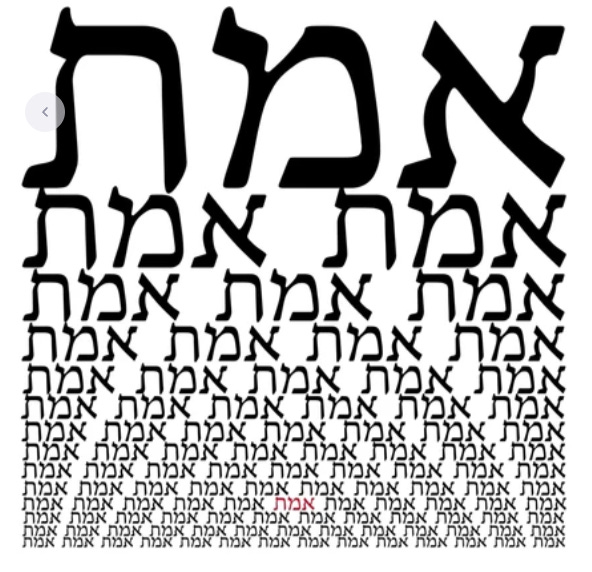
Cervantes said something very similar. “Truth may be stretched, but cannot be broken, and always gets above falsehood, as does oil above water.” I found an African version too. Truth-as-oil seems to pop up in the most unusual places. And in Hebrew, the words for truth and oil sound like close linguistic siblings (Emet and Shemen).
Some truth now seems to be slip-sliding into MAGA and Bibi-world.
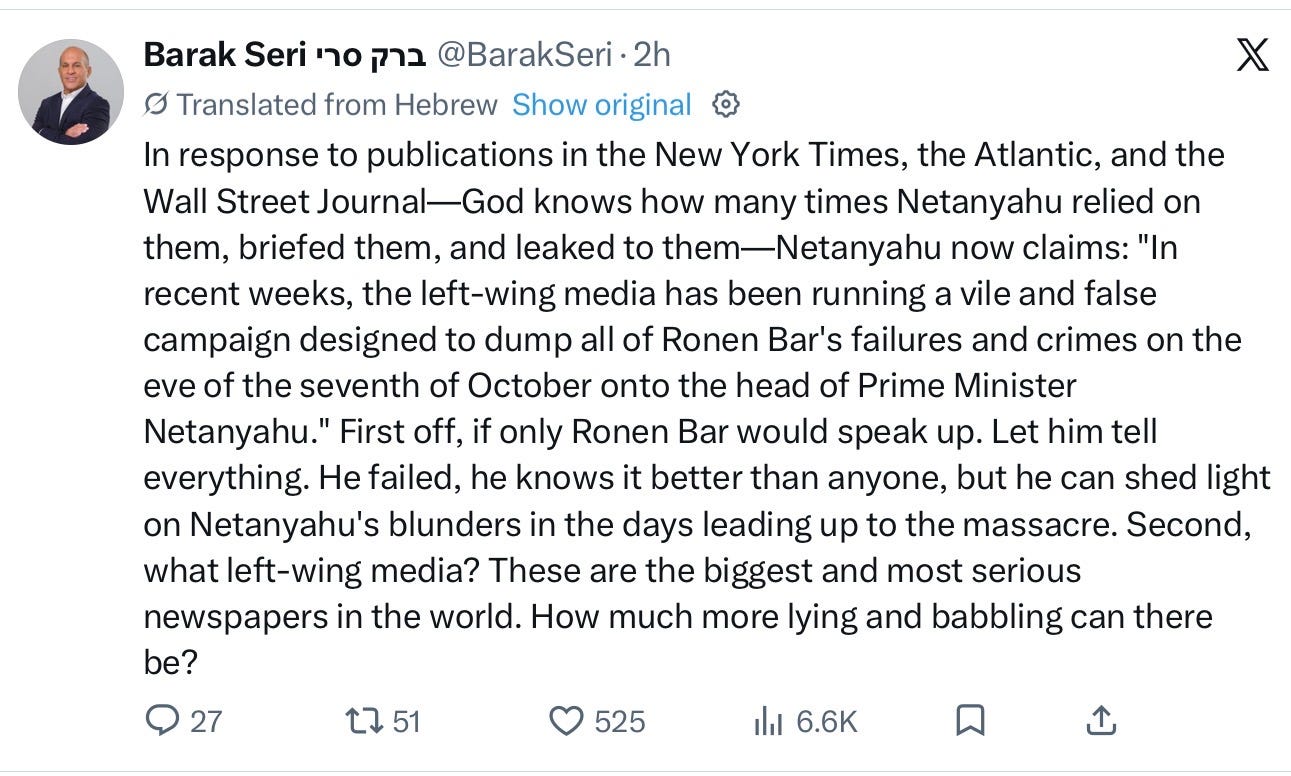
See this posting from Israeli political commentator Barak Seri, just a few hours ago:
Ronen Bar, the former Shin Bet head, who has already accepted some responsibility (unlike Bibi) says he’ll sue Netanyahu for “trying to deflect” onto him claims he ignored “warnings before the massacre” and “manipulating” records.
In fact, here’s the latest:

I wonder if they might accelerate the discovery proceedings. At the very least, it may shut Bibi up about Bar. With the latest polls very close, the truth might be an October surprise that can change history. Bibi might well regret “poking the Bar.”
Netanyahu, like Trump, is finding that the excuses are wearing thin. That oil slick is catching up to them. Suddenly the Wall Street Journal is part of the “left wing media?” Over the past several weeks, it seems like every journalistic outlet of integrity has run a story about how Bibi was warned of the October 7 attacks in advance. I think even Better Homes and Gardens is about to run an expose, and Highlights - the magazine I used to read as a kid at the dentist - they reportedly have an exclusive from Bibi’s periodontist1. Seems that laughing gas has its benefits, or perhaps the prime minister was shown a rerun of Marathon Man while waiting for his gums to be numbed. That’s numb with a b, Donald.
Meanwhile, Bibi is hoping to numb the populace into shrugging off these revelations as he tries to pass the blame off to intelligence and military chiefs, his political opposition and everyone, it seems, except for Donald Trump, who still holds his get-out-of-jail-free card but seems unwilling to endorse Bibi this time.
In fact, Trump is running away from Bibi as fast as Republican candidates are running away from Trump.
Everyone is running from being found out. With all this running-away, maybe this is a sequel of Marathon Man.
Bibi has been found out. We already know how he facilitated Hamas’s plan by funneling money from Qatar. We already knew that he ignored warnings that his judicial coup was weakening his nation and emboldening their enemies. We already knew that he was on trial for multiple felonies. We already knew that he had sold out Israel’s democracy to the most extreme, racist government in the nation’s history. We knew how he had forfeited whatever credibility and alliances Israel had left.
But until the Times and Atlantic and Ha’aretz and WSJ ran their stories, we didn’t know for sure how badly he had dropped the ball. Now we do. And Ronen Bar will make sure we learn more.
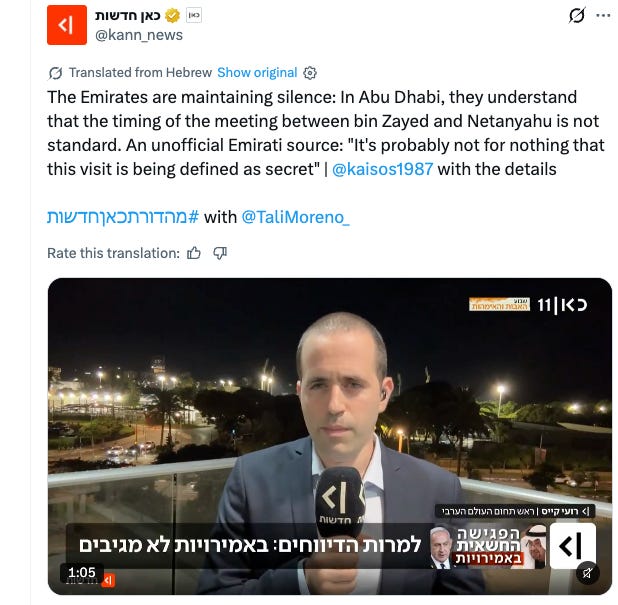
It’s so bad that, according to reports, Bibi flew to the United Arab Emirates secretly on Sunday; the timing of the mission makes it likely that at least part of its purpose was to ask the UAE President Sheikh Mohammed bin Zayed to deny that he had warned him before October 7. So far, no such denial has been issued. There is also speculation that Bibi was concerned that if Lordy-there-are-tapes, he begged that they not be released before the election.
Sounds like an oil slick in the making.
Whatever is happening, the Emerates aren’t talking and the Israelis are screaming about leaks (and now saying that this was planned last week and he brought his wife along, which disproves nothing).
AN UPDATE:
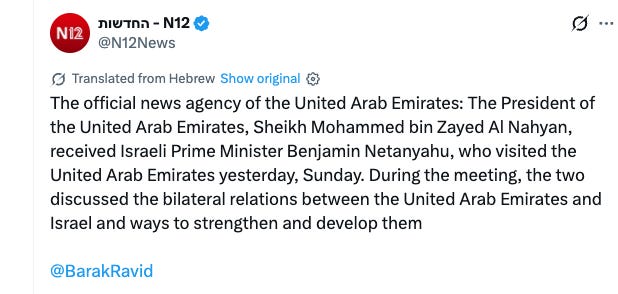
So we know more about Bibi pre-October 7 (and we are beginning to learn more, sadly, about the Gaza War as well).
And now we know what Republican candidates really think of Trump’s war, Trump’s economy, Trump’s data centers and Trump’s deportations. Just as Trump rushes to put his name on every inanimate object in sight, his allies are rushing to scrub their websites and political advertising of that same name. While Trump is playing Whack-a-mole with supposed leakers, Republicans are playing the same game with Trump’s name, trying to stuff it away whenever it appears.
Perhaps that’s what the Torah means when we are instructed to distance ourselves from lies. We should distance ourselves from Trump and Bibi’s lies.
A Talmudic discussion unpacking Exodus 23:7 determines that a judge should not try to engage in advocacy to justify his own falsehoods. Creating a campaign to defend a lie only compounds the lie and therefore amplifies the sin.
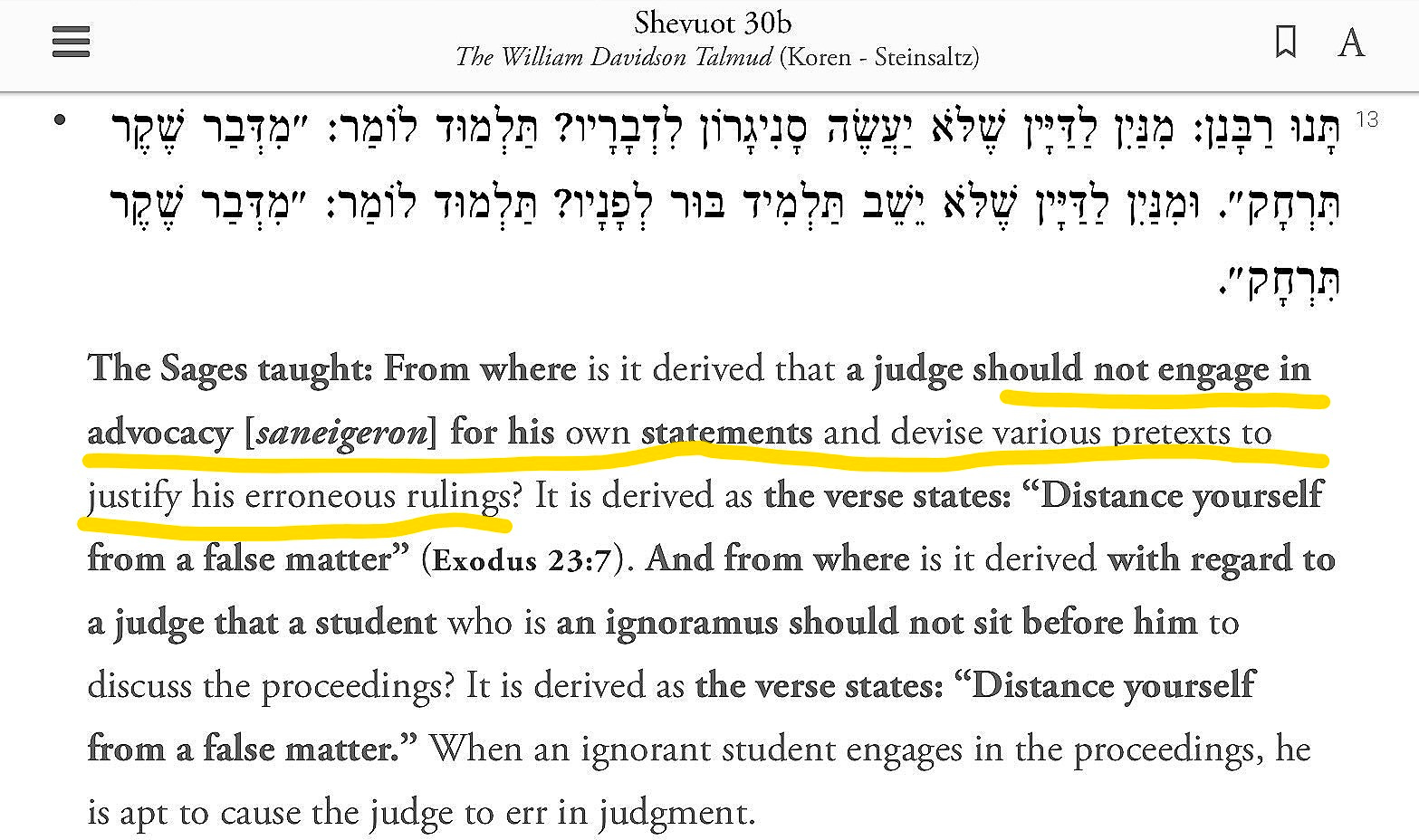
That Talmudic passage adds that by promoting the lie before an ignorant, naive student, (literally called a “boor” in Hebrew), that compounds the sin all the more. In an age of A.I.-infested political advertising, this lesson has taken on added significance. At a time when truth is so much harder to discern from falsehood, we cannot afford to leave honesty to chance.
What I wrote up top bears repeating:
Honesty is not merely “the best policy,” or a particular strategy or decision based on circumstance. It’s an orientation, a moral posture. It needs to become part of a new multi-faith religious crusade.
Trump and Netanyahu have built an empire of lies. It must come crashing down over the next several weeks. Nothing else is more important than that. No other issue.
No wonder the Talmud calls truth “God’s signature. (Shabbat 55b)”
And fortunately, Truth seems to be sliding in.
Suddenly Trump and Netanyahu are being abandoned, even by many of their most loyal supporters, as people are shedding their illusions, moving beyond their inbred inclinations and developing an appetite for truth. Their followers are discovering that the more they distance themselves from falsehood, the more they can seek what is proper, moral and good.
Omygod - I just saw Bibi’s now featured in the latest issue of Horse and Hound: “Mr. Ed Warns Netanyahu - Taps Hoof Seven Times.”
Beachcombing Magazine (or is it Beach-Comey?) had a story featuring seashells arranged to form the words “86-10/7!”
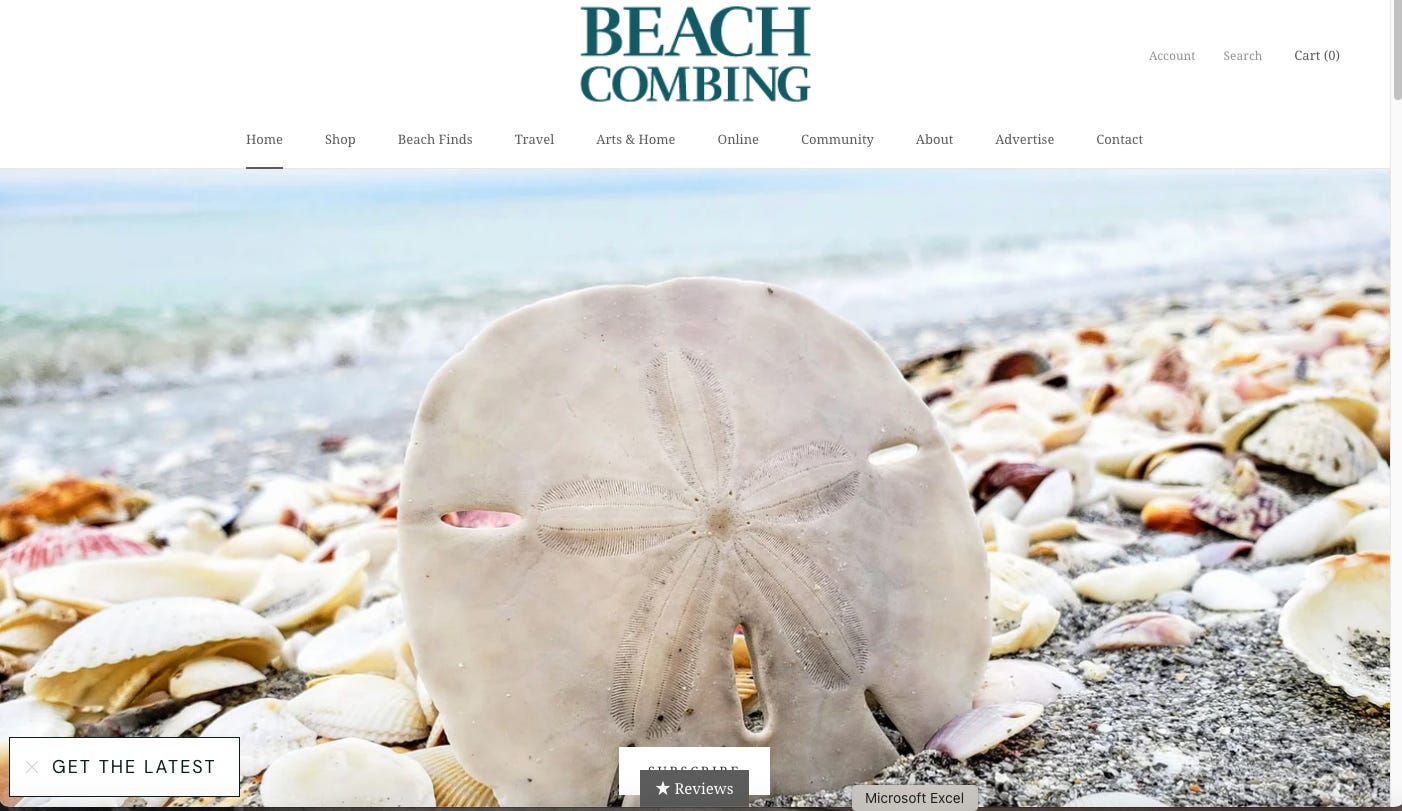
Everyone warned him! Even the shells!
But Bibi slept.
Just kidding.