 |
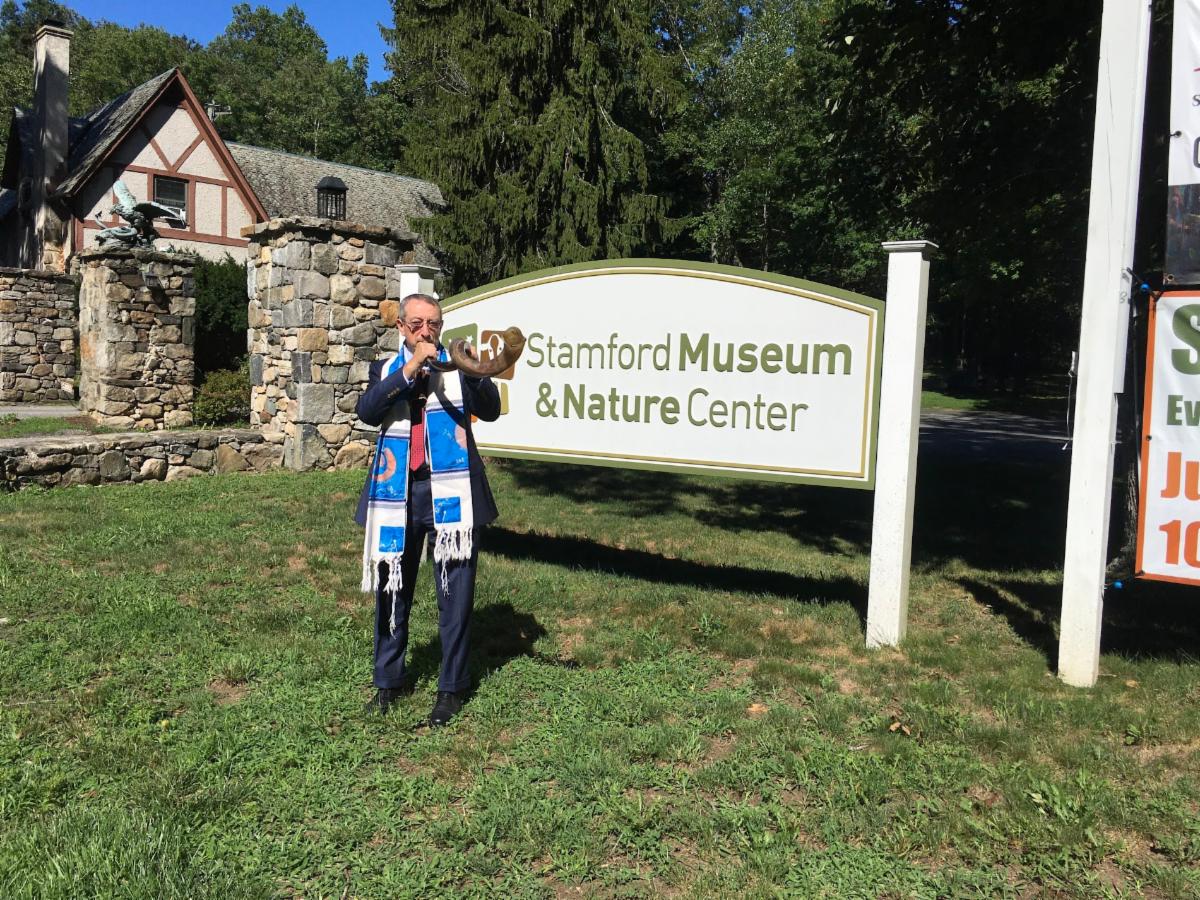
Sho-far Away... Doesn't anybody play in one place anymore?
Shabbat Shalom!
Beginning on Friday, the first of Elul, we'll be sounding the shofar each day at minyan, to prepare for the new year. Thanks to Matt Miller for organizing the shofar brigade once again, and to all our expert shofarists (Ba'alay Tekiah). Remember our 2020 High Holidays, when Marc Schneider went "on location" to sound the ram's horn right next to a real live ram at the Nature Center, and then down at the beach, or in front of Stamford Hospital? It was one of the highlights of that very unusual year. Here is the link to that album of photos and video clips, It's entitled Shofar's Excellent Adventure. Play the videos all through Elul so you can hear the shofar every day, whether or not you can make it to minyan.
Every day EXCEPT... Shabbat. In that album you'll also find the shofar-less, quiet nature clips that we used on the first day of Rosh Hashanah, which fell on Shabbat that year. Rather than try to change everything around us, which the shofar calls on us to do, on Shabbat we seek to live with the world as it is.
As Abraham Joshua Heschel wrote: |
|
Why do I mention this now? Well. for two reasons. One, because during this, my final year as senior rabbi, I'm taking some trips down memory lane, and I'm as proud of our 2020 High Holiday services as any set of service we've done here - and the room was completely empty. Beth Styles, Cantor Katie and a whole host of tekkies, volunteers and musicians deserve our eternal gratitude for that spectacular Yom Tov (holiday).
But also, because this year the first day of Rosh Hashanah falls, you guessed it, on Shabbat, so once again we will have to delay our shofar gratification. On the first day, we'll think about the shofar, and maybe even mimic it, but I recommend that you find a quiet spot, as we did in 2020, and enjoy the quiet. We can wait one more day. There's something kind of nice about stating to the world that, while Rosh Hashanah is really, really important, Shabbat, which comes around every week, is even more important. And even more important than Shabbat, the day, is the IDEA of Shabbat, which is not to subdue but to be in accord. Meanwhile, listen to Marc's piercing blasts. |
|
- And to help us in our Elul prep, another of the greatest hits from years gone by: Mensch*Marks for the New Year. The Talmudic tractate Avot, 6:6 provides a roadmap as to how to live an ethical life. This passage includes 48 middot (measures) through which we can “acquire Torah.” See the full list of middot here. For each day during the High Holiday period, running from the first of Elul through Yom Kippur and beyond, I highlighted one of these middot in order to assist each of us in the process of soul searching (“heshbon ha-nefesh”). Click here to see the full countdown, and explore a different ethical quality each day
|
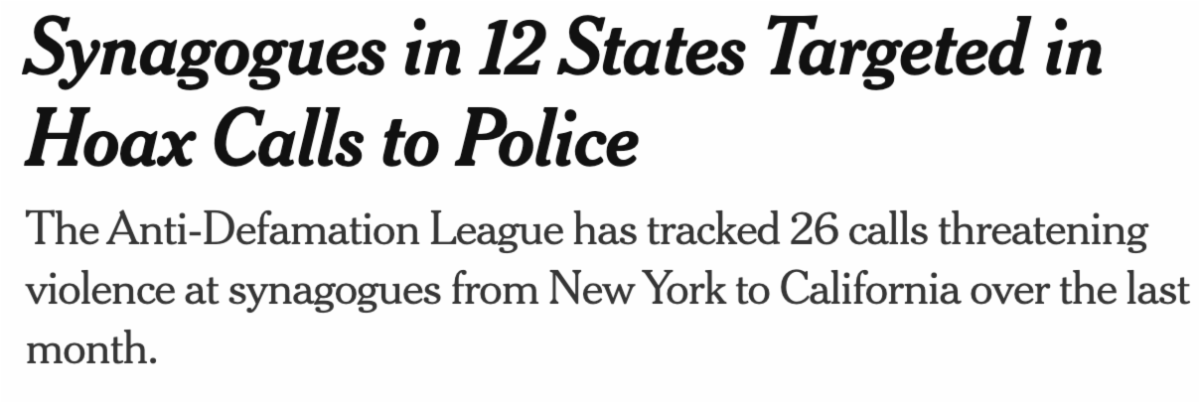 |
After a lovely service outdoors last week, it looks like we'll be heading back indoors this week because of the iffy forecast. I guess it was too good to be true. Meanwhile, JTA reports more sobering news:
At least two synagogues in California were evacuated during Shabbat services over the weekend as online trolls targeted Jewish congregations for the fourth straight week with fake bomb and other security threats. Furthermore, at least 26 congregations in 12 states have received the threats, according to the Anti-Defamation League, which is raising alarm about the barrage. The organization believes the instigators are selecting their targets based on the availability of livestreamed services and other events, motivated by their desire to watch the congregations react to the threats in real time.
Vigilance is the order of the day. It so happens that we have been chosen to participate in the ADL's Kulanu program as part of their new cohort. You can read all about the program here. It's nice to be part of a select group, but I really wish we didn't have the need. Meanwhile, we will not allow ourselves to be intimidated or victimized. |
Happy New Year to Animals! |
|
Cobie, Cassidy and Casey Hammerman
There are four New Years festivals recorded in the Mishnah. The best known are Tu B’Shevat, the New Year of Trees, and Rosh Hashanah, the Jewish New Year. But did you know that Judaism has a New Year for the Animals? It’s called Rosh Hashanah La’Behemot, and it falls on Elul 1. That means Rosh Hashanah La’Behemot is TODAY (Thursday)! Go and hug an animal!
Back in temple times, this was the day used to calculate the age of a prospective fleecy, furry or feathery candidate for ritual sacrifice. Now we can use this day to think about the sacrifices our fleecy, furry and feathery friends have made for our benefit.
We should use this day to consider the deep relationship between humans and animals of all kinds. The holiday can serve as a chance to remind people about the prohibition against unnecessary cruelty to animals. Rosh Hashanah La’Behemot is a perfect day to start conversations about animal welfare — and start taking action to improve the lives of animals around the world.
The mitzvah of kindness to animals, which is featured in next week's Torah portion, is called Tzaar Baalay Hayyim - which literally means "the pain of living creatures." As Jewish vegetarianism guru Richard Schwartz wrote in a recent column, we have much work to do if we are to reduce the pain of our fellow creatures:
It is significant that Judaism considers that for hiddur mitzvah (to enhance mitzvot) the shofar and other ritual objects should ideally come from animals that have been raised without cruelty and have died natural deaths.
Transforming the holiday would also: show that Jews are applying Judaism’s eternal teachings to today’s critical issues. It would improve Judaism’s image for people concerned about vegetarianism and veganism, animals, the environment, and related issues, by reinforcing a compassionate side of Judaism. It would also help inspire Jews who are currently alienated to some extent from Judaism and strengthen the commitment of Jews who are already involved in Jewish life, by reclaiming/transforming a holiday that they can more closely relate to and find relevant, meaningful, and appealing.
Renewing an ancient, almost completely forgotten Jewish holiday may seem audacious. But it is essential to help revitalize Judaism, improve the health of Jews, sharply reduce the current massive mistreatment of animals, and help move our precious but imperiled planet to a sustainable path.
So as we wish one another a happy Elul, and in fact we now begin to wish one another a sweet new year too, we can also turn to our pets and say, "and a happy new year to you too, Bubela!'
|
|
Barbie's "Gam Ani" Moment
Can Stereotypical Barbie help stem a worldwide tide of anti feminism? "Gam Ani" means "Me Too" and the talk of Israel this week has been the saga of the teenage girls who were forced to sit in the back of the bus and cover up, for the sin of wearing jeans and a tank top. The Hebrew headline below says "Only Because We Are Women," referring to those teens and other women who have been victimized recently. There was a Holocaust survivor given the silent treatment, because the driver "doesn't talk to women," and the woman who was banned from entering a mall because she was wearing workout clothes; and Hila, who had to walk a half hour because the driver told her that "the bus is for men only." The article adds, "More and more women find themselves excluded from the public sphere because they happen to have been born the wrong gender."
This story was featured on the front page of The New York Times, and after an awkward silence, Prime Minister Netanyahu finally responded, essentially saying, "Nothing to see here," claiming that discrimination never happens on Israeli bus lines. Which leaves us wondering, if discrimination against women is not allowed, why is this happening? Are these girls imagining that the driver made them sit in the back?
Below the Hebrew front page, see an article in Tuesday's Ha'aretz delineating a plethora of oppressive legislative initiatives the government has lined up, once they can get the Supreme Court out of their way. It's not just about subjugating women, of course, but sidelining minorities of all stripes.
I've not yet seen the Barbie movie, but the doll's Jewish roots and proud persona, plus the ecstatic reception the movie's received worldwide, puts her in a unique position (for a toy). Maybe she can help convince the Israeli government to treat women with dignity and equity and cease this slide toward dystopian theocracy.
But nothing will change unless good people speak up. |
|
- Yossi Klein Halevi's appearance at the closing plenum at the AJC Global Forum was an extraordinary moment, as he implored the assembled to do what American Jews have always been so reluctant to do - get off the fence and take sides in an internal Israeli matter. Watch his powerful presentation (video above) and note the rousing reaction he received. Given the message he gave, this would never have happened before this year.
- I've been reading an intense, fascinating book this summer on the interaction between Israel, American government leaders and American Jews. it's called We Are Not One: A History of America's Fight Over Israel, by Eric Alterman. I picked it up with some skepticism, assuming that there would be very little that I hadn't heard before. I was surprised to discover that not to be true. Alterman's exhaustive research has some shocking (and often disturbing) revelations. It's dense but very readable. Given what's happening right now over there (and here), it could not be more timely.
|
 |
|
- Shine up your tea kettles because Golda Meir is about to have a moment. Between Deborah Lipstadt's new biography and a Netflix movie, Israel's complicated Iron Lady will undoubtedly emerge more lionized than chastised. See this Forward review of Lipstadt's book, "Beloved and loathed, decisive or stubborn, icon or enemy of feminism — does Golda Meir deserve any of her reputations?" After you read that, you may want to look back at this prior book about Golda that did not pull any punches: Will of Iron, Heart of Stone: Book Shines Light on Golda Meir’s Harder Side (Forward). The author recounts how her son, Menachem, off studying the cello in Yugoslavia, was having marital problems with his new wife. She was pregnant and insisted the couple return to Jerusalem to have the baby. Meir assumed her daughter-in-law was trying to sabotage her son’s promising music career, so she decided that, as punishment, she would ignore her first grandchild. The baby girl that was born that year, Meira Meyerson, had a mild case of Down syndrome. Meir refused to see her. The child, she demanded, should be institutionalized. “Golda was like a stone,” an old friend confessed. I knew about this story because that daughter-in-law was a distant cousin of mine, and she was very bitter about the treatment her daughter received. Still, I always admired Golda and of all the books I've read about her, the best by far was her own autobiography, My Life. I look forward to this upcoming re-exploration of her life.
- 2023 Parliament of the World’s Religions - See also: From interfaith vegans to inclusive heathens, religious Parliament offers it all. It's taking place in Chicago this week. Read about its Global Ethic, a landmark declaration of the Parliament of the World’s Religions stating the universal values and principles shared by the world’s religious, spiritual, and cultural traditions. It states: Humanity needs a vision of peoples living peacefully together, of ethnic and ethical groupings and of religions sharing responsibility for the care of Earth. A vision rests on hopes, goals, ideals, standards. But all over the world these have slipped from our hands. Yet we are convinced that, despite their frequent abuses and failures, it is the communities of faith who bear a responsibility to demonstrate that such hopes, ideals, and standards can be guarded, grounded, and lived.
- Israel’s Rule Has Created a New Judaism (Ha'aretz) Supremacy, oppression, force – never before has the Jewish people engaged in such an explosive fusion of sovereignty and rule. Messianic fervor, once under the radar, is now rearing its head is no precedent in Jewish history for the existence of a Jewish state that constitutes a regional power and rules another people. Never before has the Jewish people possessed a combination like this of sovereignty, power and control.
|
|
Temple Beth El 350 Roxbury Road Stamford, Connecticut 06902 A Conservative, Inclusive, Spiritual Community |
|
|
|
|







