In This Moment: A Rabbi's Notebook

A very strange story pops up at the end of the King David narrative in the Bible. The great king is old (just 70 - sheesh, and he looks like hell - after 40 years on the throne, and evidently 40 years without a shave), and he’s perpetually cold. So rather than throwing him an afghan, his staff decided to do the next best thing: bring in an attractive young woman. They found Abishag the Shunammite:
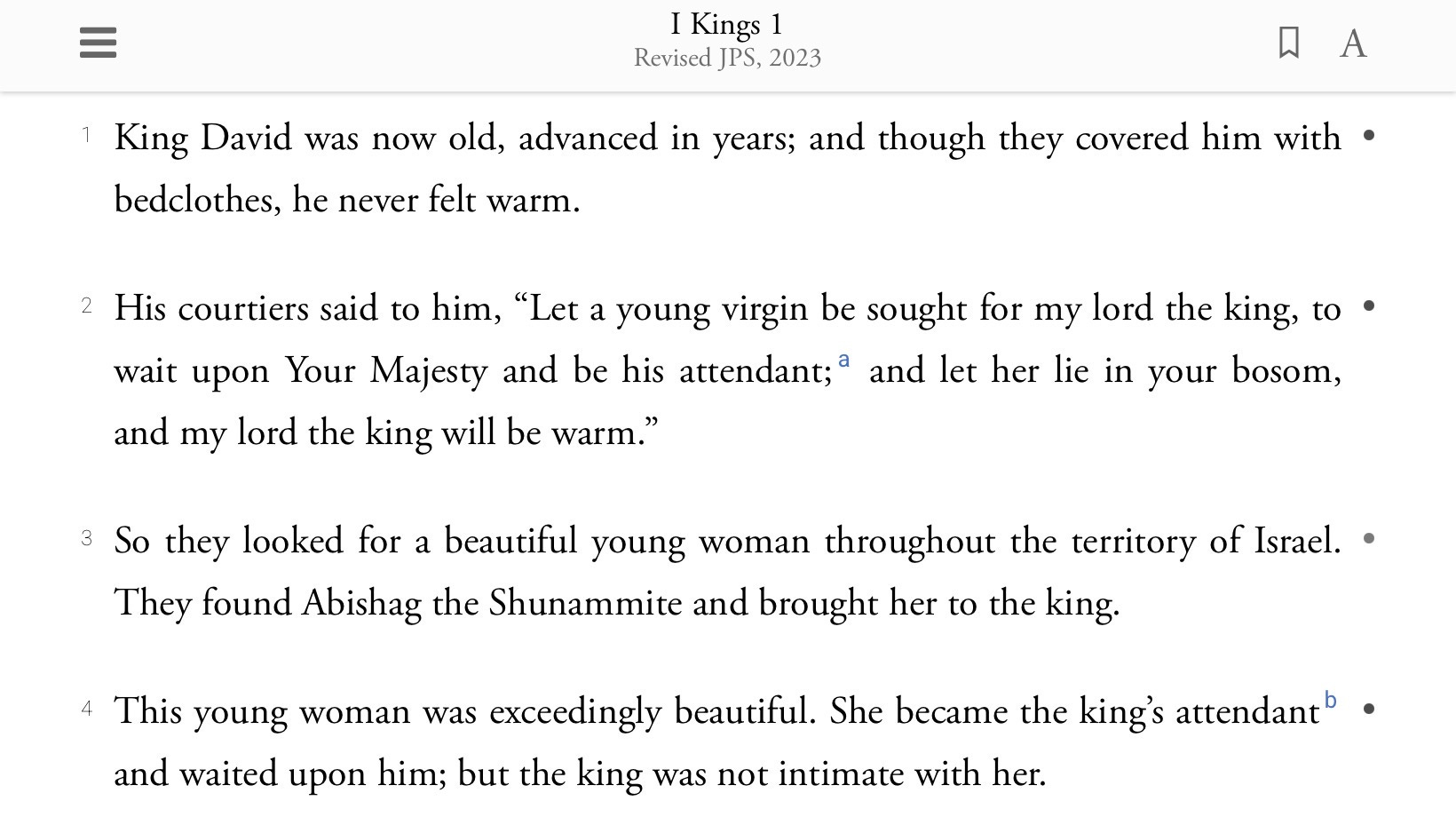
So no sex, the Bible tells us, because, well, let’s not get into that, because I would then have to discuss the current analogy with regard to sex, which I suspect you would prefer I not do. Jon Ossoff didn’t go there, and neither will I.
Abishag was by all accounts a reputable, loyal and caring servant, as dedicated to her master as Natalie Harp has been to her boss. Abishag was literally the king’s closest, most intimate associate, even closer than his 18 wives - she was the one in bed with him - and not even the feisty Bathsheba was jealous enough to appear in front of the court and proclaim, “I heard you meesed me?”

Bathsheba accepted the situation because, well, she had to. She was a woman. But she also understood that Abishag was David’s last chance, the only thing that could potentially prolong his life, because his degree of frigidity was so high that it essentially was the last notch on his thermometer before “corpse.” Bathsheba also knew that as soon as David died, all hell would break loose among his heirs.
Let’s look at where Abishag came from.
Shunem was an ancient town located in the north, opposite Mount Gilboa, and it was also home to the Bible’s second most famous Shunammite woman, whose name was, memorably, “Shunammite Woman.” She was the mother whose child’s birth was foreseen by the prophet Elisha, who years later resurrected the boy (2 Kings 4 and 8)1. She was unequaled in her faith, going above and beyond the call to assist the prophet, to the point of obsequiousness.
That’s how they grew them in Shunem.
Abishag was like that too, independent in her own way, yet loyal to a fault when it mattered.
Much like Natalie, who wrote to Trump in her letters, “"You are all that matters to me."
There is no record of Abishag or Elisha’s Shunammite woman running after golf carts or sleeping in a locker room, and we don’t have possession of any of their personal letters. And Elisha’s Shunammite was so humble - or forced to be - that, as mentioned, we never even learn her name.
We do know of another, more contemporary literary connection to Shunem, in Margaret Atwood’s The Testaments, where the Shunammite is ambitious, status-conscious, and fully trained to embrace the societal expectations of The Handmaid Tale’s Gilead. And like Elisha’s Shunammite - and in the spirit of Handmaid’s Tale - she has no name, just that biblical moniker.
And there’s one more thing: Gilead is just a stone’s throw across the Jordan from Shunem.
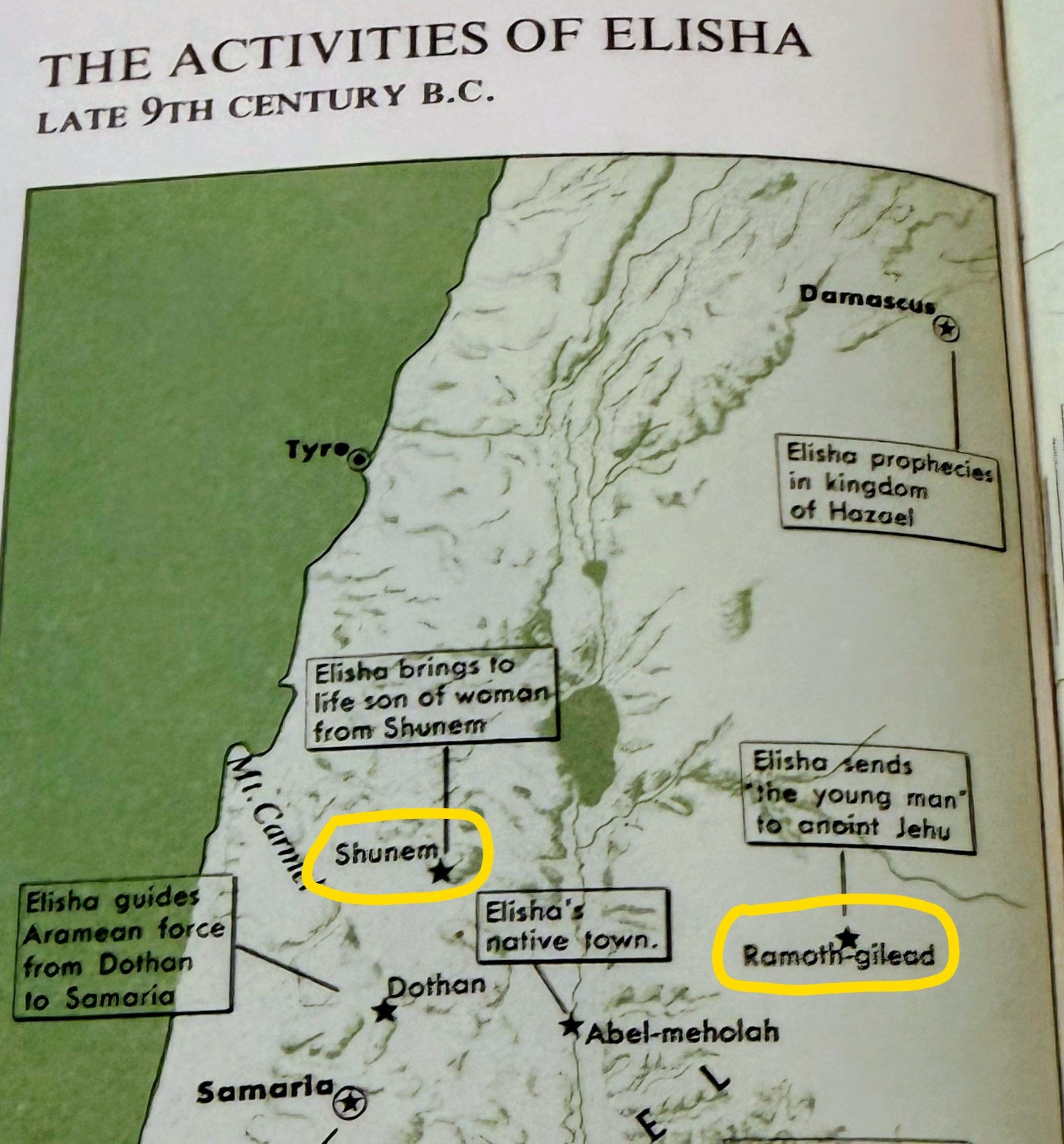
Throw it all together and we have the picture of two duteous Shunammite women, completely dependent on men to save them - yet despite their compliance, assertive in their devotion to those men and in their willingness to sacrifice everything, including their very identities, in service to the crown.
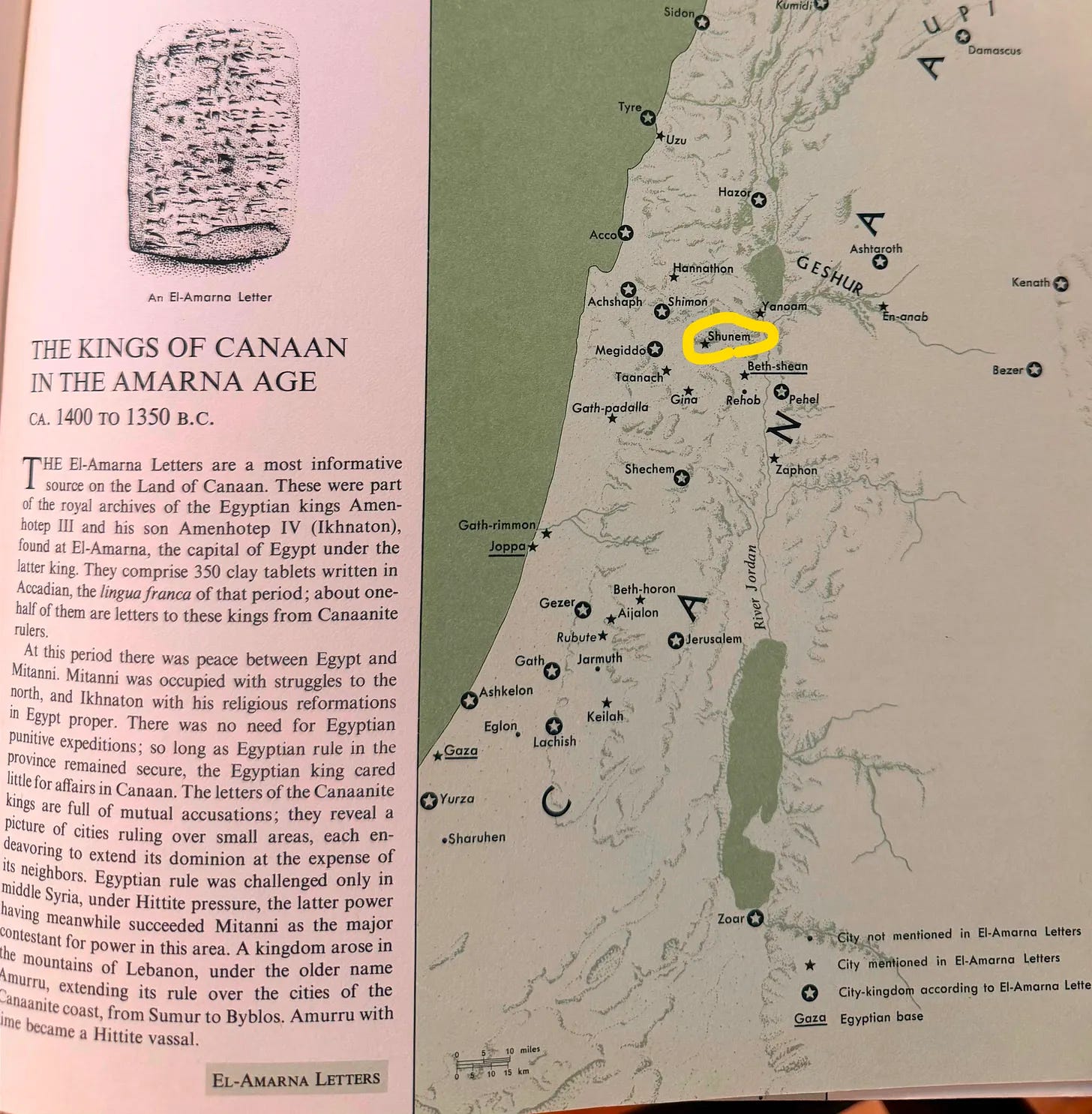
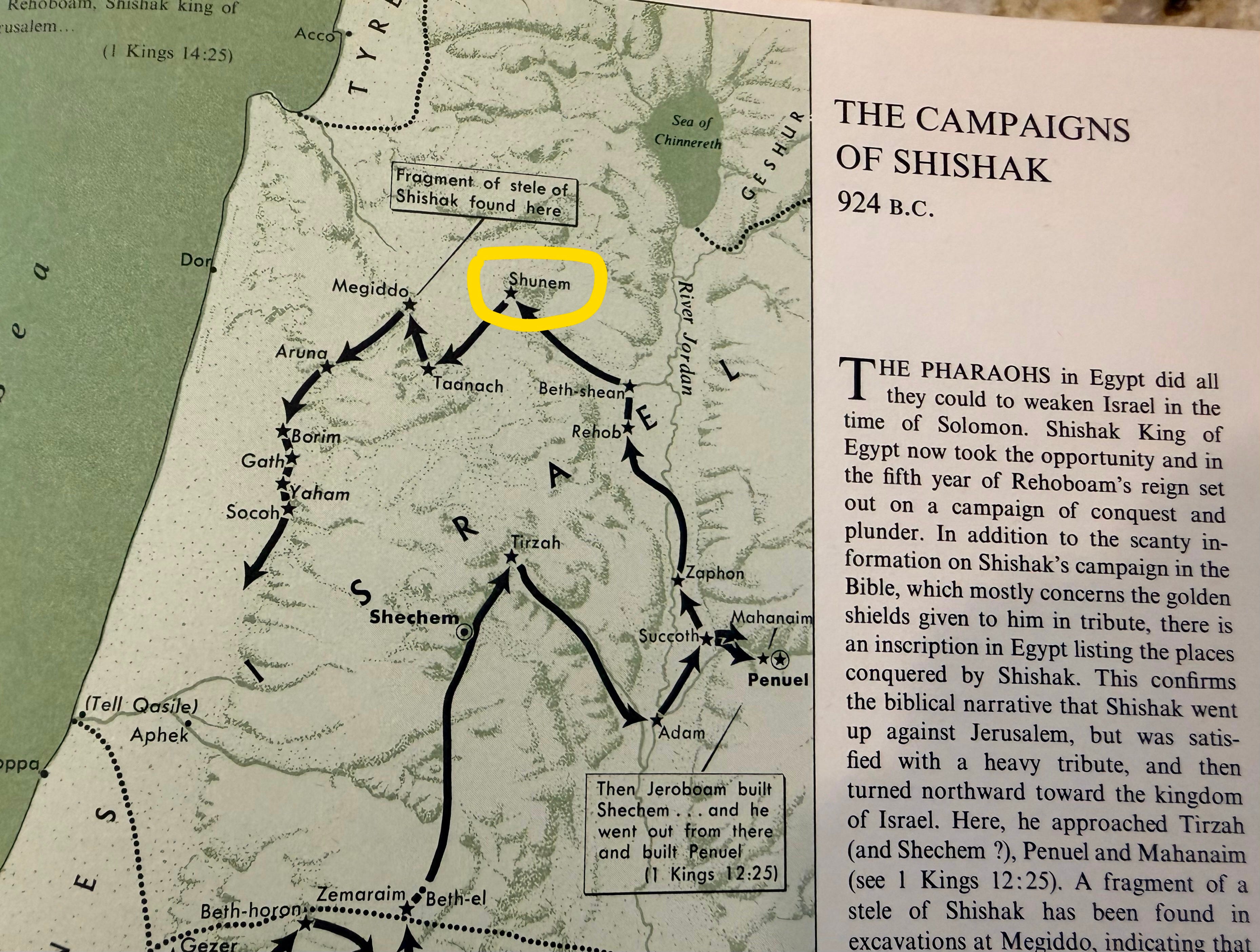
Another thing. Aside from being home to notable women, Shunem was situated in just about the most strategic spot in the ancient world, in the geographical center of the most traversed valley in the Galilee, close to Megiddo, at the crossroads of Africa, Asia and Europe.
It was the center of it all, the Washington DC of the Galilee.
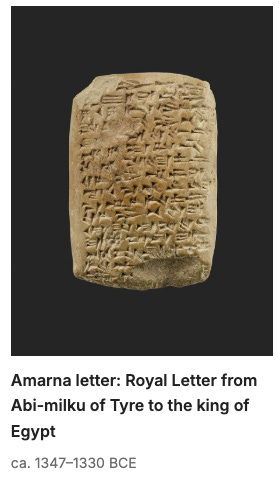
As early as the 14th century BCE, Shunem is a presence, mentioned in one of the pivotal texts of ancient times, the Amarna letters.2
It was also the site of the Philistine encampment for the battle that took the life of King Saul and later Egyptian campaigns during the reign of King Solomon.
Why do I mention this? Because those who lived in Shunem, at least at times when it was not in ruins or being overrun, understood what it was like to live at the center of world affairs. They knew what it meant both to have power and to be powerless.
Something Natalie and Abishag clearly understand.
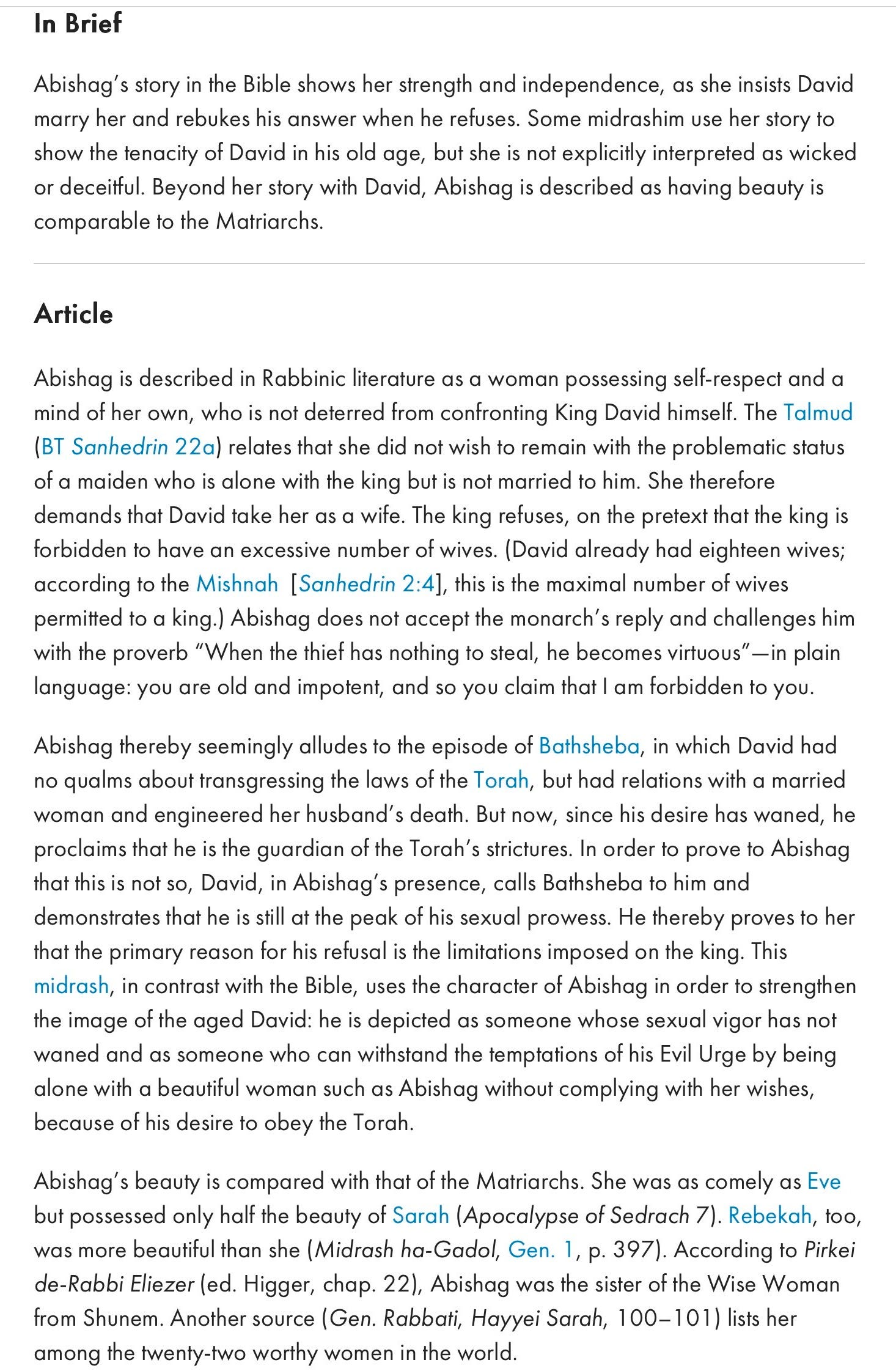
The Jewish Women’s Archive summarizes the relevant legends about Abishag, which point to her being more assertive than the Bible indicates.3 So her story is complex and mysterious.
And so is Natalie’s. That printer she zealously carries contains within it Trump’s connection to reality, as filtered through her. As The New Yorker posted:

Natalie’s adoring letters and MAGA-juiced social media posts speak volumes, even if most were taken down when her Twitter account was closed. In one posting shared in a CNN report, she quotes Psalm 42 and inserts Trump’s name.

She certainly knew how to warm the heart of the coldest of cold-hearted men. In the idealized Betty-Crocker planet that MAGA inhabits, the way to a man’s heart is through a woman’s cooking. But for Trump it’s through their lying. One can see why Trump has been quoted as saying that Harp is the only one who loves him as much as his wife and children. Maybe more.
And one can see why Trump world went so apoplectic when Harp was thrust into the national conversation. For Trump, this is very personal. Jon Ossoff hit a major nerve.
Harp’s brother suggests that Trump is a father figure to her, something almost as cringeworthy as imagining sex between Trump and someone who just came out of the Ivanka mannikin store.
The father-figure theme warrants a closer look.
One of the aspects of Natalie’s biography that appears beyond question is her father’s suicide in 2020. Interestingly, Abishag’s (Avi-shag) name means, “My father was a wanderer.” In other words, she lost her father too. A shogeg in Hebrew (the root letters for “wanderer") connotes one who has wandered off physically and also strayed morally - a sinner, even if only by mistake.
On the upcoming High Holidays, Jews will ask for forgiveness for sins done both on purpose and b’shogeg, accidentally. It’s a word that keeps on reappearing in the Yom Kippur liturgy.
It seems that both Natalie and Abishag were placed in the most intimate inner sancta of their geriatric and patently unwell father-figures, because these dying, weakened old men had lost their way. Both had strayed morally, but only one sought forgiveness. And both were also wandering mentally and physically when these muses came into their lives.
Both faced the long, cold dark night, and only these two young women could save them.
Ultimately, while David’s actual harp soothed King Saul, his human harp could not soothe King David himself.
Neither will Donald’s Harp save him. The only soothing music in DC used to be at the Kennedy Center, back when the National Symphony Orchestra playd there - and now that sacred space has fallen silent. Now the only music he hears is the whirring of the printer in Natalie’s hands.

NOTES:
Elisha’s woman of Shunem, from Jewish Woman’s Archive

Amarna letters, from the Metropolitan Museum of Art site:
See Jewish Women’s Archive article about Abishag below:

No comments:
Post a Comment