Thursday, September 22, 2022

In This Moment: L'Shana Tova, Charlie Brown! Uman or Not? Landmark Proclamation

In This Moment

Find out about the history of each of these shofars at the Jewish Museum site


This morning I was honored to join with city officials, along with AJC, UJF and synagogue leaders, to witness Mayor Caroline Simmons signing on to the AJC's Mayors United Against Antisemitism initiative, along with an added proclamation specific to this event.  Thank you to all who are responsible for this major statement - and most especially to Mayor Simmons. See the IHRA Working Definition of Antisemitism. See the city's proclamation at the bottom of this email.


Shabbat Shalom and Shana Tova!


Some links for quick reference...


Happily, I'm out of the Covid Witness Protection Program as of today and I feel fortunate to have weathered the pandemic with minimal disruption, at least in the short term. I expect to be "good to go" for Shabbat and Rosh Hashanah. Sadly, I've been preoccupied this week with funerals, among them one for a long time Beth El member, Herb Beningson. Although he moved away many years ago, he and his family made a major mark here. We extend condolences to the Beningson family.


Some quick thoughts about our services:


  • In the immortal words of Zazu"I think it's time that you and I arranged a heart to heart." My sermon on the Second Day (Tuesday) is directed especially to Millennials and Gen Z. That means, roughly, anyone who became bar or bat mitzvah between 1994 and now.  (Others may eavesdrop.) While I'll have plenty of opportunities to talk to people between now and July 1, 2024, I consider this to be my valedictory address to the thousand-plus students I've seen grow to adulthood (and anyone else in that age group).  If you can not be at services or watch remotely, my sermons will be also be available online shortly after the holiday.


  • Tashlich can be done by small groups or individual families after the tent or main services on Monday. We will have D.I.Y. Tashlich sheets available, or you can download one here. BYOB (Bring your own breadcrumbs), or better yet, collect twigs and small pebbles on the way to the body of water, to toss into the water and be less environmentally intrusive. Here's a poem for Tashlich: 


Here I am again ready to let go of my mistakes.

Help me to release myself from all the ways I’ve missed the mark

As I cast this bread upon the waters, lift my troubles off my shoulders.

Help me to know that last year is over, washed away like crumbs in the current.

Open my heart to blessing and gratitude.

Renew my soul as the dew renews the grasses. Amen.

-Rabbi Rachel Barenblat


  • A wonderful introductory guide to the High Holidays can be dowloaded here. it's from 18 Doors, which specializes in outreach to blended families and those new to Judaism.


  • To Sing or Not to Sing? Here's what I wrote about that last year, at a time when the uncertainties about Covid were more pronounced than they are now (though things are not yet perfect in that regard). I will be masked much of the time, but also singing, using my "indoor voice." We still need to be mindful of risks, but even more than that, we need to be respectful of our neighbors. Yet we also don't want our services to be a concert and prayer cannot be unidirectional. So by all means, be an active participant, wherever you happen to be. Whether in person or at home, immerse yourself in the sights and sounds of the service. Let it spur your own reflections. Be an active pray-er.  


  • And one more thing. Be welcoming. Even with a mask on, connect with those around you. We are all ambassadors, representatives of TBE, the Jewish people, and God. I started with Zazu and will finish this message back on Broadway by paraphrasing the Lovely Boylan Sisters: "You're never fully masked without a smile." 


My warmest wishes to all for a Sweet New Year!

Rabbi Joshua Hammerman


Source: JewBelong High Holidays Booklet 

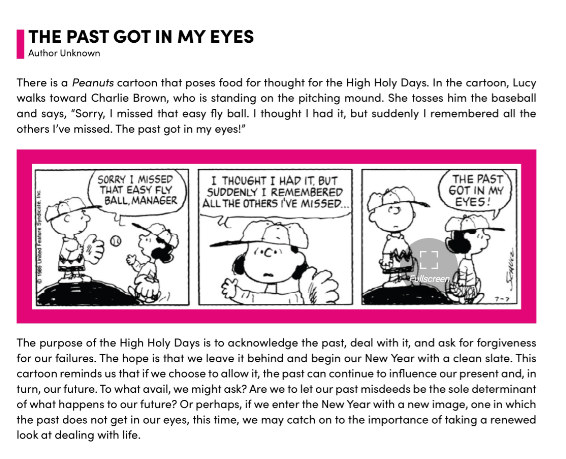
The cartoon presents a fascinating dilemma proposed by Lucy. Are we better off scrutinizing our past errors, or should the goal of Teshuvah and the High Holidays be to leave our past behind and begin with a clean slate? We certainly should not allow our past to paralyze us, to become the prologue for defeatism. It's not good to drop a dozen fly balls and then to freeze when the next one is hit, out of fear of the inevitability of a recurring pattern. 


On the other other hand, you can't possibly break the pattern unless the past becomes prologue for improvement. We must learn from our mistakes. 


That is true of individuals and it is true of nations. Which is why Ken Burns' Holocaust series running this week on PBS is so important. I've studied the Shoah all my life and still learned much from it - in particular the depth of antisemitism in the US in the 1920s and '30s. It was a populist tide that no one could overcome, not even FDR (though he was hardly blameless). Public opinion can shift overnight in ominous directions even in the most secure democracy. The Germans in the photos from the Nazi rallies of the '30s - they are us. They are just regular people who were swept up in a tide of orchestrated hate. Whether before, during or even after the Holocaust, American public opinion overwhelmingly wanted to keep Jewish refugees out. Even many American Jews agreed. Scary - and required viewing for every American and every Jew.


I'd love to hear from some of you what you learned from the series that you might not have known before. One thing we all learned is that we need to learn from our imperfections, and never cover them up. A perfect lesson for the High Holidays. I think Lucy would offer the same advice.  


That will be 5 cents, please!

Shofar from 18th century Germany - Jewish Museum

Since 1810, Jews have made pilgrimage on Rosh Hashanah to Uman in Ukraine, to the burial place of Reb Nachman of Bratzlav. Until this year. The pilgrimage has been discouraged, given how frequently Uman has been targeted by Russian missiles. But not even Putin can keep the Jewish spirit down. Latest reports say 10,000 will be going anyway. and indeed, they are already there. Stay tuned. You'll be hearing more about Uman on Day 1. On a map, you can find it almost exactly in the middle of the country, halfway from Kyiv to Odessa on a north south axis, and from Lviv to Donetsk east to west. It is literally in the center of it all - and Putin seems to know its importance to Jews - he targeted it on the very first day of the war.  As any reputable De-nazifier would do.

Recommended Reading


Three Big Surveys


Main Recommendations to the Government of Israel

  1. Dialogue with Jews who support the Democratic Party must be deepened in order to harness their support and assistance in advancing Israel’s positions on the Iran nuclear issue.
  2. Diaspora communities (with the assistance of Israel) should prioritize significant Jewish education projects – financially, socially, and institutionally.
  3. Philanthropy in Israel, by both individuals and institutions, should be encouraged, emphasizing the Jewish value of giving as is customary in Diaspora communities worldwide.
  4. A comprehensive social and political response must be formulated to an expected increase in the number of Israelis who belong to the Jewish majority population but are not recognized as Jews.
  5. Continued rapid growth of the ultra-Orthodox community requires intra- and extra-sectoral attention to the socioeconomic ramifications of this trend.


Other Key Findings:

  • 70% of Jewish voters approve of the way Joe Biden is handling his job as president, a 7% increase from a JEI poll in April 2022.
  • 70% of Jewish voters would support a Democratic candidate for Congress if the election were held today while only 24% would vote for the Republican candidate, representing a 10% increase in the Democratic lead over a JEI poll in April 2022.
  • 19% of Jewish voters hold a favorable opinion of Donald Trump
  • 92% of Jewish voters are concerned about antisemitism, and by a 52-20% margin, trust Democrats more than Republicans to fight it.
  • 61% of Jewish voters are more concerned about antisemitism originating from right-wing groups and individuals compared to 24% who are more concerned about antisemitism coming from left-wing groups and individuals.
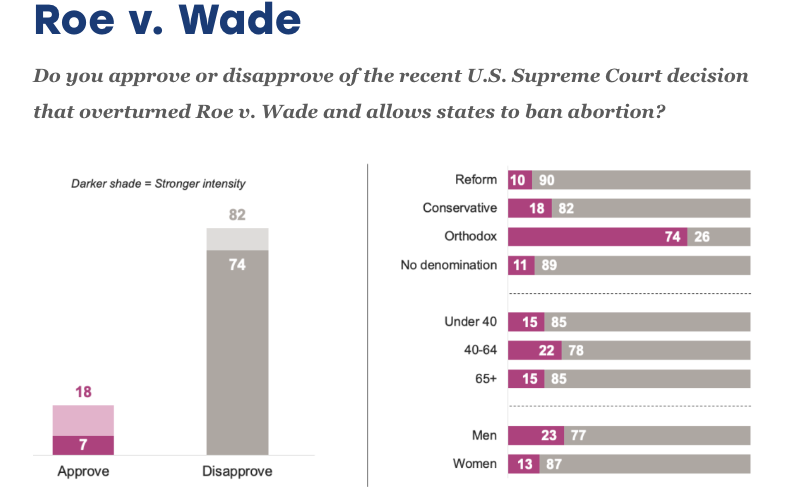
  • 82% of Jewish voters disapprove of the Supreme Court’s decision to overturn Roe v. Wade, with 56% saying that the decision makes them more motivated to vote.
  • 68% of Jewish voters support the U.S. reentering the Iran nuclear deal.
  • The survey found near-unanimous support for gun safety measures, with 96% of Jewish voters supporting requiring comprehensive background checks for all gun purchases and 91% support raising the minimum age to purchase a gun from 18 to 21.


  • Pay to pray? Not anymore. Many synagogues no longer charging for High Holiday tickets (Forward) - Two hundred synagogues across the nation responded to questions about what it costs to get in their doors on Rosh Hashanah and Yom Kippur. The answers, while not necessarily representative of the 4,000-some shuls in the United States, suggest that paying a bundle for a ticket is now the exception. Most of the 200 that filled out our questionnaire said High Holiday seats are included in the price of membership, with only a handful charging a ticket fee on top of dues. About 50 said they charge non-members to attend, with prices ranging from $36 to more than $700. And many synagogues that do charge said they provide free tickets for groups including students, people under 30, prospective congregants, members of the military, people married within the last year, people involved in Jewish community service, guests of the rabbi and “anyone in financial need.” Asked why they had made attendance free, a few rabbis expressed disdain for the practice of charging Jews to pray with one another, especially on the holiest days of the year. One rabbi deemed it “repugnant.” Others said free holiday services aligned with their congregation’s desire to be as welcoming as possible. “My sense is that by having our doors wide open at the High Holidays, we are able to be a place that people can check out with a very low barrier,” Rabbi Laurie Zimmerman of Congregation Shaarei Shamayim, a Reconstructionist synagogue in Madison, Wisconsin, said in a follow up interview. She attributes her congregation’s growth — from 20 households in 1989 to almost 200 today — in part to its commitment to free High Holiday services. In the days leading to Rosh Hashanah, the UJA-Federation of New York, which funds hundreds of Jewish nonprofits, released its “Find A Service” guide, which lists 75 synagogues of all denominations. The majority charge nothing to attend virtual services. Roughly half charge for in-person services, with most prices falling between $36 and $500. 


  • For the lockdown generation, prayer is merely code for inaction (RNS) If the lockdown generation is going to believe in God, it will always be a God who coexists with both the gunman and the ones who put the gun in his hands. Prayer, for them, will carry the stench of inaction — both parents’ prayers unanswered and the “thoughts and prayers” of nonresponsive politicians. It’s difficult to know what hope looks like in this scenario, what goodness and shalom might mean, but I am determined to figure out what it means to be the people of God when it feels like God is gone and all we have left is air. 
  • This is Banned Books Week, an annual event celebrating the freedom to read. Banned Books Week was launched in 1982 in response to a sudden surge in the number of challenges to books in schools, bookstores and libraries. Typically held during the last week of September, it highlights the value of free and open access to information. Banned Books Week brings together the entire book community — librarians, booksellers, publishers, journalists, teachers, and readers of all types — in shared support of the freedom to seek and to express ideas, even those some consider unorthodox or unpopular. Banned Books Week 2022 will be held September 18 – 24. The theme of this year’s event is “Books Unite Us. Censorship Divides Us.” By focusing on efforts across the country to remove or restrict access to books, Banned Books Week draws national attention to the harms of censorship. The ALA Office for Intellectual Freedom (OIF) compiles lists of challenged books as reported in the media and submitted by librarians and teachers across the country.  


  • Here's why banning (and burning) books and antisemitism go hand in hand (Publisher's Weekly) - Banning books like Maus erases my Jewish experience, minimizes the violence of the Holocaust, and ultimately validates Holocaust-denial rhetoric. Uncomfortable books are necessary because they preserve memories like those I’ve shared about my own family, and as a publisher, I am here to safeguard the historical record and challenge the distortion of history often expressed in contemporary antisemitism.
Temple Beth El
350 Roxbury Road
Stamford, Connecticut 06902
203-322-6901 | www.tbe.org
  
A Conservative, Inclusive, Spiritual Community

Friday, September 16, 2022

Covid Finally Got Me: Some Notes from My Bunker (Times of Israel)


Covid Finally Got Me: Some Notes from My Bunker

I will still advocate caution in much of what we do on the upcoming holidays – for instance, we will not have kissy-huggy Torah processions, even though I miss them more than anyone. I also will continue to really, really recommend masks indoors. And finally, you will not hear me trying to convince people to attend in person if they are remotely uncomfortable doing so. I love big crowds. I miss big crowds. But when I stand on the pulpit I will not neglect those who are watching from home.

I believe this pandemic has been extraordinarily destructive and corrosive for spiritual institutions and other living things. We’ve been so busy plowing forward – appropriately – that we’ve not yet stopped and looked back at the scorched earth Covid has left behind. Just the sheer number of people who have died. A million in America, over 6 million around the world.

Since when do we, the Jewish people, toss off the deaths of 6 million human beings by ripping off masks and declaring victory? There is nothing to compare to the cruelty of the Holocaust, but the sheer numbers of those families who have suffered from this lonely, isolating, dehumanizing plague rises to a total that is altogether too familiar. I know we’re exhausted, but I think we’ve been blasted by a combination of Covid brain fog and sensory overload at the sheer scope of what we have lost, how many we have lost and who we have lost. Six million may be a vast undercount. Since 2020, wherever there was death, the shadow of Covid has lurked, but people have been too embarrassed to admit it. The true impact of Covid has been a conspiracy of silence and denial. Covid has besmirched our civilization, and where in nobler times that might have brought the world together, here we can’t even get a third of America to take it seriously enough to mask up and vaccinate to protect the rest of us.

Think what the spring of 2020 did to us. Just the memory of those trucks filled with bodies outside the emergency rooms. Just the fear of touching a doorknob, and the reluctance to open one for a stranger. The anger at those who seemed so selfish or politically cynical. Those who got going when the going got tough, and left their spiritual communities. Those who raked in the PPP dough when they didn’t need it.For me now to pray that the sanctuary is NOT full, that everyone will sit apart and not sing – it is the complete antithesis of what my entire rabbinate has been about. It’s not about me – it never has been – but these three years have caused considerable and perhaps irreversible damage to our souls. We trust less, we laugh less, we care less, we dream weirder, we hope less, we love less and we die younger – and more are dying.Any good trends? There are some. Some interesting possibilities for synagogues, including the growing possibilities for virtual community. But with each idea we generate to finally get beyond this thing, God laughs a little bit more.I am hardly alone among clergy in expressing these frustrations, as 38 percent have strongly considered giving up the ministry. Actually, make that 42 percent.For clergy, there are two truths that are self evident:

  • One is that it is impossible to properly do our job in a mask. So much of what we are about is forging the kind of connection that can only happen when you see the face, the contours of a smile, the furrowed, empathic brow, the cheek damp from tears. Even when you give up the holding of hands, at the very least you need to see the face, and to hear an unmuffled voice. Kids need to see that especially.
  • The second truth is that it is impossible to do our job properly these days without masking. We need to protect others by modeling caution and self-care, and we need to protect ourselves so we will be there to share the most sacred moments of others’ lives. A sick rabbi is a useless rabbi. I’m useless this week. I’m a spun dreidel, a windless shofar. Thankfully, a bar mitzvah scheduled for this Shabbat was recently postponed. Thank God there are no weddings. Because I’m useless.

Someone said that if I managed to catch Covid, anyone can because I’ve been so “careful.” It’s true that among local public leaders, I’ve been on the more cautious side. And I’ve taken hits for that. I’d love a quarter for each time I’ve been told, “But Temple X or Church Y or school Z is back in person!” even early on, when the science strongly suggested it was not a good idea. Those arguments never moved me. Not once. I was never going to let peer pressure overrule my better judgment. I did not want anyone dying on my watch.

But at times, when my job put me in positions that I felt were unreasonably risky, I’ve acquiesced out of a sense of duty, with little resistance. If someone is dying in the Covid section of the hospital and they allow you to visit, sometimes you just have to visit. So I would hardly say that I’ve been especially careful. Like all first responders, you gotta do what you gotta do. I’ve done funerals that filled our sanctuary, where, despite my entreaties, few were masked. I’ve attended shivas at private homes where I’ve felt the hosts made a mockery of safety measures. That made me angry because it forced me to put my loved ones at risk, but I said nothing. I’ve been doing in-person burials since the very beginning (and there were so many in those first months); I had to do them. Until I was vaccinated, these funerals scared me to death, even when only a few family members were allowed to be present. And people have routinely tested positive after shivas, funerals and weddings that I attended, often mask-less. I was hardly a model of self-protectiveness.

So Covid, you got me. But not in the way you think. You actually had me at hello. Way back in March 2020, I always understood what you were – I never underestimated the damage you could wreak. I “got” you. I do know that we will eventually dig out of this. There will be a future and it will be different. It already is. For one thing, last week I informed my congregation that I will become emeritus in two years. Then God laughed and gave me Covid.

You finally caught me, Covid, but you didn’t kill me yet. Come hell or high water, or God forbid even a Paxlovid rebound, I’ll be out there on Rosh Hashanah, out from my bunker, my Doestoevskian dungeon, ready to welcome the new year, and the promise of a new future. Mask and all. There will be a future. It begins next week.

A sweet 5783 to all.

Thursday, September 15, 2022

In This Moment: Covid Finally Got Me....Or Did It? The NY Schools Shandeh

In This Moment

An article in Yiddish on the New York Times website? How quaint....until you realize that the article exposes one of the great scandals in this history of public Jewish education. The corruption that has cost thousands of students a chance to learn basic survival skills in a modern society is a great shame (in Yiddish, for you NYT typesetters out there, a "shandeh" - שאַנדע‎) for a people that prides itself on the value of education. And just in case you think the revelations from New York are unique, just today, one day after the NYT revelations, out of Israel's election campaign comes this story: Netanyahu-brokered Haredi unity deal would fund schools that shun secular subjectsUltra-Orthodox factions agree to maintain UTJ alliance in exchange for letting schools eschew core curriculum and still get public money, should right-religious bloc retake power. (see the JPost article at bottom of this email) When I read stories such as these, I recall the visit to TBE of former Haredi Shulem Deen after the publication of his book, "All Who Go Do Not Return," which describes how he had to teach himself basic survival skills before venturing "Off the Derech" and leaving Haredi society.


Deen wrote a couple of years ago in an NYT op ed


When I was in my 20s, already a father of three, I had no marketable skills, despite 18 years of schooling. I could rely only on an ill-paid position as a teacher of religious studies at the local boys’ yeshiva, which required no special training or certification. As our family grew steadily — birth control, or even basic sexual education, wasn’t part of the curriculum — my then-wife and I struggled, even with food stamps, Medicaid and Section 8 housing vouchers, which are officially factored into the budgets of many of New York’s Hasidic families.

I remember feeling both shame and anger. Shame for being unable to provide for those who relied on me. Anger at those responsible for educating me who had failed me so colossally.


Now to see in black and white just how much the taxpayers of NY are complicit in destroying these kids' lives. This is a shandeh that rivals the Triangle shirtwaist sweatshop and Agriprocessors meat producers, a callous disregard for the welfare of the most vulnerable people. Read the essay by Gary Rosenblatt, former editor of the Jewish Week: Where Were Our Leaders Before The NYTimes Exposed A Chasidic Schools Scandal?  And here's a follow up: The Struggle To Reform Chasidic Schools Is Not NewRosenblatt concludes his article by stating, "It's too late now to keep this embarrassing story from universal scrutiny, but it’s not too late to do the right thing: insisting on a basic Jewish tenet to obey the law of the land and give children their right to basic education."


Our obligation is to protect the innocent. As we read in this week's Torah portion: 

Shabbat Shalom

This week's portion is Ki Tavo


“To love is to suffer and there can be no love otherwise.”

― Fyodor Dostoevsky, Notes from Underground


Notes from the Bunker

They say that people plan and God laughs. So God decided that the only way to top last week's missive, in which I announced my future plans, was to afflict me with Covid, which is precisely what happened. Just yesterday, the W.H.O. director declared the end of the pandemic is 'in sight.' And the new vaccine booster, taking dead aim at Omicron variants, is just now arriving in Connecticut. Timing is everything, I suppose. Or as God would say, "Take THAT, scheming human."


This case will keep me in isolation through this coming weekend. Thus far the symptoms are mild, thanks to Paxlovid, the vaccines and boosters, and the fact that I managed to escape this plague for two and a half years. While the dangers are still there, particularly for people of my cohort, the risks are far less pronounced than they once were. One might say that, rather than Covid finally catching me, I managed to catch it on my own terms, outrunning it until it was weakened and more controllable. It's like having to face Willie Mays, but the Mays playing center for the Mets in the World Series of 1973, not the one playing center against Cleveland in 1954; or having to battle George Forman, but only once he stopped grilling opponents and started grilling hamburgers. So, to this point, I feel fortunate. I'll miss services and other events, like Selichot (in person - I'll be watching, though not seen), but I should be good to go for Rosh Hashanah, barring the dreaded Paxlovid rebound.


Last Shabbat we had a service on Friday night, outdoors, thankfully, and I kept some distance at a sparsely attended Shabbat morning service in the sanctuary. Thank God for sparse attendance! (Isn't that so screwed up?)


Please don't get the impression that I am happy that this chase is over and it finally caught me, because I know that the chase is not really over. W.H.O. optimism notwithstanding, this Wile E Coyote of viruses will keep on looking for new ways to insinuate itself into our lives. We're now better prepared to live in an endemic-pandemic world, but we are still at the very beginning of a long learning curve. We spend half our time closeted in bunkers and the other half in total denial. The good news is that the denial is no longer partisan, particularly in this election season. Discussing precautions and - God forbid - mandates among Covid weary voters has become as popular as discussing math scores among Hasidic Jews. No one from either party is even talking about Covid. It's just not a winner, so all parties party like it's 2019. 


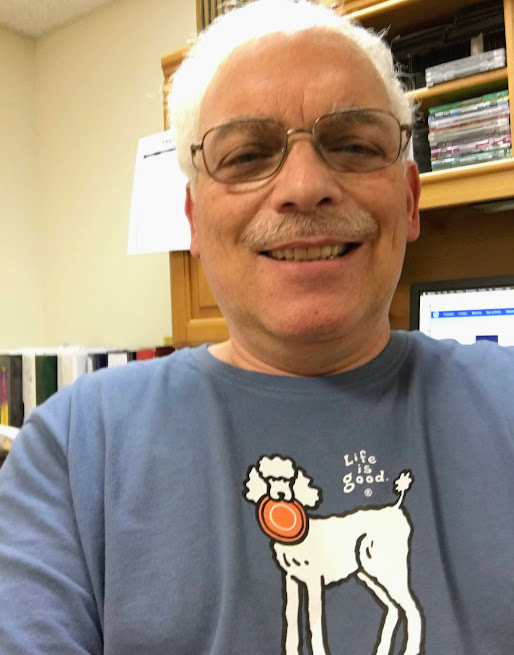
But that denial places clergy in an especially precarious position.  This variant, while seemingly diminished in destructive capacity, is still extremely contagious, more contagious than ever, and there are people who should not be playing Russian Roulette with it. We still know very little about long Covid and I still can't taste my Cheerios, so if anyone is thinking that I'm now going to start wearing an "I Beat Covid" t-shirt to work, that's not going to happen. I've got my other t-shirt on right now, since I can't pet my dogs.

I will still advocate caution in much of what we do on the upcoming holidays - for instance, we will not have kissy-huggy Torah processions, even though I miss them more than anyone. I also will continue to really, really recommend masks indoors. And finally, you will not hear me trying to convince people to attend in person if they are remotely uncomfortable doing so. I love big crowds. I miss big crowds. But when I stand on the pulpit (God willing) I will not neglect those who are watching from home. You are part of our community too, and for the time being, we will continue to be a hybrid congregation, with no bias toward either in-person or remote. We will continue to aim to be excellent at providing guidance and inspiration for both.


As you can see - and you undoubtedly surmised from my note last week - I believe this pandemic has been extraordinarily destructive and corrosive for spiritual institutions and other living things. We've been so busy plowing forward - appropriately - that we've not yet stopped and looked back at the scorched earth Covid has left behind. Just the sheer number of people who have died. A million in this country, over 6 million around the world.

Since when do we, the Jewish people, toss off the deaths of 6 million human beings by ripping off masks and declaring victory? There is nothing to compare to the cruelty of the Holocaust, but the sheer numbers of those families who have suffered from this lonely, isolating, dehumanizing plague rises to an a total that is altogether too familiar.  I know we're exhausted, but I think we've been blasted by a combination of Covid brain fog and sensory overload at the sheer scope of what we have lost, how many we have lost and who we have lost. From the unknown to the noteworthy to the greatest of our generation. Doctors surmise that Covid might even have played a role in the death of Queen Elizabeth, It played a role in many deaths not recorded as Covid-related. Six million may be a vast undercount. Since 2020, wherever there was death, the shadow of Covid has lurked, but people have been too embarrassed to admit it. The true impact of Covid has been a conspiracy of silence and denial. Covid has besmirched our civilization, and where in nobler times that might have brought the world together, here we can't even get a third of America to take it seriously enough to mask up and vaccinate to protect the rest of us. 


“I say let the world go to hell, but I should always have my tea.”

― Fyodor Dostoevsky, Notes from Underground

Think what the spring of 2020 did to us. Just the memory of those trucks filled with bodies outside the emergency rooms. Just the fear of touching a doorknob, and the reluctance to open one for a stranger. The anger at those who seemed so selfish or politically cynical. Those who got going when the going got tough, and left their spiritual communities. Those who raked in the PPP dough when they didn't need it. For me now to pray that the sanctuary is NOT full, that everyone will sit apart and not sing - it is the complete antithesis of what my entire rabbinate has been about. It's not about me - it never has been - but these three years have caused considerable and perhaps irreversible damage to our souls. We trust less, we laugh less, we care less, we dream weirder, we hope less, we love less and we die younger - and more are dying.  Any good trends? There are someSome interesting possibilities for synagogues too, including, ironically, the growing possibilities for virtual community, as we've demonstrated with our afternoon minyan and as we accomplished with well-attended Shabbat services before we went back in-person. But with each idea we generate to finally get beyond this thing, God laughs a little bit more.


So yeah, this is part two of last week's message. And I am hardly alone among clergy in feeling this way, as 38 percent have strongly considered giving up the ministry. Actually, that number has grown to 42 percent. 


There are two truths that are self evident:


  • One is that it is impossible for clergy to properly do their job in a mask. So much of what we are about is forging the kind of connection that can only happen when you see the face, the contours of a smile, the furrowed, empathic brow, the cheek damp from tears. Even when you give up the holding of hands, at the very least you need to see the face, and to hear an unmuffled voice. Kids need to see that especially. 


  • The second truth is that is is impossible to do our job properly these days without masking. We need to protect others by modeling caution and self care, and we need to protect ourselves so we will be there to share the most sacred moments of others' lives. A sick rabbi is a useless rabbi. I'm useless this week. I'm a spun dreidel, a windless shofar. Thankfully, a bar mitzvah scheduled for this Shabbat was recently postponed. Thank God there are no weddings. Because I'm useless.


Someone said, that if I managed to catch (or be caught by) Covid, anyone can, because I've been so "careful." It's true that among local public leaders, I've been on the more cautious side. And I've taken hits for that. I'd love a quarter for each time I've been told, "But Temple X or Church Y or school Z is back in person!" even early on, when the science strongly suggested it was not a good idea. Those arguments never moved me. Not once. I was never going to let peer pressure overrule my better judgment.  I did not want anyone dying on my watch.


But at times, when my job put me in positions that I felt were unreasonably risky, I've acquiesced out of a sense of duty, with little resistance. If someone is dying in the Covid section of the hospital and they allow you to visit, sometimes you just have to visit. So I would hardly say that I've been especially careful. Like all first responders, you gotta do what you gotta do. I've done funerals that filled our sanctuary, where despite my entreaties, few were masked. I've attended shivas at private homes where I've felt the hosts made a mockery of safety measures. That made me angry because it forced me to put my loved ones at risk, but I said nothing. I've been doing in-person burials since the very beginning (and there were so many in those first months); I had to do them. Until I was vaccinated, these funerals scared me to death, even when only a few family members were allowed to be present. And people have routinely tested positive after shivas, funerals and weddings that I attended, often mask-less. I was hardly a model of self-protectiveness.


So Covid, you got me. But not in the way you think. You actually had me at hello. Way back in March 2020, I always understood what you were - i never underestimated the damage you could wreak. I "got" you. As did the author David Grossman, whom I quoted back then in one of my earliest Notes from the Bunker:


Suddenly, a disaster of biblical scale has entered our lives. "Then the Lord sent a plague upon the people." And the world was plagued. Every person in the world is taking part in this drama. No person is excluded. There is no one whose intensity of participation is less than that of others. On the one hand, because of the nature of mass slaughter, the dead we don't know are only a number, they are anonymous, faceless. But on the other hand, when we look today at those who are close to us, at our loved ones, we feel how much every person is an entire culture, infinite, whose disappearance would dislodge from the world someone who is now and will always be irreplaceable. The uniqueness of every person suddenly cries out from within them, and just as love causes us to set apart one person from the masses that flow through our life, so, we see now, the awareness of death also causes us to do.


For many, the plague might become the fateful and formative event in the continuation of their lives. When it fades away, at long last, and people come out of their homes following a lengthy closure, new and surprising possibilities might be articulated: perhaps having touched the foundation of existence will foment that. Perhaps the tangibility of death and the miracle of being rescued from it will jolt and rattle women and men. Many will lose their loved ones. Many will lose their place of work, their livelihood, their dignity. But when the plague ends, there may also be those who will not wish to return to their former lives. There will be those - the ones who are able to, of course - who will leave the job that for years stifled and suppressed them. Some will decide to leave their family. To separate from their partner. To bring a child into the world, or precisely to refrain from that. There will be those who will come out of the closet (out of all manner of closets). Some will start to believe in God. There will be religious believers who will apostatize. Possibly a consciousness of life's brevity and fragility will spur men and women to set a new order of priorities. To insist far more on distinguishing the wheat from the chaff. To understand that time - not money - is their most precious resource.


Grossman's essay may or may not be prescient. We still haven't reached the end.


So we don't know yet what the future world will look like.


I do know that we will eventually dig out of this. There will be a future and it will be different. Very different. it already is.  


You finally caught me, Covid, but you didn't kill me yet. Come hell or high water, or God forbid even a Paxlovid rebound, I'll be out there on Rosh Hashanah, out from my bunker, my Doestoevskian dungeon, ready to welcome the new year, and the promise of a new future. Mask and all. There will be a future. It begins next week. 


A sweet 5783 to all.


Rabbi Joshua Hammerman

Recommended Reading

Chief Rabbi Lord Sacks' Tribute to Queen Elizabeth in 2012
  • (Video above) Chief Rabbi Jonathan Sacks' tribute to Queen Elizabeth in 2012. See also Where you find greatness there you find humility / and see alsWhat Queen Elizabeth meant to a British Jew like me. Queen Elizabeth never made an official royal visit to Israel, which was a source of much controversy. Charles did attend the funerals of Rabin and Peres - an enormous morale boost - and hopefully he will return soon. But the first official royal visit to Israel didn't happen until Prince William went in 2018, and your TBE Israel group was there to see him at the Kotel, up close and in person -- really close.... like this close (I believe Cantor Kaplan took this photo)
  • Was Queen Elizabeth a successful monarch? 


Presumably the answer is an unequivocal "yes." But if she had been a rabbi, her contract would never have been renewed for another term: 


"Let's see, Rabbi Liz.... Nice High Holidays - you're great with pomp, but maybe a little more edginess to your talks wouldn't hurt. But otherwise, not a pretty picture.... since you took over, we've lost about a billion members. We've left Europe and isolated ourselves. Your family is an embarrassment. Can't you control your kids? The country is an economic mess, and environmental mess too. When you started out, the sun never set on us. Now the damn sun is burning us up!  Sun - Please set!  And you're obsessed with those corgis. Oh, and you're too old."


Fortunately, Your Majesty, your reign will not be assessed by historians according to the size of your empire, but rather the expanse of your heart.  in evaluating you, size does not matter.  Your ancestors might have been enslavers and plunderers of half the earth - but you were different. As everyone has been saying this week, unknowingly quoting "The Woman of Valor," from Proverbs, Eshet Chayil, you were "robed in strength and dignity." And you will be missed.


  • US Supreme Court decision says Yeshiva University must recognize LGBTQ club (TOI)OK, let's just say that this is embarrassing. Lots of non-rabbis go to Y.U., including my wife, who got her PsyD from Ferkauf. It's a top notch academic institution. So what the hell are they doing, denying support to students who don't fit their halachic mold? This and the NYT Haredi education piece in the same week? If ever I needed proof that the world has gone Covid crazy, this is it. This is Y.U's most inopportune decision since they took that investment call from Bernard Madoff.


  • Fewer than half of Americans may be Christian by 2070, according to new projections (RNS) If current trends continue, Christians could make up less than half of the population — and as little as a third— in 50 years. Meanwhile, the so-called nones — or the religiously unaffiliated — could make up close to half of the population. And the percentage of Americans who identify as Muslims, Jews, Hindus, Buddhists and other non-Christian faiths could double. - 


I can hear the chant now building,with the tiki torches lit in the fields of Idaho:  "Nones will not replace us!" Well apparently, they will! 


it's time to....send in the Nones! 

Send in the Nones!


  • Blowing shofars, Jewish lawmakers, rabbis hold abortion rights ‘sho-test’ (RNS) - Blowing shofars, traditional Jewish instruments made from a ram’s horn, a group of Jewish lawmakers, rabbis and activists proclaimed their support for abortion rights outside the U.S. Capitol on Wednesday (Sept. 14), insisting that access to abortion is a Jewish value. The event was one of many demonstrations dubbed “sho-tests” to convene across the country by the National Council of Jewish Women in response to the U.S. Supreme Court decision in Dobbs v. Jackson Women’s Health Organization to overturn abortion rights and looking ahead to November’s midterm elections.


Temple Beth El
350 Roxbury Road
Stamford, Connecticut 06902
203-322-6901 | www.tbe.org
  
A Conservative, Inclusive, Spiritual Community