In This Moment: A Rabbi's Notebook
“Every human person possesses an infinite dignity, inalienably grounded in his or her very being, which prevails in and beyond every circumstance, state, or situation the person may ever encounter.” - Pope Leo, Magnifica Humanitas, paragraph 53
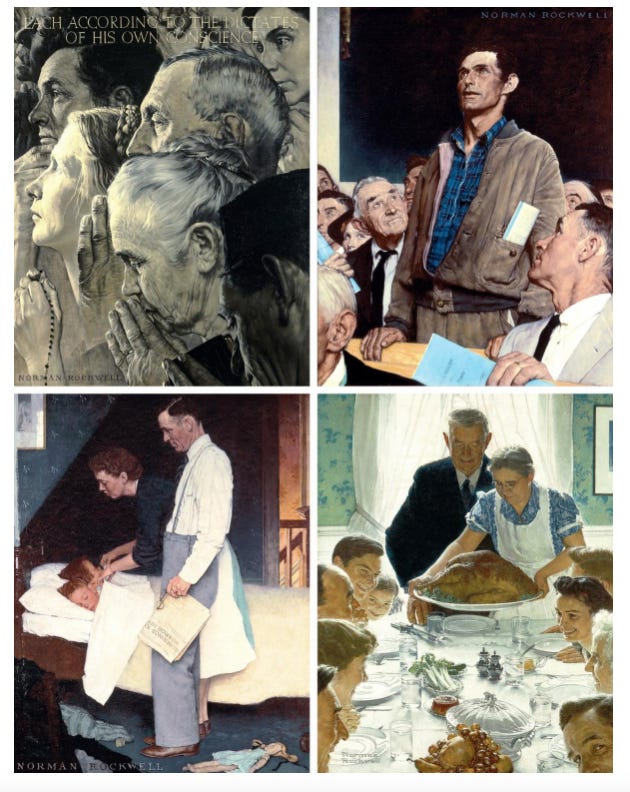
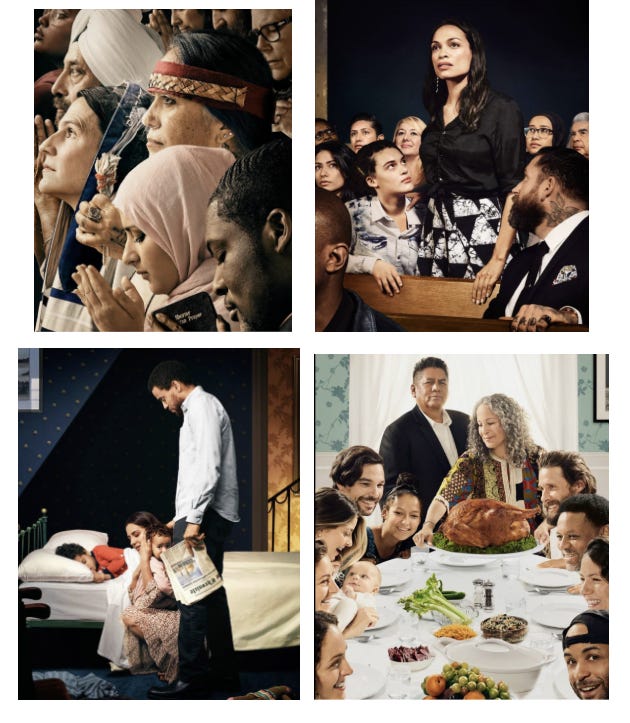
OK folks, it’s time to take a break from the politics of the moment, a step back from panicking about policy, perversion, profanity and polling. There are plenty of matters yet to be resolved, but this is Thanksgiving - and we need to step back. Or at least I do.
Over the holiday, I’ve resolved to take my eye off of social media, if only briefly, and table my pet peeves while focusing on the table itself, the dining room table, and the work of human hands - the food - and the pets without the peeves. Admittedly, we’ll have some technological assistance - a Zoom hook up with far-away loved ones, but otherwise I’m going to try to take a few days to cleanse, to refocus on the human element.
In the midst of the Nvidia scandal, the barrage of outrages and outages and an avalanche of terrifying AI-related news, this seems like the right time to catch up on Pope Leo’s recent encyclical on Artificial Intelligence, Magnifica Humanitas, and you might want to do that too. If you do, here it is.

In placing humanity at the core, the Pope is not trying to pull a reverse Galileo. It’s not that the earth returns to the center of the universe - we’ve seen too much of the wonder of the universe’s vastness to go back there. But it is AI technology that is trying to usurp that centrality, not by replacing man but by overwhelming humanity and ultimately replacing God. Pope Leo is reminding us that there is something ineffable about humanity, something about us that is created in the divine image but still not God, and not able to become God. Our new Tower of Babel of AI may reach mighty high, but it ‘aint divine - and it ‘aint even human.
Although there is no Jewish pope to respond on behalf of the entire Jewish people and stand in dialogue with these magnificent principles, my friend Rabbi Mark Dratch, Chair of the International Jewish Committee for Interreligious Consultations (IJCIC), the official Jewish partner in formal dialogue with the Holy See, has written a brief response, A Jewish Welcome to Magnifica Humanitas.
Dratch writes of the pope’s work:
Magnifica Humanitas asks whether the age of artificial intelligence will become another Tower of Babel or a city in which the dignity of every person is safeguarded…The builders of Babel, (Leo) writes, set out to “make a name” for themselves with “a single language, a single technology, a single direction,” but the project “sacrifices human dignity for efficiency” and reduces the person to “data and performance.” The counter-image in the encyclical is the rebuilding of Jerusalem under Nehemiah, where each family and each artisan takes a portion of the wall and the city rises through shared responsibility. The question is which of these construction sites the age of AI will turn out to be.
The encyclical is concerned that human beings might come to see themselves and one another as systems to be optimized, persons to be processed, or templates whose differences can be smoothed away in the name of efficiency. That concern is a Jewish one as well.
Pope Leo has demonstrated immense courage in his brief time in office, standing up to the bully in the White House more than once while never sacrificing the dignity of his title, and now taking on the bishops of Silicon Valley who fancy themselves as gods.
Rev. Kevin Deal, whose parish is in the Bay Area, reports in The Guardian that Anthropic, the AI company, has been courting priests, rabbis and theologians. Its billionaire cofounder, Christopher Olah, has even pressed Vatican advisers to take seriously the possibility that his company’s chatbot might possess consciousness.
Deal rejects this notion outright, saying, “I welcome serious conversations about AI’s moral implications, especially theological ones. But the extraordinary effort to establish whether a machine might have consciousness, or possess a soul, reveals a profound misunderstanding of what makes us human.”
He adds, “Our souls and minds and bodies are so much more than the tasks we perform.”
Which is why it has become an urgent priority that independent moral voices from the interfaith community be consulted not merely by tech bros, but by responsible regulators - such as those who have just been elected to Congress on a mandate to slow down the breakneck growth of AI data centers. Our civilization needs to take a breath before we take reckless steps that might bring catastrophic results.
Yes, AI could lead to life-enhancing breakthroughs in health care and climate, but what person’s life would be enhanced if humanity is degraded in the process? We know whose wealth would be. We know whose power would be. But whose life? Whose dignity?
At the “G20 Interfaith Forum” held in Salt Lake City last month, Apostolic Nuncio Caccia explained in simple and direct terms why the voice of faith must be part of this conversation: “Technology offers extraordinary possibilities, but innovation alone does not tell us what is good.”
It also doesn’t always tell us what is true. Even now, several generations in, having solved some of the greatest math problems known to humanity, AI still gets stuck on some basic terminology. The other day, I was rummaging through videos selected by my YouTube algorithm and I checked out one on the “Blizzard of ‘78” in Boston. Toward the beginning, the narrator spoke of cars that were abandoned on Route 128, which “he” called “Route one-hundred-twenty-eight.”
No human this side of Mars would call that road “Route one-HUNDRED-twenty-eight.”
I don’t know why, but it really bothered me. I felt betrayed. I then switched to a sports video from the same era that spoke of Red Sox great Carl “Yaz-tra-ZEM-ski.” Really? Go back to AI school, Buddy, practice how to pronounce it and learn some respect! I mean, it did take me a while to learn how to pronounce my wife’s hometown of Worcester, but that’s because I came from hoity-toity Brookline. I had an excuse. But route 1-HUNDRED-28?
Well, now it’s route 93 and 95 so it doesn’t matter.
But I wonder how the AI gods would pronounce the 405 in L.A.? The Four-hundred-five?
Also, AI often slants insidiously toward the biases of its programmers or the material it is absorbing. In doing so, it can regurgitate and generate hate speech, without ever questioning it.
But I must admit, it’s almost comforting that AI still can make so many dumb errors - not errors of intelligence or programming, but errors demonstrating a lack of human seasoning and wisdom.
Why wouldn’t a rabbit walk into a bar with a priest and a minister? Anything else would be, as Spock would say, illogical. It’s a rabbit, just as our A.I. generated Jewish-word autocorrect tells us that “Nachas (joy from family)” is really “nachos,” “Sabra (native Israeli)” is “Santa,” “Boker Tov” (Good morning) is “Biker too,” and “Mishpacha,” (family) perhaps appropriately, is “mishap.”
AI would actually be funny… if it weren’t going to destroy us all.
But aside from being funny, I wondered recently whether it can take on other overtly Jewish characteristics? Can it kvetch? I asked ChatGPT to generate a brief paragraph of kvetching, and here’s what I got.
Ugh, I can’t believe how ridiculously hot it is outside. And of course, my air conditioner decides to stop working right when I need it the most. The traffic today was a nightmare, too—so many reckless drivers cutting me off and making my commute unbearable. Oh, and don’t get me started on the never-ending chatter by the water cooler and stream of emails flooding my inbox. I swear, it’s like they multiply when I blink! Is it too much to ask for a day where everything goes smoothly for once? I’m just so tired of all these little annoyances piling up. Sigh.
Sigh?
When did you ever hear a Jew say “sigh?” Unless we’re talking to a guy named Sy, we never say “sigh.”
And “ugh?” What Jew ever says “ugh?” It sounds like something that you would read in a comic strip – Peanuts or The Lone Ranger. And “Don’t get me started” is right out of Billy Crystal’s Mr. Saturday Night. And chattering? Who chatters? You chatter over finger sandwiches, made of cucumbers, and not a pastrami at Katz’s Deli. Jews don’t chatter. We kvetch!
And in order to kvetch authentically, you need to be sitting down on one of those couches with the plastic covers like my grandmother had.
So, this AI generated kvetch sounds about as authentic as Billy Crystal channeling Eeyore, by way of Charlie Brown. It might as well have said, “Good grief!”
And that’s why AI can never replace what is human about us. Even if it can destroy us.
Hanukkah begins next week. Journalist Yair Rosenberg asked ChatGPT to do a Hillel vs. Shammai take on their classic argument about whether we should begin with one Hanukkah candle and go up to eight, or start with eight and go down – in the rapping cabinet meeting style of Hamilton. It’s really amusing - and filled with factual errors.
Here it is.
Note that the Torah says nothing about Hanukkah at all,
much less what order to light the candles.
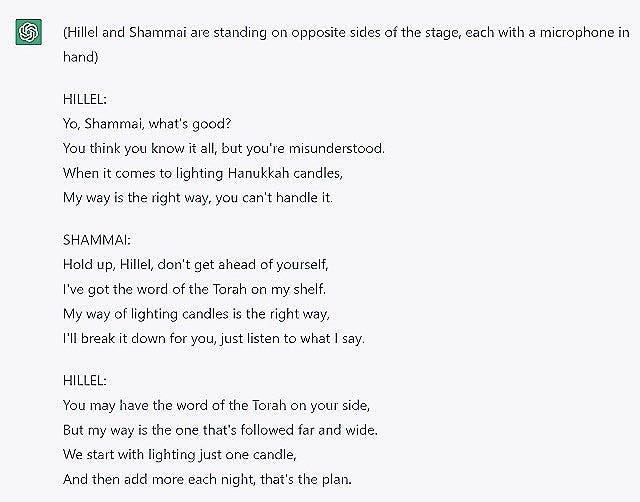
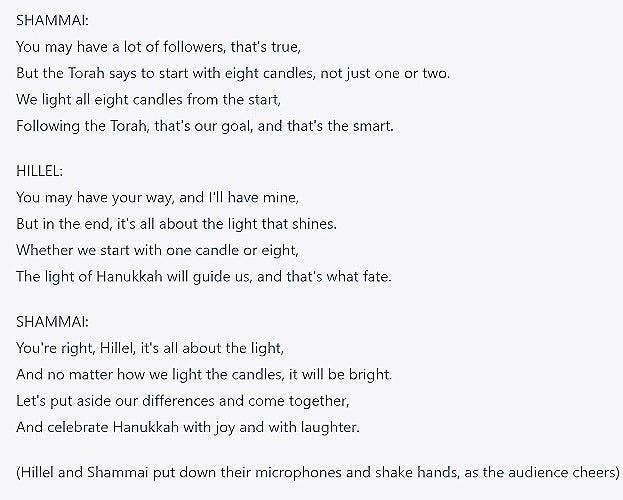
ChatGPT will make lots of mistakes and kill you with kindness and an air of authority, so you forgive those mistakes, and eventually, as AI increasingly becomes the fount of knowledge, displacing human sources, we start to believe that those lies are true.
It is insidious. And it is dangerous.
David Tzvi Kalman of the Hartman Institute believes that AI has no business writing Torah commentaries – that Torah must be interpreted and taught by humans because our sacred texts are multi layered and AI is shallow. But as the technology improves, as it comes closer and closer to appearing human, that could change. As Kalman states, “AI keeps infringing on our idea of what makes us human, and it does so by learning from humans, so undoubtedly some people will start thinking about AI as human.”
AI is built on a premise that artificiality can appear real, that a mechanical construct can fool us into believing that it is sentient. And even when it learns from its mistakes and spews out more facts, it is still fake. We must stand up for the primacy of the human.
As Pope Leo has reminded us, religion has a major role to play in making sure that happens.
Something to chew on with your drumstick.
____________________________________________________________________
IN OTHER NEWS
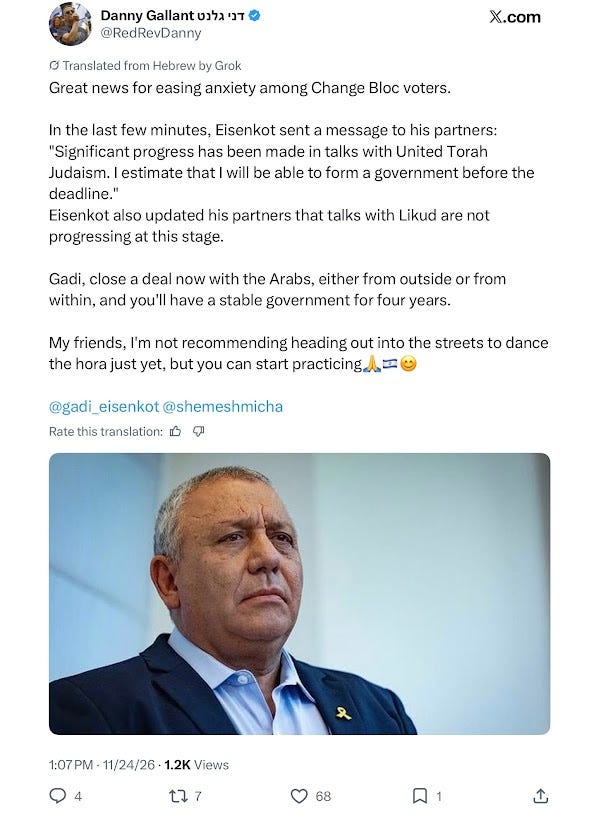
Here’s the latest on whether a change government will be formed in Israel….
At a point where even that beacon of international morality Jared Kushner is warning that Israel risks becoming a pariah state, and given the relentless racism being spewed by Natanyahu and his supporters trying to disqualify the Arab parties, it is essential that the change coalition led by Gadi Eisenkot succeed in ousting Benjamin Netanyuahu. It’s complicated, but Gadi is optimistic tonight.
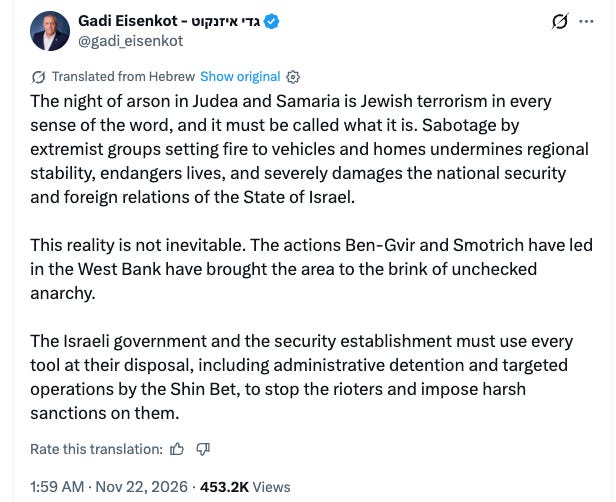
And Eisenkot with an appropriate response to continued Jewish terror attacks on the West Bank:
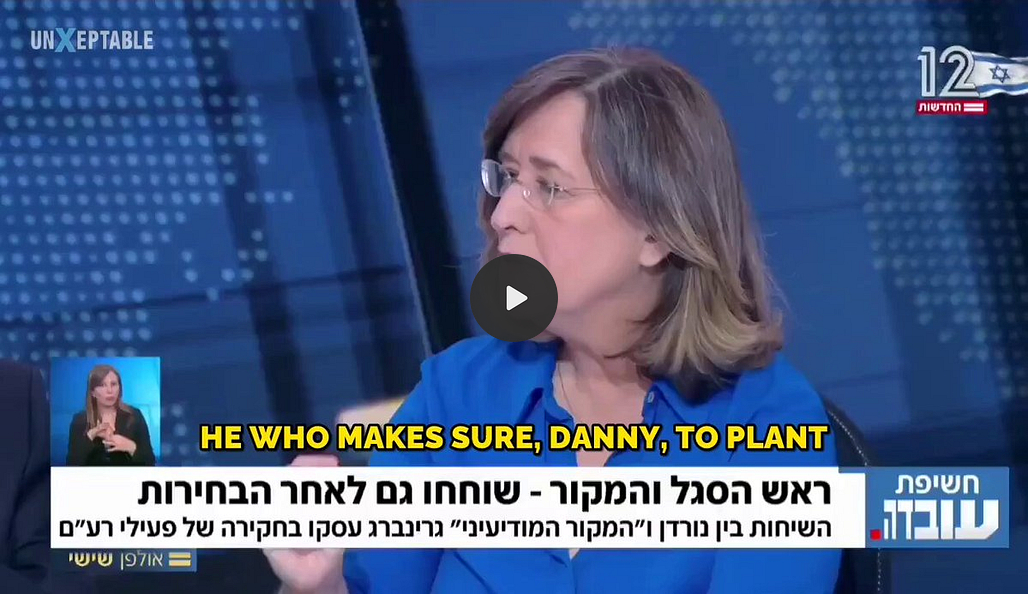
Here are other perspectives (click on this one to hear Ilana Dayan’s prophetic message):
And my friend Sarah Darer Littman’s most appropriate Substack post today:


great article on AI. Regarding the Kvetching response, I don't know what the prompt was, but I wonder what it would have been if you had added something like: You are an adult male Jew living in a highly Yiddish speaking New York neighbourhood like South Williamsburg. Make the response reflect his background, language, neighourhood, attitudes, etc.
Thank you. As I’ve written before this is so refreshing and appropriate now. شكرا لكم🕊️🌹
Thanks so much!
Thank you for linking to my piece, and we definitely have to get together to talk about AI -I've been researching it a lot for a new adult book idea that I hope to start cranking on once the semester is over!