Monday, October 29, 2018

Eulogy for Miriam Hammerman


Miriam Hammerman
I want to thank Rabbi Hamilton and Kehillath Israel for the gracious invitation that this funeral take place here.  I know my mom would have really appreciated it.  KI was always close to her heart – even at times when it wasn’t as close to mine.  And when she was no longer a fixture here and moved to Nahanton Woods, she belonged to Mishkan Tefilla for many years and loved that congregation too.  And now, here we all are, together.  And the fact that the certificate of occupancy for this building was received at almost the very moment of my mother’s passing, gives almost a bashert quality to our all being here today. It truly closes a circle, for my family and undoubtedly for others.

This coming week, Jews throughout the world will read of the death of the matriarch Sarah.  Strangely, the title of the portion is Hayye Sarah – the life of Sarah.

א  וַיִּהְיוּ חַיֵּי שָׂרָה, מֵאָה שָׁנָה וְעֶשְׂרִים שָׁנָה וְשֶׁבַע שָׁנִים--שְׁנֵי, חַיֵּי שָׂרָה.
1 And the life of Sarah was a hundred and seven and twenty years; these were the years of the life of Sarah.
Two things of note – first, that a portion describing death has a title connoting life – and second, that the word for “years of” – shnay – also means two.  Shnay hayye Sarah, then, can literally mean, “the two lives of Sarah.”

When I think of my mother’s 95 years, I can really describe it as two distinct lives.  Her final chapter -the past decade – was very painful for her and those who love her, and her decline from Parkinson’s was horrible to witness and even more horrible to live.  She lost the gift of words, a bad enough fate, but even more cruel for a pianist, she lost the gift of her hands.  In a sense, the day her Steinway was sold and moved from her home in Nahanton Woods was the beginning of the end.  But the last chapter played out over six years, four residences and two states.  The care she got was excellent, particularly at the Jewish Home in Fairfield – but she was a shell of herself and, worst of all, she was keen enough to realize it.

Thursday afternoon, I received the call that she had breathed her last – it was a shock but not a surprise.  I had seen her the day before and she seemed noticeably weaker, her will to live ebbing from her.  But she still had enough life left in her to allow me to feed her one last guilty pleasure - a Drakes Yodel.  She loved chocolate until the end.  And when she died, classical music was playing in her room.

And so now, from the moment of her passing, we are liberated to look back at the whole life of Miriam Hammerman – to put that final chapter in its proper place, but to look at it all.

And when you do, you can find two distinct lives, in fact,  Shnay Hayye Miryam.  And almost right in the middle, the dividing line, was my father’s tragic death.

Seven weeks from now, just at the conclusion of Hanukkah, we will mark my dad’s 40th yahrzeit.  She was young when he died.  But what could have been the end for her was instead a new beginning.  She never wallowed in self-pity.  She picked herself up and built a life – a new life  - a second life, as it were.  She traveled – a lot.  She learned how to invest her money and did well at it.  She spent time with family and friends.  She loved elder hostels and never stopped challenging her mind – especially when it came to learning more about her Jewish heritage.  She even had a couple of boyfriends, but never wanted to remarry.  She reveled in seeing her grandchildren and at the end, great grandchildren.  She followed the news assiduously.  She was a CNN junkie long before cable news became a thing.  She stopped watching, but news such as yesterday’s out of Pittsburgh would have greatly troubled her.

And she cultivated her music.  For the first half of her life, she developed and honed her art, practicing many hours each day as a child, and giving up everything else.  Then as a concert pianist she most often accompanied others.  In fact, that’s how she met my father.  A girlfriend of hers was supposed to accompany him at a concert he was giving in the area, but she had to back off at the last minute and she reluctantly agreed to take it on.  They met and as she recalls, he gave her really hard music to learn.  It was not love at first sight, although she admitted that he was very handsome.  So the night of the concert arrives and they get to the hall – and there’s no piano.  He did the whole thing acapella and she was relieved. And it was nice but she figured that was it.  Until a few weeks later, she attended the first big convocation at Brandeis, where Eleanor Roosevelt spoke, and there he was!

And the rest was history.

Life number one was filled with music – and it was also filled with challenges. It's not easy being the spouse of clergy, while raising three children, including one with special needs. But she did it effortlessly, assisted by her two best friends, her Steinway, and Filene’s Basement.

My mom always had a bag in her hand, usually to return.  She had the whole system gamed.  She knew where to properly bury items in piles of clothing, so that you could go back a week later and everything would be marked down.

She had the gift of New England frugality down to a science.  Which is why I didn’t hire a rabbi to do this service.  For one thing, I know she was very proud of me, and for another, I came prepaid.  She was a saver – never wanted to waste anything.  Anything in her refrigerator that was about to go bad – she froze.  She would freeze eggs.  She would freeze so many items that I used to joke that if I opened her freezer we would find Ted Williams in there.

But when she wasn’t at Filenes, she was just being a great mother – she was always there for me, my biggest booster and biggest fan – as I’m sure all her friends will attest.  Her coffee table was also known as the Museum of Josh. 

She knew what the life of clergy is like and that my schedule was not my own.  As her health declined during her last years in Newton, I tried to get up to see her maybe every other week.  She always thanked me when I visited – but I always wished I could have done more.

Mom had a great sense of humor – though often overshadowed by the Hammerman side of the family, she was pretty funny herself.  Once, when she was looking at assisted living options, we were in my car and we decided to check out Newbridge.   I called them on my speaker phone and was explaining to the person there that I was looking to bring my mother by to see some of the units – and then suddenly, on cue, she blurted out, “I’m the mother.”

And she had a great laugh.  I always liked to make her laugh, which is another reason why the past few years have been so hard.  She did smile until very recently, whenever I would visit. 

And I should add, that she was a big Red Sox fan.  Right now, I can imagine her and my Brooklyn born Dad having interesting World Series conversations up there.

In her first life, maybe the biggest favor I ever did for her was to get the measles as a kid.  When the doctor made a house call, he noticed her smoking and slapped the cigarette out of her hand and said, this must stop now.  And she did. She was able to will herself to get rid of a lifelong habit. And it might have saved her life.  About a decade after my father died, my mother was diagnosed with lung cancer and the decision was made to have one lung removed.

She survived the surgery and lived the last three decades of her life with one lung.  Aside from occasional huffing and puffing, you would never have known.  Any time she had a respiratory infection, it was scary.  But she truly defied death.  She feared death and was often preoccupied with matters of health.  Her health lectures were constant - and sometimes comic.  For our anniversary, she once gave us an electric toothbrush.   Every time I would visit her, she would show me the “when I die” file that she kept, and planned meticulously.  Decades ago, she was suggesting caterers for the shiva.  But the fact is, she never gave in to death, and for as long as she could, she never stopped living.

She kept on playing, for a while doing concerts of duets and chamber music.  She taught many students and in only one case did she fail – with me.  I wish I had taken piano more seriously.

וַתִּקַּח מִרְיָם הַנְּבִיאָה, אֶת-הַתֹּף--בְּיָדָהּ.

Like the Miriam of old, my mother took the instrument, went out and made music.

My mom loved family.  She took care of her mother of blessed memory, who also lived most of her adult life as a widow.  She was a loving sister to Ernie of blessed memory and her sister Eleanor was also her best friend.

She became a family matriarch of sorts, for my cousins on her side, and on my dad’s side as well.  She was so proud of Lisa and Asher and their family, and until it just became too difficult, she loved going to Israel to see them, and when they came here. And she got to see Adereth several times, and then often via Skype, and her great grandchildren Neriya and Ohr Ariel – who visited last year, and through photos, videos and Skype.  When most of her words evaded her over the past couple of years, she would always want me to test her on the names of her grandchildren and great grandchildren – and she never did forget them. 

She and my brother Mark had a special relationship, and when my father died, she did not miss a beat in assuming his leadership roles at Humanity House, which she had helped my father to found, and later to the Barry Price Center.  Although it was very hard for them to communicate with each other at the end, she was always very concerned about Mark, who, in large part thanks to her, is in a very secure place now.

And she also had a very special relationship with Mara and Ethan and Dan and was so proud of them.  She beamed at her grandsons’ b’nai mitzvah, came to every birthday and brought back exotic gifts from her trips – including the most cherished item, a sheepskin rug from Morocco.  On those rare Shabbats when I was off, I often took them up to Boston with me to spend the weekend with her, and get a glimpse into my childhood.  And when it came time to move her into a new apartment, I knew I needed Dan with me, because no one brought a smile to her face more than Dan.  She wrote a letter to him for his bar mitzvah – saying that even when he entered this world he had a beautiful melodious cry.  You’ve blossomed into a well-rounded individual with wonderful values and interests,” and she talked about how she loved sitting with him in the morning and reading the New York Times movie reviews together.  She said, “I’m very grateful for the time we have together.”  She wrote to Ethan as well, saying, “You bubble with enthusiasm in all that you do.  I treasure the time you came over to me and sad, “I want to bond, Grandma.  Let’s watch this TV program together.”

She loved her family and she loved being Jewish.  Every week while growing up, I was entranced as she would wave her arms and bless the Shabbat candles, always adding special prayers that God bless her loved ones.  Even when all other words evaded her, she remembered the candle blessing, nearly perfectly.

For a few years, she kept a diary sporadically, jotting down impressions and quotes that she liked.

She wrote there of her family, after describing her 75th birthday celebration: “You are the best thing that ever happened to me.”  And “I have loved and been loved.  All the rest is background music.” She taught us all how better to appreciate all the music – background and otherwise.

And she wrote, "Turn your wounds into wisdom."  That wisdom is most helpful now.


May your memory be for a blessing, Mom.

Thursday, October 18, 2018

Shabbat-O-Gram

Shabbat-O-Gram


Educational Director Lisa Gittelman-Udi welcoming a slithery guest to Hebrew School at last Sunday's Noah's Ark petting zoo.  

Mazal tov to Lisa as she celebrates the wedding of her son Adam to Maya Lewin-Berlin


Shabbat Shalom!

 
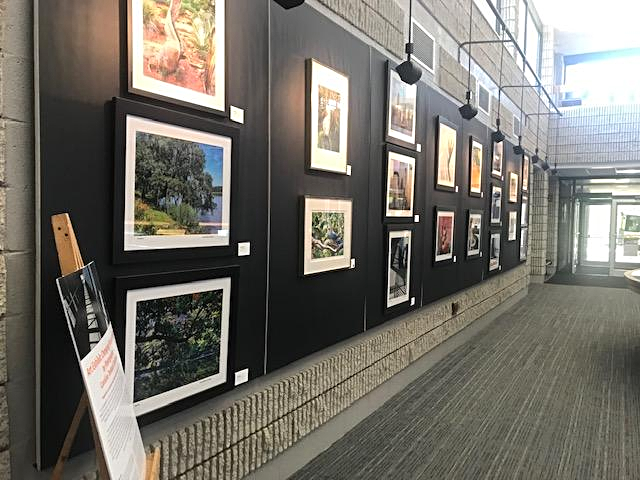
TBE congregants continue to contribute to our community in the most creative ways.  Mazal tov to Caroline Temlock Teichman, whose exhibit (see photo above), "Changing Perspectives," is continuing at the gallery of the JCC. 

And mazal tov also to  bestselling author, TBE's Sarah Darer Littman, whose new young adult novel is out this month.  Details on the book launching can be found at the bottom of this O-Gram.

This week's portion is Lech Lecha - the story of Abraham and Sarah's journey to...

Sorry, I've been a bit preoccupied with canines lately.

Anyway, for Abraham, leaving home was the only option.  Maimonides mocked the inhabitants of Abraham's hometown, writing in the Mishneh Torah (Laws of Idolatry, chapter 1):

He had no teacher, nor was there anyone to inform him. Rather, he was mired in Ur among the foolish idolaters. His father, mother, and all the people were idol worshipers, and he would worship with them. But his heart was exploring and growing in understanding.

Somehow Abraham was able to surmount the limits of his little town, gaining insight and even picking up a few proselytes along the way, but the going was slow and at times dangerous.  He made some significant enemies, including the king, who desired to kill him. His father Terach remained not just any old idolater, according to the famous midrash, but he was owner of the Macy's of idolatry.  Then, just before the moment of decision, Terach died.  Abraham's break with the past was complete in every sense, except geographically. Now more than ever, he needed to leave his past behind.
So that's how the world's first Jew also became the world's first Jewish refugee.


This Shabbat we are proud participants in National Refugee Shabbat. See the list of communities around the country who will be participating in this special Shabbat. There are dozens - but we are the only ones in Fairfield County.  You can read more about it on the HIAS website.  Join us on Friday night and again at Shabbat-in-the-Round on Saturday morning (beginning with breakfast at 9:30).

Welcoming the stranger is a key theme Jewish sources. It was also the theme of last week's Interfaith Seder at Grace Farms. Click here to see the supplement we put together for that Seder.  

At services on Passover this year, I dug down into the topic of migration, Jewish values and the Exodus. I shared an excellent source packet, "Immigration in the Haggadah and in Jewish Law" created by Rabbi David Siff, which intersperses Jewish quotes laws from the Middle Ages about migration between communities.

Also see "Loving the Neighbor/Loving the Stranger," a packet by Rabbi David Seidenberg, which includes every Torah law that mentions the stranger.

HIAS explains the rationale behind this effort:  
 

WHY NOW?

"We are witnesses to one of the largest humanitarian crises in human history. There are now more than 65 million people who have fled their homes due to persecution and violence. And, yet, in this moment of unprecedented need, our government is grinding the U.S. refugee admissions program to a halt and cutting humanitarian aid. This year, the United States is poised to admit tens of thousands fewer refugees than in years past.  
The Jewish movement for refugees in the U.S. has grown exponentially since 2015 - with individuals, congregations, and organizations volunteering, raising awareness, and advocating for refugees around the country and the world. The involvement of our community has made a difference.
This is a moment when we must give voice to our values as Jews and as Americans and stand up for the safety and the lives of people around the world. " 
Every Jew should be proud and grateful of the legacy of this organization. Read below about its history.
Founded in 1881 originally to assist Jews fleeing pogroms in Russia and Eastern Europe, HIAS has touched the life of nearly every Jewish family in America and now welcomes all who have fled persecution.
From our beginnings in a storefront on the Lower East Side of Manhattan, a group of American Jews organized to provide much-needed comfort and aid to thousands of Jews fleeing waves of anti-Semitic riots. While those who arrived were refugees - people who were being killed in their homelands because of who they were - the world did not yet have a legal concept for people who needed safe refuge outside their homelands.
In New York City, the once tiny Russian Jewish population swelled by the thousands. They formed the Hebrew Immigrant Aid Society to provide meals, transportation and jobs for the new arrivals to Manhattan.
A shelter was established on the Lower East Side providing dormitory space, a soup kitchen and clothing to any needy Jew.
HIAS established a bureau on Ellis Island in 1904 providing translation services, guiding immigrants through medical screenings, arguing before the Boards of Special Enquiry to prevent deportations, and obtaining bonds to guarantee employable status. We lent some the $25 landing fee and sold railroad tickets at reduced rates to those headed for other cities. We even installed a kosher kitchen, which provided more than half a million meals to new arrivals on Ellis Island.
HIAS also found relatives of detained immigrants. Six hundred immigrants were detained during just one month in 1917 because they had neither money nor friends to claim them. HIAS was able to locate relatives for the vast majority who were then released from Ellis Island.
We became famous worldwide - and in many languages - as HIAS, the abbreviation that was our first cable address.
In 1921, HIAS bought the former Astor Library on Lafayette Street in Manhattan to serve as a shelter providing housing, kosher kitchens, a small synagogue, classrooms for job training and civics education, a playground, and a weekly bazaar for the thousands of immigrants who passed through the doors each year.
In the 1920s laws changed to recognize the need for safe haven but countries like the United States established legal requirements for resettlement. HIAS expanded to ensure that Jewish refugees could find welcome and safety.
The outbreak of World War I brought the largest influx of Jews from Eastern Europe yet; more than 138,000 in that year alone. But soon after, restrictions limited the number of immigrants allowed into America to no more than 2 percent of the total of each nationality residing in the U.S. in 1890, severely restricting the entry of Jews from Eastern Europe.
Though precious few refugees were rescued during World War II, due to the restrictive National Origins Quota of 1924, HIAS provided immigration and refugee services to those who were. It was not until 1965, through the aggressive work of HIAS, that the National Origins Quota was replaced with a new law, liberalizing decades of restrictive admissions policies.
After the war, we were instrumental in evacuating the displaced persons camps in Europe and aiding in the resettlement of some 150,000 people to 330 communities in the U.S., as well as Canada, Australia, and South America.
The Universal Declaration of Human Rights, as well as the 1951 Refugee Convention became the basis for U.S. asylum law, giving HIAS the basis for all future work to assist refugees no matter where they were.
  • 1956 - HIAS assisted Jews fleeing the Soviet invasion of Hungary and evacuated the Jewish community of Egypt after their expulsion during the Sinai Campaign.
  • 1959 - HIAS set up operations in Miami to rescue the Jews fleeing Cuba's revolution.
  • 1960s - HIAS rescued Jews from Algeria and Libya and arranged with Morocco's King Hassan for the evacuation of his country's huge Jewish community.
  • 1968 - HIAS came to the aid of Czechoslovakia's Jews after the suppression of "Prague Spring" and to Poland's Jews after pogroms racked that country.
  • 1975 - Following the fall of Saigon, the State Department requested HIAS' assistance with the resettlement of Vietnamese, Cambodians, and Laotians. That year, HIAS found new homes for 3,600 in 150 communities in 38 states.  While not the first time HIAS had assisted in the resettlement of non-Jews, the organization's assistance with this large-scale refugee crisis garnered a special thank you from President Gerald Ford. HIAS continued to assist refugees from Southeast Asia through 1979.
  • 1977 - HIAS helped evacuate the Jews of Ethiopia, which culminated in several dramatic airlifts to Israel.
  • 1979 - The overthrow of the Shah precipitated a slow but steady trickle of Jews escaping the oppressive theocracy of Iran. HIAS helped hundreds of Iranian Jews with close family living in the U.S. resettle here.
In two modern waves, the Jews of the former Soviet Union have found their way to freedom with thehelp of HIAS. The first wave peaked in 1979. The second wave, which began in the late '80s, has so far brought more than 140,000 Jews to these shores for reunification with their relatives. (While not traditionally considered refugees, the U.S. Congress created a special refugee status for religious minorities from the former Soviet Union, which now allows for resettlement of Jews, Christians, and Baha'is from Iran.)
In 2001, HIAS celebrated our 120th anniversary with a "HIAS Day" festival in Brighton Beach, Brooklyn. Two days after the joyful celebration, Al-Qaeda terrorists attacked America, throwing the entire U.S. immigration system into turmoil. HIAS mobilized its network to continue serving refugees, despite extreme delays in the arrival process brought on by increased security measures and the reorganization of the Immigration and Naturalization Service into the Department of Homeland Security.
Because we have helped more than 4.5 million people escape persecution, HIAS is uniquely qualified to address the modern refugee situation, which has mushroomed into a global humanitarian crisis.
We understand better than anyone that hatred, bigotry, and xenophobia must be expressly prohibited in domestic and international law and that the right of persecuted people to seek and enjoy refugee status must be maintained. And because the right to refuge is a universal human right, HIAS is now dedicated to providing welcome, safety, and freedom to refugees of all faiths and ethnicities from all over the world.
Starting in the 2000s, HIAS expanded our resettlement work to include assistance to non-Jewish refugees, meaning we became involved in the aftermath of conflicts from Afghanistan, Bosnia, Bulgaria, Czechoslovakia, Ethiopia, Haiti, Hungary, Iran, Morocco, Poland, Romania, Tunisia, Vietnam, and the successor states to the former Soviet Union. We began to work in countries where refugees fled to identify those in immediate danger to bring them to safety. We realized that there were many refugees who would not be resettled and that it was important for us to help.
We began a new chapter in 2002 when we established operations in Kenya to provide protection to refugees from several African countries plagued by conflict, to advocate on their behalf, and to resettle the most vulnerable. This was the beginning of HIAS' work to build safe communities for refugees in the countries of first refuge where the majority now remain indefinitely.
HIAS recently celebrated 130 years of helping refugees escape persecution and resettle in safety; reuniting families who have been separated; and helping them build new lives in safety and freedom. HIAS continues to resettle the most vulnerable refugees of all faiths and ethnicities from all over the world. We facilitate the application process for the most vulnerable refugees who can be resettled in countries around the world. In the U.S. we work with local social service organizations around the country to welcome refugees and help them integrate into their communities and build new lives. 
Finally, we continue to be on the front lines, working with refugees in camps and cities from Kenya to Ecuador. We are the only Jewish organization whose mission is to assist refugees wherever they are.


Shabbat Shalom!

Rabbi Joshua Hammerman

Wednesday, October 17, 2018

TBE Bar/Bat Mitzvah Commentary: Will Herckis on Noah


Shabbat Shalom!

This past summer I devoted countless hours to a single goal. No I’m not talking about preparing for my bar mitzvah, even though I did spend a lot of time studying. Right Mom and Dad?

But I also spent a lot of time watching the popular TV show  “Friends,” I watched dozens of episodes, until I realized that I should probably get back to my Bar Mitzvah studies.  What I love about Friends is that they are all so supportive of each other. It made me realize that the type of people you hang out with makes a big difference in the person you become.

 My torah portion of Noah teaches the same lesson. In the portion, Noah builds an ark to save his family and every animal from a flood. The Torah describes how Noah was an average person in evil times. But strangely he was called a righteous person. What does that mean? That means he was a very good person compared to the rest of his generation.

I’m lucky to live in a time where my friends and family are all good people, and no one is leading me in the wrong direction.

Is it better to be an average person where everyone else is evil or to be a great person where everyone else is average. This is like Noah vs. Abraham. Where Noah was average during evil times and Abraham was great during normal times. Personally, I would rather be an average person when everyone else is evil because by being an average person you would be able to stop evil people from doing evil things, and would be able to make them better people. If you are a great person where everyone else is average you can’t help them to do something better when they aren’t doing anything wrong.

This is also like my soccer team. Although we all go to different schools and come from different backgrounds, when we get on the field none of that matters. We all make each other better players and better people.

They are like my other siblings because we’ve all spent so many weekends in hotels together for tournaments, I’ve lost count

This also, reminds me of when Lebron James steps on the court with his team, and when his team starts playing he finds a way to make all of his teammates better than before.

What do you think it means to be a righteous person in this generation today. I think to be a righteous person in this generation you need to be nice to people offline as well as online.

That means on social media, you need to check what you post before you post it because we use social media so much in today’s society and sometimes it can get really out of hand with what you say and do on social media.

For my Mitzvah project I did a bunch of different bake sales for the charity St. Judes. St. Judes is a charity/children's hospital that researches cures for all different cancer types. This is meaningful to me because I’ve learned about St. Judes before and because cancer research can change/save peoples lives. In conclusion, I think that Noah was a more righteous because he lived harder times and it’s a lot harder to changes people’s minds when they’re already evil.

Thursday, October 4, 2018

Shabbat-O-Gram for October 4

Shabbat-O-Gram
 
Over 400 came to hear Bret Stephens last week at the Hoffman Lecture. 


New Hammer-pups Cassidy and Casey were introduced to the world at our Sukkah Hop


Yanks and Sox: They’re Baack!

With the holidays behind us, we can now move on to important matters - like the looming Red Sox - Yankees series, their first meeting in the playoffs since the Curse-busting 2004 ALCS. Yes, the Rivalry is back. I’ve written in the past about that classic series as well as why the Red Sox are God’s chosen team. But for today, with tribalism having left the baseball stands and infected our body politic in a much more insidious manner, I’d rather lower the temperature by recalling the lesson I learned from the Voice of the Yankees and TBE member Mel Allen. You can read my eulogy for him here. At his funeral I recalled this anecdote:

Two years ago (in 1994), just hours prior to Yom Kippur, baseball officially cancelled the World Series for the first time in Mel's lifetime. Everywhere, people were in deep mourning. How could it be the fall without the Fall Classic? Where would our heroes come from? What would become of our nation without our national pastime? The baseball world, the country and the calendar were entering an autumnal abyss.

I wasn't sure what to say to Mel that evening. I wanted to comfort him in the hope that he could comfort me. So I said to him, "Such a sad day." And Mel, in his matter of fact way, which could often mask deep wisdom as plain common sense, replied: "This is not a tragedy. War, now that's tragic. Poverty and hunger, that's a tragedy. This is not a tragedy."

And I ascended this pulpit that night a whole lot wiser. Mr. Baseball, the one I had thought lived and breathed only for the game, made me understand that it was just a game, a game which lived and breathed through him, but only inasmuch as it expressed the drama, beauty and poetry of life. It wasn't the game that mattered: it was the living and breathing. It was on that night that the Voice of the Yankees enabled this Red Sox fan to understand that ultimately, we are all on the same team.

It’s something for all of us to recall.

Now, play ball!

TBE Teen in USA Today

I was so proud to see TBE Teen Menanie Roloff’s op-ed about anti-Semitism this week in the USA Today. See it here.

She writes movingly of her response to the anti-Semitic bullying she faced as a child:

Many times I ask, what if I had never met an ADL representative? What if my mother had told me not to worry? What if I stayed silent, hoping the harassment would go away and they would stop hurting me? 

Instead, I was taught to stand up for myself and others. I got help, and a door was opened for me I never knew existed. My message to children all over the world is this: Have hope. Be strong, fight for what you believe, and always tell your mom and dad everything. Being bullied is not OK. It is never OK, and you don’t need to accept it or stand for it.

As bleak as your circumstances seem, it will not be dark forever if you find a community and support and make change for yourself, as I did.

Mazal tov, Melanie!
 
Creation and Evolution: Perfect Together?

Just in time for the portion of Bereisheet, which includes the two creation accounts, Wired magazine gives us the story, ”America’s Clergy are Teaming up with Scientists.” As you’ll recall, my Kol Nidre sermon dealt with the compatibility of science and religion, and we will be having a guest speaker here in early December who has founded a website dedicated to that premise, called Sinai and Synapses. The story of the creation of the universe puts that idea to its greatest test.

The American Association for the Advancement of Science has been wrestling on how to bridge this country’s religion-science divide. The Wired story states that AAAS says that seminaries are most fascinated by cosmology and neuroscience. But some schools have branched into other areas under the guidance of science advisers. For instance, divinity students at Wake Forest University in North Carolina dissected a sheep brain (thankfully that never happened at my rabbinical school). Catholic University in America seminarians discussed what finding aliens might mean for the future of their religion, while other schools hosted screenings of Ender’s Game and The Martian.

I'm a fan of the website Religious Tolerance.org.  I found there the following chart, which points out the apparent conflicts between Genesis and evolutionary theory.

Comparison of 1st creation story with the theory of evolution:

There are many discrepancies between the first creation story (derived from the Bible) and evolutionary theory (derived from astronomical observations, the fossil records, radiometric dating of rocks, etc.):
ItemAccording to GenesisAccording to Evolution Theory
SourceGenesis 1:1 to 2:3Paleontologists, Biologists, Astronomers, Geologists, etc.
SunCreated after the worldPresent before world coalesces
Grass, land plants, treesCreated before the sunEvolved after the sun
First forms of lifeLand plantsMarine organisms
BirdsCreated before land animalsEvolved from land animals
Fruit TreesCreated before fishEvolved after fish
Initial diet of animalsRestricted to plantsAnimals evolved as meat, plant eaters, and omnivores.
Age of the universeLess than 10,000 yearsAbout 14 billion years
Age of the EarthLess than 10,000 yearsAbout 4.5 billion years
Age of earliest life formsLess than 10,000 yearsAbout 3.5 billion years
Where humans came fromFrom Adam who was created by God(s). Genesis 1:27 does not explain the method. Genesis 2:7 explains that Adam was made from dust, the ground, or soil (translations differ).Evolved; higher apes and Homo Sapiens share a common ancestor. Actually, any two species of life have a common ancestor, even humans and cabbages, or dogs and sharks.

The differences, while substantial, do nothing to shake my belief that the two narratives are complementary.  Note that I said complementary, not compatible.  Yes, we can go as far as to say that days in Genesis might well have been measured in eons rather than hours.  And yes, there is a stunning symmetry in the fact that humans are the last beings created in both accounts.  And yes, the Big Bang can be said to echo the starting point of Genesis.  But the Torah account never was and never will be intended to describe scientific fact.

It's a shame that both in this country and Israel literalist forces have made this such a controversy, when, as I see it, Genesis and evolution can easily co-exist as complementary rather than conflicting stories.

Given the newest discoveries in DNA research, Darwin's theories on evolution have now been nearly universally accepted by the scientific community. Even Pope Benedict gave it his "hechsher." The evidence of our evolutionary ancestry is written all over the human genome. Intelligent Design has been discredited - notably in trials in Pennsylvania and Ohio. But that doesn't mean God is out of the picture.

There are those who are very concerned that accepting Darwin's notion that humanity is an accident of nature would be a bad thing for morality. They claim that if you teach kids that they are evolved from apes they are going to behave like murderous animals.

I guess if Darwin hadn't come around, there wouldn't have been over 250 mass shootings in the US thus far this year.

Prof Kenneth Miller, a biologist at Brown and bestselling author, disagrees with the Creationists on evolution's role on morality. The core of the Creationists' argument is that evolution is driven by mistakes. And it's true that evolution is driven by mutation. "But imagine an organism that never made these mistakes," Miller says. "We think of mistakes as being bad, but if you have no mistakes, you have no mutation, you have no evolution. What's going to happen to an organism that replicates its DNA perfectly every time? It's not going to survive. So by what standard are we calling these mistakes?"

in evolution, perfection is the road to extinction. The path to survival is the path of growth, of change, of shattered patterns.

Maybe evolution is not a mistake of nature, Miller suggests. Maybe it is, in effect, the "design" of nature, the way nature is supposed to work. Somehow, and we don't know how, something happened that drove that first amphibian to take a big gulp of air and climb ashore. Somehow, at some point, something drove that first bird to flap its wings and soar.  Somehow, at some point, a pair of chromosomes melded together - we know which ones they are - marking the evolution from ape to human. Maybe it was random, maybe it wasn't, but either way, one can easily fit a model of God into this scenario, not a God who micromanages every detail of the universe, but who created a process of flow and change that we call evolution, which reflects the will of the Creator.

One could easily make the claim that evolution is simply teshuvah writ large. Just as we make mistakes and grow from them, so does DNA. So does the universe. So does God.
I think Einstein would agree. The universe, like Judaism, has a bias for change.

Even God has evolved, at least our conception of God; it's shifted dramatically from the warrior sky God of the Bible to the Rabbis' concept of ha-Rachaman - the womb-like embodiment of love (which is also, by the way a Muslim name for God). Maimonides looked to reasoned Aristotelian thought for his God, while the Kabbalists added a sense of balance, of yin and yang, to their mystical eroticism. Arthur Green writes, "The Oneness of God, for the Kabbalists, is dynamic and flowing rather than static and unmoved." God is flowing, emanating, unfolding, and so is Creation.

God is, in fact, breath itself - the life force embodied in breath. We actually have a prayer that says just that. Nishmat Kol Chai tevarech et shimcha Adonai Eloheynu. All who breathe praise You.  To breathe is to testify to the march of life, the gift of constantly becoming, constantly growing. Even God's very name mimics the act of breathing. Yod-Hey-Vav-Hey. Pronounce it and you get the sound of breath. It's no accident. God is found in that flow of life, in the process of change, and we are created in God's image. Kol Haneshama t'halelya halleluyah says Psalm 150. The mere act of breathing is a prayer.

Columnist Charles Krauthammer (of blessed memory) wrote the following after a trial where the Kansas Board of Education tried to impose anti-evolution curricula on classrooms - and lost.

"How ridiculous to make evolution the enemy of God. What could be more elegant, more simple, more brilliant, more economical, more creative, indeed more divine than a planet with millions of life forms, distinct and yet interactive, all ultimately derived from accumulated variations in a single double-stranded molecule, pliable and fecund enough to give us mollusks and mice, Newton and Einstein? Even if it did give us the Kansas State Board of Education, too."

The God I believe in is a God of change. Our lives are governed not by stagnancy but by flow. The only constant is change, and we need to adapt, constantly adapt to it. We need to Grow with the Flow. Like nature itself, we are not perfect. We make mistakes. But perfection is the road to extinction. When we become perfect someday, we'll all have become robots. Perfection is not a goal to aim for; it is an illusion to dispel.

Evolution, therefore, is completely compatible with Jewish sensibilities and belief.  And Genesis provides us with crucial lessons on growth, change and...how we have all evolved from day one.

Shabbat Shalom!
Rabbi Joshua Hammerman

Friday, September 28, 2018

Shabbat-O-Gram for September 26

Shabbat-O-Gram

 
TBE's embrace of diversity knows no bounds - at Sunday's Blessing of the Animals


Several have asked about the essay by Elie Wiesel's son, read at Yizkor.  Here it is


Shabbat Shalom and Happy Sukkot

Today's Senate testimony has undoubtedly opened wounds for many people.  To those who are feeling most vulnerable at this time, I offer the prayer below.  Understanding the need to come together at times like these, we will add a special focus on healing to our service on Friday night.  Anyone who is in need of safe space or a quiet moment, our doors are wide open to you.
Be with me, God. I feel so lost. I can't seem to escape the dark cloud
that is hanging over me today. Help me, God. Give me strength
to combat despair and fear. Show me how to put my pain
into perspective. Teach me to have faith in the new day
that is coming. Thank you, God, for today's blessings,
for tomorrow's hope, and for Your abiding love.
Amen.
Teach me always to believe in my power to return to life, to hope, and to You, God,
no matter what pains I have endured, no matter how far I have strayed from You.
Give me the strength to resurrect my weary spirit.
Revive me, God, so I can embrace life once more
in joy, in passion, in peace.
Amen.
When I feel tainted, God, remind me that I am holy.
When I feel weak, teach me that I am strong.
When I am shattered, assure me that I can heal.
When I am weary, renew my spirit.
When I am lost, show me that you are near.
Amen.
May God heal you, body and soul.
May your pain cease,
May your strength increase,
May your fears be released,
May blessings, love and joy surround you.
Amen.
-Rabbi Naomi LevyTalking to God: Personal Prayers for Times of Joy, Sadness, Struggle and Celebration
Meanwhile, there are so many reasons to join us over the next few days! Among them are:

1) Hoffman Lecture tonight. Who knows what Bret Stephens will have to say about today's events, as well as the changing Middle East. Stephens was a Hoffman Lecture once before, exactly ten years ago, and is the first "second timer" in the history of the series.
Listen to his prior appearance. The topic then was, "Will Israel Survive?" But the real question, now as much as then, is whether Israel can survive as both a Jewish and democratic state.

2) Join us for Kabbalat Shabbat on Friday night, and then, on Shabbat morning, we'll celebrate Hank Silverstein's 80th birthday.  Hank will be leading much of the service and delivering the d'var Torah, and he and Meryl are sponsoring lunch for everyone.  Hank has brought so much to our community - please join us to honor him.

3) You can have Steak and Scotch at the Temple Sukkah on Saturday night, and then on Sunday from noon to 1:30, hop on over to the Hammerman Sukkah for some lunch and - just possibly - a peek at the new puppy.

4) And last but definitely not least, in addition to Shmini Atzeret (and Yizkor) and Simchat Torah morning services on Mon. and Tues. at 9:30, we will be celebrating Simchat Torah big-time on Monday evening at 6:30, with Torah processions, a jazz band, candy, flags, fun for all ages, and the chance to honor two very special people with the final aliyah of the Torah - Lael Shapiro and Judy Aronin.

And then, at long last, the holiday season will be over...just in time for the baseball playoffs to begin!

Shabbat Shalom!

Rabbi Joshua Hammerman